Claude Code Goes Company-Wide: Reading KAG's Department-by-Department Deployment Map
KDDI Agile Development Center deployed Claude Enterprise across all departments — not just engineering. Breaking down the 4-department use-case map and the decision framework for where your organization should start this week.
What you'll learn in this article
- Where pricing and adoption questions around Claude Code stand right now
- Which plan or rollout stage fits the reader's situation
- Which follow-up article to open next for setup, cost, or bigger-picture context
On June 1, 2026, KDDI Agile Development Center (KAG) announced company-wide deployment of Claude Enterprise and Claude Code.
Not just the engineering department. Leadership, HR, design, sales and marketing. Every department, every role.
Reading that announcement, the first thing I felt was: the phase has changed. Many people assumed Claude Code was an engineer’s tool. KAG broke that assumption.
What follows is a breakdown of KAG’s company-wide deployment mapped by department — and a decision framework for “which department does my company start with?”
The Assumption That Claude Code Is “Just for Developers” — Gone
Claude Code is spreading fast.
The JetBrains survey (published April 2026) showed Claude Code adoption grew 6x in 9 months. As I detailed in Claude Code 6x Surge: What the JetBrains Data Actually Shows, GitHub Copilot’s growth is stalling while Claude Code and Cursor are gaining presence rapidly.
But that spread has been mainly a developers’ story. For people who don’t write code, it didn’t feel relevant. That’s still the assumption for many people.
KAG dismantled it.
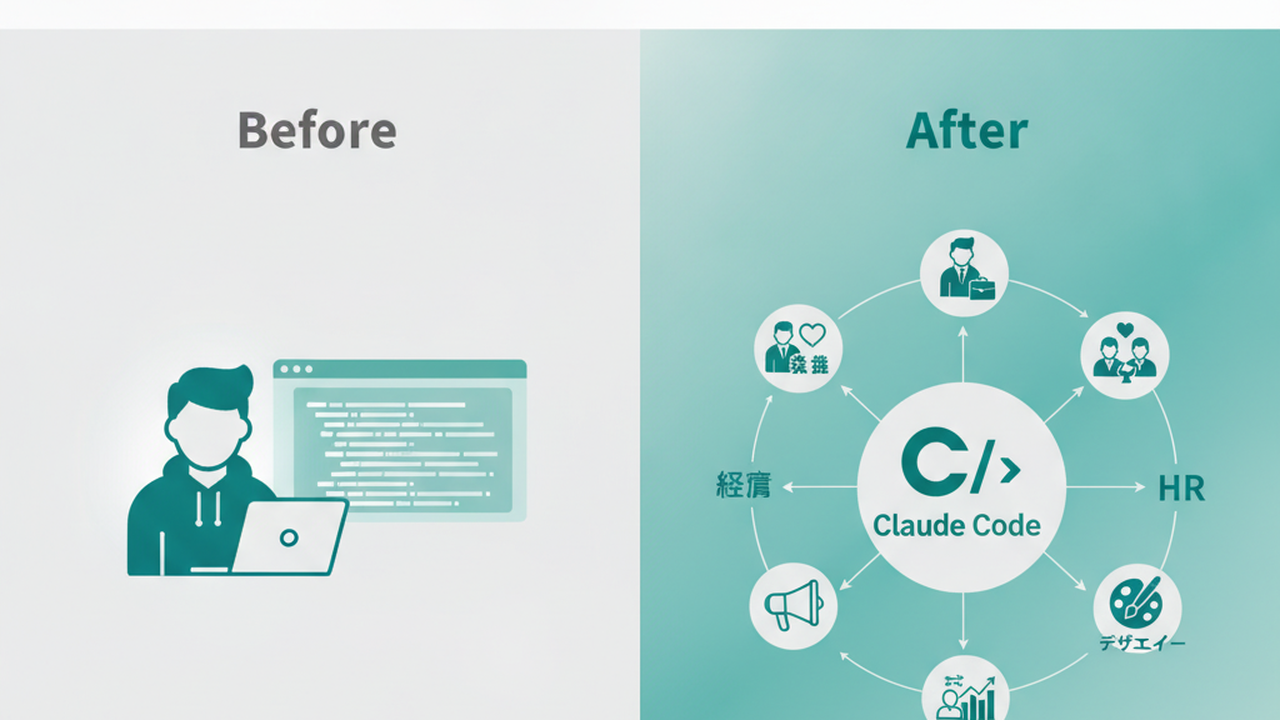
KDDI Agile Development Center is a KDDI Group subsidiary handling DX and agile development — an engineering-centric organization. Yet this announcement stated that Claude Code would be actively used across every department and role: leadership, HR, design, and sales and marketing (KAG press release, June 1, 2026).
“AI-native organization” is a phrase you hear often lately. But at most companies, the reality is “a few engineers and advanced users are using AI.” What KAG is aiming for is different: every person, in their daily work, collaborating with Claude Code.
Why go company-wide now?
The background is Claude Code’s ability to run on natural language. Without programming knowledge, you can instruct Claude Code in plain language — it generates code, processes data, and produces dashboards. That capability is what breaks Claude Code out of “developer tool” territory.
KAG has been building on AI adoption since around 2023. The company-wide deployment reads as the result of that accumulated trial and error — “we proved everyone could use it, then made the announcement.” Practice came first, announcement followed.
When I first started using Claude Code, I wondered: “I can’t really code either — will this actually work for me?” When I tried it, I found that saying “I want this data turned into a chart” in plain language was enough. No code needed. What KAG is showing is that experience scaled to an entire organization.
Reading the 4-Department Use-Case Map
KAG’s press release spelled out department-specific use cases in concrete detail. Walking through all four.
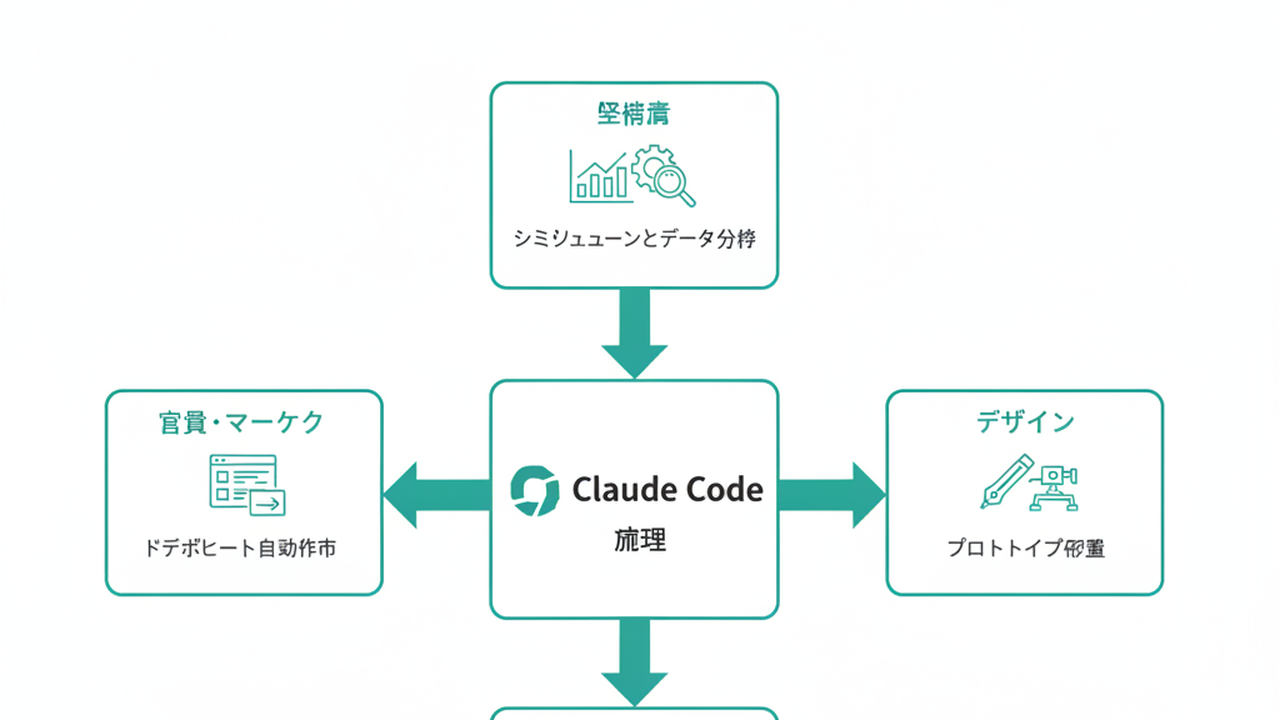
Leadership: Run Simulations Without an Engineer in the Room
Leadership’s use case: data integration and simulation.
Until now, the simulations and analyses needed for executive decisions required requesting an engineer — or manually processing everything in Excel. At KAG, executives now pass internal documents and structured data directly to Claude Code for analysis and data validation.
The phrase “without going through an engineer” is the key. The pace of business decisions is no longer constrained by engineering resource availability.
At first glance this might seem strange — “executives writing code?” They’re not. That’s not the point. “I want to run a simulation on this data with these parameters” — say it in plain language, Claude Code handles the execution. Humans set direction, Claude Code executes. That’s the division of labor.
The cycle of executive decision-making gets faster. Form a hypothesis, validate with data, form the next hypothesis. That loop can now run without waiting for an engineer’s availability. That’s the real change for leadership.
HR: Bring People Analytics In-House
HR’s use case: automating recruitment and engagement analysis.
Anonymized engagement scores and recruitment data trends are analyzed with Claude Code, and evaluation processes are automated. The press release used the phrase “bring people analytics in-house.”
People analytics is the practice of analyzing HR data to drive decisions about the organization, hiring, and development. Until recently, it required either a large company or a specialized vendor tool. With Claude Code and internal data, HR practitioners can run the analysis themselves.
This isn’t just a cost reduction story. It’s a shift in organizational capability — “we can answer our own questions with our own data.”
What changes when you internalize analysis that was previously outsourced: speed. “How is hiring tracking this month?” — now answerable by the next morning. When HR practitioners can move data at their own pace, the quality of decision-making changes too.
Sales and Marketing: Build Dashboards Autonomously
Sales and marketing’s use case: data analysis and report automation.
Historical performance data and DX challenge data are analyzed with Claude Code; web access log analysis and dashboard creation are automated. The press release used the word “autonomously.”
“Autonomously” means practitioners run data themselves without requesting an engineer or dedicated analyst each time. Marketing staff updating monthly reports at their own pace, checking campaign results the same day — that’s the intended state.
The shift is from “looking at data” to “running data yourself.”
This is the part that resonates with me most as a marketer. The day after a campaign, you want to know: “how did CVR move?” In the old workflow, that meant opening analytics tools and manually going through data processing each time. Tell Claude Code “show me yesterday’s campaign performance compared to last week” — it handles the processing.
Design: Cut Rework Before It Happens
Design’s use case: improving prototype accuracy.
AI is connected to design data to produce prototypes that are closer to the final implementation. Rework is reduced. Time to alignment with engineering is cut.
The communication gap between design and engineering is a problem in most development environments. “What I designed isn’t what got built” — everyone’s experienced that at least once. When Claude Code processes design data into an implementation-ready form, that gap narrows.
Across all four departments, the underlying axis is clear: “humans decide, Claude Code executes.” Not just for engineers — practitioners in each department use Claude Code as a tool for their own domain. That’s the core of KAG’s company-wide deployment.
Reverse-Engineering the Process: What Came Before the Announcement
Reading the announcement, what I wanted to understand was: how did they get here?
KAG didn’t just announce “everyone use Claude Code” and deploy it. Company-wide rollout always requires a preparation process. Working backward from the announcement content and industry knowledge:
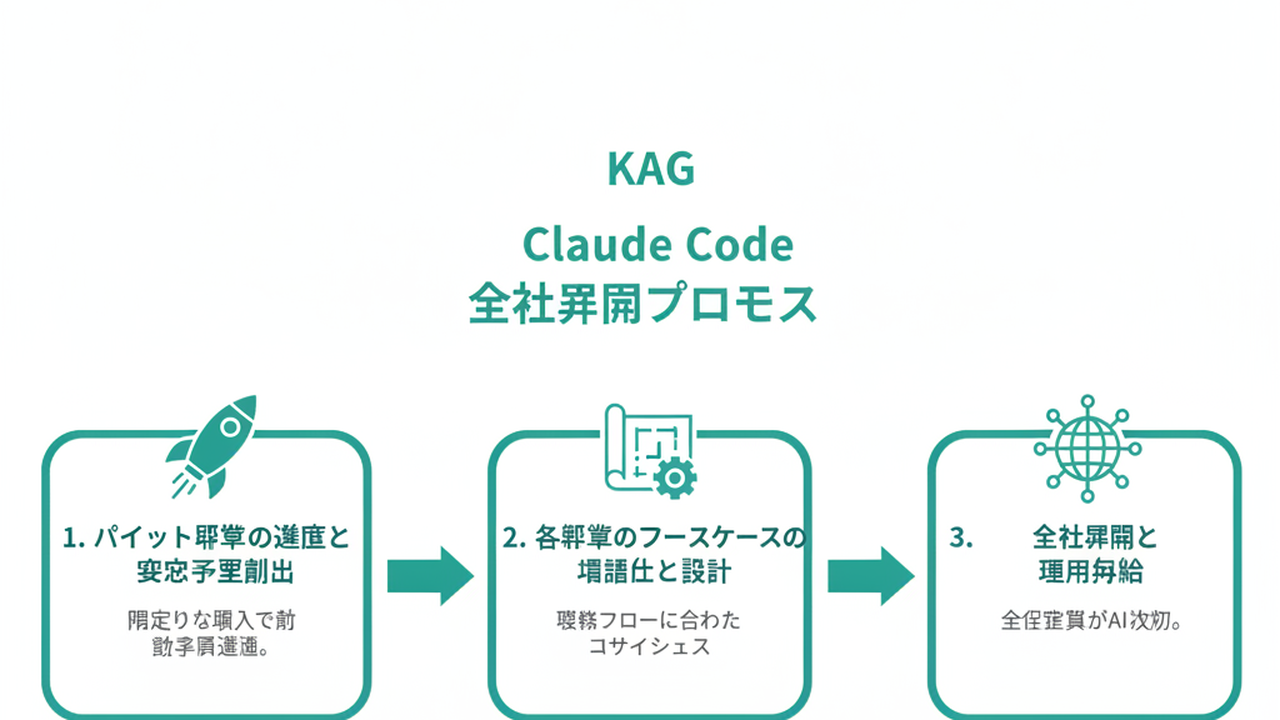
Pilot department selection came first
Before company-wide, there was a pilot somewhere. For KAG, the engineering org was likely that pilot. Claude Code is easiest to try first in engineering.
The principle for selecting a pilot department: clear workflows, measurable outcomes, and relatively high AI-readiness. To make the call for company-wide deployment, you need “this worked” as demonstrated evidence first. Company-wide deployment without a proof point becomes a tool graveyard. Building one success case is the prerequisite for the expansion decision.
Use cases were articulated department by department
Once the pilot produced results, the next stage is designing use cases for other departments. Each department needs to be able to picture “what can Claude Code do for us?” before anything gets rolled out.
KAG’s press release being concrete and department-specific signals that this design work is already complete. “Leadership: simulation. HR: people analytics.” When use cases are already articulated at that level, it shows. Giving people a tool without articulating use cases produces “I don’t know what to use this for.” The use case has to come first.
Governance design is the foundation
Security and data management are unavoidable in company-wide deployment. Rules for “can we send internal confidential data to Claude Code?” and “what data should never be entered?” need to be designed before you hand the tool to everyone.
Claude Enterprise includes security and access management built in. That’s one reason KAG chose Claude Enterprise over individual plans — the organizational data governance layer is covered. Rolling out without governance is a risk: if a problem surfaces after deployment, you face a company-wide shutdown.
Cross-functional knowledge sharing keeps it alive
After company-wide rollout, KAG plans to sustain it with initiatives like “KAG AI Week” — structured sessions where knowledge is shared across the organization. This is critical. Deploying a tool doesn’t mean people will use it. Sharing use cases and giving people “I could do this too” moments is what makes it stick.
KAG’s learnings are also planned to feed into DX support for KDDI Group companies and customer organizations. One company’s practice propagates through the entire group. The design has that built in.
Before You Think “We’re Not KAG Scale”
Here’s the reaction most readers have at this point: “KAG is an IT company — that’s different.” “They’re a large enterprise — of course they could do this.”
That reaction is half right, half wrong.
The half that’s right: KAG has high AI literacy. Engineers are at the center of the organization, and technical support is accessible. Those conditions aren’t replicable at a typical company.
The half that’s wrong: Claude Code is designed to run without technical skill. What KAG demonstrated is not “you can do company-wide deployment if you have engineers.” It’s “non-engineering departments can run Claude Code in plain language.” That’s the fact.
A framework for deciding where to start by company size:
Under 50 people
Start with one person. The position carrying the most operational bottlenecks — often the founder or the marketing lead — becomes the pilot. Start with Claude Pro, and if “this works” is the verdict, move to a Team plan. (Claude Pro: $20/month as of June 2026, Anthropic official pricing.)
This keeps initial costs low while building a proof point. When one person’s success story exists inside the company, the decision to expand moves fast. The pilot user’s own words become the most persuasive internal argument.
50–300 people
Run pilots in 2–3 departments, build a success case. How you select pilot departments is critical. Look for the three conditions: “clear workflows,” “measurable outcomes,” and “at least one team member who’s genuinely interested.” In terms of KAG’s case, sales and marketing or HR tends to be the most approachable starting point.
Once one success case exists, expansion to the next department accelerates. “If it worked there” becomes the internal justification.
300+ people
Security and governance design comes first. Build out the data management rules before rollout, with Claude Enterprise as the assumed plan. As I detailed in Claude Code Enterprise: The First 30 Days, establishing the governance framework in the first 30 days determines whether company-wide deployment succeeds or fails.
One principle holds across all sizes: “design use cases before you deploy the tool.” Installing Claude Code and saying “go ahead and use it” produces no users. The specific scenario — “for your role, here’s how you use it” — has to come first.
3 Actions to Move This Week
What KAG’s announcement signals: Claude Code has moved from “developer tool” to “organizational tool.”
As I wrote in The Tipping Point When Claude Code Enterprise Became a Product, the enterprise market has been rapidly maturing over the past few months. With named, real-scale case studies like KAG’s now available, “we can evaluate this for our organization” is an easier judgment to make.
Right now is the fork between “still watching” and “starting to move.”
Three concrete actions to take from KAG’s deployment:
Action 1: Decide your “first department” this week
Decide where to pilot this week — before anything else. Company-wide deployment requires building a first success story somewhere. Using KAG’s example, pick a department that meets three conditions: “clear workflows,” “measurable outcomes,” “at least one team member who’s genuinely interested.” If there are multiple candidates, start with the one where “the cost of failure is smallest.”
Action 2: Write out one use case for that department
Rather than asking “what can Claude Code do?”, start from “I want to solve this specific bottleneck in this specific workflow.” Monthly report creation, recruitment data aggregation, prototype review. Pick one concrete workflow. One clear use case means you can actually test it.
Action 3: Run a small test with Claude Pro
Test it for real with Claude Pro. “Try before going to production” is the prerequisite for company-wide deployment. If one person can run a 2–4 week trial and conclude “this works,” you have grounds to expand to the pilot department. For cost concerns, Claude Code Pricing: 3 Scenarios Calculated is a useful reference.
What KAG designed is a transformation process toward an AI-native organization. Use that map as a reference, and move your organization’s “first step” this week.
Wrapping Up
KDDI Agile Development Center’s company-wide Claude Enterprise deployment matters for three reasons.
The “engineers-only” frame is gone. The target is all four departments: leadership, HR, sales and marketing, design. Claude Code runs on natural language — programming skill is no longer a prerequisite. Anyone can process business data by giving instructions in plain language.
Department-by-department use cases are already articulated. The announcement specified what each department is doing with Claude Code. This isn’t “let’s try it and see” — it’s “we designed it and we’re running it.” The KAG case shows the process: articulate use cases first, then deploy.
It’s a map for your own deployment. The KAG rollout process — pilot, use-case design, governance, company-wide deployment, in that order — applies regardless of organizational size. The number of departments and headcount differ; the sequence doesn’t.
For companies working toward an AI-native organization, KAG has put down a map. How you use it is up to you.
This week, pick your first department. That’s where company-wide deployment starts.

AIを使いこなせない方は、この先どんどん差がつきます。僕はAIエージェントを毎日動かして、壊して、直して、また動かしてます。そういう泥臭い実践の記録をここに書いてます。理論は他の方にお任せしました。僕は動くものを作ります。朝5時に起きてウォーキングしてからコードを書くのがルーティンです。