The Day Claude Code Enterprise Became a Product. Digirise's First-10 Program Decoded Across 3 Dimensions
Digirise launched a formal Claude Code enterprise onboarding package on May 1, 2026. Breaking down the 3-pillar structure, Plan A vs B, 4 adoption barriers, and what 'first 10 companies' really signals.
What you'll learn in this article
- Where pricing and adoption questions around Claude Code stand right now
- Which plan or rollout stage fits the reader's situation
- Which follow-up article to open next for setup, cost, or bigger-picture context
Claude Code — until recently a power tool for individual developers — entered the enterprise market as a formal package on May 1, 2026.
The announcement: Digirise’s “Claude Code Enterprise Onboarding Program.” Three pillars — 60 training videos, hands-on workshops, and ongoing support — capped at the first 10 companies (Digirise press release, May 1, 2026).
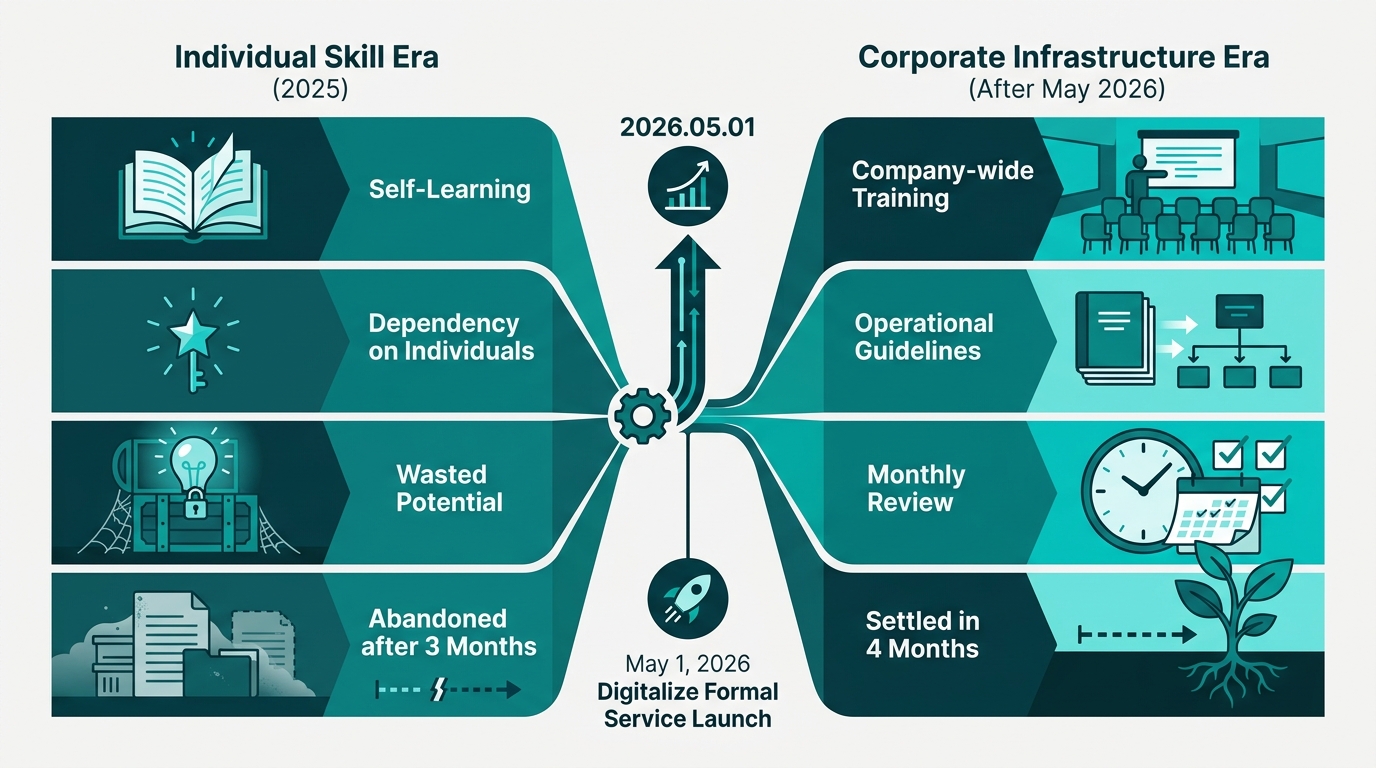
This might read as “one more training service launched.” It isn’t. This is the symbolic release marking the moment Claude Code moved from individual skill to corporate infrastructure.
Why now? Why the three-pillar structure? Why the unusual “first 10 companies” cap? Working through these three questions with primary sources reveals what your organization should be building in the next six months. Let’s map it out together.
May 1: What Was Actually Announced — Facts from the Primary Source
Let me set out the facts, without embellishment.
What Digirise announced on May 1, 2026 was the formal launch of its enterprise program, “Claude Code Enterprise Onboarding.” Breaking it down:
- 60-video training series “Claude Code Edition” (approx. 5 hours total; three parts: fundamentals, advanced, and workplace application)
- Hands-on group workshops (4 sessions × 3 hours each: foundations practice / business practice / MCP applications / final presentation)
- Ongoing support (Slack/Teams chat, weekdays 10:00–18:00 JST + monthly review meetings)
- Duration: 4 months (for Plan A, the corporate training program)
- Open to the first 10 companies
- Dedicated service site: claudecode.digirise.ai
Digirise is led by Masahiro Chaen, known for his YouTube channel “Chaen’s AI Lab.” The company delivered back-to-back talks at Japan IT Week Spring 2026 — a major IT trade show — to standing-room-only crowds, and added an emergency encore webinar on April 22 to serve those who missed the live sessions.
Digirise also holds recognition as Japan’s No. 1 provider by number of companies served with corporate AI reskilling programs, with over 500 enterprise clients under their belt.
The interesting question is why they spun out a standalone “Claude Code” program at all. Inside the broader AI training category — ChatGPT, Gemini, Copilot — they chose to name and package Claude Code specifically. That’s evidence the market is beginning to recognize Claude Code’s rapid rise through 2026.
I first felt the Claude Code enterprise market shifting in early May. My earlier piece, “The 10 Days That Turned Claude Code into a Market”, traced how Anthropic’s official enterprise plan, consulting firm support services, and full-staff rollouts by Japanese IT companies all landed in quick succession. This Digirise announcement means that “marketization” has now progressed from individual menus to standardized packages.
Why Three Pillars? Why Neither 60 Videos Alone Nor Workshops Alone Work
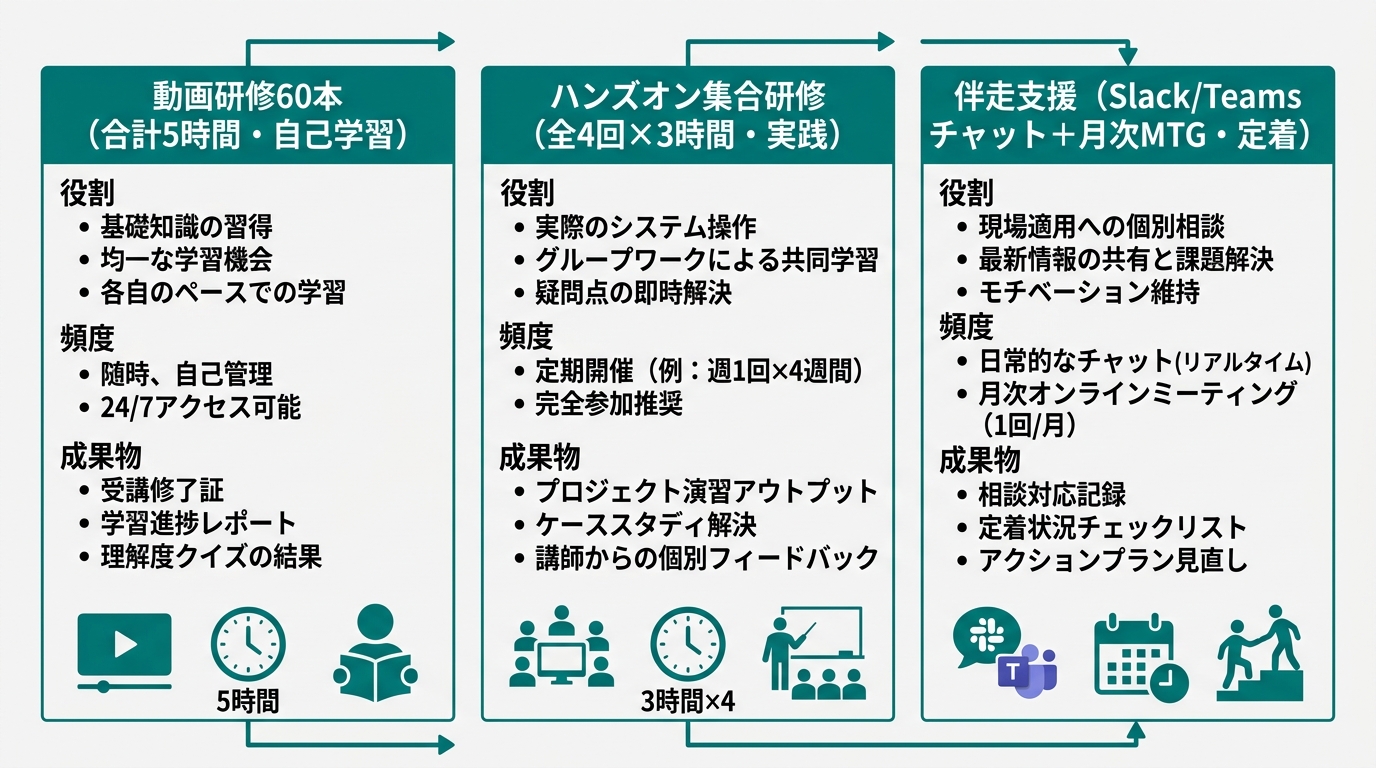
Don’t skim past the three-pillar structure with a “wow, 60 videos, impressive.”
This package is built like a textbook case in enterprise training design. Plenty of companies sell videos, workshops, or ongoing support individually. Digirise’s design decision was to connect all three into a single integrated program.
Why doesn’t a single component work? The press release spells out the “adoption barriers” Digirise has observed across more than 500 client engagements:
- “We don’t know where to start”
- “Only our most tech-savvy employees are actually using it”
- “Security requirements are blocking us from using it on real work”
- “It never took root — we’re sitting on an unused tool”
These are not performance problems with the tool itself. Hand over 60 videos and some people never watch them. Run a one-day workshop and by the following week it’s forgotten. Offer only ongoing support and you never establish baseline literacy.
The three pillars are the minimum viable structure to cover all three stages: learn, practice, and embed. Videos build the foundation; workshops get hands on the keyboard; ongoing support carries people through the wall of real implementation. Remove any one element and you get the “unused tool” outcome Digirise has seen across 500 client sites.
There’s one more layer worth adding here: Claude Code operates as a self-directing AI agent. This isn’t a “ask a question, get an answer” tool like ChatGPT. Claude Code takes instructions, edits files, executes commands, accesses external systems, and determines its own next steps as needed. That means the gap between “can use it” and “can’t” is far larger than with ChatGPT.
Having used Claude Code to build business automation systems myself, I’ve felt firsthand the enormous step between “I understood this from the video” and “I ran one real workflow end to end.” I touched on Claude Code’s depth in “44 Hidden Features Sleeping Inside Claude Code”, but knowing the features and knowing how to weave them into your organization’s specific workflows are entirely different skills. That’s why three pillars are necessary.
Plan A vs. Plan B — The Fork Between “Training Company” and “Transformation Company”
Digirise’s program comes in two plans.
Plan A: Corporate Training Program (4 months)
- Target: Companies that want to raise AI skill across their workforce and start using it immediately after training
- Contents: 60 training videos + 4 group workshops + Slack/Teams support + monthly review meetings
- Price: ¥400,000/person (~$2,700) before tax, minimum 5 participants (Digirise official announcement)
Plan B: AI Implementation Support Program
- Target: Companies ready to develop an AI strategy at the executive level and automate entire business workflows
- Contents: AI strategy development support + business workflow automation and build-out
These two plans present a fundamental choice: training engagement or consulting engagement.
The natural question is which one your company needs. Here’s a clean decision framework:
- If raising baseline literacy across your staff is the priority → Plan A
- If leadership has already defined an AI strategy but is stuck on execution → Plan B
- If you need both → start with Plan A, then add Plan B in sequence
Running the Plan A numbers: five participants at ¥400,000 each comes to ¥2,000,000 (~$13,500) before tax as the minimum. With four months of ongoing support included, this typically comes in lower than a one-off engagement with a major consulting firm. That price point is the benchmark for deciding whether to bring in outside help.
From what I’ve seen, most mid-sized Japanese companies are right to start with Plan A. Companies that can honestly say “leadership has a defined AI strategy” represent maybe 10–20% of the market. The other 80–90% need to close the literacy gap among their employees first.
For closing that gap, the framework I laid out in “The First 30 Days of Claude Code Enterprise Adoption” — “lock on to one metric” — is decisive. Pick one: time required, error rate, or employee satisfaction. Track just that one metric over four months and you can explain Plan A’s results to leadership in concrete numbers.
There are also cases where Plan B is clearly the right call. Companies like AR Advanced Technology — a Japanese IT firm that rolled out Claude Code to every engineer and every consultant (reference: “The Japanese IT Company That Deployed Claude Code to Every Engineer and Consultant”) — have already cleared the literacy phase. Their next problem is strategic: where in the business workflow does it belong? That’s Plan B territory.
The 4 Adoption Barriers Digirise Has Seen — Why “Unused Tool” Happens
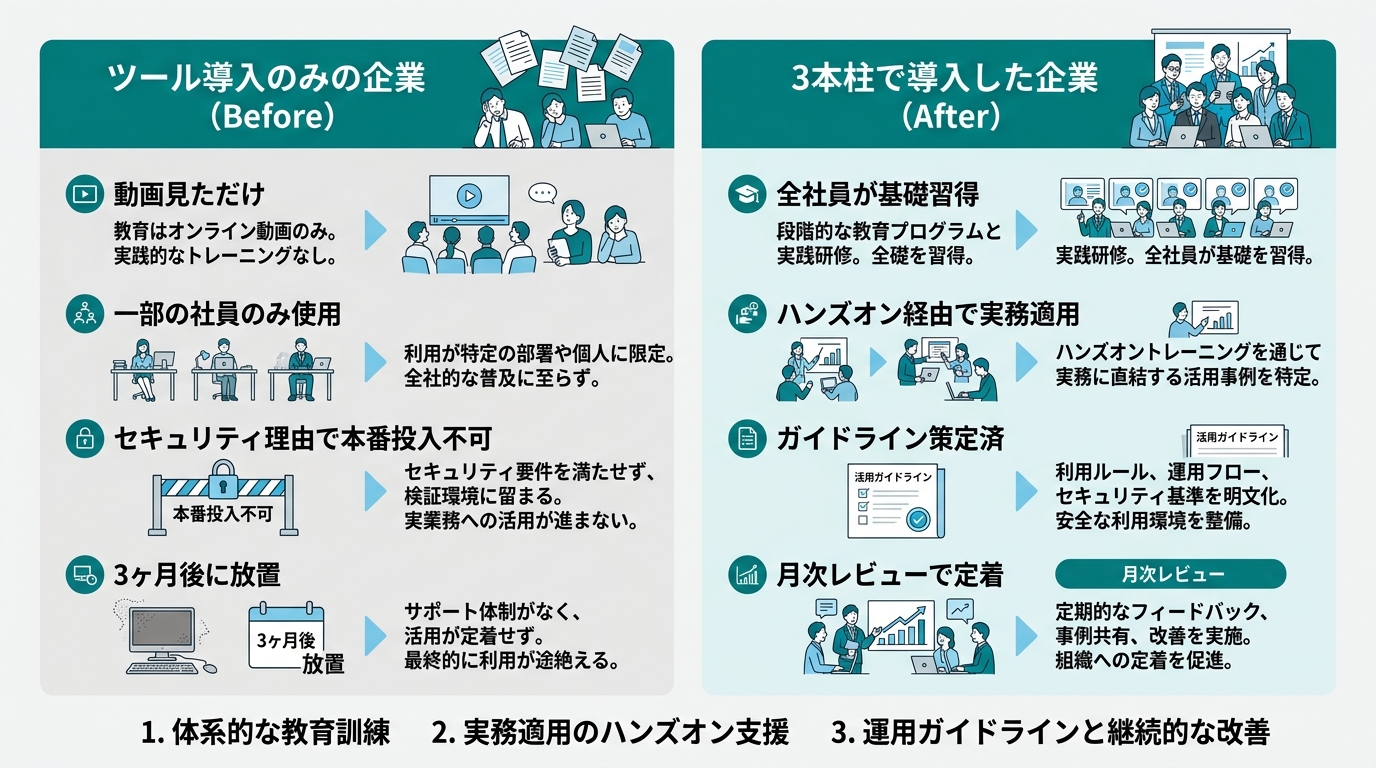
Let me take a closer look at the four adoption barriers listed in the press release. These match exactly what I’ve heard repeatedly in the field.
Barrier 1: “We Don’t Know Where to Start”
Claude Code’s official documentation is extensive — but it doesn’t tell you which of your business processes to tackle first. Reading technical docs won’t surface a step-by-step guide for automating your company’s monthly reporting close. This is where the largest number of companies stall.
Among the three pillars, the “business practice” session of the hands-on workshops is specifically designed to break through this barrier.
Barrier 2: “Only Our Most Tech-Savvy Employees Are Actually Using It”
This pattern hits mid-sized companies hardest. One technically fluent person does all the implementation. That person leaves and everything stops. Classic single-point-of-failure.
The combination of 60 videos plus group workshops is the mechanism for raising everyone to a minimum viable literacy level. The goal isn’t “every employee becomes an expert.” It’s “every employee knows the essential operations.”
Barrier 3: “Security Requirements Block Live Business Use”
This is where IT/infosec teams and frontline staff end up in friction. IT says “we can’t send confidential data externally.” The frontline says “too many restrictions, we can’t actually use this.” Classic standoff.
The realistic path forward: use the monthly review meetings in the ongoing support phase to build out usage guidelines incrementally. Trying to write a perfect policy framework before going live means never going live.
Barrier 4: “It Never Took Root — We’re Sitting on an Unused Tool”
This is the saddest outcome. Deployed, never used. Six months later: “Didn’t work for us.”
The key to adoption is getting one workflow to run successfully end to end. One real win is enough to spread to other departments. As I wrote in “The Day Anthropic Handed 15 AI Agent Blueprints to Small Businesses” — it’s not “do everything,” it’s “get one thing running.” That’s the fastest route to adoption.
Looking across all four barriers, the common thread is that these are operational problems, not technology problems. Claude Code’s capabilities are sufficient. What’s missing is the operational sequencing to embed it in your specific workflows, and the organizational mechanisms to spread it. The three pillars are a package delivering exactly that sequencing and those mechanisms.
What “First 10 Companies” Means — Author’s Take: The Market Temperature in May 2026
Why “first 10 companies”? The press release doesn’t explain the intent. What follows is my analysis from a marketing perspective. There are three ways to read this number.
Reading 1: A Hard Cap on Quality-Maintainable Supply
A package that includes four months of ongoing support — Slack/Teams chat coverage plus monthly review meetings — carries significant labor per client. The realistic ceiling for Digirise to deliver at full quality is 10 companies. This isn’t scarcity marketing. It’s an honest disclosure of capacity. Ten slots, then a waitlist for the next cycle.
Reading 2: Building Case Studies with Launch Partners
The first 10 companies are effectively Digirise’s launch partners. Their implementation stories become the marketing material that attracts the next 100 and 1,000 companies six months from now.
These 10 aren’t just “clients” — they’re closer to co-developers. They’re shaping the program alongside Digirise, with the understanding that their stories will be public. For mid-sized companies, that’s a meaningful PR opportunity in addition to the training value.
Reading 3: A Market Thermometer
Announcing “first 10 companies” makes the market’s response rate legible. Filled in a week: “Claude Code enterprise demand is hot.” Takes a month: “Still too early.” For Digirise, this is also a quantified market test.
Given that Japan IT Week drew standing-room-only crowds across two consecutive days, my prediction is the 10 slots fill early. The parallel: Claude Code seminars that sold out 300 seats ahead of schedule. Corporate decision-making velocity has visibly accelerated since April 2026.
How you react to “only 10 slots” reveals your company’s AI adoption literacy. Companies that feel “that’s not many” are still in the “purchasing a service” mindset. Companies that feel “that’s about right” understand it as a co-design opportunity.
3 Actions for Executives, IT Directors, and HR Leaders to Take This Week
Here are three concrete actions for anyone who’s read this far — with time estimates.
Action 1: List 5 “Claude Code candidate processes” at your company (30 minutes)
Paper or spreadsheet, either works. List exactly five business processes. The filter: processes consuming 20+ hours per month right now.
Examples: monthly report compilation, meeting transcription and summarization, sales data formatting, first-response drafting for customer inquiries, code review. Pick routine, time-heavy processes.
This list becomes the foundation for deciding whether you need Plan A or Plan B. If listing five takes longer than 30 minutes, that’s a signal: your business processes are being thought of in half-day blocks rather than task-level units. Start by practicing decomposition to that finer granularity.
Action 2: Set up a 1-hour “Claude Code trial session” with leadership, IT, and frontline leads (within 1 week)
Three to five people. Get Claude Code running live. Thirty minutes demo, thirty minutes Q&A.
The critical piece: a frontline leader actually works the keyboard. Discussions between leadership and IT alone won’t surface the frontline barriers. Make the temperature differential between IT’s “we can’t do that for security reasons” and the frontline’s “we can’t function without this” visible in the room.
The outcome of this session will clarify whether you need Plan A or Plan B, whether to bring in outside support or go internal.
Action 3: Build a comparison table across 3 enterprise training options (2 hours)
Digirise isn’t the only option. Concrete alternatives:
Anthropic’s official Enterprise contract centers on a Claude.ai site-wide license with admin controls — hands-on training and ongoing support are not included (Anthropic official). Right fit for teams that can self-direct after tooling access. Consulting firm Claude Code engagements focus on project-based design and implementation — the time and cost structure differs substantially from Digirise. Digirise Plan A delivers training, hands-on practice, and adoption in a single integrated four-month program.
Five comparison axes are enough: duration, cost range, training format, ongoing support included, and number of past client companies. Building this table alone will accelerate your internal decision-making by a full step.
Conclusion — May 2026: The Fork Between “Individual Skill” and “Corporate Infrastructure”
Four core points from the Digirise announcement:
- Three-pillar structure: 60 videos × hands-on workshops × ongoing support integrated into one program, covering all three stages: learn, practice, and embed
- Plan A/B fork: Decide upfront — literacy-building (Plan A) or business transformation (Plan B). Plan A is ¥400,000/person (~$2,700), minimum 5 participants
- 4 adoption barriers: “Where to start / who uses it / what’s in scope / whether it sticks” — the classic Claude Code failure modes. Operational problems, not technology problems
- “First 10 companies”: A launch design carrying three intentions — quality assurance, case study development, and market testing (author’s analysis)
Claude Code is no longer a tool individuals quietly experiment with. May 2026 is the inflection point where companies are formally positioning it as infrastructure for the entire organization.
The gap between a company that does nothing this week and a company that spends 30 minutes listing five business processes will compound into a substantial six-month lead. The moment you push it to “let’s discuss at the next meeting,” someone inside your organization has probably already started experimenting. You can cut off the single-point-of-failure risk today, in 30 minutes.
Will your company be on the side that masters Claude Code, or left behind by it? The fork is right here, in this one month.
Sources
- Digirise, “Digirise Launches Formal Enterprise Program ‘Claude Code Enterprise Onboarding’”, May 1, 2026
- Claude Code Enterprise Onboarding dedicated site
- Digirise, “Two Consecutive Days on Stage at Japan IT Week Spring 2026”, April 2026
- Digirise, “Ranked No. 1 by Number of Companies Served with Corporate AI Reskilling Programs”

AIを使いこなせない方は、この先どんどん差がつきます。僕はAIエージェントを毎日動かして、壊して、直して、また動かしてます。そういう泥臭い実践の記録をここに書いてます。理論は他の方にお任せしました。僕は動くものを作ります。朝5時に起きてウォーキングしてからコードを書くのがルーティンです。