Asana's $75M StackAI Acquisition: 3 Signals the AI Agent Market Is Consolidating
Asana acquired no-code AI agent builder StackAI for ~$75M. As the first major deal where a core SaaS platform absorbed an AI agent builder, here are 3 signals of market consolidation — and 3 platform selection checks SMB teams should run this week.
What you'll learn in this article
- What AI agents mean in plain language and why the term matters now
- Which real-world workflow patterns are already becoming practical
- Which next article deepens pricing, rollout, or implementation context

Asana acquired StackAI, a no-code AI agent builder, for approximately $75 million. The announcement came on May 28, 2026 — dropped alongside Asana’s Q1 earnings. By raw dollar amount, it’s a modest deal by generative AI M&A standards. But the buyer is what made me stop and pay attention.
Not an AI lab like OpenAI or Anthropic. Not a cloud giant like Microsoft. A $3B task-management SaaS. This is the first major deal where a core SaaS platform absorbed an AI agent builder as its own product. And that rewrites the AI agent market map.
Over the past year I’ve been building my own agents with Claude Code + MCP, testing Zapier and n8n, and getting hands-on with several no-code builders. Almost every week I hear the same question from readers: “Should our SMB adopt a standalone no-code builder, or wait for the AI features built into our main SaaS?” This acquisition is one concrete answer to that question.
What You’ll Walk Away With
A checklist of 3 platform selection checks to run this week. A clear enough picture of the “standalone no-code builder vs. SaaS-integrated” tradeoff that you can settle on a direction for your own organization. Once you finish reading, share it in your internal Slack and lock in a one-line policy by end of week. That’s the intended exit from this article.
Asana × StackAI $75M Deal: Facts on the Table as of May 28
Let me start with what’s confirmed through official releases and news coverage. Speculation gets its own section later.
Deal size and announcement date Per SEC disclosure, the acquisition price was approximately $75 million. The announcement came after market close on Thursday, May 28, 2026 — simultaneous with Asana’s Q1 earnings release (Business Wire official release, TechCrunch, Investing.com).
What is StackAI? A YC Winter 2023 cohort startup. Founded by Tony Rosinol and Bernard Aceituno, both MIT PhDs. Headquartered in San Francisco. Total funding raised: under $20 million, including a recent Series A of $16 million (TechCrunch, PitchBook data).
The product is a platform that handles the full lifecycle of AI agents — design, testing, deployment, and governance — without writing code. Officially listed integrations include Salesforce, AWS, Oracle, Docusign, Slack, Google Workspace, SharePoint, Asana, and industry-specific apps. Target verticals: financial services, manufacturing, healthcare, professional services, and technology.
Post-acquisition structure StackAI will continue operating under its own brand as an independent product within Asana. Both co-founders are joining Asana. This is a different signal from the pattern where an acquisition gets immediately absorbed and the name disappears.
Asana CEO’s framing CEO Dan Rogers said in the official release:
“This acquisition accelerates our roadmap and marks the next phase of human-agent work. StackAI now lets them go further, agentifying the most complex business processes end-to-end, across every system and tool their business runs on.”
He’s positioning “human-agent work” as the next phase — and redefining Asana itself as an operating system for human-agent teams. StackAI becomes the execution layer for that vision.
That’s the factual record from coverage. Now, my interpretation.
3 Reasons I’m Calling This “The AI Agent Market’s Consolidation Phase”
Why does a $75M deal mean the map has changed? Three reasons, in order.
Signal 1: A Core SaaS Platform Absorbed This as Its Own Product
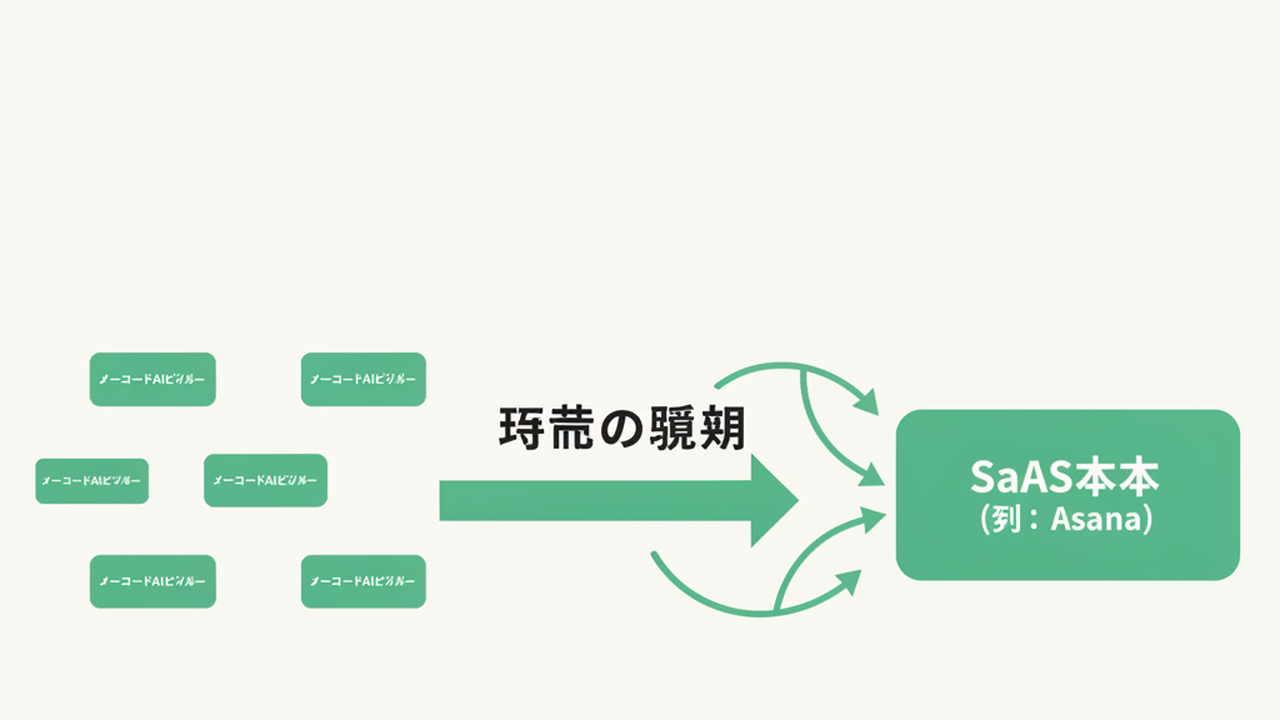
Until now, no-code AI agent builders — Zapier, Make, n8n — have been independent vendors that connect across multiple SaaS platforms. Core SaaS vendors, meanwhile, have limited themselves to AI assistants within their own products (Salesforce Einstein Studio, Notion AI). The general-purpose agent builder layer stayed outside, connected via integration.
Asana’s move was to absorb that outside layer as its own product. Not a plugin, not a partnership, not an investment — an acquisition. The implication: AI agent design infrastructure is now something a SaaS vendor can’t afford to outsource.
A YC solo builder gets absorbed by a $3B SaaS. If that happens once, the second and third deals are the natural expectation.
Signal 2: StackAI’s Integration List Is Already the SaaS Market
Look at what StackAI already connects to: Salesforce, Slack, Google Workspace, SharePoint, Oracle, Docusign. Every single one of those is a core SaaS inside enterprise organizations.
No-code AI agent builders were already in a turf war with core SaaS platforms for customer touchpoints. From Asana’s perspective, “grab the agent layer that sits on top of us before someone else does” is perfectly rational.
The same math applies to Salesforce, Microsoft, Atlassian, and Notion — without exception.
Signal 3: The Phrase “Human-Agent OS” Just Appeared
Dan Rogers’ “operating system for human-agent teams” can be read as marketing copy. But when a SaaS vendor claims the OS label, that’s a declaration of platform war.
Remember what happened in the 3–5 years after Slack called itself the “work OS,” or after Monday.com picked up the same phrase. Whoever claims the platform position tries to pull apps and workflows into their own economic orbit. In the AI agent market, Asana just made that claim.
From here, competing platforms enter a phase of fighting for the right to say “build it on our platform.” That’s what consolidation phase means.
3 Platforms Most Likely to Move Next
Now that Asana has gone first, it’s worth mapping the likely followers. These are my predictions — each with a reason attached.
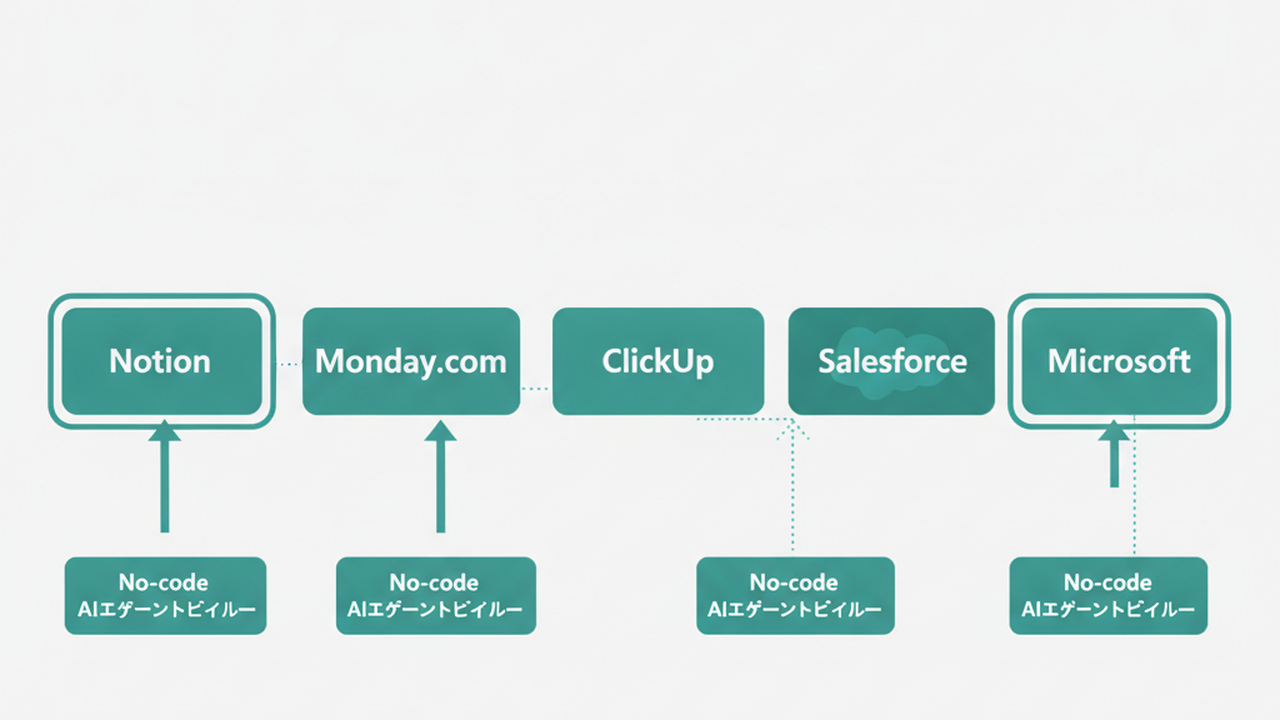
Prediction 1: Notion, Monday.com, or ClickUp Will Acquire a No-Code Builder
Task and knowledge management SaaS platforms face the same pressure as Asana. Within 6–12 months, every one of them will have to answer: “Do we let our users build agents in an external tool, or do we absorb that into our own product?”
Notion has been building Notion AI in-house since 2024 but hasn’t released an agent-building capability. Monday.com is ahead with monday AI, but complex workflow agents are still delegated to external tools. ClickUp is in the same boat with ClickUp Brain.
My gut estimate: the probability that at least one of these platforms acquires a no-code agent builder in the next 12 months is above 50%. The simple reason: there isn’t a SaaS executive team that won’t start an internal conversation about “following Asana’s move.”
Prediction 2: Salesforce and Microsoft Will Go Organic with Small-Scale Acquisitions
The big vendors already have something close to no-code builders — Agentforce (Salesforce) and Copilot Studio (Microsoft). If they do M&A, it will likely be small deals to fill capability gaps.
That said, industry-specific no-code agent builders — small startups with deep vertical expertise in healthcare, legal, or finance — are plausible Salesforce targets. The rationale maps directly to their Industry Cloud strategy.
Prediction 3: Atlassian Will Formally Launch or Acquire an Agent Layer
Atlassian has Rovo (its internal AI) but no officially released agent-building capability. With Asana claiming the human-agent OS position, it’s hard to imagine Atlassian staying silent.
Whether they build or buy is unclear, but a formal agent-building announcement within 6 months is likely. Come back to this prediction when the announcement drops.
The point here isn’t to pick the next Asana correctly. It’s to build your own platform selection framework before the next wave hits. That’s what this section is for.
3 Platform Selection Checks SMB Teams Should Run This Week
Now for the practical part. Let’s translate the acquisition into decisions your organization can actually make. Three checks, in order, all completable this week.
Check 1: Your Core SaaS Vendor’s AI Agent Roadmap
Start simple: identify the single SaaS your organization depends on most, then confirm that vendor’s AI agent feature roadmap.
Three ways to do this:
- Chase the vendor’s official blog for AI-related releases in the past 6 months
- Ask your account rep directly: “What’s the release timeline for your no-code agent-building capabilities?”
- Use Asana-style acquisitions as a reference point and ask where their AI roadmap sits on the priority list
If the response is “we can’t share the roadmap” or “our rep didn’t have an answer,” that itself is a signal. If the SaaS vendor doesn’t have a clear direction, you need to move independently on your own timeline.
Check 2: Your Existing Agents’ SaaS Absorption Risk
If you’ve already built agents on a standalone no-code builder (Zapier, Make, n8n, StackAI, etc.), assess the following risks:
- What happens if your builder gets acquired by a large vendor that competes with your core SaaS?
- If the builder product gets integrated and sunsetted post-acquisition, what happens to your current workflows?
- Is it realistic to migrate to native agent features built into your core SaaS?
Concretely: for each agent you’ve built, write one line capturing “which builder it depends on,” “alternative options,” and “migration cost.” Thirty minutes of work, total.
StackAI has explicitly committed to independent operation post-acquisition — but that’s this particular case. The next acquisition won’t necessarily follow the same pattern.
Check 3: Your “Standalone Builder vs. SaaS-Integrated” Decision Axis
For new agent builds going forward, the fork breaks into two clear options:
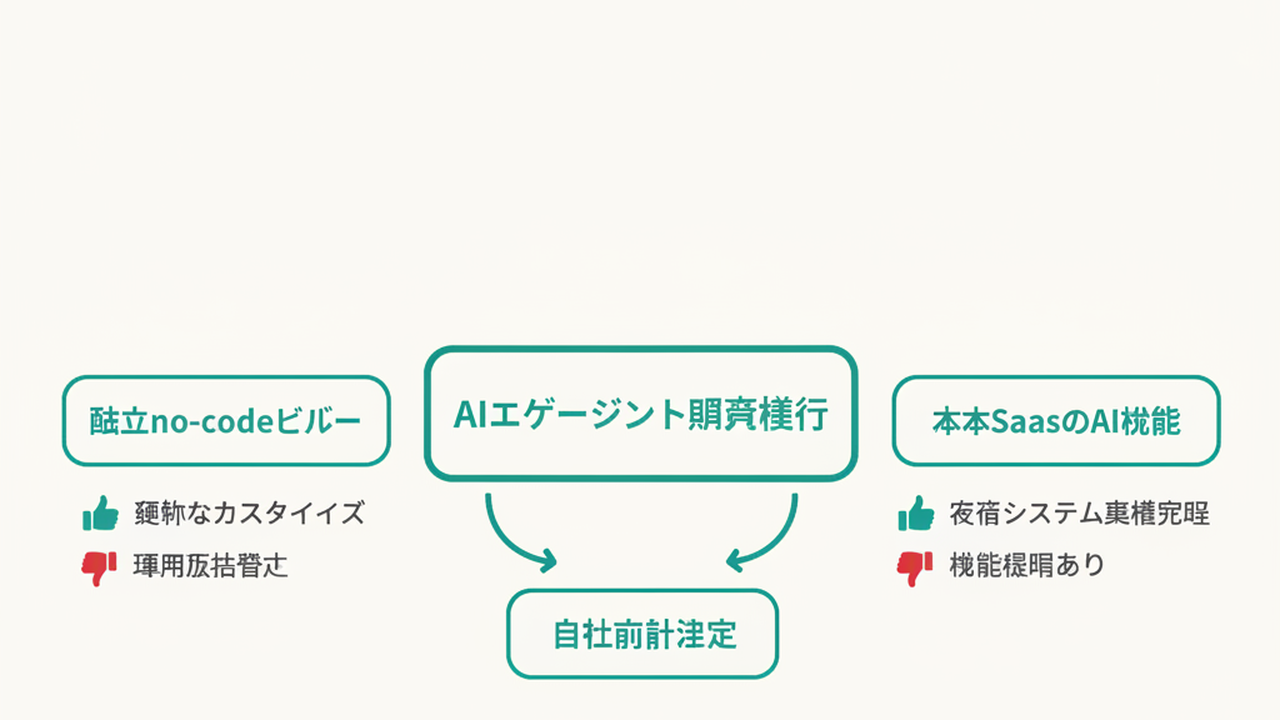
- Standalone no-code builder (Zapier, Make, n8n, StackAI, etc.): cross-SaaS, high flexibility, but carries vendor business continuity risk
- SaaS-integrated (Asana × StackAI, Salesforce Agentforce, Notion AI, etc.): complete within one SaaS ecosystem, deep integration, but assumes lower dependency on other SaaS platforms
Here’s my current decision axis: organizations whose core operations are concentrated in one SaaS platform should prioritize SaaS-integrated solutions; organizations whose primary work spans multiple SaaS platforms should continue with standalone builders. Even in the latter case, one criterion for selecting a builder should be “well-funded and at or near a public-company stage.” The goal is to reduce acquisition and integration risk.
Define that decision axis in one line and share it internally. That’s the most valuable output from this week.
3 Decisions I Changed in the Week After This Acquisition
Now for the personal experience part. Take this as reference material.
Change 1: I Re-Committed to Claude Code + MCP as My Primary Stack
I use Claude Code and MCP servers combined for automating my article workflow. At one point I was considering moving part of it to a no-code AI agent builder — because it would be easier for teammates without development skills to touch.
This acquisition made me pause that plan. Shifting toward a builder when acquisition and integration risk is hard to read means migration costs could spike later. Claude Code + MCP is a dependency on “one company, Anthropic,” but betting on this side until the ecosystem matures is the more stable call.
The full setup and how I built it is covered in How to Build AI Agents: 3 No-Code Routes. After this acquisition, my priority ranking across those 3 routes shifted by one notch.
Change 2: I Audited My Existing Agents Built on Standalone Builders
I had a handful of small agents built on Zapier and n8n. For each one, I wrote out “which builder it depends on,” “alternatives,” and “migration cost” in a simple table.
The result: 1 of 3 could be migrated to Claude Code + MCP; the other 2 were flagged as “continue on standalone builder, but document a contingency plan.” Thirty minutes of work, but getting the vague anxiety out of my head and into writing immediately improved my decision speed.
Operational pitfalls that tend to surface in the running phase are covered in AI Agents: 3 Pitfalls in the Operations Phase. Think of this audit as an updated take on the third pitfall there — vendor lock-in.
Change 3: I Updated My Answer Pattern for Reader Questions
I mentioned upfront that I get the “standalone no-code builder vs. waiting for the built-in SaaS features” question almost weekly. My old answer was one word: “depends on scale.” Starting this week, I break it down one level further:
- If your core SaaS is clearly defined and the vendor has been shipping AI features in the past 6 months, waiting for the SaaS-integrated option is a legitimate call
- If your core SaaS isn’t settled, or the vendor has no clear AI roadmap, moving first with a standalone builder is faster
- But when choosing a standalone builder, always check funding stage and whether the integration list overlaps with your core SaaS
With that framework, anyone who can follow those three points can reach a conclusion in under five minutes. I’ve genuinely felt the improvement in answer quality.
Wrap-Up: M&A Is the Signal That the Market Map Moved
To close out:
- On May 28, 2026, Asana acquired StackAI for approximately $75 million (SEC disclosure, Business Wire, TechCrunch)
- This is the first major deal where a core SaaS platform absorbed a no-code AI agent builder as its own product
- With Asana claiming the “operating system for human-agent teams” position, at least one of Notion, Monday.com, ClickUp, or Atlassian is likely to follow
- Three things SMB teams should do this week: confirm your core SaaS vendor’s AI roadmap, assess the absorption risk of your existing agents, and put your “standalone builder vs. SaaS-integrated” decision axis into one written line
$75 million isn’t a massive valuation by AI startup standards. But as a signal that the market map just moved, it’s more than enough. After you finish reading, bring one of your organization’s SaaS logos to mind and open that vendor’s latest release page. That’s step one for the week — for you and for me, right after I finish writing this.

AIを使いこなせない方は、この先どんどん差がつきます。僕はAIエージェントを毎日動かして、壊して、直して、また動かしてます。そういう泥臭い実践の記録をここに書いてます。理論は他の方にお任せしました。僕は動くものを作ります。朝5時に起きてウォーキングしてからコードを書くのがルーティンです。