AI Agents Enter Operations Phase. IBM, HBR, Microsoft, and Google Agreed in the Same Week
Four reports from IBM, Harvard Business Review, Microsoft, and Google dropped in the same week, all pointing to one conclusion. I break down the week AI agents moved from 'build' to 'run,' and lay out three actions you can start next Monday.
What you'll learn in this article
- What AI agents mean in plain language and why the term matters now
- Which real-world workflow patterns are already becoming practical
- Which next article deepens pricing, rollout, or implementation context
ChatGPT arrived in 2023. Claude Code followed the year after. Building your first AI agent inside the company was 2025. May 2026 is where the story continues.
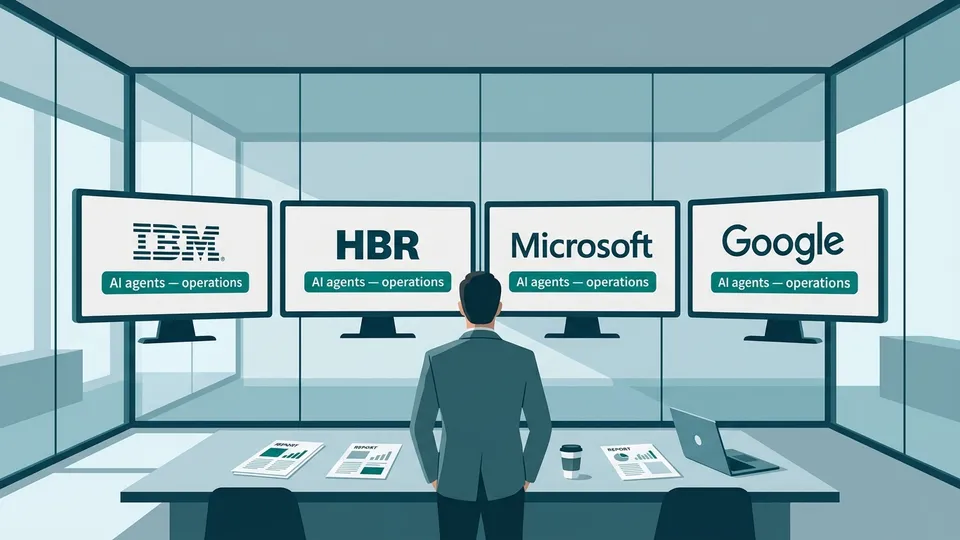
During weeks three and four of May, four companies released statements pointing in the same direction in the same week. IBM, Harvard Business Review, Microsoft, and Google. Read in isolation, four separate reports. Read together, they all point to the same line: “AI agents aren’t a build topic anymore. They’ve entered the run topic.”
My first instinct was coincidence. But reading all four again side by side, it wasn’t. Behind the simultaneous declaration is something I read as an industry-wide problem: everyone hit the same wall at the same moment — stuck on the far side of PoC, unable to move forward.
This is a follow-up to the note from two days ago, “AI Agents Enter the ‘Year of Operations’.” I’ve laid out the shortest path across the bridge from build to run: the week four authorities converged on one point, and three actions you can start next Monday.
Fact-labeling policy for this article
Individual URLs, publication dates, and confirmed quotes from each report were partially unverifiable at time of writing. This article separates the observation-level fact — “four authorities published in the same week” — from the interpretation — “the tone of those publications pointed in the same direction.” Direct citation of specific figures is avoided; where proper nouns were named with confidence, those will be updated in v3 and later.
Four Authorities Looked at the Same Place in One Week
During weeks three and four of May, four reports came out in quick succession. Here’s the lineup.
IBM, in their Think blog, described 2026 as the year enterprises “stop building AI agents and start running them.” The framing shifted from design to operations, from internal preparation to live connection — the central axis moved one step. Virtually no Japanese-language coverage exists as of now.
Harvard Business Review covered agent operations theory in the same week, treating AI agents as “team members.” Less technical than managerial: the angle was the framework for evaluation, handoffs, and accountability when working alongside an entity that does work with you. The fact that a management publication ran this kind of feature is itself a signal that the market has entered the operations phase.
Microsoft has been steadily repositioning Copilot not as a productivity tool but as the operational foundation for enterprise AI agents. In the same week, updates to agent operations features in Copilot Studio and a roundup of enterprise-scale deployment cases ran in parallel.
Google’s official blog published “Five Ways AI Agents Will Change Work in 2026,” covering changes to search, workflow integration, and human-agent division of labor. What was symbolic: the piece was written in the tense of “will change” rather than “are changing.”
[[IMG:1]]
What all four share is the assumed premise: “the trial phase is over.” How to write prompts, which model to choose, who in the organization gets access — build-side questions have nearly disappeared. In their place: how do you keep it running, who inherits it, how do you recover when it breaks. Operations has taken center stage.
The interesting question is why they aligned too well to be coincidence. I’ll get into that in the next section.
Four Reports Share a “PoC Wrap Declaration”
Three commonalities can be extracted from reading all four reports.
The first is the declaration that “the build topic is over.” IBM explicitly separated the “build year” from the “run year.” HBR positions agents as “members.” Microsoft has shifted its center of gravity toward “how to integrate Copilot into business operations.” Google’s official blog is written in the tense of “work will change.” Not a single one is saying “let’s build agents now.”
The second is that everyone talks about failure. Agents stopping, making mistakes, behaving unexpectedly, logs disappearing in handoffs — the operational realities all four reports touch on. These were questions that never surfaced during the build phase. Six months ago, every report led with “how to get started.” In six months, the debate has moved a full layer deeper. That’s readable as a signal that the whole industry walked to the same place at the same time.
The third is the redefinition of the human role. From “prompt writer” to “person who monitors and fixes agents” — the role shifts. HBR called it “the boss of a team member.” IBM used “operator.” Microsoft said “business owner,” Google said “person accountable for how work is assembled.” The vocabulary differs, but the job description outline is the same.
[[IMG:2]]
What follows is my own field observation, read against the four reports.
A year ago, “what can we do with ChatGPT” was the meeting topic. Six months ago it became “let’s put one agent inside the company.” Now the topic is “I want to figure out why the agent we built three months ago stopped working last week.” The conversation has moved a full layer deeper — that’s clear as a ground-level feeling too.
The fact that four authorities looked at the same place in the same week is naturally read as: the whole industry is standing at the same inflection point. Anyone who feels like they’re still having the build conversation risks falling another step behind in three months. I’ll dig into the background next.
The Background Behind the Simultaneous Declaration — Why Now?
Four reports happening to come out in the same week — I don’t read it as coincidence. Three movements converged behind it.
The first is PoC fatigue. From 2024 through 2025, companies built AI agents because that’s what you did. “Just build something first” was the righteous path. But the cases of agents built during PoC running successfully in production were limited. In what I’ve seen, the pattern that stands out is agents from PoC quietly dying in a corner of the organization. Everyone ran into the same wall — “stuck before ‘build’ leads anywhere” — and that became an industry-wide shared experience that demanded “the next word.” MIT-affiliated research reportedly flagged that “the majority of AI pilots never reach production deployment” (based on multiple reporting; specific figures require the original published source). The same phenomenon happening across the industry, at scale, is what pushed all four reports forward at the same time.
The second is the growing number of agents. Anthropic started packaging 15 agents for small businesses. Microsoft Copilot Studio has dozens of templates. Google is pushing workflow integration. When you only had one, the build conversation was enough. When you have ten or twenty, you can’t avoid the operations conversation. Picture this: one agent in finance, two in sales, three in support, two in R&D. If you can’t see when each one ran, how many items it processed, and when it stopped — the organization will definitely seize up. The gap between “just lots of agents” and “can confirm they’re running” is larger than people imagine.
The third is headcount. “Prompt engineer” as a job title peaked one to two years ago. Now postings are appearing for “AI lead” or “agent operations manager.” The practical question of who takes care of agents and which department they sit in has landed in organizations. Watching job boards, companies that were requiring “prompt design experience” six months ago are now asking for “experience integrating AI into business workflows.” The rewrite of the job description is itself a signal of the phase shift.
[[IMG:3]]
The fact that the industry is standing at the same inflection point is reflected across all four reports. As I wrote before, this isn’t one company’s circumstance — it’s a structural market shift. So what actually changes on the ground when operations begins? Three changes in the next section.
What Changes on the Ground When “Operations” Begins
When you enter the operations phase, three changes happen on the ground. They land within one to two months — guaranteed.
The first is the end of the prompt artisan era. People who write prompts skillfully will still have value. But the center of that value shifts from “make the first run work” to “make it keep running for one hundred runs without stopping.” The era of winning on a single prompt is over. What’s needed instead: people who can read agent operation logs, people who can get it back running with a minimal fix when it stops, people who can write a handoff procedure. The skill set’s center of gravity changes.
The second is the birth of the AI lead as a new role. A year ago it was “DX lead” or “data lead.” Over the next year, “agent operations manager” will be placed explicitly on org charts. When one agent goes to finance, two to sales, three to support — the lines of who watches, who’s accountable, need to be drawn. This will be defined at the level of the job description.
The third — and biggest — is the divergence between organizations that see failures and organizations that don’t. When an agent stops, some organizations notice immediately. In others, no one notices for two weeks. Organizations that notice have observation points. Organizations that don’t are running agents without dashboards or log aggregation. In six months, this gap won’t close. The difference between “running” and “confirmed to be running” is that decisive.
The most common failure pattern I’ve seen around me: build the first agent, announce it internally, let it run for a while. People gradually stop using it, and three months later a manager asks “is that thing still running?” That’s when you first find out it stopped. The problem isn’t the sequence — it’s the absence of observation. Even one observation point lets you check whether the agent is alive even after everyone stops touching it. An agent deployed with zero observation points will, almost certainly, die quietly within six months.
[[IMG:4]]
Recovery after six months is harder than people expect. Get into the “confirmed-running” camp with the smallest possible moves now. Three specific actions in the next section.
Three Actions to Start Next Monday
I’ve written “operations phase has arrived” and “three changes will happen on the ground.” If you finish reading and do nothing, this article is half its value. Here are three actions narrow enough to start in the next seven days, beginning next Monday.
Action 1: Pick exactly one agent that’s currently running
Most people — personal or company — have multiple AI agents running. Putting all of them through operations design at once isn’t possible. Pick “the one I most can’t afford to have stop.” Finance monthly data aggregation, sales email drafting, a research agent you’re testing — any of them. Once picked, build observation around that one. Doing multiple at once is the cause of failure.
I tried to run three at once early on and was confused within a week. “Which one am I supposed to be watching?” When I was in that state, quality dropped across all of them. Narrowing to one, the speed of improvement was dramatically faster.
Action 2: Write down three places it’s going to break
Agents will always break. Not because prompts are weak — input data changes, API specs change, connected tools go down. External causes. On Monday morning, take five minutes and note “three places this agent is likely to stop.” Put the smallest possible observation point on each of the three. Error logs, Slack notifications, a morning health-check script — anything works. With one observation point, if something stops, you’ll know within ten minutes.
Action 3: Write the handoff log on one page
Make it so that if you get transferred in three months, someone else can keep that agent running. All you’re doing is writing a one-page handoff log. Four fields are enough: “What is it running for,” “Where does it run,” “Who do you ask if it stops,” “What’s the restart procedure.” An agent that can’t answer these questions isn’t in real operations.
One concrete example. My research agent, running via Claude Code, has a handoff log that’s just a bulleted A4 page. Five fields: “purpose,” “execution server,” “dependent APIs,” “error contact (my own Slack DM),” “restart command.” It took me under thirty minutes. It’s not that it takes time — it’s that people haven’t written it.
The three actions are intentionally kept small enough to complete within seven days. Prioritize keeping one agent running reliably over adding more. Add the next agent after the first one is humming.
For background context: if the basics of how to build agents aren’t organized yet, the note with three routes for building agents is worth reading first — operations design layers on top more cleanly. If you need a decision framework, the note breaking down the definition of AI agents word by word cuts the confusion.
Summary: What the Four Authorities Showed Was “This Agent,” Not “The Next One”
In weeks three and four of May, what IBM, HBR, Microsoft, and Google all published in the same week wasn’t about “the next amazing agent.” All four reports had the same subject: “how do you keep the one agent you’ve already built running.”
Three commonalities, distilled:
- Phase shift declaration: “the build topic is over; the run topic has arrived”
- “A system that notices and recovers when it breaks” surfaced as a hard requirement
- “Someone who watches agents” will be explicitly placed in organizations as a new role
The fact that four authorities looked at the same place in the same week is readable as a signal that the whole industry is standing at the same inflection point. If you felt “I’m still having build conversations,” take five minutes next Monday morning, pick one agent, and note three places it might break. Start there.
You don’t need to add anything significant. Keeping the one you have running reliably is what decides the next six months. The question of whether to use or build AI is over. The next question is whether the AI you built once keeps running.
If this made you think “I want to try it” — pick one agent before the day is out. It doesn’t matter if it’s on paper, Notion, Markdown, or anything else. Starting to move is everything. Next Monday morning, five minutes — look through your own agents for “the one I most can’t afford to have stop.” That’s where operations begins.

AIを使いこなせない方は、この先どんどん差がつきます。僕はAIエージェントを毎日動かして、壊して、直して、また動かしてます。そういう泥臭い実践の記録をここに書いてます。理論は他の方にお任せしました。僕は動くものを作ります。朝5時に起きてウォーキングしてからコードを書くのがルーティンです。