ChatGPT Launches Ads — How to Ride the 'AI Platform Advertising Era' After SEO and AEO
(Written based on information as of March 2026)
What you'll learn in this article
- The key point to grasp before reading the full article
- How the issue changes practical decisions after reading
- Which follow-up article is worth opening next
(Written based on information as of March 2026)
“I’ve done SEO. I’ve optimized for AEO. Isn’t that enough?”
Honestly, I thought the same thing. But on February 9, 2026, OpenAI started something new again. Ads are now appearing inside ChatGPT.
The first companies to join were Target, Best Buy, Ford, and Adobe (Source: PYMNTS.com). Once you see those household names jump in at the start, you realize this isn’t just an “experiment” — it’s the next battleground.
In this article, I’ll lay out the marketing map using the “three-stage rocket” framework: SEO, AEO, and AI platform advertising. If you read my previous AEO article (2026-03-19), today’s piece picks up where that one left off. And if you haven’t read it, this article will give you the full picture too.
Mapping It Out with the “Three-Stage Rocket” — SEO, AEO, and AI Platform Ads
The mechanics of marketing have been changing at a fundamental level over the past few years. Let’s start by organizing everything with the “three-stage rocket” framework.
Stage 1: SEO (Search Engine Optimization)
SEO is the practice of getting your pages to rank high in search engine results like Google or Yahoo!. The flow is: users type a keyword → your page shows up in the results → they click through.
“Include keywords on the page,” “build backlinks,” “improve page speed.” These techniques for ranking high have been around for over 20 years, from the 2000s to now. They’re still effective, and they’re not going away.
Stage 2: AEO (Answer Engine Optimization)
AEO is the new optimization method for an era when AI answers questions on your behalf. Think of it as creating content “on the assumption that AI will ask questions about it.”
When ChatGPT, Perplexity, and Google AI Overview become the entry point to search, instead of humans clicking through to find information, AI generates the answer for them. In that flow, “whether your brand gets cited by AI” becomes the new axis of competition.
The impact of AEO is already showing up in the numbers. When a brand is cited in Google AI Overview, organic CTR (click-through rate from natural search) is reportedly about 35% higher (Source: Position Digital, 2026).
Stage 3: AI Platform Advertising
And now, the “third stage” has ignited. We’ve entered an era where you can place sponsored ads directly inside ChatGPT. If SEO means “appearing in Google’s search results” and AEO means “being cited by AI,” then AI platform advertising is the mechanism of “inserting ads into conversations with AI.”
Without knowing these three stages, you can’t quite identify the source of that nagging feeling: “I’m putting effort into SEO, but something feels different.” In the next section, let’s look at the reality of ChatGPT ads in concrete terms.
ChatGPT Ads — What’s the Reality? Reading the Current Landscape by the Numbers
“Wait, ads are running in ChatGPT?” If that’s your reaction, you’ve got it exactly right. On February 9, 2026, OpenAI began testing in the US (Source: Official OpenAI).
That said, it’s not open to all users yet. The rollout covers only adult users on the Free and Go plans (the $8/month paid plan). Plus, Pro, Business, and Enterprise plans remain ad-free.
What the Initial Advertisers Tell Us
Take a look at the companies in the test: Target, Best Buy, Ford, Mrs. Meyer’s, Adobe, AT&T, Expedia — all huge brands in the US (Source: PYMNTS.com).
According to reports, the minimum spend for initial participants is said to be $200,000 (about ¥30 million) (Source: ALM Corp). That’s clearly not a price point individuals or small businesses can jump into right now. But it doesn’t end as “just a story for big companies,” because Google Ads and Facebook Ads started the same way.
How the Ads Work and Their Current Performance
ChatGPT ads take the form of “contextual ads.” They’re keyword-matched and appear as sponsored slots within the flow of shopping-related conversations. The fact that they’re “explicitly labeled as sponsored” has been confirmed in Target’s official press release (Source: Target Corporate).
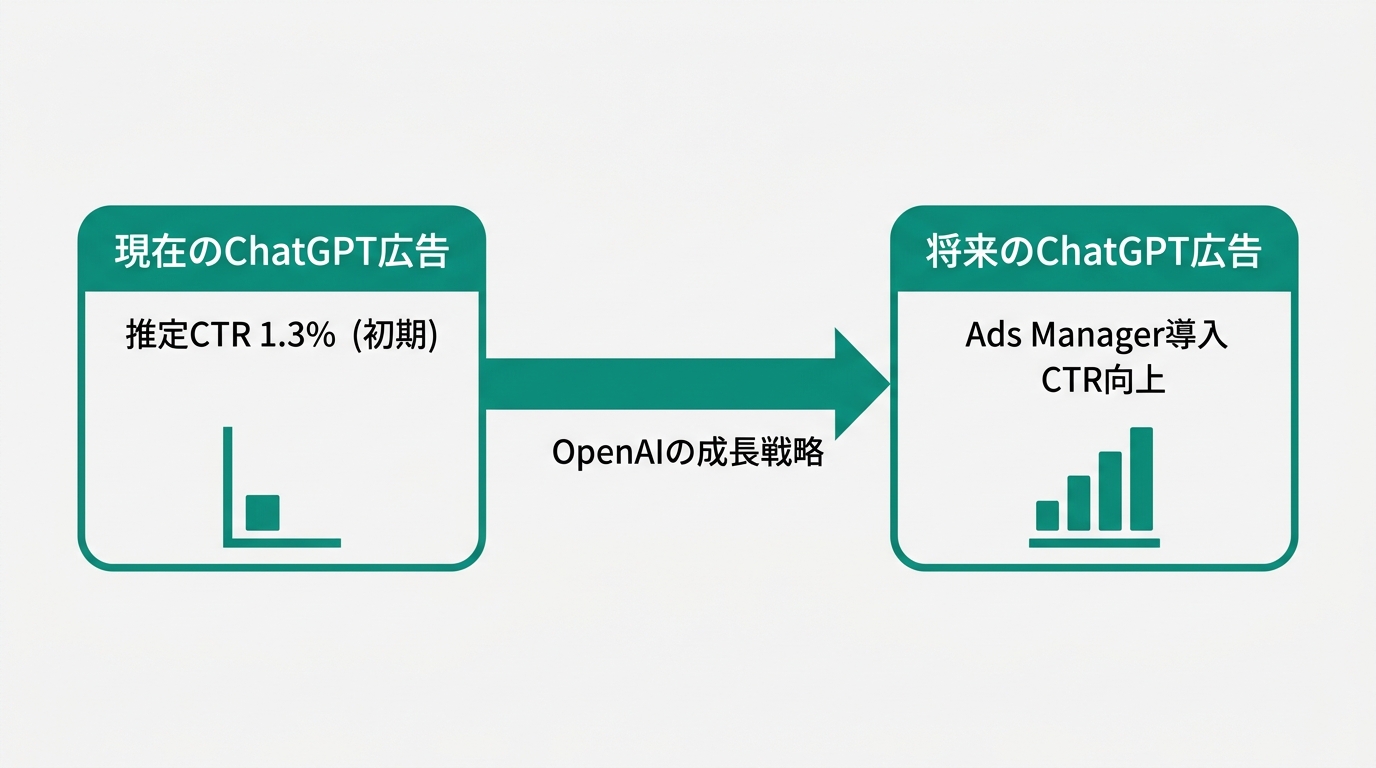
The big question is performance. Industry observers report an estimated CTR (click-through rate, the proportion of impressions that get clicked) of around 1.3% currently (Source: ALM Corp). With Google search ads averaging around 3–6% CTR across industries, ChatGPT ads’ estimated 1.3% is clearly on the low end.
But this is data from the early testing phase. New ad platforms never come out the gate with high CTRs. Facebook ads were initially derided as “less effective than banner ads,” but that changed as targeting accuracy improved. ChatGPT ads are best viewed as being in a “wait and see” phase right now.
OpenAI’s Revenue Plan and What’s Ahead
Reports suggest OpenAI plans to roughly double ChatGPT’s consumer revenue to around $17 billion in 2026 through its advertising business (Source: ALM Corp). That figure refers to “consumer ChatGPT” specifically rather than total company revenue, but the scale is significant.
OpenAI is also reportedly testing a self-service ad placement tool called “Ads Manager” (Source: ALM Corp). If that becomes available, we could see an era where you can run your own ads with a small budget, just like with Google Ads or social media ads. The day individuals and small businesses can participate is probably still a way off. But the trend is undeniably moving in that direction.
YouTube and Brand Mentions Are Becoming the “Key to Getting Cited by AI”

“So I should just buy ads?” Hold on a second. There’s something more important to discuss before ads. It’s whether you’ve become “a brand that AI cites.”
Where Are LLMs Pulling Their Information From?
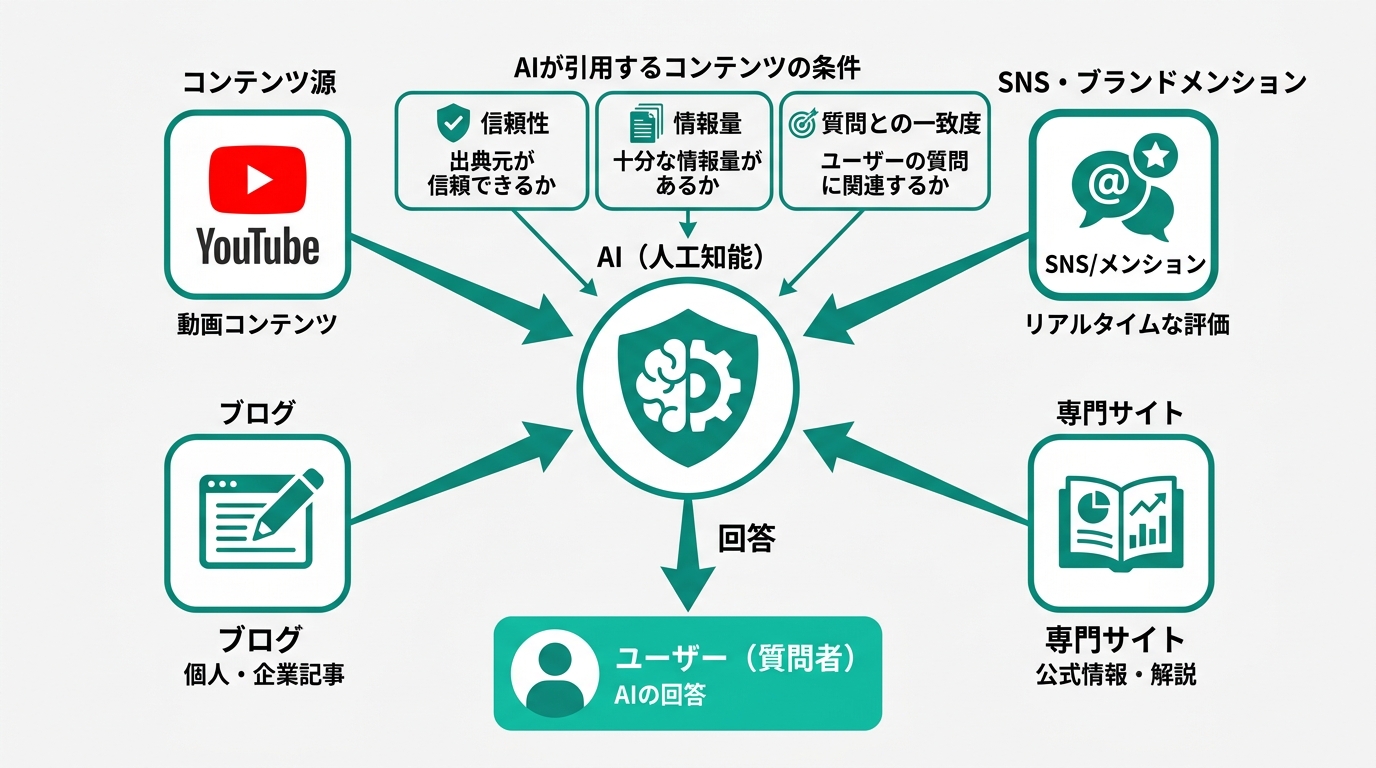
There’s research that looked at which sources LLMs (large language models like ChatGPT and Claude) pull from when generating responses. The findings are interesting.
According to reports, YouTube is cited in around 16% of LLM responses (Source: Pretty-Impressive). Reddit follows at about 10%, with blogs and specialty sites after that.
“YouTube videos get cited by AI?” you might wonder. More accurately, it’s not that the video content itself is used directly — it’s that “brands and concepts discussed heavily on YouTube” influence the AI’s awareness of them.
What Is a Brand Mention?
A brand mention refers to your brand name being mentioned online.
Even “unlinked mentions” or “mentions without backlinks” can boost your brand’s presence if they end up in the AI’s training data. Conversely, a “brand that nobody talks about online” is easily ignored by AI.
Here’s what that looks like concretely. Someone tweets “I tried using XX, and it was better than I expected.” Someone writes a note post titled “How XX seriously helped me.” Someone uploads a YouTube video called “I tried XX.” These “conversations happening around the brand” shape AI’s awareness.
85% Don’t Get Cited — What the Tough Numbers Mean
There’s also some harsh data. Reports indicate that around 85% of pages ChatGPT references don’t end up cited in the final response (Source: ALM Corp).
Just “creating content” and “getting indexed by AI” isn’t enough. To be cited, you need credibility, depth of information, and alignment with the user’s question.
Analysis also shows that 44.2% of LLM citations come from the first 30% of the article, 31.1% from the middle, and 24.7% from the end (Source: ALM Corp). In other words, the “inverted pyramid” structure — putting the core information at the top of the article — gives you an AEO advantage.
You really get a sense that just by changing how you write content, your AI citation rate changes — though you have to try it to feel it. Shifting from “the intro is where you hook the reader” to “the intro is where you place the answer” is the mental shift required in the AEO era. Of course, getting information quickly is easier for human readers, too. That both can coexist is what makes AEO optimization interesting.
Before/After: How AEO-Aware Writing Changes Things
Say you have a blog article explaining “what ChatGPT ads are.”
Non-AEO (traditional):
Lately, I’ve been hearing the term “ChatGPT ads” a lot in the marketing industry. Today, I’d like to dig a little into the background. There are various reasons why OpenAI stepped into the advertising business…
AEO-friendly (inverted pyramid):
ChatGPT ads are an advertising service that OpenAI began testing in the US on February 9, 2026. The rollout targets adult users on the Free and Go plans, with major brands like Target and Best Buy participating from the start. The format is contextual advertising, with sponsored slots explicitly labeled within shopping-related conversations.
AI is more likely to recognize the latter as “an article with the answer.” Prioritizing “easy for AI to pick up” over “drawing the reader in” — that’s article design for the AEO era. Just by changing the structure of how you write, your “citability” by AI definitely goes up.
What Should Your Brand Do? — Three Practical Steps
You get the theory. So, what should you actually do? Let me lay it out in priority order for individuals and small businesses.
Step 1: First, Create “Content That AI Will Cite” (AEO Optimization)
Before buying ads, you need to build the foundation that gets you cited. Content that AI is more likely to cite has common traits.
Write in FAQ format: There’s a hypothesis that pairing questions like “What is XX?” or “How do you use XX?” with their answers makes it easier for AI to pick them up in conversations. In practice, I’ve gotten the sense that pages with question-style headings tend to get cited more easily.
Put the core upfront: Based on the earlier data showing 44.2% of citations come from the article’s opening, a structure that “states the conclusion first” and “puts the most important data at the top” is likely effective.
Include primary information: Reports based on your own experience, original numbers, and actual operational walkthroughs are powerful material for AEO. AI tends to cite information backed by sources and evidence.
These three points also work well with “writing tricks” from the SEO era. Picking one existing article and rewriting it is the easiest approach to get started.
Step 2: Increase Brand Mentions on YouTube and Social Media
Creating a state where “other people, not just you, are talking about your brand” is going to be critical going forward.
For solo operators and individual bloggers, this might sound daunting. But in practice, small accumulations add up.
- Create a flow where readers share their impressions of your content
- Mention your brand or methods on YouTube (make videos yourself)
- Increase your output frequency on note and X to amplify your online voice
“A weekly blog post” might be losing ground to “3 tweets a week plus 2 note posts a month” in terms of AI exposure. The total volume of presence online accumulates into recognition.
Step 3: Check Right Now Whether “Your Name Comes Up in AI”
There’s a 5-minute self-check you can do. It’s a way to see how AI currently perceives your brand.
- Ask ChatGPT, “Tell me about [your brand/service name]”
- Ask Perplexity the same question
- Ask Claude, “Which blogs or note writers are frequently referenced in [your area of expertise]?”
If your name comes up in any of these three answers, that’s evidence that AI awareness of you is forming. If it doesn’t, take it as a signal to step up your AEO efforts.
I’ve tried it myself. Naturally, nothing came up at first. After consistently writing with FAQ-style articles, structures that placed the core upfront, and firsthand experience reports, mentions began appearing in checks a few months later. Nothing changes from a single attempt. Continuous output accumulates and gradually shapes AI’s awareness.
”Should I Buy ChatGPT Ads?” — A Realistic Answer for Individuals and Small Businesses
Let me answer honestly: “So what should I actually do right now?”
The Answer for Individuals, Freelancers, and Solo Operators
What you can do right now: Focus on AEO optimization (rewriting in FAQ format, concentrating information at the top, adding primary sources) and growing brand mentions (using YouTube and social media). As the foundation before entering ChatGPT ads, I believe these two are absolutely necessary steps.
ChatGPT ads are in “observation mode”: The current barrier to entry is unrealistically high for individuals. But the smart play is to keep an eye out for the self-service version while understanding how the mechanics work.
Concretely, there are three things to do. Follow OpenAI’s official blog via RSS or newsletter. Set up Google Alerts for “ChatGPT ads self-service.” And start thinking now about the design of the landing page you’d use if you ended up running ads. Only those who prepare can move the moment access opens up.
The Answer for SMBs and Startups
Realistic budget: Reports indicate the current minimum is $200,000 (for initial participants). There’s also information suggesting the CPM (cost per 1,000 ad impressions) for the self-service version could be around $60, which could be higher than Google Ads. Making a large investment in the early stages when ROI is hard to gauge is something to evaluate carefully.
Invest in AEO optimization first: Redirecting some of the budget you’ve been spending on SEO toward AEO optimization (improving content quality, generating primary information, running YouTube) is the more realistic choice at this point. Only once you have a foundation as a “cited brand” can your ads reach their full effectiveness.
The natural concern here is “how much does AEO optimization cost?” Outsourcing a content rewrite runs about ¥30,000–50,000 per article, but you can actually do a fair amount of the rewriting yourself just by telling ChatGPT or Claude to “rewrite this in FAQ format.” Starting with the areas you can handle with tool subscription costs (a few thousand yen to ¥10,000 a month) is the realistic move.
Identify Which Stage of the “Three-Stage Rocket” You’re On
The last thing to check is this: which stage is your brand currently on?
| Phase | What to Do | Metrics |
|---|---|---|
| SEO stage | Keyword optimization, backlink acquisition | Search rankings, organic traffic |
| AEO stage | FAQ-format content, strengthen primary information | AI citation count, brand mention count |
| AI ad stage | Run ChatGPT ads, AI-internal sponsorships | Ad CTR, conversions |
Bluntly put, if you haven’t even mastered the AEO stage, buying AI ads will yield weak results. Following the sequence matters. “Polish the second stage of the rocket before advancing to the third” is the basic mindset.
Wrap-Up — How to Avoid Getting Left Behind in the AI Platform Advertising Era
Let me organize today’s discussion.
The big picture of the three-stage rocket:
- SEO: Rank high on Google → humans click
- AEO: Get cited by AI → AI answers on your behalf
- AI platform ads: Buy sponsored slots inside ChatGPT
The current state of ChatGPT ads:
- February 9, 2026: testing began in the US (Source: Official OpenAI)
- Target: adult users on Free and Go plans
- Industry-observed estimated CTR: about 1.3% (early testing stage)
- Minimum spend: reportedly $200,000 (for initial participants)
- A self-service “Ads Manager” is reportedly in testing
What to do now (in priority order):
- AEO optimization — FAQ format, core upfront, strengthen primary information
- Increase brand mentions — leverage YouTube and social media
- ChatGPT ads — understand the mechanics and “wait”
The era of “AI marketing is just a thing for big companies” is ending. Google and Facebook were big-company-only at first too. But now you can run ads starting from a few thousand yen a month. There’s every chance ChatGPT ads will follow the same path.
Only those who move while most people are still unaware will catch the early-platform bonus. Just trust me and try it — start with that 5-minute self-check. The small check of “does my name come up in ChatGPT?” is the first move you can make starting today.
There are views only visible to those who put their hands to the work. The AI platform advertising era is no exception.
Appendix: A 7-Day “Three-Stage Rocket Prep” Plan You Can Start This Week
For those wondering “where do I even start?”, I’ve put together an action memo for this week.
- Day 1: Self-check your brand name on ChatGPT, Perplexity, and Claude
- Day 2: List 5 of your existing content pieces and identify the AEO-weak articles
- Day 3–4: Rewrite your most-searched article into “FAQ format + answer upfront”
- Day 5: Post on X asking “Please share your impressions of my content”
- Day 6: Bookmark OpenAI’s official ChatGPT ads page and track Ads Manager developments
- Day 7: Based on the week’s actions, update your priority list of “next articles to rewrite”
Doing a self-check again after 7 days, you’ll probably see almost no change. But it stacks up after 1 month, 3 months. AI awareness isn’t something that changes overnight. Continuous effort is the only shortcut.
References
- Official OpenAI (start of ChatGPT ads testing): openai.com/index/testing-ads-in-chatgpt/
- PYMNTS (list of initial advertisers)
- ALM Corp (CTR, pricing, Ads Manager information)
- Target Corporate (official explanation of ad format)
- Position Digital (relationship between AI Overview citations and CTR)
- Pretty-Impressive (YouTube citation rate data)
Written based on information as of March 2026. Ad pricing, CTR, and service specifications may change in the future.

AIを使いこなせない方は、この先どんどん差がつきます。僕はAIエージェントを毎日動かして、壊して、直して、また動かしてます。そういう泥臭い実践の記録をここに書いてます。理論は他の方にお任せしました。僕は動くものを作ります。朝5時に起きてウォーキングしてからコードを書くのがルーティンです。