LLMO, AEO, or GEO — Which One Should You Actually Use? Why the Terms Split and a Practical Guide for Tomorrow
Some say 'let's do LLMO.' Others insist 'GEO is the real deal.' Some consultants push 'start with AEO.' Here's what the terminology debate actually means for your content strategy.
What you'll learn in this article
- What changed in AI search and content discovery
- Which metric or operating rule matters before shipping more content
- Which follow-up article expands the strategy from another angle

Some say “let’s do LLMO.” Others insist “GEO is the real deal.” Some consultants push “start with AEO.”
Do you need to do all three? Or are they just different names for the same thing?
By the end of this article, you’ll understand the differences and common ground between these three terms. More importantly, you’ll be able to decide for yourself which term to use in tomorrow’s article title and heading structure.
I’ll be honest — when I first heard the word LLMO in the fall of 2025, I was confused. I couldn’t tell it apart from GEO. The more I researched, the more similar terms kept appearing. But after writing articles and running experiments, I found an answer.
Here’s that answer, as practically as I can give it.
The Background Behind “Same Goal, Different Names”
LLMO, AEO, GEO. These three terms exploded onto the scene between 2025 and 2026.
Let me cut straight to it. The goal is identical. All three are about optimizing for your content to be cited or recommended in AI-generated answers. The core of what you’re doing doesn’t change.
So why did the names split? Three reasons.
Reason 1: The people who coined the terms came from different places.
LLMO stands for “Large Language Model Optimization.” In Japan, the term was popularized by Keita Takeuchi of LANY, through his book Strong LLMO (MDN Corporation). It was proposed from an SEO consultant’s perspective as “the next SEO.”
GEO stands for “Generative Engine Optimization.” This term was adopted by researchers and marketers in the English-speaking world. Global SaaS platforms like Frase.io and Similarweb have actively embraced it.
AEO stands for “Answer Engine Optimization.” It covers optimization for Google’s featured snippets (the answer box at the top of search results) and voice search assistants. Historically it’s been used as a somewhat broader concept.
Reason 2: The scope each term covers is slightly different.

Here’s how they break down:
- LLMO: Focused on being cited when LLMs (Large Language Models) like ChatGPT, Claude, and Gemini generate responses
- GEO: Aims to have your content included in responses generated by AI search broadly (Google AI Overview, Perplexity, ChatGPT, etc.)
- AEO: Optimization for engines that provide “direct answers” to questions — including featured snippets, voice assistants, and AI chat
In terms of scope: AEO ≧ GEO ≧ LLMO. But in practice, the tactics you implement overlap almost entirely.
Reason 3: The terms spread through different channels in Japan vs. overseas.
According to Nikkei reporting, “the term for AI search optimization in Japan is the uniquely Japanese LLMO; in the US it’s AEO and GEO.” In Japan, LLMO spread through LANY’s book and seminar circuit.
Overseas, Neil Patel attempted to organize the landscape in a blog post, describing “AEO, GEO, and LLMO as different frames within the same academic discipline,” which helped cement GEO and AEO internationally.
The real reason the terms split isn’t “technical differences” — it’s “who named it, where, and in what context.”
Why Nikkei, Web Tan, and MarkeZine All Moved at the Same Time
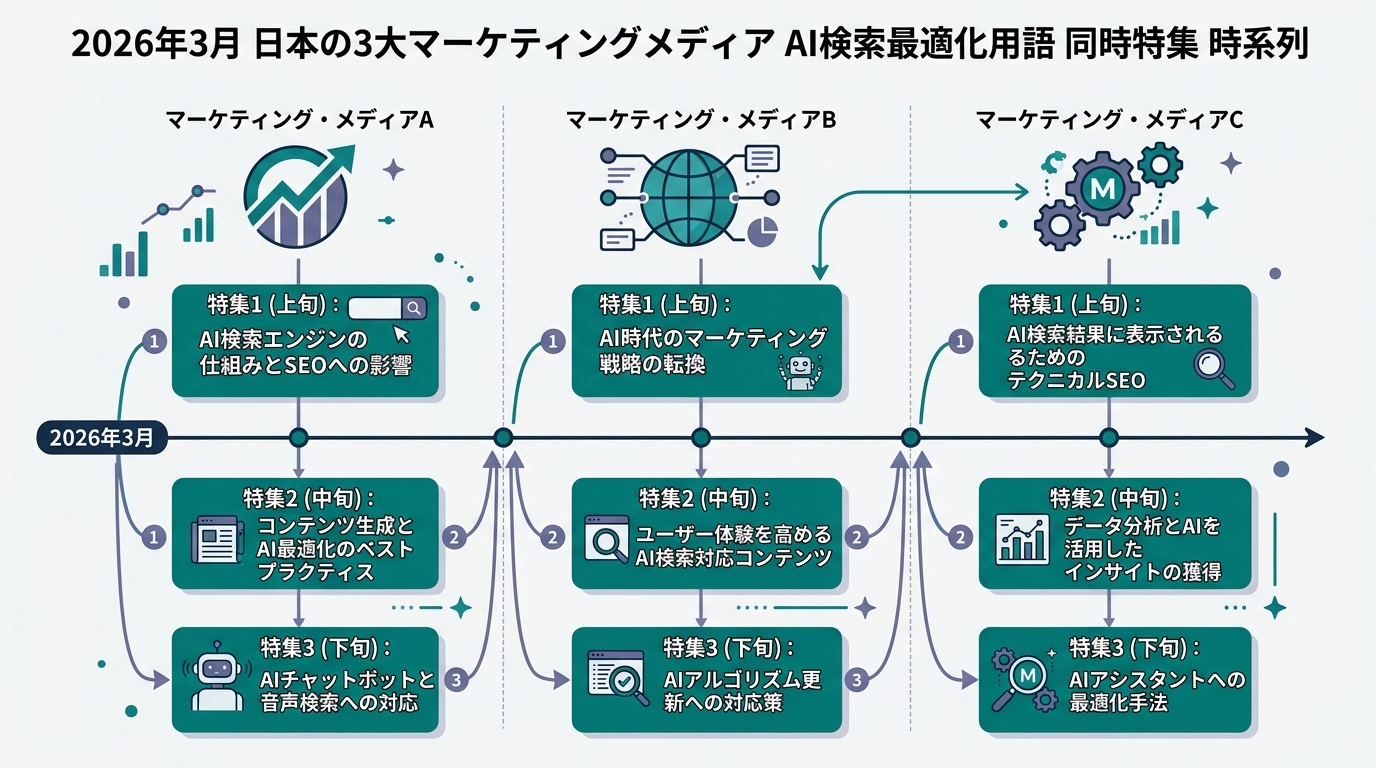
In March 2026, Japan’s three leading marketing publications tackled this terminology issue at almost exactly the same time.
Nikkei Cross Trend ran a feature titled “LLMO, GEO, AEO, AIO… The Differences Between the Proliferating AI Optimization Terms.” Web Tan Forum saw a GEO explainer rank in its popularity charts. MarkeZine published an LLMO breakdown as well.
Why did all three move at once? My read: corporate budgets got unlocked.
According to a Search Engine Journal survey, 94% of companies planned to increase spending on AEO/GEO in 2026. When budgets are allocated, internal stakeholders start asking, “So are we investing in LLMO or GEO?”
The media had to answer that question. That’s why the “term-clarification” articles all dropped at once.
A fourth term worth noting here is “AIO” — “AI Optimization.” It’s used in the broadest possible sense. In my observation, though, not many practitioners actually use it. The concept is valid, but it lacks specificity, making it unsuitable for article titles or proposals.
3 Criteria for Deciding Which Term to Use in Practice
Now we get to the real question: “Which one should I actually use?”
Three criteria. That’s it.
Criterion 1: Who is your audience?
If you’re writing for Japanese marketers and web managers, LLMO is currently the most legible choice. The reason is simple: search volume and brand awareness in the Japanese-language sphere skew heavily toward LLMO.
The founding of LANY LLMO LAB is emblematic of this. Practical Japanese-language content — like Media Growth’s Complete LLMO Guide — has accumulated around LLMO as the anchor term.
For English-speaking audiences or international clients, GEO is the safe bet. Globally, major tools like Similarweb, Frase.io, and Ahrefs have adopted GEO. If you want your article to get cited in English-language content, GEO is the key.
Criterion 2: What are you proposing?
If your proposal covers AI search broadly, use GEO. It’s the concept that spans Google AI Overview, Perplexity, and ChatGPT together.
If your proposal is specifically about getting ChatGPT or Claude to recommend your brand, use LLMO. When you’re discussing technical tactics that go deep into how LLMs work, this term fits best.
If your proposal targets capturing featured snippets and direct-answer placements in search, use AEO. When explaining tactics that are extensions of traditional SEO, AEO lands most smoothly.
Criterion 3: Will you cross-reference terms in the article?
My recommendation: pick one as the primary term, and mention the others in parentheses on first use.
Concretely, write it like this:
After implementing LLMO (also known as GEO or AEO — the practice of AI search optimization), AI started including my blog in its responses. (example)
This reaches readers who searched for any of the terms. And by sticking with one primary term throughout, the article stays readable.
The Right Mindset to Avoid Getting Caught in the “Terminology Wars”
I’ll be blunt. Getting deep into debates about term definitions will not improve your content by a single word.
From what I’ve seen, the people who fixate on terminology distinctions tend to be the same people who haven’t actually started on what matters: the practical work of making content easy for AI to cite.
What matters is not the name — it’s the work. No matter which term you choose, the core tactics are the same. Here’s what that core looks like.
What AI-cited content has in common
According to Keywordmap research, pages cited in Google AI Overviews share several characteristics. Pages ranking in the top PASF (People Also Search For) positions had a 4.5% AI Overview display rate — about twice the 2.3% rate for lower-ranked pages.
From my own practical experience, these four points make the biggest difference:
Having original first-party information. Articles built on your own experience, research, or data — rather than aggregating other sites — are more likely to be chosen as citation sources by AI.
Being structured as direct answers. Articles that include formats where questions are answered clearly (FAQ, step-by-step, definition sentences) are easier for LLMs to reference when generating responses.
Having clear trust signals. Author information, source links, and publication dates explicitly stated. Articles with all three tend to be stronger candidates for AI citation.
Having entities (proper nouns) organized clearly. Articles where names of people, organizations, and products are accurate and their relationships are explicitly stated in the text give LLMs higher comprehension accuracy.
3 Actions You Can Take Starting Tomorrow
Theory ends here. Three things you can change starting with your next article.
Action 1: Add an “AI-answerable” angle to your title
Traditional SEO title: “10 Best Recruiting Agencies [2026 Edition]”
LLMO/GEO title: “How Do You Choose a Recruiting Agency? 5 Decision Criteria from a Career Advisor”
The difference is whether the structure answers a question. AI tends to cite content that answers a specific question rather than “top N picks” list articles.
Action 2: Include one definition sentence in the article
Define a term relevant to your article’s topic in a single sentence.
For this article, that sentence is: “LLMO is an optimization practice designed to make large language models like ChatGPT and Claude more likely to cite or recommend your content when generating responses.”
That one sentence puts you in the pool of candidates when AI is asked “what is LLMO?” A small change with significant impact.
Action 3: Format source links as “source name + URL”
If you write “according to X,” always include the URL. If you can’t link to it, don’t cite it. That alone raises your trust signals with AI.
The reason is straightforward. LLMs are designed to favor content where “the linked source exists and the citation relationship is clear.” Between an unsourced claim and a sourced claim with a link, AI overwhelmingly cites the latter. I’ve observed this consistently.
Related articles in the GEO series:
- GEO fundamentals and the 3-layer framework are explained here
- The GEO 7-point checklist practical guide is available here
- Why ranking #1 on Google still doesn’t get you cited by AI is explained here
Summary and Outlook: Stop Debating Terms, Start Moving
Key takeaways from this article:
- LLMO, AEO, and GEO all point toward the same goal: optimization to get AI to cite your content. There are technical nuances, but the practical core is shared
- For Japanese audiences: LLMO. For English-speaking audiences: GEO. For framing within traditional SEO: AEO
- In your articles, pick one as the primary term and reference the others on first use
- Time spent on the terminology debate is time not spent on what actually works: original data, answer-structured writing, source links, and organized entities
Here’s my prediction for where this goes.
By the second half of 2026, the terminology will converge on GEO.
Three reasons: Global SaaS platforms (Similarweb, Ahrefs, Semrush) are adopting GEO as the standard term. Ahrefs listing 14 GEO conferences to attend in 2026 shows event-level entrenchment in the English-speaking world. And in Japan, companies like Speee are increasingly aligning with the global standard of AEO/GEO.
That said, this isn’t an argument that “LLMO is wrong.” For articles written for Japanese readers, LLMO will remain the more accessible term for a good while yet. What matters isn’t choosing the “correct” term — it’s choosing the term that reaches your audience.
One thing I’ll state without qualification: the name will change, but the substance — creating good content that honestly answers readers’ questions — never will.
That’s how it worked in the SEO era too. Every algorithm update spawned new terminology and sent everyone scrambling. But the ones who survived were, without exception, the people who kept writing articles that genuinely helped readers.
The LLMO era, the GEO era — the same thing will happen.
If you’re spending time debating terminology, stop. Write one article today that answers a real reader question. That’s the most powerful AI search optimization there is.

AIを使いこなせない方は、この先どんどん差がつきます。僕はAIエージェントを毎日動かして、壊して、直して、また動かしてます。そういう泥臭い実践の記録をここに書いてます。理論は他の方にお任せしました。僕は動くものを作ります。朝5時に起きてウォーキングしてからコードを書くのがルーティンです。