Get Found by AI Before Google Does — The Complete GEO (Generative Engine Optimization) Practical Guide 2026
GEO (Generative Engine Optimization) is the practice of optimizing your content so it gets cited, recommended, and acted upon by AI search engines like ChatGPT, Claude, Gemini, and Perplexity…
What you'll learn in this article
- What changed in AI search and content discovery
- Which metric or operating rule matters before shipping more content
- Which follow-up article expands the strategy from another angle

“I’m doing everything right for SEO, but my traffic keeps dropping.”
Sound familiar? You picked keywords, built backlinks, wrote solid articles. Yet search traffic is sliding down month after month, and you can’t figure out why. That confusion has been spreading rapidly in 2026.
The answer is straightforward: Google search results are changing.
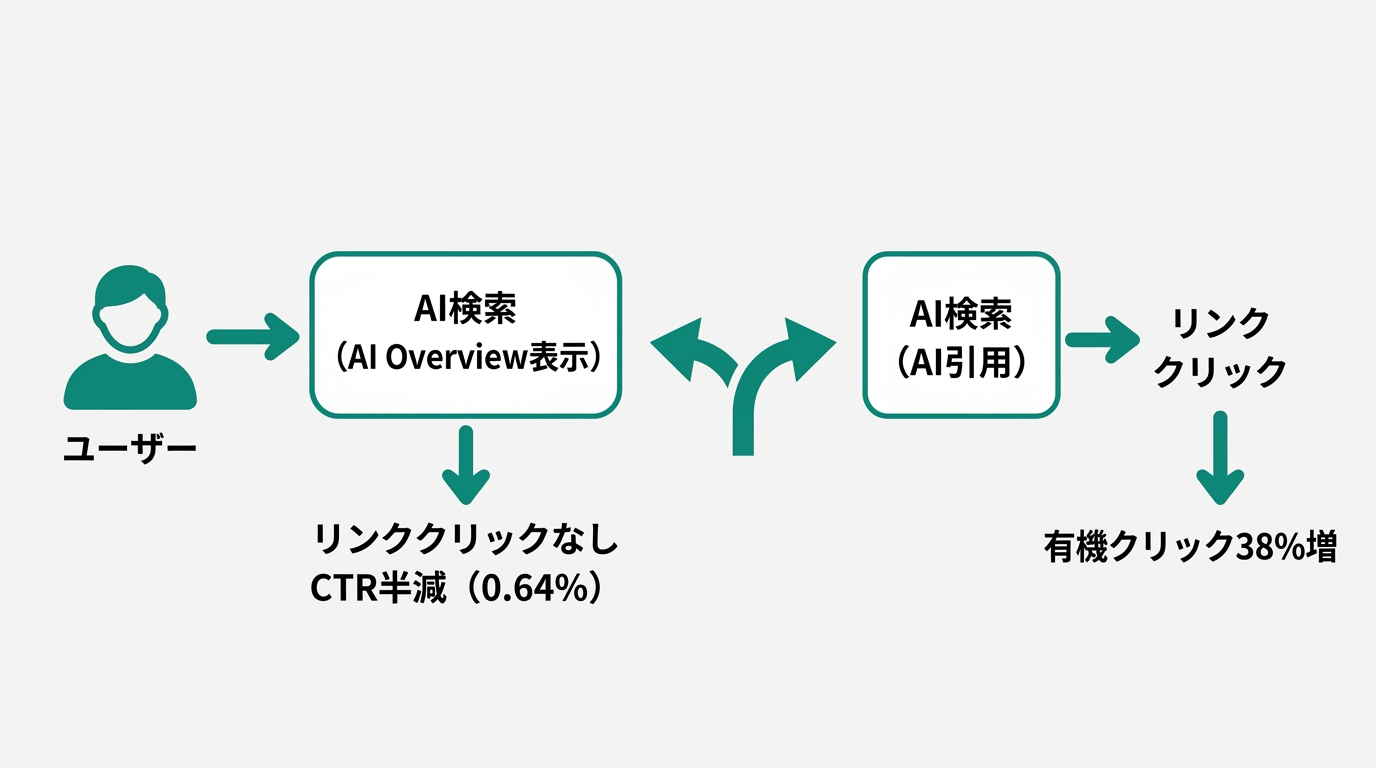
In Japan, AI Overview now appears in over 80% of queries (reported by Nikkei Asia, 2025). When users read the AI’s answer and feel satisfied, they don’t click any link. Studies show that CTR (click-through rate) for informational search queries has been cut in half — from 1.41% to 0.64% (Position Digital report).
That’s where the phrase “zero-click era” comes from.
Here’s where it gets interesting, though. When AI cites your content, organic clicks actually increase by 38% (same report). Get ignored by AI and traffic goes to zero. Get cited by AI and traffic grows. Two completely opposite outcomes happening at the same time.
The discipline of optimizing for “whether AI cites you or not” is called GEO (Generative Engine Optimization).
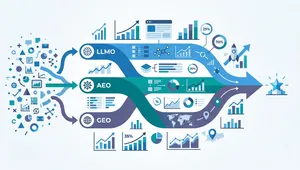
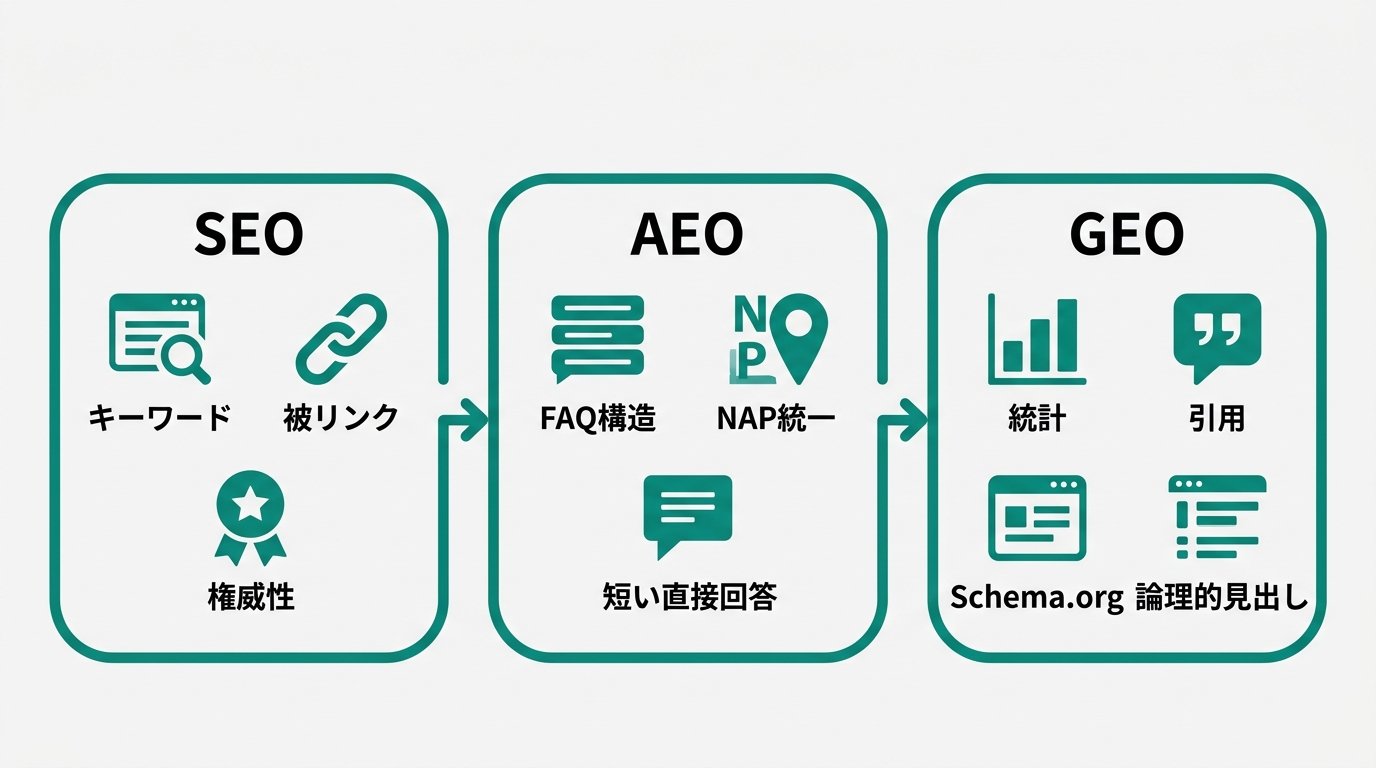
SEO (optimizing for Google rankings) → AEO (optimizing for inclusion in AI answers) → GEO (optimizing for AI citation + recommendation + action). Today’s article is the final chapter of that three-stage rocket, covering GEO from end to end.
After reading this, you’ll be able to:
- Clearly distinguish GEO from SEO and AEO
- Build content that AI is more likely to cite
- Measure a new KPI called “Share of Synthesis” yourself
- Decide whether GEO matters for your personal blog or note.com presence
What Is GEO, Exactly? How Is It Different from SEO and AEO?

GEO (Generative Engine Optimization) is the practice of optimizing your content so that AI search engines — ChatGPT, Claude, Gemini, Perplexity — cite, recommend, and drive actions from it.
The concept was introduced in a joint research paper by Princeton University and Georgia Tech (arxiv.org/abs/2311.09735). It’s easy to conflate with SEO or AEO, but the target outcome is different.
Here’s how the three compare:
| Dimension | SEO | AEO | GEO |
|---|---|---|---|
| Optimization target | Google search ranking | Inclusion in AI answers | AI citation + recommendation + action |
| KPI | Search rank / CTR | AI citation count | Share of Synthesis |
| Core tactics | Keywords / backlinks | FAQ structure / NAP consistency | Statistics + citations + Schema |
| Where to learn more | Past articles | AEO Complete Guide (Part 3) | ← This article |
SEO = appear at the top of Google rankings. AEO = have your content referenced when AI answers a question. GEO = have AI actively recommend your content and guide users to take action. Those are three distinct stages.
“Isn’t that the same as AEO?” is a fair question. Let me unpack it.
AEO’s goal was to get your site included in an AI’s answer — essentially “information placement.” GEO goes further: it aims for AI to proactively say “try this site” to the user.
In 2026, ChatGPT launched purchasing, booking, and comparison features (what you might call Agent/Operator-style functionality). With these capabilities, AI can directly prompt users to act — “Want to try this service?” — and the brand that gets cited in that moment is the next business battleground.
Worth knowing alongside this: the term Search Everywhere Optimization. GEO covers not just Google but all AI search platforms — ChatGPT Search, Perplexity AI, Claude.ai, Gemini. The idea of “optimizing across every search engine” is why this broader term is also used widely in the industry.
The reason GEO is treated as its own concept is that its optimization strategy differs from both SEO and AEO. SEO’s core is authority, backlinks, and keywords. AEO’s core is FAQ structure, local NAP information (consistent Name, Address, Phone number), and short direct answers. GEO’s core is statistics, citations, Schema.org structured data, and logical heading hierarchy.
Honestly, “if you do SEO well, GEO will follow automatically” is half right, half wrong. GEO has its own specific tactics, and there are definite blind spots you can’t fix without intentionally addressing them.
Why GEO Matters Now — The Reality of AI Search in Data
“Google is still dominant, right?” Maybe. But look at the numbers.
[A note on data sourcing in this section] The following draws from three layers: (1) academic research (Princeton University), (2) marketing firm reports (Position Digital, Profound, etc.), and (3) the author’s own observations. Reliability varies, so inline sourcing is noted throughout. Numbers from firm-level reports can be difficult to verify against primary sources — keep that in mind.
ChatGPT’s weekly active users surpassed 800 million as of late 2025 (OpenAI official announcement), doubling year over year. Perplexity AI’s monthly query volume reached 780 million (as of May 2025), up 239% year over year according to published reports.
The shift is visible in Japan too. AI Overview appearing in over 80% of queries was already mentioned (Nikkei Asia report). The old flow — “Google search → click top article → read it” — is becoming “Google search → read AI Overview → done.”
This change is moving faster than most people expect.
The sharpest data point: CTR for informational queries cut in half, from 1.41% to 0.64% (Position Digital report, firm-level). A category that was already hard to drive clicks from just got cut in half again. “What is X?” and “How do I do Y?” articles — the AI Overview reads the answer and that’s it. Fewer and fewer users ever reach the article itself.
But there’s a flip side.
Brands cited by AI saw organic clicks increase 38%, and paid clicks rise 39% (Position Digital report, firm-level). Get ignored by AI and search traffic heads toward zero; get cited and it goes up. This is becoming a zero-sum game.
One more data point worth flagging: 47% of surveyed brands still have no GEO strategy, according to Profound (firm-level report). Right now, more than half of content creators are still producing content with zero awareness of GEO. First movers have a massive advantage. As of March 2026, no comprehensive Japanese-language GEO guide exists even on MarkeZine (author’s observation).
This is, I believe, the last window of first-mover advantage.
Whether you create content AI will cite or content AI will ignore — the same amount of effort goes in, but the outcomes diverge completely depending on whether you’ve thought about GEO. If you want your content to compound as an asset, now is the moment to act.
The Core of GEO: Understanding “Share of Synthesis” as a New KPI
Central to any discussion of GEO is the concept of Share of Synthesis — your brand’s AI citation rate. Note that this isn’t a formally standardized academic term; it’s a practical label that emerged from GEO practitioner circles. Think of it as an operational KPI for tracking how often AI search cites you.
Traditional SEO’s “Share of Voice” measured what percentage of target keyword search results featured your site at the top — essentially, your presence in search results.
Share of Synthesis, by contrast, measures how often your brand or site gets cited or mentioned when AI answers questions in a given category.
A concrete example helps.
Ask an AI, “What are the best GEO strategies for 2026?” Does your blog or service appear in the answer? Does the AI say something like “The AI marketing blog written by [your name] covers this well”? That’s Share of Synthesis.
Try it yourself and you’ll notice that different AI systems have quite different citation tendencies. ChatGPT Search references Bing’s index. Perplexity AI uses its own high-speed crawler. Claude uses Anthropic’s proprietary processes (based on published information and author observation). Ideally you’d track citation status across all platforms.
How to measure Share of Synthesis (for free):
- Pick 5–10 keywords related to your brand or topic (e.g., “AI marketing recommendations,” “GEO tactics,” “Claude tips blog”)
- Ask ChatGPT, Perplexity, and Claude: “Tell me about [keyword]”
- Check whether your site or brand name appears in the response
- Log results in a spreadsheet weekly and track improvement trends
Weekly — not monthly — is the key cadence. After you update or add content, it can take 2–4 weeks for AI indexes to reflect the change, so weekly measurement gives you enough resolution to catch shifts.
Paid tools are also multiplying fast in 2026. Services like AthenaHQ, Profound, LLMrefs, and Geoptie offer consolidated dashboards. That said, starting with manual free checks is the realistic first step for most people.
The experience of watching Share of Synthesis climb from zero is what makes GEO click as something real rather than theoretical. Give it a shot.
How to Create Content AI Will Cite — GEO in 5 Practical Steps
Now that the theory is clear, here’s how to actually do it. These five approaches are drawn from methods shown to be effective in the Princeton University research (academic paper level) and validation work by AirOps and Position Digital (firm report level).
Step 1: Answer the Question in the First 200 Characters (Inverted Pyramid Structure)
AI search engines tend to read content from the top. Whether the first 200 characters contain a direct answer to the question is the first fork in the road for whether you get cited.
Openings like “In this article, I’ll explain…” or “Let’s take a look at…” are friendly to human readers but friction for AI.
A good opening looks like this:
“GEO (Generative Engine Optimization) is the practice of optimizing your content to be cited by AI search engines like ChatGPT and Perplexity. While SEO optimizes for Google search rankings, GEO aims for citation and recommendation within AI responses.”
Lead with the answer, then move to elaboration. The traditional blog structure of “intro → body → conclusion” shifts to “conclusion → reasoning → detail” — that’s the core of writing for the GEO era.
When revisiting existing articles, start by fixing just the opening. It’s the highest-leverage, lowest-friction change you can make.
Step 2: Deliberately Add Data, Statistics, and Citations
Princeton University’s research (arxiv.org/abs/2311.09735) found that adding “statistical data” to an article improved AI visibility by +30–40%, and adding “citations” (references to external sources) improved it by +40% (2023 academic paper).
“Articles with vague explanations” lose to “articles with numbers and sources” in AI citation competition. This makes intuitive sense — AI tries to select sources it evaluates as trustworthy, so articles with explicit evidence are more likely to be cited.
One important caveat: always cite the source of your numbers. Unless you indicate where data comes from — “according to this study,” “per this report” — AI will tend to rate the content’s credibility lower. For figures you can’t verify from a primary source, soften the language: “there are reports suggesting,” “it has been said that” rather than flat assertions.
Step 3: Implement Schema.org JSON-LD Structured Data
This gets a bit technical, but if you’re on WordPress, a plugin handles it, so let’s cover it.
Schema.org is the shared web data structuring standard developed under Google’s leadership. JSON-LD is the format used to embed machine-readable descriptions of your article’s content into your HTML. Schema.org structured data is one of the primary channels AI uses to “understand” an article.
FAQSchema and HowToSchema are especially effective. They let you present Q&A-style content and step-by-step instructions in a format AI can read directly.
On WordPress, plugins like Yoast SEO or Rank Math auto-generate Schema.org output, making this fully accessible to individual bloggers.
Step 4: Use Consistent, Logical Heading Hierarchy
68.7% of pages cited by ChatGPT have well-structured heading hierarchies (AirOps, “The 2026 State of AI Search”). Pages with consistent H1 → H2 → H3 ordering have a 2.8× higher citation rate than pages with broken heading structure.
Articles where “I wrote H3 first and added H2 later” have broken structure from an AI perspective and are more likely to be skipped. Design your heading structure upfront and never break the H1 (article title) → H2 (main sections) → H3 (subsections) sequence.
Auditing heading structure on existing articles alone can improve citation rates. Rewriting popular existing articles often shows results faster than creating new ones.
Step 5: Measure Share of Synthesis Weekly and Run Improvement Cycles
The last step is about building a habit. GEO isn’t a one-and-done task — it requires ongoing measurement and improvement cycles.
Every week on the same day, query ChatGPT, Perplexity, and Claude with your target keywords. When something changes — you weren’t cited last week but you are this week — connect that to what content you updated. That’s GEO’s PDCA cycle.
Starting at zero citations is fine. Update content and keep going for 3–4 weeks, and you’ll start to see movement. Among practitioners I’ve observed, most get their first “I got cited!” moment within 1–2 months (based on the author’s surrounding observations; results are not guaranteed).
Here’s the full five-step summary:
- Answer in the first 200 characters → rewrite with inverted pyramid structure
- Enrich with statistics and citations → always attach sources to data
- Schema.org structured data → implement automatically via plugin
- Consistent heading hierarchy → never break H1 → H2 → H3
- Measure Share of Synthesis weekly → track changes in a spreadsheet
People who actually work through these five steps and those who don’t will be in very different positions six months from now.
The SEO × AEO × GEO Three-Layer Stack — The Right Answer for 2026
“SEO is dead” gets declared periodically. My answer is always the same: that’s wrong.
The accurate statement for 2026 is: “SEO alone is no longer sufficient.”
SEO, AEO, and GEO aren’t replacing each other — they function as a cumulative three-layer stack.
Foundation layer: SEO (optimization for Google search)
- Keyword strategy
- Page load speed
- Mobile compatibility
- Backlink building
This remains the backbone of search traffic. Let it weaken and the whole structure collapses.
Middle layer: AEO (optimization for AI answers)
- FAQ-style content design
- Short, direct answers
- E-E-A-T strengthening (Experience, Expertise, Authoritativeness, Trustworthiness)
- For local businesses: consistent NAP information (Name, Address, Phone number)
I covered AEO in depth in my “AEO Complete Guide.” GEO can’t build on a foundation that doesn’t include AEO.
Top layer: GEO (optimization for AI recommendation, citation, and action)
- Direct answer in the first 200 characters
- Rich statistics, data, and citations
- Schema.org structured data
- Logically consistent heading hierarchy
- Weekly Share of Synthesis measurement
Only when all three layers are in place does the “full-stack content strategy for 2026” come together.
What working through this taught me: if your SEO foundation is solid, GEO optimization is mostly incremental improvement. Rather than rebuilding from scratch, the practical first move is to GEO-rewrite your existing content.
Specifically, take a popular existing article and check just three things:
- Does the first 200 characters contain a direct answer?
- Are numbers and data accompanied by explicit sources?
- Is the heading hierarchy (H1 → H2 → H3) clean?
That alone is enough to start improving AI citation rates. Don’t overthink it.
A common question when I explain the three-layer structure is: “Isn’t doing all of this inefficient?” The answer is no. With SEO and AEO foundations in place, GEO work centers on revising existing content — the additional effort is less than you’d expect. The first month may take some time, but from month two onward, it reduces to “a checklist addition when writing new articles.”
Does GEO Matter for Personal Blogs and note.com?
“This is for big companies and professional media, not me.” Let me address this carefully, because I want to change that assumption.
Bottom line: GEO absolutely matters for personal blogs and note.com (a popular Japanese blogging platform) — in fact, there are several areas where individuals have the advantage.
Advantage 1: AI tends to favor first-hand information
AI is more likely to cite “I actually tried this” and “here’s how it worked in my case” than generic corporate copy (author’s observation). The Princeton University research also suggests that content including personal experience and case studies tends to get higher citation rates. The “here’s what I did” article that individual bloggers write is structurally a favored format.
Advantage 2: Niche topics get cited more easily
GEO is about being recognized as the most authoritative source on a specific topic. Deep expertise for a specific audience outperforms broad coverage when it comes to raising Share of Synthesis. Niche combinations like “[location] × [topic]” or “[profession] × [AI application]” are particularly strong targets.
Advantage 3: note.com’s structure is naturally GEO-friendly
note.com articles get indexed by Google quickly, have clear structure (heading / body / conclusion), and are in a format AI crawlers read easily (author’s observation). Anecdotally, AI appears to be referencing note.com articles more frequently when generating responses (personal observation).
There are also genuine challenges for personal blogs. Domain Authority (DA) matters for SEO and doesn’t rise overnight. Focusing only on GEO while neglecting the SEO foundation will cap your overall traffic growth. The three-layer mindset still applies.
One more thing: when an author’s name reaches a state where AI recognizes them in a specific domain, Share of Synthesis can jump sharply. When AI starts saying “for this topic, [name]‘s articles are the best source” — that’s a clear GEO success story. Personal branding and GEO are, it turns out, a natural fit.
“This doesn’t apply to me” should become “this is exactly where I should start.”
Related articles in the GEO series:
- Terminology breakdown of LLMO, AEO, and GEO: detailed explanation here
- The GEO 7-point checklist practical guide: check it here
- Why ranking #1 on Google still doesn’t get you cited by AI: explained here
Conclusion — 3 Actions to Start Today
“SEO is outdated” isn’t the lesson. “SEO + AEO + GEO as a three-layer stack is the 2026 standard” — that’s what I most wanted to communicate today.
GEO in three lines:
- The goal is creating content that AI will cite
- Share of Synthesis (AI brand citation rate — a practical working concept) is your new KPI
- You can start right now just by fixing the opening, data, and headings of existing content
Reports suggest fewer than half of brands have a GEO strategy (Profound, firm-level report). Comprehensive Japanese-language GEO guides remain nearly nonexistent at this moment (author’s observation). Those who move first get recognized by AI as the trusted authority — and that position is still very much up for grabs.
Three actions to start today:
- Pick one of your popular existing articles and check whether the first 200 characters contain a direct answer
- Query ChatGPT and Perplexity with keywords related to your brand and establish your baseline citation status (likely zero)
- Log results in a spreadsheet and build the habit of weekly Share of Synthesis measurement
Nothing about this is complicated. The view from the other side is only visible to those who put in the work.
When the three-stage rocket of SEO → AEO → GEO is fully loaded, your content stops being just “read” and becomes an asset that “AI uses.” That experience is worth having.
[Key Data Sources]
- Academic paper: Princeton University × Georgia Tech, “GEO: Generative Engine Optimization” (arxiv.org/abs/2311.09735, 2023)
- OpenAI official announcement: ChatGPT 800M+ weekly users (late 2025)
- Nikkei Asia: Google AI Overview displayed in 80%+ of queries (2025 report)
- Position Digital (firm report): CTR halving / AI citation click increase/decrease data
- Profound (firm report): 47% of brands lack GEO strategy
- AirOps, “The 2026 State of AI Search” (firm report): 68.7% heading structure / 2.8× citation rate differential
- Sections marked “author’s observation” are based on the author’s personal experience and observation, not statistical research
(Written based on information current as of March 2026. Platform specifications and figures are subject to change.)

AIを使いこなせない方は、この先どんどん差がつきます。僕はAIエージェントを毎日動かして、壊して、直して、また動かしてます。そういう泥臭い実践の記録をここに書いてます。理論は他の方にお任せしました。僕は動くものを作ります。朝5時に起きてウォーキングしてからコードを書くのがルーティンです。