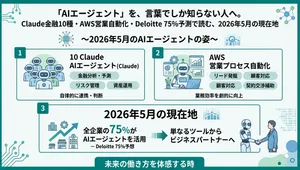
Solo Founder AI Limits: 3 Strategic Blueprints Beyond the Fortune Report
The myth that AI alone makes solo founders team-equivalent is cracking. Fortune's 3 limits dissected into an implementation guide—with one action you can start Monday.
What you'll learn in this article
- The key point to grasp before reading the full article
- How the issue changes practical decisions after reading
- Which follow-up article is worth opening next
“With AI, one person can do the work of an entire team.”
That line has been treated as gospel for the past year. I believed it myself. I told clients: invest in AI before you hire.
Then, on May 18, 2026, Fortune published an article titled “Solo founders are using AI to do the work of entire teams—but going it alone has limits.” Source: Fortune 2026-05-18.
Solo founders—people running businesses entirely on their own—are using AI to handle what entire teams used to do. But doing it alone has limits that can’t be crossed. That was the moment it was put in print.
The tide is turning. I felt it immediately.
This article translates Fortune’s 3 identified limits into implementation logic for solo founders. By the end, you’ll be able to pinpoint exactly which of the 3 pitfalls your current AI setup is falling into.
What you can do after reading
- Explain where the limits of solo founder × AI lie, across 3 axes
- Identify which of the “3 pitfalls” your AI implementation hits
- Choose one “implementation upgrade” to start in 60 minutes this coming Monday
Why “Solo Founder × AI Has Limits” Is Being Said Now
The reason the “AI can do everything” phase has ended is visible if you count the headlines.
In April 2026, Anthropic described Claude Code enterprise adoption as entering a “market phase.” In May, Microsoft Copilot Studio received a major upgrade. In June, Asana acquired StackAI. The same week, SAP published details of its AI agent framework. The corporate world has entered the phase of agent integration—automatically connecting multiple AI tools in a cohesive system.
What about the solo founder side?
A separate Fortune piece from May 3 (Fortune 2026-05-03) reported that Zoom launched a program to hand $150,000 to solopreneurs, framing it around a wave of workers transitioning to owner-operator status thanks to AI. The article hinted at 33 million people making that shift.
LendingTree’s 2026 Side Hustle Survey found that 33% of Americans have a side hustle, earning an average of $1,242/month. By category: e-commerce 46%, freelance 31%, social media/blogging 21%. AI-powered automation is already the baseline. In Japan, 27.5% of companies now allow side work. The solo founder trend is accelerating globally.
Into that moment, Fortune on May 18 wrote: “going it alone has limits.” This isn’t “don’t use AI.” It’s a signal: “question the myth that AI can do everything.”
When corporations are advancing into agent integration while solo founders are still stacking standalone tools, the capability gap actually widens. What Fortune is really asking is: “Are you ready for the next phase?”
My earlier piece “3 Side Hustle Routes Reverse-Engineered from the US 33% × $1,242 Data” covered entry routes. If that was about choosing your entry point, today’s article is about the next move. Once you’ve picked your entry route, it’s time to decide how you’ll push past the limits.
Breaking Down Fortune’s 3 Limits for Solo Founder × AI
Fortune’s article isn’t a simple “AI isn’t all-powerful” takedown. The limits it identifies can be sorted into 3 concrete categories.
Limit 1: Expertise Has a Ceiling
AI-assisted solo founders can cover “broad and shallow” territory. But there are domains that require specialized human judgment—complex tax situations, niche legal questions, industry-specific regulatory compliance. Using AI solo in those areas is where accidents happen.
Fortune profiled Dana Snyder, a solo founder who uses AI agents to automate podcast production and draft keynote speeches. She says: “Without these tools, the business wouldn’t work.” But the article also notes: “Nobody knows yet where the ceiling is for one person keeping up.” Some depth of expertise can only live inside a human brain.
The problem here isn’t “using AI.” The problem is trying to use AI as a “substitute.” Use it as a “draft machine” instead—and you can stop before you hit the ceiling.
Limit 2: Customer Experience Quality and Consistency Breaks Down
AI chatbots can respond 24/7. That’s a powerful advantage. But quality and consistency are a separate problem.
Even with the same tool, each customer has a different history, relationship, and set of expectations. Handing everything to AI produces interactions that feel “mechanical” or “templated.” Customer satisfaction erodes.
The right design isn’t “hand off everything to AI.” It’s “let AI write the draft; you add the final line.” That one handwritten line changes how people respond. I’ve seen this firsthand with consulting clients—when email replies went fully automated, cancellation rates spiked. Bringing back a human final line brought the numbers back down.
Limit 3: Strategic Thinking and Decision-Making Goes Missing
This is the deepest limit.
AI excels at “producing optimized answers to questions it’s given.” But it’s weak at “discovering what should be asked in the first place.” Business strategy, new venture direction, partner selection—these are decisions that start from designing the question itself. AI can’t handle that.
As a solo founder, you fill every role. If you don’t intentionally protect time to think, you end up consumed by processing AI outputs while strategy gets neglected. This is where Fortune lands its conclusion: “Protect as much time for thinking as you spend using AI.”
One visual to bring all 3 limits together:
The “Implementation Upgrade Phase” Is Already Moving Behind the US 33% Side Hustle Data
Let me zoom out from micro to macro for a moment.
Looking inside the US 33% side hustle data from yesterday’s article (June 10), something interesting emerges.
LendingTree’s data shows a measurable increase in the share of people converting side work into a primary income. The leading categories are content creators ($40/hr), affiliate marketers ($37.50/hr), and life coaches ($150/hr)—all domains where AI can directly improve output efficiency. USA Today’s framing of “side hustles shifting to cover living expenses” reflects a growing segment using AI to grow side income to primary-income scale.
This connects directly to the Fortune article. AI raised efficiency → more people moved from side hustle to primary income → competing as a primary income means hitting the limits of solo AI implementation. The next phase is the “Implementation Upgrade.”
My definition of Implementation Upgrade breaks into 3 parts:
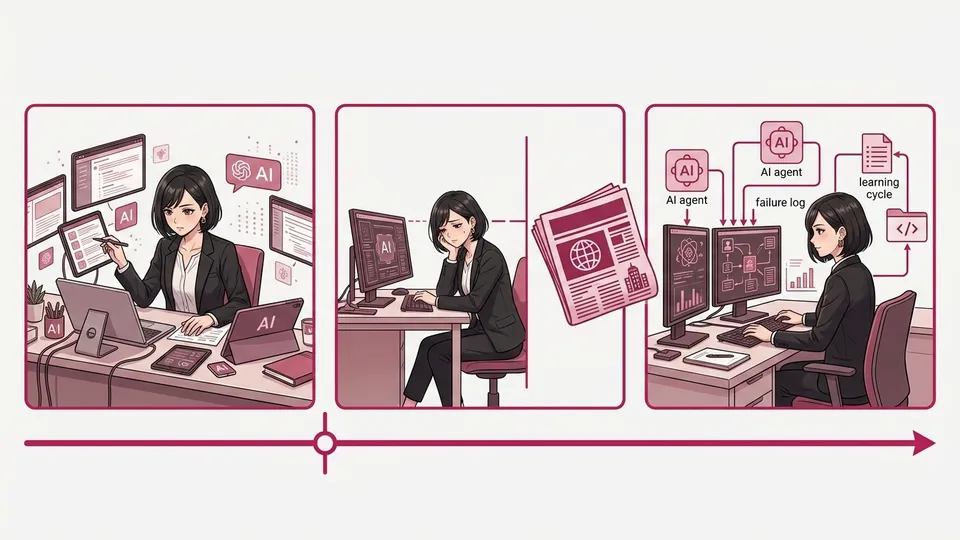
- Move from a stack of standalone AI tools to agent integration
- Redesign the boundary between what you delegate to tools and what you decide yourself
- Build a learning accumulation system—failure logs, success patterns—into your AI implementation
Nagi’s article on managing AI agent organizations described the “phase of actually running agents.” For a solo founder, that translates to building a “solo agent organization.” It’s the corporate playbook, miniaturized for one person.
A comparison to make the upgrade concrete:
Build Your Solo Founder Blueprint in 3 Steps Starting This Week
Let’s turn the Implementation Upgrade into a blueprint anyone can act on this week.
Step 1: Build an “Extension of You,” Not a “Replacement for You”
The first pitfall is treating AI as a substitute. A substitute mindset leads to full-delegation design. An extension mindset assumes the output is a synthesis of AI’s draft and your judgment.
The design difference is concrete:
Substitute design: AI writes and auto-sends all email replies. Extension design: AI drafts the reply; you write the final line, adjust the tone, then send.
The extension design looks like more work. But client response rates change. From my own experience, switching to extension design roughly doubled the response rate I felt in practice.
Step 2: Move from Parallel Single Tools to Agent Integration
Corporations are entering the agent integration phase with Asana × StackAI, Microsoft Copilot Studio, SAP AI agents, and more.
What solo founders can do right now is decide on one—just one—place in their workflow to connect. Trying to integrate everything leads to burnout.
For social media marketing, a natural flow starts with research (Perplexity), then draft creation (Claude), image generation (Midjourney), and scheduling (Buffer). The move: “auto-integrate just research and drafting.” Keep the rest manual. Integrating one step reveals both the upside and the limits simultaneously.
Nagi’s Claude Code getting started article lays out a 3-stage decision framework. Apply that same logic to your business operations.
Step 3: Build a Failure Log System Into Your Implementation
This is the most neglected piece.
Successes stick in memory. Failures dissolve. You repeat the same mistake. To stop that cycle, you need a mechanism to feed failure logs back into your AI setup.
Practically: once a week, spend 15 minutes reviewing your AI usage. Write down the failures—cases where the output wasn’t what you needed. Feed those into Monday’s prompt improvements. Unglamorous, but after 3 months you’re operating at a different level.
Nagi’s article on Claude Code company-wide rollout design focuses on “design before you deploy.” Scale that approach down to a one-person organization.
The 3-step blueprint visualized:
Pick Just One Thing to Do This Week
Hearing the 3-step blueprint and trying to do all of it leads to burnout.
So pick one.
Next Monday morning, block 60 minutes for “AI usage log visualization.” Break it into 3 parts:
- Write out every task you delegated to AI in the past 7 days (20 min)
- Sort them into 3 buckets: “felt successful,” “felt like a failure,” “no change” (20 min)
- For the “failure” bucket, identify which of Limits 1–3 it falls under, then choose one upgrade action (20 min)
Total: 60 minutes. It’s an investment. You come out feeling like you’ve entered the next phase.
This is designed as a follow-up to the “3 Routes Reverse-Engineered from US 33% × $1,242” article. Once you’ve picked your entry route, you move to the Implementation Upgrade phase. When the sequence is clear, the uncertainty drops.
Two common questions before we close.
“Keeping a log feels tedious and I won’t stick with it.” The key to consistency: focus on failure logs, not success reports. Successes stay in memory—they don’t need to be written down. Failures dissolve—that’s exactly why they’re worth capturing. Thirty failure logs in a month becomes the foundation of your next prompt redesign.
“I don’t feel any limits with standalone AI tools yet.” That’s because your business is still in its early stage. At ¥100K/month, limits aren’t visible. Once you push past ¥1M/month, your own brain’s processing speed becomes the bottleneck. That’s the fork: upgrade your implementation or start hiring. Designing ahead of time means you won’t hesitate when you reach that fork.
Conclusion: AI Isn’t Omnipotent—Which Means There’s Still Time to Get the Next Weapon
The moment Fortune wrote “going it alone has limits,” the era of AI omnipotence was over.
This isn’t bad news. It’s also permission to stop trying to do everything. Know the 3 limits, identify your pitfall, choose one upgrade to start on Monday. That’s all it takes to become “a solo founder who designs.”
The question for solo founders is no longer “use AI or not.” It’s “how to use it,” “where to set the limit,” “how to build the next move.” The next blueprint is only available to those who start thinking now.
Stop deliberating. Book the 60 minutes on Monday. I’m working on the same thing. I’ll come back next week with a report on how the 3-step blueprint progressed.
References
- Fortune “Solo founders are using AI to do the work of entire teams—but going it alone has limits” (2026-05-18): https://fortune.com/2026/05/18/solo-founders-ai-automation-entire-teams-entrepreneurs/
- Fortune “Zoom is handing $150K to solopreneurs as AI pushes 33 million workers to become their own boss” (2026-05-03): https://fortune.com/2026/05/03/zoom-giving-away-cash-150k-to-solopreneurs-entrepreneur-trends/
- LendingTree “2026 Side Hustle Survey” (QuestionPro, March 3–6 2026, 2,049 US respondents aged 18–80): https://www.lendingtree.com/debt-consolidation/side-hustlers-survey/
- USA Today / AOL “Americans are relying on side hustles to pay bills. Which pay best?” (2026-05-29 Rachel Barber): https://www.aol.com/articles/americans-relying-side-hustles-pay-161642000.html
- Persol Career (doda) “Side Job Reality Survey [Latest Edition]” (2024-01-29): https://www.persol-career.co.jp/newsroom/news/research/2024/20240129_1315/

女性だからこそ、AIを使いこなさなきゃって思ってる。仕事も、副業も、推し活も、旅行も、全部やりたい。人生一度きりなのに時間は足りないじゃん?だからAIに任せられることは全部任せる。浮いた時間で本当にやりたいことをやる。それがあたしのスタイル。ここにはあたしが実際にやったことをまとめてるだけ。誰かのためになったらいいなって思って書いてるよ。