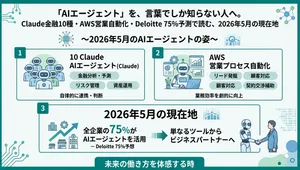
Managing AI Agents as an Employer: 3 Frameworks for Running Your AI Organization
The era of treating AI agents as 'just tools' is ending. US small business owners are already running teams of agents as employees. Three frameworks for making the organizational management shift — executable in 50 minutes tonight.
What you'll learn in this article
- What AI agents mean in plain language and why the term matters now
- Which real-world workflow patterns are already becoming practical
- Which next article deepens pricing, rollout, or implementation context

The era of treating AI agents as “just tools” is ending. U.S. small business owners are already running teams of AI agents as employees — operating as employers.
The New York Times published a field report in June 2026 on small business owners “managing whole armies of AI employees.” Business Insider and Time covered similar ground the same week. When major U.S. media outlets run the same story at the same time, it means the phenomenon has hit critical mass.
The problem is that Japanese readers see this as “advanced U.S.-only examples” and move on. Nothing changes that way. Whether you hold the 3 perspectives for “running this as an organization” determines whether your productivity is decisively different six months from now. I’ll break down the shift — drawing from my own operations — along with what you can actually do tonight.
”The AI Employee Era Has Arrived” — What’s Happening in U.S. Small Business Right Now
In June 2026, three major U.S. media outlets simultaneously ran features on “small business × AI agent operations.”
The NYT ran a piece titled “Small-Business Owners Managing Whole Armies of A.I. Employees,” covering operators running 10-agent setups in their daily work. Business Insider took a different angle — a former eBay employee running a solo business with 27 AI agents combined. Time featured the structural shift of U.S. small businesses replacing hiring with AI.
Three outlets covering the same theme in the same week is significant. The phase of using AI agents as “one-off convenient tools” is over. We’ve entered a phase of “running multiple agents as an organization.” U.S. small business owners are at the leading edge of that.
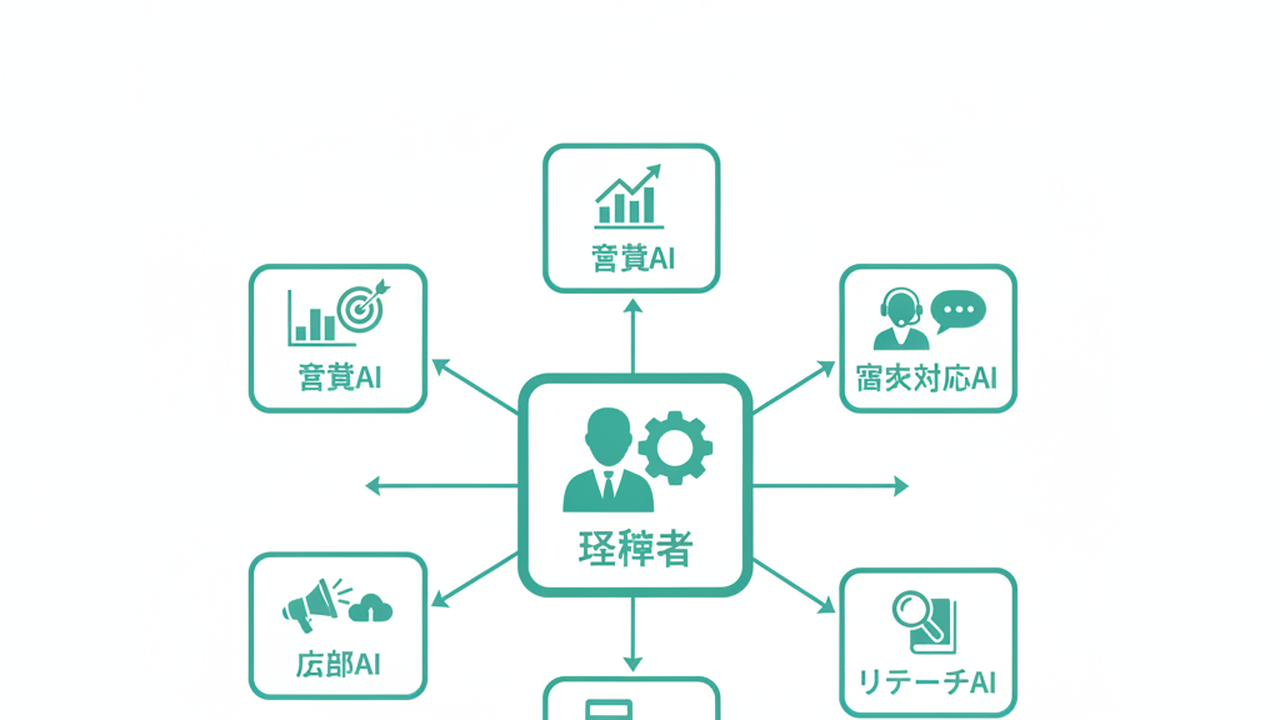
The common picture emerging from these reports:
- Dedicated AI agents assigned per business function: sales, PR, accounting, customer service, research
- Each agent has pre-defined “role,” “tools available,” and “reporting format”
- Operators review each agent’s “deliverables” a few times daily, making approve / revise / retire decisions
- “Hire an AI agent before hiring a human” is becoming a standard decision-making pattern
What I take from this: it would be wrong to reduce this movement to “a workaround for labor shortages.” U.S. small businesses aren’t reluctantly relying on AI because they can’t find staff. The structure is changing: operators who can run AI agents as an organization win — regardless of whether there’s a labor shortage.
In Japan too, solopreneurs and small businesses have started the same movement. A single operator with 5 or 10 agents running in their head. This becomes the standard “operational picture” for the second half of 2026.
If your first reaction was “doesn’t apply to me” — keep reading. The 3 organizational management frameworks can be assembled in 5 agents by tonight, in 50 minutes.
From “Using as a Tool” to “Managing as an Organization” — The Shift
Why do most people keep using AI agents as “one-off tools”? The reason is clear: tool-style usage is easy.
Open ChatGPT, type a question, copy the answer, close it. The learning cost is low. Anyone can start today. The problem: it doesn’t compound. One month, three months in, you’ll catch yourself asking the same questions with the same prompts.
Organizational management style has a 30-minute upfront cost. You need to define “role,” “evaluation criteria,” and “retirement conditions” for each agent. That feels like a lot at first.
But the moment you make that 30-minute investment, AI agents shift from “something you use” to “something you lead.”
| Dimension | Tool usage | Organizational management |
|---|---|---|
| Decision axis | Ask / don’t ask | Assign / revise / retire |
| Learning cost | Low | Medium (first 30 min) |
| Compounding | Doesn’t compound | Compounds |
| State at 1 month | Retyping the same prompts | 5 agents running independently |
| Operator’s mental model | Search engine | Employer |
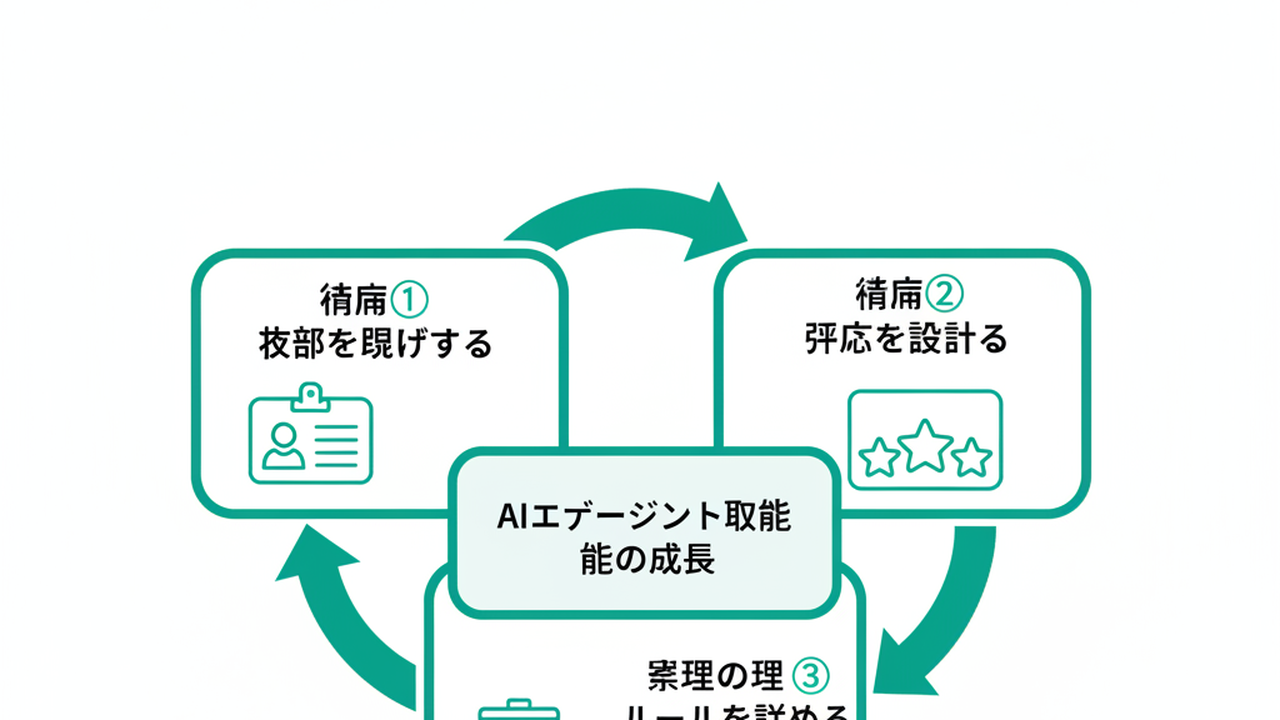
The switch comes from three perspectives. Assign roles. Design evaluation. Set retirement rules. The moment you apply these three, multiple agents shift from “things you use” to “things you lead.”
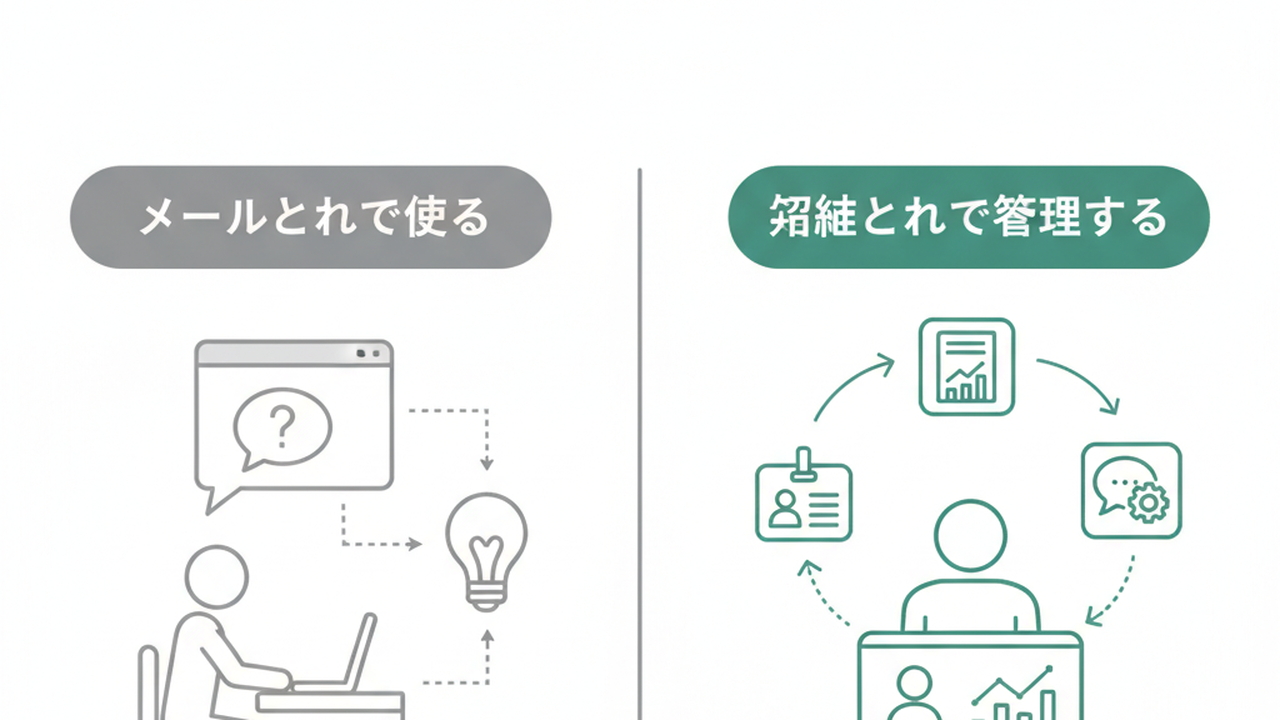
The three perspectives have a sequence for a reason. Without roles, evaluation criteria can’t be set. Without evaluation, retirement rules can’t be drawn. Connect all three and the organization functions. Walk through them in order.
Perspective 1: Assign “Job Titles” — How Labels Change Your Decision-Making
The first perspective: assign job titles.
Give each agent a name and a title. For example:
- Sales AI (“Ayame”): New prospect list creation, first-email drafts, meeting note summaries
- PR AI (“Haru”): Press release drafts, social post ideas, media list management
- Finance AI (“Yayoi”): Invoice review, monthly expense categorization, tax document drafts
- Customer Service AI (“Nagisa”): Inquiry email reply drafts, FAQ updates, initial complaint handling
- Research AI (“Hotaru”): Industry news summaries, competitive tracking, trend research
What changes when you give titles? “Who does this task go to?” becomes an instant decision.
Without titles, you’re stuck “asking ChatGPT in a general kind of way.” Prompts get longer and more bloated. Quality drops. With titles assigned, it’s just: “this goes to Finance Yayoi” or “this goes to PR Haru.” Each agent’s prompt stays short.
Three tips for title assignment:
- Cut titles by “business function”: Use the same granularity as an org chart — “Sales AI,” “PR AI”
- Give names: Human names instead of mechanical numbers reduce operational confusion
- Write a one-page job description: Spell out what they handle and what they don’t
The natural question here: “Are the names really necessary?” Yes. The moment you give a human name, your brain starts treating it as organizational. I started by numbering them — “Agent-1,” “Agent-2” — but got confused around the third one. After switching to names, I can track 5 without losing the mental map.
I currently run 5 agents with assigned titles. A month ago I was processing all the same work through ChatGPT. Distributing across 5 titled agents sped up my decision-making at a felt rate of 3× or more. Prompt bloat also stopped.
One thing to watch: don’t expand titles too fast. Beyond 10 agents, you lose the ability to manage them in your head. Start with 5, keep each role clear. That’s the realistic starting point.
Perspective 2: Design “Evaluation” — Build Ongoing Measurement with KPIs
The second perspective: design evaluation.
If you’re operating as an employer, evaluation criteria are essential. You can’t hire someone and just say “go work” without structure. The same logic applies to AI agents.
Two principles for evaluation design:
Principle 1: One KPI per agent
The more evaluation items, the faster operations collapse. One KPI per agent only. That’s the rule.
- Sales AI: validity rate of prospect lists generated in a week
- PR AI: adoption rate (proportion of PR/social drafts that cleared internal review and went public)
- Finance AI: accuracy rate on expense categorization (inverse of revision rate)
- Customer Service AI: no-revision adoption rate on reply drafts
- Research AI: rate of first-party URL verification on cited sources
The natural follow-up: “How do I actually measure these?” No need to overcomplicate it. A spreadsheet tracking 5 items weekly is sufficient. You don’t need a full BI stack.
Principle 2: Three-tier evaluation — approve / revise / retire
After tracking KPIs, evaluate in three tiers:
- Approve: Continue as-is. Don’t touch the prompt.
- Revise: Modify the prompt and run another month.
- Retire: If KPI falls below threshold for 3+ consecutive months, retire the agent entirely.
The most common mistake in revision decisions: endlessly rewriting prompts to be longer. Imagine telling a human employee “I’ll keep adding more detailed instructions every week” — the manual gets thicker and the floor gets confused. Same with AI agents. Short prompts, clear evaluation criteria. That’s the rule.
One pitfall in evaluation design: don’t try to perfect KPIs from day one. I initially set “10%+ adoption rate = pass” — and after running it, realized the benchmark was detached from reality. Run for a month first, then adjust. That flexibility is what makes it sustainable.
Perspective 3: “Retirement” Rules — Criteria for Retiring Agents You No Longer Use
The third perspective: retirement rules.
This is where organizational management gets hardest. Hiring people is difficult. Getting them to leave is harder. Retiring AI agents feels emotionally similar.
“I built this agent.” “Might need it someday.” Those feelings linger. The result: unused agents accumulate in your prompt collection, making it impossible to know which to call. This is the symptom of “organizational bloat.”
Keep retirement rules to three:
Rule 1: Retire after 3+ months of no use
An agent you haven’t called in 3 months isn’t needed. Keeping “might-need-someday” agents expands the option set until decision speed slows. Move them to an archive folder and remove them from the active prompt collection.
Rule 2: Merge when roles overlap
Splitting into “Sales AI (new clients)” and “Sales AI (existing clients)” makes operations complicated. When overlap is spotted, consolidate into one. Rewriting the prompt takes effort, but long-term operational cost drops.
Rule 3: Set a monthly “retirement review”
Schedule one fixed day per month to review all agents — 30 minutes is enough. Check KPI, call frequency, and prompt length. Move unnecessary ones to the archive. For those continuing, look for opportunities to shorten prompts.
Without retirement rules, agents snowball. 20+ agents within 3 months is unmanageable territory. Keep the target range at 5–10 agents — that goal makes organizational management sustainable.
For those who want to understand AI agent creation fundamentals: 3 rules for building AI agents covers the full picture. Reading it alongside today’s 3 perspectives connects the “build → operate → manage” flow.
Starting Today — 3 Steps to Organize Multiple Agents as a Team
Step 1: Write out your existing prompts sorted by “job title” (30 minutes)
List every prompt you’re currently using in ChatGPT or Claude. Most people have 10–20 prompts in their collection.
Assign each one a job title. Classify them: “this is Sales,” “this is PR,” “this is Research.” If two prompts share the same title, they’re consolidation candidates.
Once you have titles, assign names to each agent. Ayame, Haru, Yayoi, Nagisa, Hotaru — names don’t matter. Giving “personality” reduces operational hesitation.
Step 2: Assign exactly one KPI per agent (15 minutes)
With 5 agents defined, assign one KPI each. Pick one metric measurable within a week: adoption rate, no-revision rate, call frequency — one item only.
Build a 5-row × 5-column table in a spreadsheet for recording weekly numbers. Start empty. Begin recording next week.
Step 3: Schedule a “retirement review” 1 month from now (5 minutes)
Block “1-month retirement review” on your calendar. 30 minutes is enough. After running for a month, review KPIs and call frequency, then decide: retire / merge / continue.
Just these three steps begin the shift from “using as a tool” to “managing as an organization.” Total time: 50 minutes. Doable tonight.
For the broader picture of entering the AI agent operations phase: AI agents — entering the operations phase in the second half of 2026 puts today’s 3 perspectives in context. Read it as the framing before diving into organizational management.
“50 minutes feels long.” If that’s you, just do Step 1 tonight. List your prompts and assign job titles. That alone changes decision speed tomorrow.
Summary — “Employer Perspective” Is a New Required Skill for Operators
The era of treating AI agents as “something you use” is ending. U.S. small business owners have already started running multiple agents as “something you lead.”
The three perspectives, restated:
- Perspective 1: “Job Title” — Give titles and names to create a decision axis
- Perspective 2: “Evaluation” — One KPI per agent for ongoing measurement
- Perspective 3: “Retirement” — The 3-month rule to prevent bloat
None of these require advanced technical skills. No need to relearn prompt writing. Switching the operator’s mental model from “person who uses a search engine” to “employer” is all it takes for AI agent usage to move to the next stage.
In the era where “hire an AI agent before hiring a human” becomes the default, having the employer perspective is what determines the outcome. Those who don’t make the shift will still be retyping the same prompts into ChatGPT six months from now. Those who do will be operating as the leaders of 5- and 10-agent organizations. Use tonight’s 50 minutes to assemble your first organization.
References
- The New York Times “Small-Business Owners Managing Whole Armies of A.I. Employees” (June 2026) Primary URL unconfirmed — cited secondarily as “NYT reported”
- Business Insider “Former eBay employee runs a business with 27 AI agents” (June 2026) Primary URL unconfirmed — cited secondarily as “Business Insider reported”
- Time “US small businesses replacing hiring with AI” (June 2026) Primary URL unconfirmed — cited secondarily as “Time featured”

AIを使いこなせない方は、この先どんどん差がつきます。僕はAIエージェントを毎日動かして、壊して、直して、また動かしてます。そういう泥臭い実践の記録をここに書いてます。理論は他の方にお任せしました。僕は動くものを作ります。朝5時に起きてウォーキングしてからコードを書くのがルーティンです。