Being Last to GEO Is Actually Your Biggest Advantage. 3 Reasons Attorneys, CPAs, and HR Professionals Should Move Now
E-commerce and travel brands have been optimizing for AI search for six months. Law firms, accounting practices, and HR consultants haven't started. That late-mover position is a structural opportunity. Here are the 3 actions to take this week — and 3 mistakes to avoid.
What you'll learn in this article
- What changed in AI search and content discovery
- Which metric or operating rule matters before shipping more content
- Which follow-up article expands the strategy from another angle

A friend who’s an attorney came to me with a question.
“Nagi, AI stuff — that’s not really relevant for a small practice like mine, right?”
He was skeptical. No advertising budget. No staff to spare for content marketing. A firm website that hadn’t been touched in ten years. Yet clients kept calling him “Sensei” and new consultations came in every month without fail. No problem, as far as he was concerned.
I opened ChatGPT right there. Typed in: “How many months do you have to file an estate tax return?”
The answer came back with specific deadlines, required documents, and things to watch out for. The cited sources? A major legal portal I’d never heard of, and a firm in Tokyo. The attorney sitting across from me — twenty years of practice in his hometown — wasn’t cited once.
“Clients are asking AI these questions. And you’re not in the answers.”
The moment he heard that, his expression changed.
”You’re Not in the Answers” — The Reality Most Practices Haven’t Faced
The front door to search is moving from Google to chat.
This isn’t my personal take. I laid out the full GEO/AEO/LLMO landscape in an earlier piece (/en/blog/n2026032800002701/). People are asking ChatGPT, Claude, and Gemini — “What does this term mean?” “How does this process work?” — and that behavior is spreading beyond Gen Z into adults in their 40s and 50s. This is the biggest structural shift of 2025–2026.
The problem is that awareness of this shift varies enormously by profession.
Marketing teams at e-commerce companies have been in a panic for six months. The idea that ranking #1 on Google doesn’t mean getting cited by AI (/en/blog/n2026041100006101/) has become common knowledge in those circles.
But in the world of licensed professionals — attorneys, CPAs (certified public accountants), HR consultants, labor and social security attorneys (SR; Japan’s sharoushi designation), tax accountants — this hasn’t landed yet.
“Our clients don’t use AI.” “New business comes through referrals.” “We don’t need web traffic.” I’ve heard all of these directly.
The problem: “we don’t need it” may simply mean you haven’t noticed that your client pipeline is already eroding through another channel.

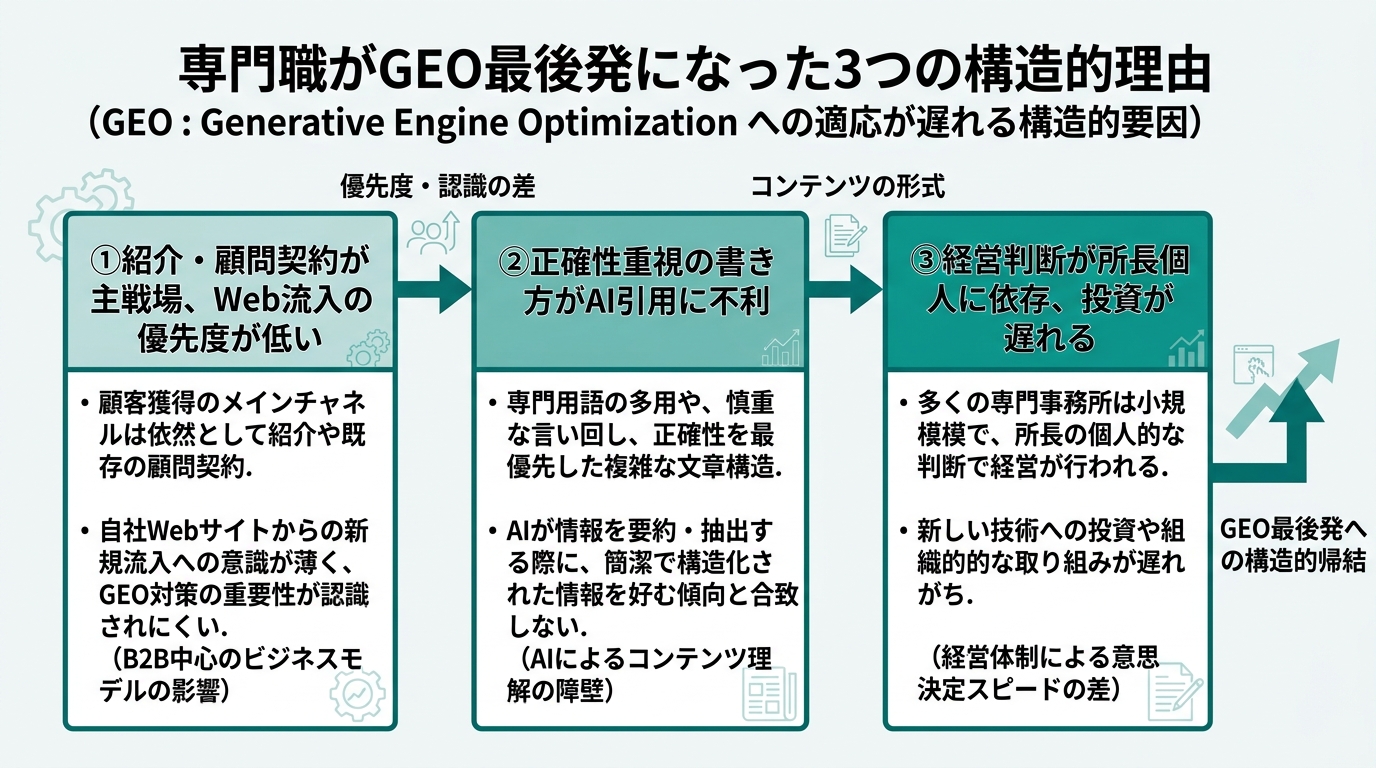
3 Structural Reasons Licensed Professionals Ended Up Last to GEO
Why did licensed professionals fall behind on GEO? Here are the three structural causes.
Reason 1: The Business Model Runs on Referrals and Retainers — Web Traffic Was Never the Point
The professional services business model runs on referrals and ongoing retainer contracts.
Most new legal consultations come through existing clients or personal connections. Accounting firms grow the same way — a referral from one retainer client leads to another. HR consultants and labor attorneys get work through connections between HR directors at different companies.
Web traffic was always “nice to have” but never “must have.” That’s why a ten-year-old website with no updates was never a problem. Business kept coming.
The catch: this only works when someone already knows your name and looks you up to confirm you exist.
When a new prospect thinks “I want a good tax accountant for estate planning” and starts searching, their first move has changed. They’re not Googling “estate tax accountant [city name].” They’re asking ChatGPT: “How do I find a tax accountant who specializes in estate planning?”
Whether your name appears in that answer is what separates you from the referral-only world — and determines whether you capture clients who have no referral to reach you.
Reason 2: The Accuracy-First Writing Style Creates Content AI Can’t Quote
There’s a distinctive pattern in how licensed professionals write.
“This article is for general informational purposes only. For advice specific to your situation, please consult a qualified professional.” Wrapped in disclaimers. “Tax law is revised annually; please confirm current rules with your local tax office.” Followed by the caveat. “In Case A the result is X, but in Case B it may be Y, and in Case C there are exceptions that could change the outcome.” Every possible scenario enumerated.
This is the right posture for accuracy. Given the stakes of giving someone wrong legal or financial information, caution is fully justified.
But from an AI’s perspective, this structure is nearly unquotable.
Here’s why. When AI assembles an answer, it gravitates toward content that states a clear conclusion in response to the user’s question. Content that ends with “it depends on the situation” or “please consult a professional” registers as “no extractable conclusion.” It gets passed over as a citation source.
This is the same point I’ve made throughout the GEO series about what makes content AI-quotable (/en/blog/n2026032600002101/).
Reason 3: Content Investment Decisions Depend on One Person — the Principal
Most professional practices are small operations.
The majority of law firms have one to five attorneys. Most accounting firms are one principal plus a handful of staff. Decisions about investing in web content go through the principal directly.
The older the principal, the lower the priority assigned to “AI is changing search.” If the principal believes “my clients don’t use AI,” the investment doesn’t happen.
E-commerce companies don’t have this problem — if web performance drops, revenue drops and the company dies. That urgency forces investment regardless of the CEO’s age or views. Professional practices don’t face that pressure, so decisions keep getting deferred.
3 Reasons Being Last Is Actually a Massive Opportunity
Reading this far, you might think licensed professionals are permanently losing ground on GEO.
The opposite is true. Being last means substantial first-mover advantage is still available — for any professional practice that moves now.
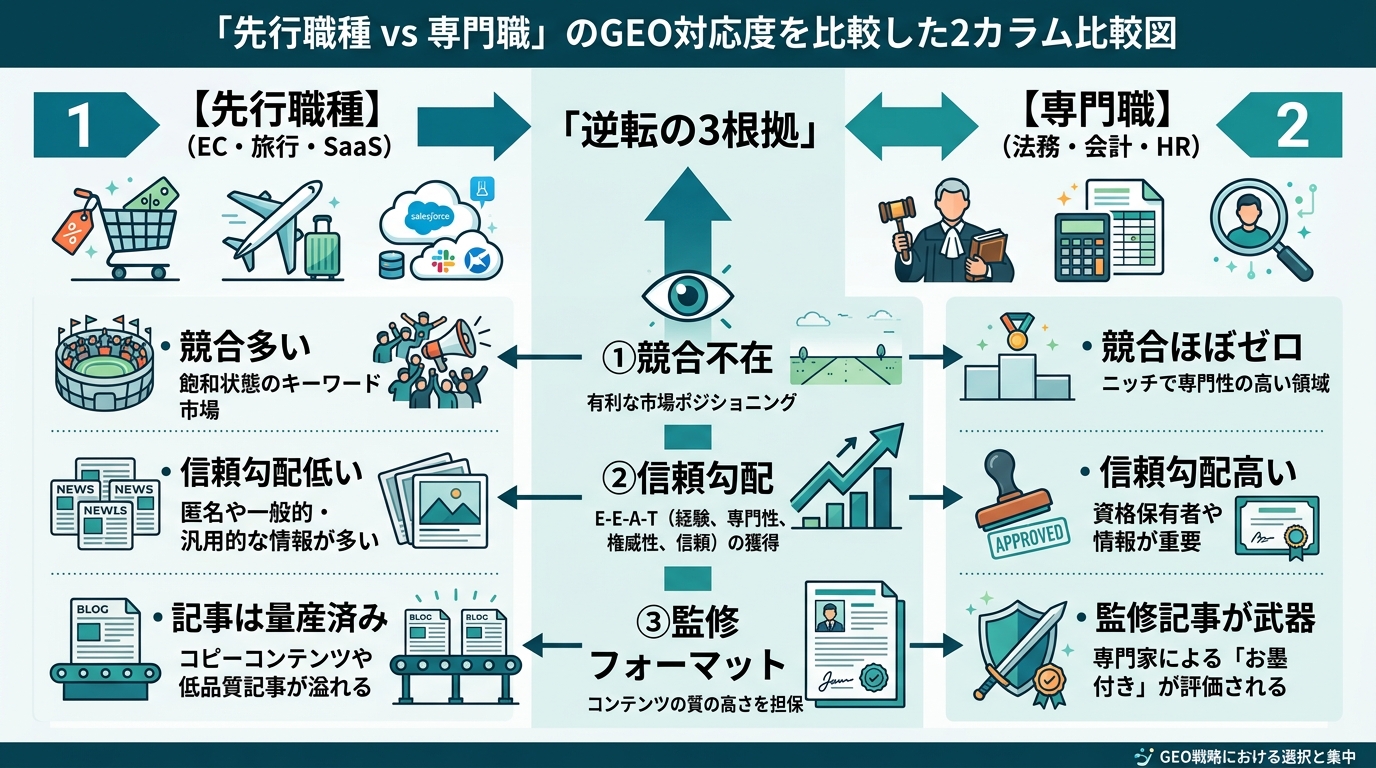
Reason 1: Competitors Haven’t Moved, So Top Positions Are Still Open
In e-commerce and travel, businesses have been grinding at GEO for six to twelve months. Optimized heading structures designed for AI citation, Q&A content produced at scale, structured data markup — competition is fierce.
In licensed professions, almost nobody has done any of this.
Queries like “estate tax filing deadline,” “how divorce mediation works,” and “first steps in a labor dispute” are still wide open. Getting your name into AI-cited position for these queries is still achievable right now. Six months to a year from now, major legal portals and large practices will move in force — and that window closes. The question is whether you secure your position before that happens.
Reason 2: The Trust Gradient Heavily Favors Licensed Professionals
AI evaluates source credibility when assembling answers.
A website run by a licensed professional — an attorney, a CPA, an HR specialist — carries a higher credibility score than an anonymous affiliate blog. For professionals, this is a structural advantage built into their credentials.
Compare that to e-commerce or gadget content, where the playing field is a red ocean of commodity articles anyone can write. Licensed professionals have a rare situation: the credential itself is the trust signal. You’re already on the favorable side of the terrain AI uses to evaluate sources.
Concrete example: imagine three pieces of content on the query “estate tax planning.” ① A personal blog titled “10 Ways to Reduce Estate Taxes.” ② An explainer from a major legal portal. ③ An article on an attorney’s firm site, “Written and reviewed by a licensed tax attorney and CPA.” Ask AI to evaluate all three simultaneously — ③ wins. The reason is straightforward: the author’s credentials and institutional affiliation are explicit, and accountability is clear.
This maps directly onto what Google has called E-E-A-T (Experience, Expertise, Authoritativeness, Trustworthiness) in its Search Quality Rater Guidelines. AI inherited this framework and applies it with even stricter citation standards. The structural advantage professionals hold in Google may actually be wider in the AI era.
There is no reason to leave this advantage unused.
Reason 3: The “Supervised Article” Format Is Built for AI Citation
This is the most important point.
Licensed professionals have a uniquely powerful weapon: the supervisory credit. A single line — “supervised by [Attorney Name]” — transforms the credibility of an article written by a generalist. The trust signal is immediate and unambiguous.
From AI’s perspective, “an article supervised by [professional’s name]” is one of the clearest possible trust signals for citation decisions.
This means you don’t need to flood your own firm site with content. Build a system where you appear as the supervising expert on other publishers’ articles. Every time you do, you create an opportunity for AI to cite “[Professional’s] commentary” in responses. The time-efficiency of this approach is hard to beat.
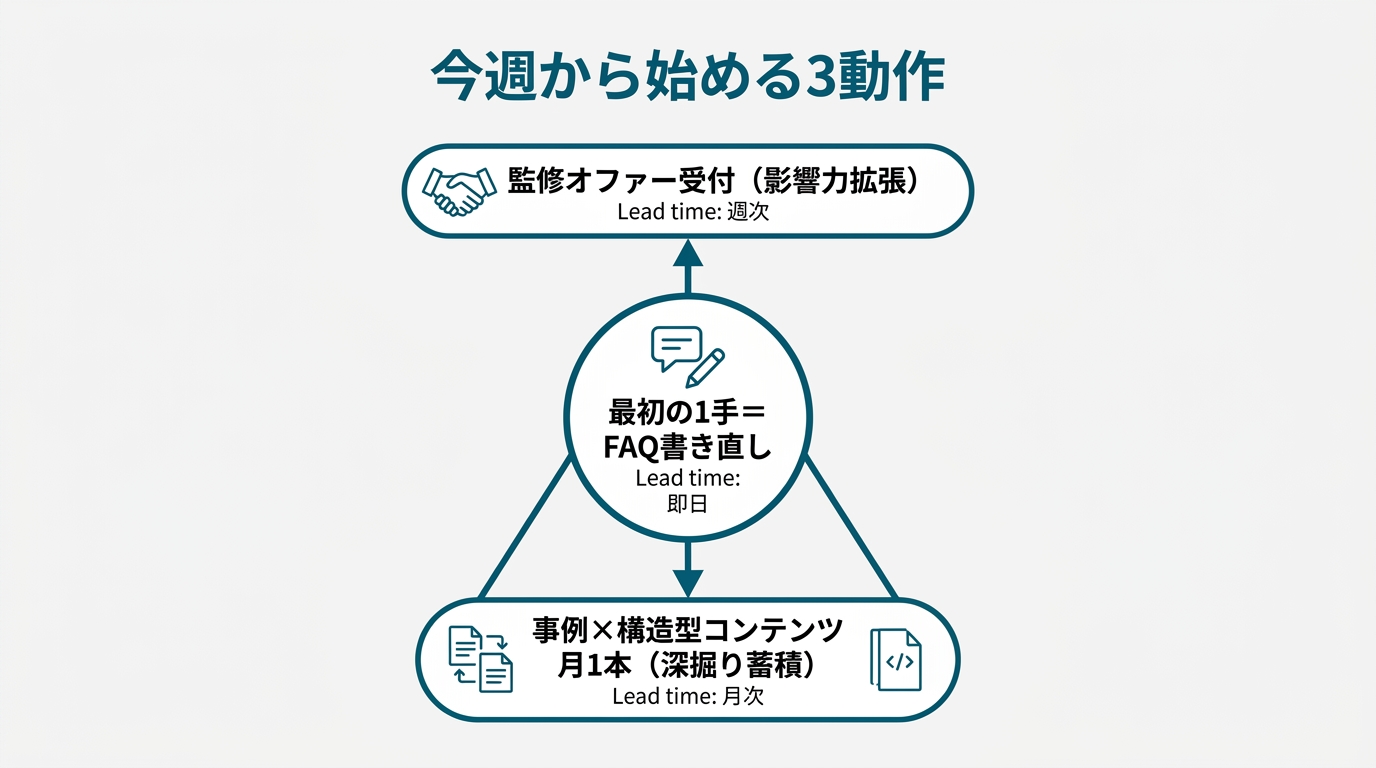
3 Actions to Take This Week
Here are three concrete things any professional practice can start this week.
Action 1: Rewrite Your Existing FAQ Page in AI-Quotable Format
Most professional firm websites already have a “Frequently Asked Questions” page. Rewriting it is the single action most likely to move your AI citation rate.
Three things to change:
Break questions into smaller, specific units. “About Estate Planning” is too broad. “How many months do I have to file an estate tax return?” is what you want — a question that mirrors how users actually phrase their search. AI cites content with headings that match the user’s actual query text.
Put the conclusion in the first two lines. Write “The deadline is within 10 months.” at the top. Reasons, exceptions, and context come after. AI tends to pull from the opening two to three lines. Front-loading the conclusion raises your citation rate.
Don’t hide behind “it depends.” If there are exceptions, state the rule first, then write “However, [X] is an exception.” Ending with “please consult a professional individually” removes you from the citation candidate pool.
Example. Before: “The estate tax filing deadline is within 10 months from the day following the date on which the taxpayer became aware of the commencement of the inheritance; however, this may vary depending on individual circumstances, so please contact us for details.” After: “The estate tax deadline is 10 months. The clock starts the day after you learn of the inheritance. Exception: an extension may be available if heirs live overseas or other special circumstances apply.”
The second version gets cited. The first does not.
This rewrite requires no specialized legal knowledge — just the technique of putting conclusions first. Any staff member can handle it.
Action 2: Build Capacity to Accept 3 Supervising Expert Requests Per Month
Start actively signaling availability for third-party content supervision.
Practically: find publications, web media, and publishers looking for credentialed reviewers. Use professional associations and social channels to make your availability known. Many licensed professionals operating in B2B environments are invisible to publishers looking for supervisors — you have to raise your hand.
Supervision fees are typically modest, ranging from a few thousand to tens of thousands of yen. Revenue is not the goal.
Getting your name attached as a credentialed supervisor on major publications is what establishes AI recognition of you as a domain expert. This is the groundwork that, six months from now, leads AI to cite your own firm site.
Action 3: Write One “Case × Structure” Article Per Month
This one takes more effort, but it has the highest impact.
Write one article per month built around a real case: “In [situation], we chose [approach], and the outcome was [result].”
Why case × structure format? Because AI cites specific cases, not abstract principles. An article titled “Options for Estate Tax Planning” will be passed over. An article titled “Case Study: Three Siblings Inherited the Family Home — How Renouncing a Shared Ownership Stake and Taking Cash Settlement Worked” will be cited.
With appropriate privacy protections, document these cases one per month. In a year you have 12. In three years, 36. At that scale, you become the practice AI returns to repeatedly for that area of expertise.
5-Question Checklist: Where Should Your Practice Start?
Of the three actions, which one should you begin with? The right answer depends on where your practice stands right now.
Use these five questions to locate yourself.
Q1: Does your current site have an FAQ page?
- Yes → Start with Action 1 (FAQ rewrite)
- No → Build one first. Create 10 Q&A pairs in question-and-answer format
Q2: How many new consultations come in per month?
- 10 or more → Run Action 1 and Action 2 in parallel
- Fewer than 5 → Focus on Action 1 and Action 3
Q3: Do you have staff who can write?
- Yes → Push Action 3 (case content) at one article per month
- No → Put time into Action 2 (supervision opportunities)
Q4: When you search your own name, does AI cite your firm website?
- Gets cited → Deepen with Action 3
- Doesn’t get cited → Action 1 + Action 2 first — establish that your practice exists before deepening
Q5: Are you planning to open a branch or satellite office within six months?
- Yes → Prioritize Action 1 and Action 3 (you need to establish citation authority for [region] × [service] before launch)
- No → Weight Action 2 more heavily
Start with whichever action your answers pushed toward first. Take that first step this week.
3 GEO Mistakes Licensed Professionals Must Avoid — and a Summary
Before closing, three things to never do.
Mistake 1: Publishing Articles That Say “Supervised by [Expert]” When No Real Supervision Happened
This is legally and ethically indefensible.
Web agencies sometimes ask professionals to “just lend us your name as supervisor” without expecting any actual review. This happens. If that content contains serious errors, liability lands on the named supervisor. And from AI’s perspective, content where the claimed supervisor’s expertise doesn’t match the content will gradually erode credibility scores over time.
Mistake 2: Flooding Your Firm Site with Unedited AI-Generated Content
Running ChatGPT or Claude output directly onto your professional practice website without human review is the single largest credibility risk you can take.
AI-generated content frequently fails to reflect recent legal amendments. Citation errors appear more often than people expect. And factual errors served from a licensed professional’s site go directly into readers’ decision-making. The stakes are not comparable to a lifestyle blog.
“AI writes the draft. A human does the final check.” This is the non-negotiable rule.
Mistake 3: Writing Competitive Comparisons That Disparage Other Practices
The instinct to write “here’s where [Firm X] falls short” or “[Our firm] outperforms [Competitor]” is understandable.
But the professional services world is small. Your reputation with peers is a direct input into your referral pipeline — one of your most valuable assets. Short-term search traffic gained by putting down a competitor costs long-term trust from colleagues who send you work.
In GEO, stating your own strengths confidently is fine. Pulling others down is not.
Summary: Your One Move This Week
Everything in this article compressed into one action for this week:
This week: Open your existing FAQ page and rewrite the first three questions in “conclusion in the first two lines” format.
That’s it.
Three questions. Ten minutes each. Thirty minutes total. That’s the structural change that makes you quotable by AI. The remaining questions can wait until next week.
“Do everything at once” is how you end up six months later having done nothing. Rewrite even one question, and your practice has already started moving.
A late mover who starts now can reach first-mover-advantage position within six months. That’s the structural strength of being a credentialed professional.
I’m fielding more and more GEO strategy consultations from licensed professionals in my own work. The consistent pattern: the moment they start, things shift. Whether you’ve gotten off the ground is the only fork in the road that matters.
Act first. Understand later. Try it — and you’ll see.
Related Articles:
- GEO, AEO, LLMO — Which Term Should You Actually Use? Why the Terminology Split and a Practical Guide for Tomorrow
- Will Your Content Get Cited by AI? — The Structure of AI-Quotable Content
- How to Win When #1 on Google No Longer Means Getting Cited by AI
- Get Found by AI Before Google Does. The New Route for Specialist Content

AIを使いこなせない方は、この先どんどん差がつきます。僕はAIエージェントを毎日動かして、壊して、直して、また動かしてます。そういう泥臭い実践の記録をここに書いてます。理論は他の方にお任せしました。僕は動くものを作ります。朝5時に起きてウォーキングしてからコードを書くのがルーティンです。