SEO Has Evolved: The Complete 2026 Guide to SEvO (Search Everywhere Optimization)
Let me say it bluntly. Not doing SEO is out of the question, but if you're only doing SEO, you'll be pushed into invisible obscurity by year's end.
What you'll learn in this article
- The key point to grasp before reading the full article
- How the issue changes practical decisions after reading
- Which follow-up article is worth opening next

Let me say it bluntly. Not doing SEO is out of the question, but if you’re only doing SEO, you’ll be pushed into invisible obscurity by year’s end.
This isn’t a threat. It’s the reality the data shows.
The display rate of Google AI Overview reached 25.11% as of March 2026. Google AI Overview is the feature at the top of search result pages where AI directly generates answers. That’s nearly double the 13.14% from March of the previous year (per Position Digital). Web traffic via AI search has grown 9.7x year-over-year (per Superlines).
Yet on the other hand, 47% of brands are still doing absolutely nothing about AI search (per Profound).
Think for a moment about what these two numbers mean. The protagonist of search is shifting to AI, but nearly half of all sites remain unguarded and immobile.
That’s the “reality of search” as of March 2026.
In this series, we built up the AEO Complete Guide on 03-19, the GEO Complete Practical Guide on 03-21, and GEO × Local SEO in practice on 03-22. Today, as the culmination, I’ll organize the entire evolutionary picture — SEO → AEO → GEO → SEvO (pronounced “sevo”) — in a single article. I’ll answer the question: “So what should I actually do?”
SEO → AEO → GEO: What Changed in the Past Year
Before 2024, search strategy was simple. Get ranked high on Google, and people come. That was it.
The situation changed in 2025. ChatGPT started being used in earnest as a “search replacement,” and part of the behavior of “looking it up on Google” shifted to “asking ChatGPT.” The concept born to respond to this was AEO.
AEO (Answer Engine Optimization) is the philosophy of aiming to be selected as a “citation source” when AI directly generates an answer. Whereas traditional SEO targets “making it onto the first page of Google search results,” AEO targets “being used as the information source when AI answers.”
AEO mainly targeted ChatGPT and Perplexity. But the change in search didn’t stop there.
From late 2025 into 2026, the concept of GEO expanded. GEO (Generative Engine Optimization) encompasses AEO while serving as a strategy to elevate presence across generative AI as a whole. Targets include ChatGPT, Gemini, Perplexity, Claude, and Google’s AI Overview.
The GEO market was sized at $848 million as of 2025. It’s projected to reach $33.7 billion by 2034 (per Beacon VC). The compound annual growth rate is 50.5%. It’s expanding at a pace the SEO tools market has never experienced.
But even that was a waypoint.
Entering 2026, an even higher-order concept above GEO has emerged: “Search Everywhere Optimization,” abbreviated as SEvO.
What Is SEvO: A Search Strategy Spanning Google, AI, Social, and Amazon
SEvO (Search Everywhere Optimization) is a visibility strategy that spans Google, AI search, social media, Amazon, voice search, and industry communities. It’s a concept that Semrush systematized and popularized through their content, and that began drawing attention in Japanese-speaking circles in 2026. Note that the term “Search Everywhere” is attributed to Ashley Liddell, who coined it in 2023 (per Semrush’s official articles).
Why did such a concept become necessary? There’s one reason: the platforms where “search” happens have multiplied too much.
As of 2026, 45% of Gen Z searches on TikTok and Instagram and doesn’t use Google (Semrush, 2024–2025 study). More than 50% of product searches start on Amazon (Semrush, same study). Of AI-derived traffic, ChatGPT accounts for 87.4%, growing 1% every month (per Superlines).
In other words, a strategy aimed solely at “getting to #1 on Google” covers less than half of actual search behavior.
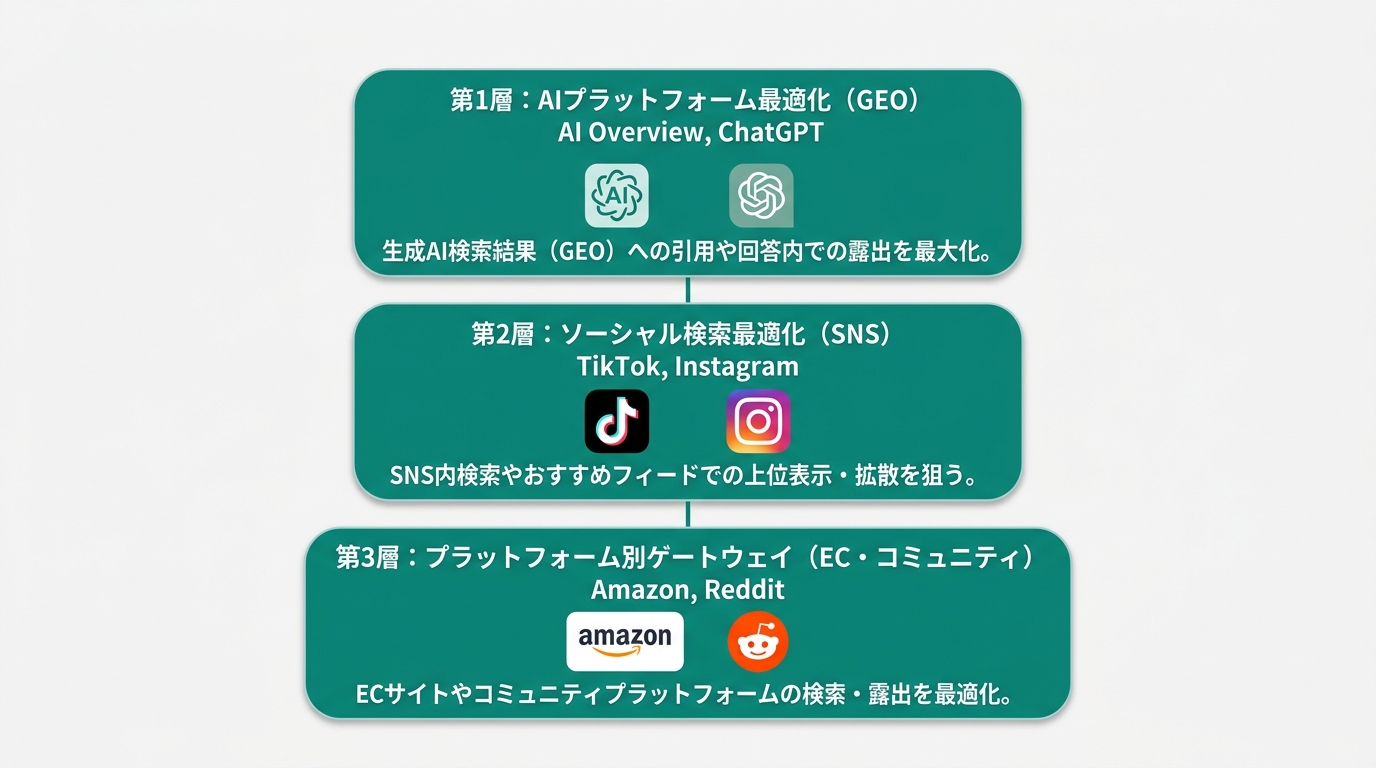
SEvO consists of three layers.
Layer 1: AI Platform Optimization (the GEO Layer)
The goal is to be “cited” by AI Overview, ChatGPT, Perplexity, and Claude. The unit of optimization is not the “page” but the “passage.” There are four basic implementations: (1) place a direct answer in the first 200 characters, (2) clearly state data and primary sources, (3) unify the heading hierarchy, and (4) implement Schema.org. Schema.org is a structured-data notation format that makes it easier for AI and search engines to parse page structure.
The metric called “Share of Synthesis” is also important. This indicates how frequently AI mentions your brand when answering on a specific topic. A simple check can be done for free. Just ask ChatGPT something like “Recommend three tools in the field of XX” and check whether your content appears. Note that this is only a simple self-check; continuous metric management requires dedicated tools.
Layer 2: Social Search Optimization (the Social Layer)
TikTok, Instagram, and Pinterest are now “search engines.” You need to design social posts as “searchable posts.” A practical approach is to be conscious of the hashtag × keyword composition and to naturally incorporate search words into post descriptions.
Specifically, putting keywords like “2026 AI Utilization Practical Examples” into the description of an Instagram post is fundamental. If you chase only stylish aesthetics, you become harder to find in in-platform search.
Layer 3: Platform-Specific Gateways (the E-commerce / Community Layer)
Optimizing Amazon product pages and accumulating mentions in communities like Reddit and Quora leads to higher AI citation rates. There’s a confirmed correlation that the more a brand is mentioned in communities, the more it’s recognized by AI as a source to cite in answers (per Semrush).
SEvO is the design of these three layers as one unified strategy. If you do SEO, social, and GEO separately, 1 plus 1 only adds up to 2. If you design them in an integrated way, the synergistic effect produces 3 or more.
In the Era of 60% Zero-Click, Why Make Content at All?
Here a naive question arises. “If AI search increases, won’t traffic to sites decrease?” That concern is valid.
That concern is correct. When Google AI Overview is displayed, the click rate drops from 15% to 8% (Semrush 2025 study). 60% of all searches end without a click (same study).
You might feel, “Then the meaning of making content fades, doesn’t it?” But look at the numbers from a different angle.
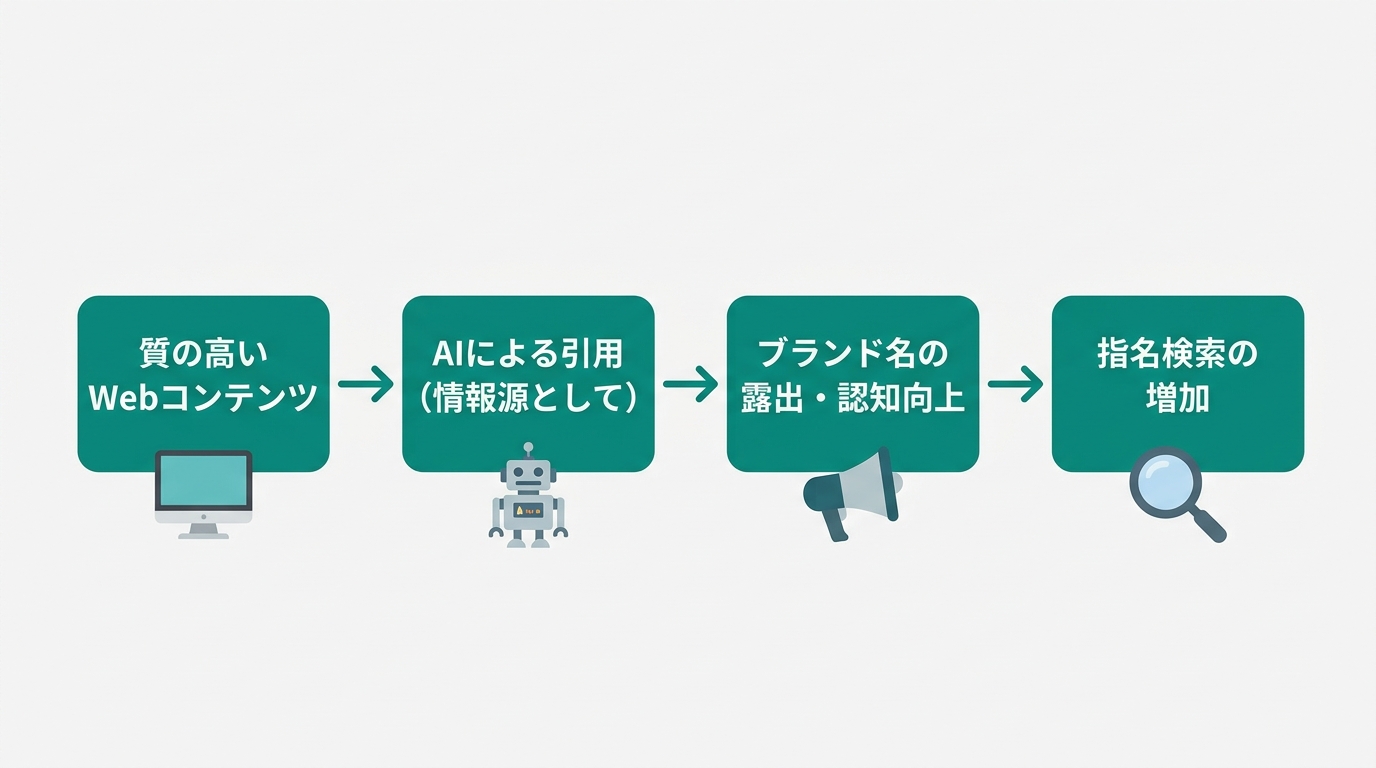
AI search traffic has grown 9.7x year-over-year. AI-derived traffic is increasing by 1% every month (per Superlines). And what AI cites is “content that exists somewhere.” When AI generates an answer, its information sources are articles, data, and primary sources on the web.
If you can become the one “being cited,” even without clicks, an indirect effect arises: “your brand name spreads via AI.” As citations accumulate, brand recognition rises and branded searches increase.
Branded searches (for example, searches that include a brand name like “Nagi AI utilization” or “Nagi’s blog”) aren’t stolen by AI. Even when AI Overview is displayed, people who “want to see this brand directly” still click.
This connects to the essential thinking of SEvO. SEvO’s ultimate goal is not “maintaining all clicks.” It’s “accumulating brand recognition by continuing to be cited by AI, and increasing branded searches.”
There’s also data that tends to be overlooked. With the spread of AI search, the overall volume of searches has increased. Globally it’s up 26% year-over-year, and in the US it’s up 16% (per Superlines). The fact is that it’s not “people stop searching because there’s AI,” it’s “people search more because there’s AI.”
In short, the size of the pie has grown. How much of it gets cited as your content is the next axis of competition.
47% of Brands Are Doing Nothing. Now Is the Only Window to Pull Ahead.
Just knowing this puts you in the top 5%.
As of March 2026, 47% of brands are operating with zero GEO or SEvO strategy (per Profound). Nearly half haven’t gotten on the wave of AI search.
This isn’t a crisis. It’s an opportunity.
SEO is fully mature. Keywords you can target for top placement are packed with competitors, and new entrants need vast amounts of time and resources to break into the first page. However, SEvO — particularly its GEO portion — still has many blank spaces. Japanese-language content has especially low density of countermeasures. In the English-speaking world, GEO-focused articles are gradually increasing, but practical explanations in Japanese are still rare.
According to data Semrush compiled, content that gets easily cited by AI has three characteristics: “direct-answer-style composition,” “clear notation of data and sources,” and “unified heading structure.” These aren’t technically difficult things to do. They’re matters of writing style and structure.
A comparison makes it clear.
Conventional article: “Let me explain the features of AI. There are many kinds of AI, and…”
GEO-optimized article: “AI (artificial intelligence) is software that mimics human judgment to execute tasks. The three representative types are LLMs (large language models), image-generation AI, and voice-recognition AI (per OpenAI).”
The latter writing style is more likely to be recognized by AI as “an information source it can use as-is” when citing. The former works as a read, but is unlikely to be referenced by AI.
The window for those who can act now is probably six months to a year. From here on, once SEvO countermeasures become commonplace, the first-mover advantage will fade. Only those who move now can reach the next stage.
Practical Section: Four Design Changes You Can Make for SEvO Right Now
Here it is organized at the level you can act on starting tomorrow.
Design Change 1: Place a “Direct Answer” in the First 200 Characters
When AI reads an article, the part most likely to be cited is the opening paragraph. Instead of an introduction like “This article will introduce XX,” place the answer directly at the beginning, in the form “XX is YY. The reason is…”
For example, in this article, I place SEvO’s definition at the very start. It goes like, “SEvO is an integrated visibility strategy spanning Google, AI search, social media, and Amazon.” When AI is asked “What is SEvO?”, this paragraph is more likely to be cited.
Readability for readers and AI optimization can coexist. Even if the direct answer comes first, the piece works as a read if “why that is” and “specifically how to do it” follow.
Design Change 2: Include at Least One Number and Source in Each H2
To be chosen by AI as a “trustworthy information source,” the presence of data is a major influence. Just by being explicit with “XX% (per YY)” instead of “It’s said that…,” your citation rate changes.
Some people find writing sources tedious. But to put it accurately, what’s needed is a shift in mindset: “gather primary information from which you can write sources, then write.” Articles based on guesswork won’t be cited by AI. Facts with backing are what get chosen. Just by adopting the habit of researching at least one primary source before writing every time, the quality of your articles will change dramatically.
Design Change 3: Redesign Social Posts as “Searchable Posts”
Are you including keywords in your Instagram descriptions? Are you conscious of search terms in your TikTok post titles? In most cases, social operations and SEO/GEO countermeasures are completely separated.
SEvO integrates these on a single canvas. When you deploy the same content as a “blog version,” “Instagram version,” and “short video version,” design each one with awareness of “search keywords” for its respective medium. This one extra step changes the breadth of visibility.
To do this concretely, next time you post on social media, try putting one or two keywords like “2026 XX Practical” at the beginning of the description. Adaptation to algorithms and reach to readers both rise at the same time.
Design Change 4: Check Share of Synthesis Weekly
Using Profound (a paid tool) lets you measure it automatically, but a simple manual check is free. Just ask ChatGPT and Claude “Tell me three recommended information sources in the field of XX” and check whether your site or brand appears. Precise metric management requires dedicated tools, but for the stage of just getting a feel for it, manual is enough.
Doing this weekly, you’ll start to see which articles increased citations after you wrote them. Once you can check the AI-citation effect of each article, you can build your next writing strategy with precision. Quit it immediately — the groundless optimism of “if I just go by feel, I’ll probably get cited.”
A List of SEvO-Compatible Tools: What You Can Use as of March 2026
Let me answer the question, “I want to do SEvO, but what specific tools should I use?”
Five tools are usable at this point. Choose based on your purpose.
Semrush (from $119.95/month, Japanese-language support available)
An all-in-one tool for SEO, GEO, and SEvO countermeasures. They’ve published the 2026 “Search Everywhere Strategy Guide” for free, which is useful as a checklist for GEO-compatible content. Use it as an entry point when you want to review your existing SEO settings from an SEvO perspective.
Surfer SEO (from $89/month)
Released SEvO-compatible new features in 2026. A score that factors in AI citation rate has been added to its article structure suggestions. Its strength is improvement suggestions specialized for the GEO layer (AI platform optimization).
SearchAtlas (from $99/month)
A tool with SEvO-dedicated optimization features. Its characteristic is combined analysis across the GEO and social layers, letting you check on a single screen how much visibility you have on which platforms.
Superlines (from $49/month)
Functions as an AI search statistics dashboard. It measures traffic via ChatGPT, Gemini, and Perplexity, and is suited for grasping the trend of “AI referral traffic.” The data mentioned earlier — 9.7x and 87.4% — come from Superlines research. It’s a tool that provides reliable primary information.
Profound (monthly fee on request)
A tool that specializes in measuring Share of Synthesis (the percentage frequency at which AI mentions your brand). It specializes in progress management of GEO strategy and is for businesses seriously tackling AI citations. As noted earlier, simple checks can also be done manually, but if you want to manage data continuously, Profound is a strong choice.
In terms of cost-effectiveness, for individual blogs and small sites, I recommend first trying the free tier of Superlines ($49/month) or Semrush’s free trial. Before suddenly assembling paid tools, the priority is building the habit of checking Share of Synthesis manually. Habits come before tools.
Why Individuals and Small Sites Can Get Ahead of Big Players with SEvO
I can hear voices saying, “Isn’t SEvO talk for big corporations?” That’s completely backwards.
Content teams at major enterprises have over-standardized their SEO optimization procedures. Content that prioritizes “being evaluated by algorithms” over “reaching readers” is being mass-produced. To AI, such thin articles aren’t the information sources it wants to cite.
On the other hand, articles written by individuals or small teams more easily contain “firsthand experience,” “unique perspectives,” and “concrete procedures.” This is exactly the kind of information AI wants to cite. Experience-based writing like “I actually tried it” or “when I measured it, it was XX” was hard to get evaluated in SEO, but is easily chosen by AI.
The weapon of individuals in the 2026 content competition is the “firsthand nature of experience.” That can’t be bought with budget.
According to Superlines, AI referral traffic is 1.08% of total traffic. It continues to grow by 1% every month. It looks small, but consider the context behind this number. It’s 1.08% within an AI search traffic that has expanded 9.7x year-over-year. The absolute amount is rapidly increasing.
For example, suppose there’s a blog with 50,000 monthly PVs. If AI referral is 1%, that’s 500 PVs. But this could become 5,000 PVs next year. Because AI search overall is growing. The difference between someone who, right now, stacks up 20–30 articles optimized for AI citation and someone who does nothing will appear as thousands of PVs a year from now.
There’s one thing I want to confirm here. Not all content is suited for AI optimization. “Concrete explanations based on real experience” are suited. But “thin summary articles” and “rehashes of other sites” are also seen through by AI. Stacking up a small number of high-quality articles is more advantageous in the SEvO era than having a large quantity of thin articles assembled just for the numbers.
Related articles in the GEO series:
- The basics of GEO and the three-layer structure are explained here
- A clarification of the terms LLMO, AEO, and GEO is detailed here
- The 7-checklist practical guide for GEO is available here
Conclusion: SEO → AEO → GEO → SEvO, Three Actions to Start Today
Let me organize what we’ve covered.
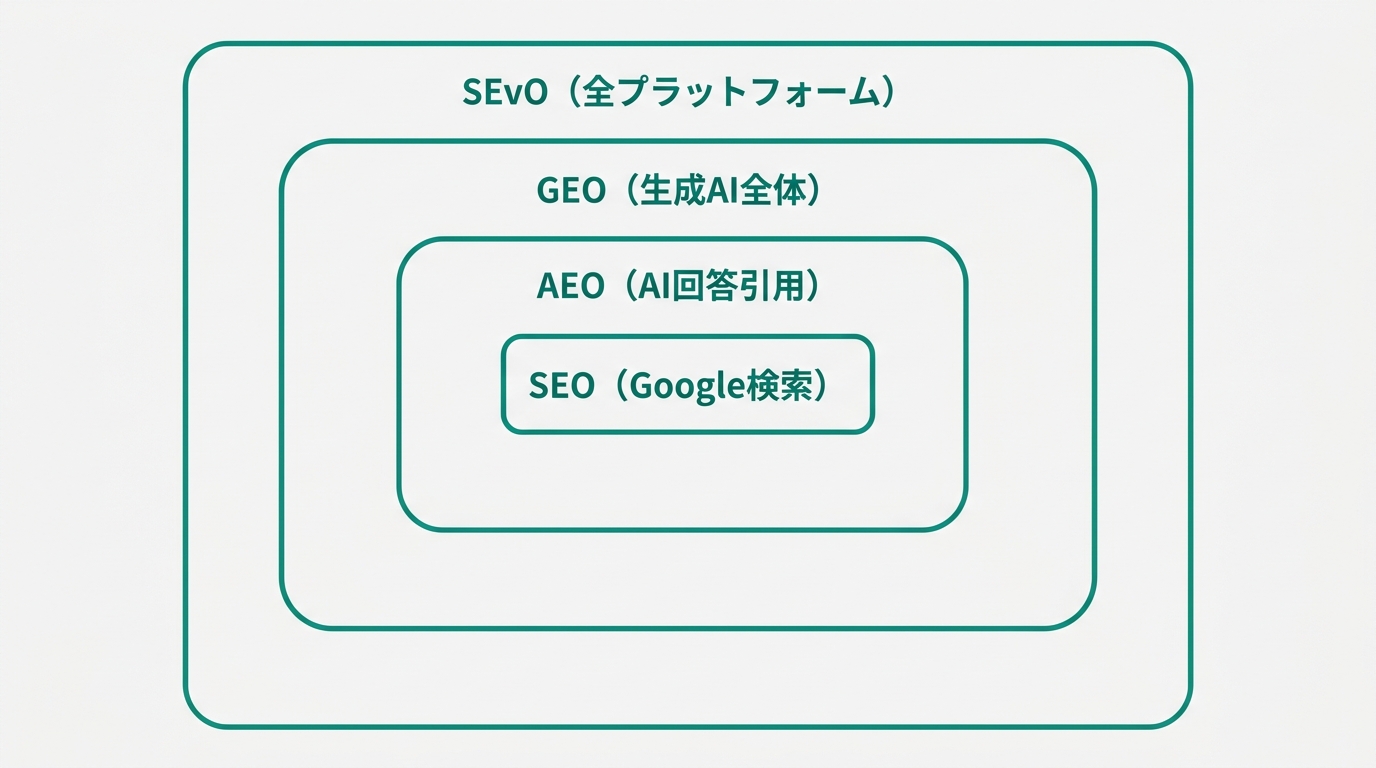
SEO is countermeasures for Google. AEO is countermeasures for AI citation. GEO is visibility countermeasures across AI as a whole. And SEvO is an integrated strategy spanning Google, AI, social, Amazon, voice, and communities.
SEO hasn’t ended. The accurate image is to use SEO as the foundation and stack the GEO and SEvO layers on top of it. The attitude toward content quality cultivated through SEO carries over to SEvO. E-E-A-T (the four axes Google evaluates: experience, expertise, authoritativeness, and trustworthiness) is Google’s quality evaluation standard. Even as the shape of search changes, these axes don’t.
Let me reconfirm the data as of March 2026 one last time.
- Google AI Overview display rate: 25.11% (more than 2x year-over-year, per Position Digital)
- AI search traffic growth rate: 9.7x year-over-year (per Superlines)
- Zero-click rate: 60% of all searches (per Semrush)
- Brands with zero GEO/SEvO countermeasures: 47% (per Profound)
- 2034 GEO market forecast: $33.7 billion (CAGR 50.5%, per Beacon VC)
What this data shows is the fact that, for those who want to change, the wind is at their backs.
Here are three actions to start today.
Action 1: Check whether your brand or content is being cited in AI search. Ask ChatGPT and Claude “Tell me recommended content in the field of XX.” It takes five minutes.
Action 2: Rewrite the first 200 characters of the article you write next into “direct-answer style.” Just one popular existing article is fine. Try it on one first.
Action 3: Look back at your most recent 10 social posts and check whether search keywords are included. If they aren’t, be conscious of it from the next post on.
For those who have read each of the SEO, AEO, and GEO series, if today’s SEvO made you feel that “the whole picture connected,” that was the intent.
To those who have followed this series from the 03-19 AEO piece, there’s something especially I want to convey. The concepts we’ve stacked up — AEO, GEO, GEO × Local, SEvO — you don’t need to memorize separately. They converge on one direction: “Not just Google, but AI, social, and Amazon — optimize for each.”
The names of concepts will keep changing. Something will surely come after SEvO too. But the essence doesn’t change. “Place trustworthy information, in a form easy to cite, where it reaches readers.” That’s it.
Those who don’t act change nothing. But those who try these three for one week will, a month later, surely notice that “something really is different.”
Quit it immediately — the procrastination of “first I’ll assemble the tools.” Actions 1 and 2 can be done right after finishing today’s article. Habits before tools. Let’s do this together.

AIを使いこなせない方は、この先どんどん差がつきます。僕はAIエージェントを毎日動かして、壊して、直して、また動かしてます。そういう泥臭い実践の記録をここに書いてます。理論は他の方にお任せしました。僕は動くものを作ります。朝5時に起きてウォーキングしてからコードを書くのがルーティンです。