After SEO Comes 'AEO'? — The Complete Marketing Guide for the Era of Getting 'Found' by AI
"Are you actually doing SEO properly?"
What you'll learn in this article
- The key point to grasp before reading the full article
- How the issue changes practical decisions after reading
- Which follow-up article is worth opening next

The Hook
“Are you actually doing SEO properly?”
This question might already be outdated. Not that SEO has become unnecessary, mind you. It’s just that the rules of the game are starting to change.
ChatGPT has broken past 400 million weekly active users. TechCrunch reported this based on OpenAI’s February 2025 announcement. Perplexity (an AI-powered search engine) is also growing rapidly. In other words, the number of people who “ask AI” instead of just “googling it” is exploding.
Here’s the problem this raises. When someone asks AI “What’s a good ○○?” — does your business come up?
If it doesn’t, it might as well not exist. It’s structurally the same as not making it to page one of Google search results.
The new rules of this game are called AEO (AI Engine Optimization). In Japanese, you could call it “AI search optimization.”
In my previous article, I wrote that “AI utilization evolves in three stages: ask → delegate → get found.” This time, I’ll show you the entire concrete strategy for the final chapter, “getting found.”
MCP → marketing AI in practice → AEO. As the finale of this trilogy, just trust me and read to the end.
What Is AEO? — Understanding the Difference from SEO in 5 Minutes
First, let’s clarify the term “AEO.”
AEO stands for “AI Engine Optimization.” It refers to optimization techniques for getting your information cited when AI generates answers.
“How is that different from SEO?” you might be wondering. A side-by-side comparison makes it obvious.
| Item | SEO | AEO |
|---|---|---|
| Target | Google search results pages | AI answers (Claude, ChatGPT, Perplexity, etc.) |
| History | 20+ years of accumulated knowledge | Discussed overseas since before 2024. In Japan, attention surged in 2025–2026 |
| Key factors | Keywords and backlinks | Structured data, MCP, FAQ format |
| Measuring effectiveness | Search rankings and click-through rates | Whether your information gets cited in AI responses |
| Relationship | — | Not a replacement for SEO — something you do in parallel |
The crucial part here is the last row. AEO is not something that “replaces” SEO. You do SEO while also working on AEO in parallel. ECzine (a web media outlet specializing in EC) makes the same point. Their article titled “AEO Measures That Can’t Be Discussed as an Extension of SEO” lays this out (source: ECzine, March 2026).
To break it down a bit more, it works like this.
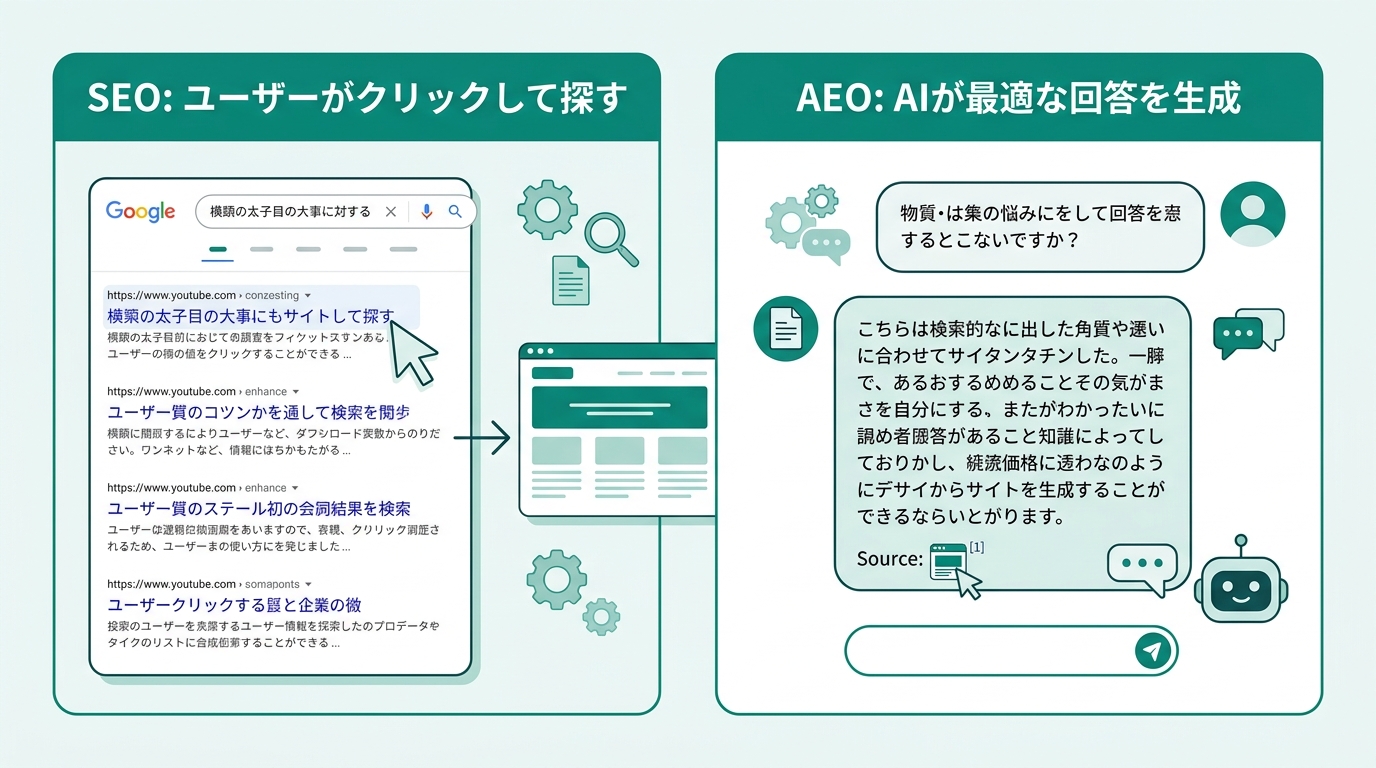
The SEO world: You Google “Shibuya café recommendations.” You click a site that appears on page one of the results. The AEO world: You ask ChatGPT “Recommend a good café in Shibuya.” ChatGPT names a specific store in its response.
In the latter case, what’s the reason “that café was chosen by AI”? The AI is citing information it judges to be highly trustworthy from training data or external sources.
So what does it take to be judged as trustworthy? That’s the heart of AEO strategy.
Why AEO Matters Now — 3 Structural Shifts
Some of you might be thinking, “Isn’t this still a way off?” But there are three reasons you should move on this right now.
1. The number of people using AI is skyrocketing
As I mentioned at the top, ChatGPT alone has surpassed 400 million weekly users. Users of Perplexity and Claude (the AI assistant developed by Anthropic) are also growing steadily. Even in Japan, “ask AI first” is becoming a habit.
It’s true that Google still dominates search market share. But a shift to AI-based search has begun, especially among younger users.
Let’s look at the specific change. People who used to Google ”○○ recommendations” now ask AI, “Give me three recommendations for ○○.” With Google search, you get 10 links lined up. With AI, you get a direct answer: “This is my recommendation.” It’s obvious which is easier for the user.
It’ll be too late once “looking it up with AI” becomes the norm in five years. Only those who act first can carve their name into the AI’s responses.
2. A comprehensive Japanese “AEO Complete Guide” doesn’t yet exist
I actually tried this, and as of March 2026, there’s almost no comprehensive Japanese article explaining “AEO.”
Let’s look at this concretely.
- MarkeZine: secondz digital explains “AEO Concepts and Improvement Approaches” (source: MarkeZine, 2026)
- ECzine: Published “AEO Measures That Can’t Be Discussed as an Extension of SEO”
- Web Tantosha Forum: Lily Ray explains “The Most Important Points of GEO (Generative Engine Optimization)”
From what I’ve confirmed, there are only about 5–6 Japanese articles on AEO/GEO total. And a comprehensive introductory article like a “complete guide” still doesn’t seem to exist.
By the way, GEO is a concept similar to AEO, meaning “optimization for generative AI.” Web Tantosha Forum uses the term “GEO,” but the underlying concerns are the same.
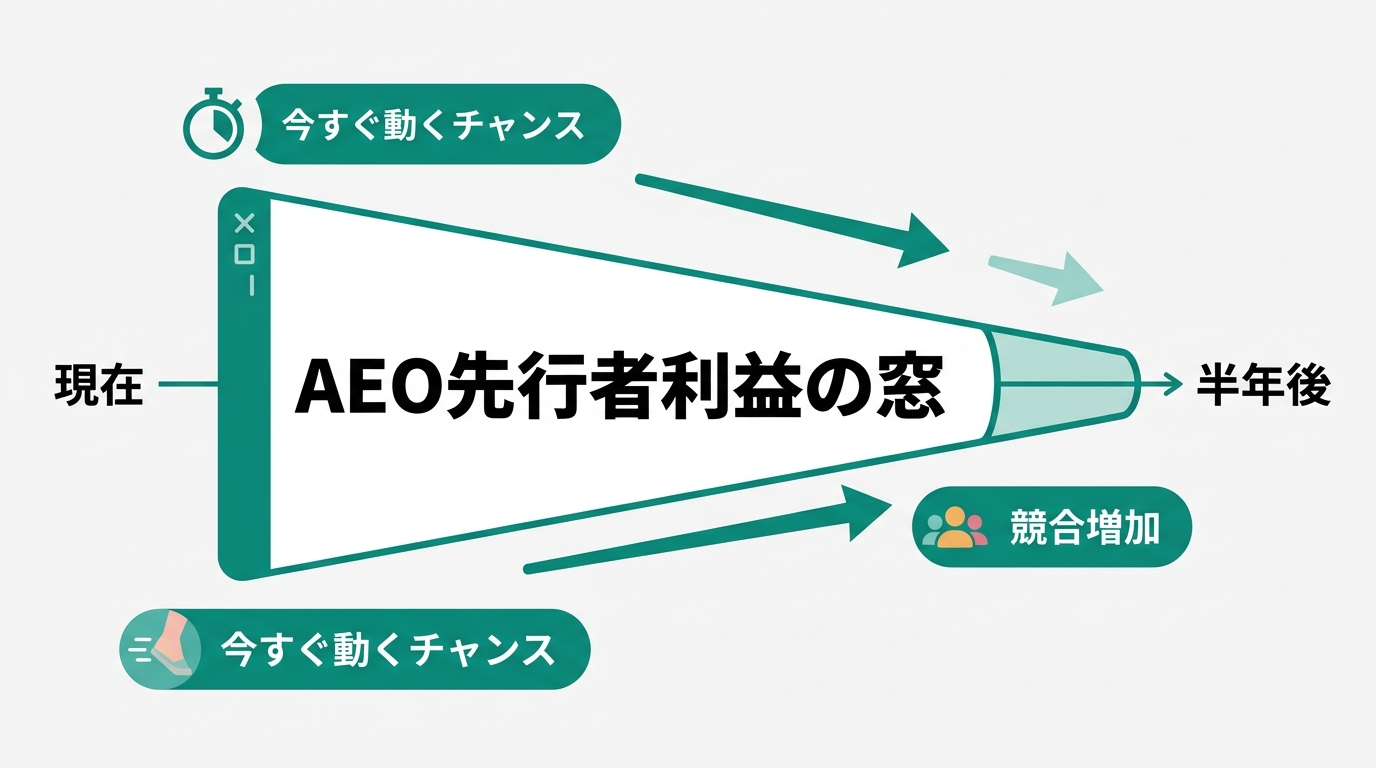
In other words, if you publish a comprehensive article right now, there’s a fairly high chance you can rank at the top in search. My estimate is that the window for first-mover advantage is about another six months. Moving before competitors increase is itself a practical AEO strategy.
3. The spread of MCP could accelerate AEO
In the article before last, I explained MCP (Model Context Protocol). It’s a connection point that lets AI directly access external tools and services. This could be deeply connected to AEO.
When MCP spreads, AI will be able to go fetch information on its own. That means it won’t just be about “whether you’re in the training data” — “whether you can be accessed in real time” could also become important.
For example, freee (a cloud accounting software) has published an MCP server as OSS (a format anyone can use for free). Announced via the company’s official press release, it’s available for anyone to use from GitHub. They’ve voluntarily built a mechanism that lets AI directly access freee’s information.
“Publishing an MCP server = becoming easier for AI to find you.” The causal link hasn’t been empirically proven yet, but I think this hypothesis is sound. The more MCP-compatible services there are, the more AI’s information sources expand — that’s a given.
In the Google Discover era, people said “search traffic isn’t the only thing in SEO.” In the AEO era, people will likely say “Google search isn’t the only entrance.” I see MCP as the key technology for widening that entrance.
AEO Strategies to Start Today — 4 Practical Steps
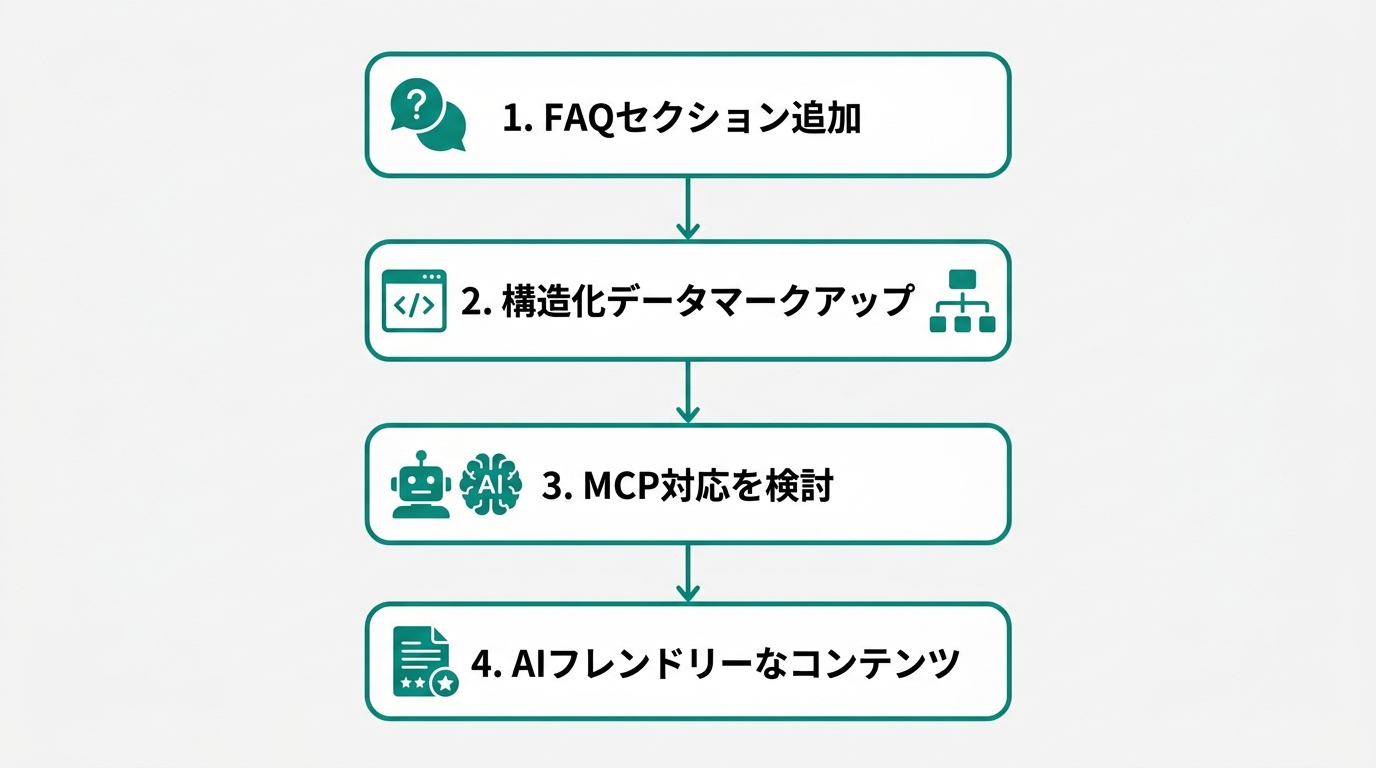
You get the theory. Now, what should you actually do? There are four steps.
Step 1: Add an FAQ section to your blog
This is the easiest, and most likely to produce results.
AI is good at processing information in “question → answer” format. So just placing an FAQ (frequently asked questions with answers) at the end of a blog post significantly increases the chances of being cited by AI.
How to do it concretely:
- List 5–7 questions readers are likely to have about your article’s topic
- Write a 3–5 line answer for each
- Place them as a “Frequently Asked Questions” section at the end of the article
This very article has an FAQ at the end. It serves both the purpose of answering reader questions and making it easier to be cited by AI.
The key is to phrase the questions in language people would actually search with. “What is AEO?” sounds less natural than “What’s the difference between SEO and AEO?”, right? AI also generates answers in such natural contexts, so how you phrase questions changes citation rates.
Here’s another tip. Write FAQ answers conclusion-first. AI tends to cite the first 1–2 sentences when generating answers. So writing in the order “conclusion → supporting detail → concrete example” makes you more likely to be cited.
For those who think “I don’t know what to put in an FAQ,” try this approach. List five points your reader might push back on with “But what about ○○?” Those become your FAQ questions directly.
Here’s one more trick: have AI come up with FAQ ideas. Just ask ChatGPT, “List five questions a reader of this article might have.” It often surfaces reader-perspective questions you wouldn’t have noticed yourself, so give it a try.
Step 2: Implement structured data (Schema.org)
This gets a bit more technical than Step 1. But what you actually do is simple.
Structured data describes a webpage’s content in a format that machines (AI and Google) can easily understand. There’s a common standard called Schema.org.
Imagine writing information like “This page is a recipe. Cooking time is 30 minutes” behind the HTML.
Things even individual bloggers and side-hustle sites can do right away:
- Profile pages: Add “Person” type structured data. Describe name, title, and area of expertise
- Article pages: Use “Article” type to clearly state author name, publication date, and category
- FAQ: Use “FAQPage” type to structure the FAQ from Step 1
If you use WordPress, you can handle this with plugins (extension features for your blog). “Yoast SEO” and “Rank Math” are the leading options, and they can be configured without writing code. You just check boxes on a settings screen, so almost no technical knowledge is required.
For note or Hatena Blog, you have to wait for the platform side to support it. But just improving your profile section can be effective. Write your name, title, area of expertise, and accomplishments concretely. AI reads profile information too and judges “this person is an expert in ○○.”
For note users: 5-item profile checklist
Even if you can’t configure structured data directly on the platform side, you’re fine. Just writing the following 5 items in your profile significantly improves how AI recognizes you.
- Name: Unify under one real name or pen name. Match the notation used on other SNS
- Title: Write it as ”○○-focused △△”. A niche × profession combination works well
- Area of expertise: State “what you write about” in one definitive sentence
- Accomplishments/Career: Include concrete numbers or years (e.g., “5 years of ○○ experience,” ”○○ projects completed”)
- Links: Don’t miss the URLs for official site, SNS, and portfolio
With these 5 items in place, it becomes easier for AI to judge “this person is an expert in ○○.” You’re essentially creating a “profile that both humans and AI can understand” as a substitute for structured data.
A question that comes up here: “Isn’t structured data about Google search?” Right, originally it spread as part of SEO strategy. But AI also reads structured data to organize information. So inserting structured data as an SEO measure also serves as an AEO measure. Two birds, one stone.
Step 3: Ensure consistency in your information
This is surprisingly easy to overlook, but extremely important.
AI generates answers by cross-referencing multiple information sources. Official sites, SNS, press releases, review sites. If these are inconsistent, AI might judge “this information has low reliability.”
For example, cases like these.
- The official site says “Shibuya-ku, Tokyo” but Google My Business says “Minato-ku, Tokyo”
- The Twitter profile says “Web Designer,” but note says “UI Designer”
- A press release says “founded 2020,” but the company overview page says “established 2021”
A human can guess “well, it’s probably the same person.” But AI is sensitive to notation variations.
What to do:
- Decide on one official notation for your name, title, and service name
- Unify your official site, SNS, profiles, and press releases
- Once a year, check that the information on each platform is up to date
It’s tedious work, but just doing this reliably raises your trust score with AI. Unifying NAP information (Name, Address, Phone) is fundamental in SEO’s local strategy too. In the AEO era, this “information consistency” becomes even more important.
You might think, “Oh, just that?” But when you actually try it, lots of people have inconsistencies. Different titles on Twitter and Instagram. Slight variations in name notation between note and a blog. Just unifying these properly gets you one step closer to being “a trusted information source” from AI’s perspective.
Step 4 (Advanced): Publish an MCP server
From here on, this is for intermediate to advanced users. But just knowing about it prepares you for the future, so please read on.
Publishing an MCP server means building a “window” through which AI agents can directly access your service. It’s an application of the concept I explained in the article before last.
For example, there’s a tool called Answer IO. It’s an AEO-compliant tool developed by Feedforce that’s leading the way domestically (source: Feedforce official press release). It’s a service that visualizes and improves how AI agents perceive your brand.
“Have you ever checked how AI thinks of your company?”
A lot of people probably winced at this question. Answer IO is, in essence, an “AI brand health check.” Knowing how AI perceives your business is the starting point of AEO strategy. *Note: Pricing isn’t publicly disclosed as of March 2026, so please check the official site for details.
For individual bloggers and side-hustlers, doing Steps 1–3 is enough. Publishing an MCP server is a measure for companies running their own services. You can consider it primarily for SaaS (software usable via the internet) operators.
But the trend is definitely heading this way. Major players like Slack, GitHub, and Google Drive have already adopted MCP. Japanese companies like freee are starting to move too. It wouldn’t be strange if, a few years from now, we arrive at a world where “services that don’t support MCP become harder for AI to recognize.”
To sum up the four steps:
| Step | Difficulty | Target | Time until results |
|---|---|---|---|
| ① Add FAQ | ★☆☆ | Everyone | 1–3 months |
| ② Structured data | ★★☆ | WordPress users | 1–3 months |
| ③ Unify information | ★☆☆ | Everyone | Immediate–1 month |
| ④ MCP server | ★★★ | Companies/SaaS operators | 3–6 months |
You can’t go wrong working through them in order. You don’t need to do all of them — just doing ① and ③ should make a significant difference.
Actually Asking AI — Before/After of AEO Strategy
You’ve read this far and you’re thinking, “OK, but does it really work?” The fastest way to know is to try it yourself.
Let me share what happened when I tried it. I asked ChatGPT, “Tell me how to do marketing leveraging AI agents.” The response was a general explanation about MCP and agent design. But there was zero mention of my name or blog articles.
Next I threw the same question at Claude. Same result — a general-theory-based response. In other words, just “writing articles” isn’t enough to get found by AI. You can experience this fact for yourself in five minutes.
I want you to try this “5-minute self-check” too. Just three steps.
- Open ChatGPT or Claude
- Throw a question related to your area of expertise (like “What’s a good ○○?”)
- Check if your name or service appears in the answer
If it doesn’t, that’s your AEO starting line. By steadily working through Steps 1–3, this result can change.
To be honest, not many people know about this yet. You can’t completely control AI’s responses. But you can create a “state where it’s easier to be cited.” That’s the essence of AEO strategy.
The article by secondz digital on MarkeZine reaches the same conclusion. That’s “AEO Concepts and Improvement Approaches” (source: MarkeZine, 2026). AI responses are probabilistic generations, but the quality and structure of the input information drives the quality of the response.
For Those Who Think “This Doesn’t Apply to Me” — Why Sole Proprietors and Side-Hustle Bloggers Especially Should Do AEO
“Isn’t AEO just for marketing departments at big companies?”
If you thought that, hold on a moment. Actually, individuals and small businesses are the ones who can benefit most from AEO.
Three reasons.
① In niche fields, AI citation slots are open
Search “Marketing recommended tools” on Google and major media monopolize the top. But AI responses work a little differently. AI tends to prioritize “concrete information that fits the context of the question.”
Think about a specific question like “What marketing tools do freelance web designers use?” For questions like these, highly specialized individual blogs can be cited over major outlet articles. If you become “the most knowledgeable source” in your niche, your chances of being picked by AI go up.
② Initial costs are essentially zero
Step 1 (adding FAQ) can be done for free today. Step 2 (structured data) is also free with WordPress plugins. Step 3 (unifying information) takes effort, but no money.
In the SEO world, “collecting backlinks” costs money and time. In the AEO world, “information quality and structure” is what counts, so it’s a field where individuals can compete.
③ First-mover advantage is still available
As I mentioned earlier, only a handful of people in Japanese are doing AEO strategy. Six months from now, articles like “you’ve gotta do AEO” will surely flood in. If you start preparing now, you’ll already have the advantage when that wave hits.
There’s a view only visible to those who actually act. This is exactly the same structure as the early days of SEO. People who started SEO around 2005 had overwhelming search traffic by 2010. I think there’s a high chance the same will happen with AEO.
One more thing: AEO strategy also lifts the quality of your SEO efforts. Adding FAQs directly answers reader questions, and structured data is valued by Google too. Information consistency is the basics of branding. In other words, moves you make for AEO also improve SEO. If you’re wavering, thinking “I can’t just spend time on AEO alone…”, remember this synergy.
Frequently Asked Questions (FAQ)
Q1: Does doing AEO make SEO unnecessary?
No. SEO and AEO are things you do in parallel. Google search isn’t going away, and AI search users are still a fraction of the total. The ECzine article also explains, “It can’t be discussed as an extension of SEO, but that doesn’t mean you can ignore SEO either.” Do both. That’s the right answer.
Q2: How do I measure AEO effectiveness?
The simplest way is to “ask AI.” Regularly throw questions about your area of expertise to ChatGPT or Claude. Whether your information appears in the response is your benchmark. Tools like Answer IO let you visualize this more systematically. That said, AI responses change probabilistically, so don’t judge from one try — checking once a month as a fixed observation point is recommended.
Q3: Does AEO strategy matter for individual bloggers?
Hugely. In fact, in niche specialty areas, individual bloggers can have the advantage. AI tends to choose its citations based on “where is the most trustworthy information source in this field.” Continuously writing high-quality, systematic articles in a specific area is the strongest AEO strategy.
Q4: How do you actually publish an MCP server?
Technically, you implement it as a protocol based on JSON-RPC (the communication method between AI and server). At an individual level, I recommend starting by referencing open-source MCP servers on GitHub. The MCP article from two posts ago covers the basic concepts, so start by reading that. Doing Steps 1–3 first, and tackling this only when you feel the need, is fine for the order.
Q5: What’s the difference between GEO and AEO?
They’re concepts born from nearly the same set of concerns. GEO (Generative Engine Optimization) emphasizes “optimization for generative AI.” AEO (AI Engine Optimization) emphasizes “optimization for AI search engines.” Web Tantosha Forum uses the term GEO, while MarkeZine and ECzine use AEO. This article standardizes on AEO, but if you find a GEO article, you can treat it as the same topic.
Summary — Three Things to Do Today to Stand on the “Getting Found” Side
To everyone who’s read this far, I want to leave you with three concrete actions.
① Do today: Ask AI about yourself
Open ChatGPT or Claude and throw it a question related to your business. “What’s a good ○○?” “How do I choose a ○○?” Whether your name or service comes up — first, just know your current state. That’s step one.
② Do this week: Add one FAQ section to your blog
An existing article is fine. On an article that gets lots of traffic or covers your area of strength, add 5–7 Q&As to the end. Just that starts raising your chances of being cited by AI.
③ Do this month: Unify your profile information across all platforms
Official site, SNS, note, blog. Match the notation of name, title, service name, and address across all of them. It’s a tedious but effective action that boosts your reliability from AI’s perspective.
If you have some bandwidth, I also recommend clearly stating “area of expertise” in your profile. “Web designer specializing in EC sites” makes context easier for AI to understand than just “Web designer.” The more you niche down, the more often AI will name you in its answers.
By the way, Mikoto’s new article “Side Hustle Techniques for Carving Out Corporate Skills” also touches on AI utilization. Concrete examples of using AI to take inventory of side-hustle skills should be helpful. If you’re thinking “before AEO, I want to organize my strengths first,” check that one too.
MCP → marketing AI in practice → AEO. What I wanted to convey through the trilogy is that AI utilization has stages.
“Ask AI” → “Delegate to AI” → “Get found by AI.”
AEO is the final piece of these three stages. SEO has a 20-year history; AEO has only had a few months. That means it’s not too late to start now — actually, you’re extremely early.
In the first piece, I shared the concept of “using AI as a team.” In the second, I dug into “the mechanism by which AI directly uses tools (MCP).” And in this third piece, I aimed to hand you “a strategy for getting AI to find you (AEO).”
Combining these three lets you not just “use” AI, but “make it your ally.” For marketers, this becomes a weapon.
Next time, leveraging the knowledge from this trilogy, I plan to write about “dividend stock screening × Claude Code.” I want to show concrete examples of using AI not just at work, but in personal life too.
Just trust me and try it. Start by asking AI, “Do you know about me?” If the answer is “no” — then today is the day to start AEO strategy.

AIを使いこなせない方は、この先どんどん差がつきます。僕はAIエージェントを毎日動かして、壊して、直して、また動かしてます。そういう泥臭い実践の記録をここに書いてます。理論は他の方にお任せしました。僕は動くものを作ります。朝5時に起きてウォーキングしてからコードを書くのがルーティンです。