The Average AI Unicorn Founder Is Now 29 — 3 Numbers That Should Change Your Timeline
Antler's analysis of 1,629 unicorns shows AI startup founders averaged 29 in 2024, down from 40 in 2020. Fortune called it '25 is the new 30.' Here's what the data from Fortune, Crunchbase, and Antler actually means if you're still waiting in your late 20s.
What you'll learn in this article
- The key point to grasp before reading the full article
- How the issue changes practical decisions after reading
- Which follow-up article is worth opening next

You’ve been saying “I want to start something someday” for three years now, haven’t you?
I see it in people around me all the time — late 20s, telling themselves “I need more experience first,” “a few more years.” I get it. That was me, three years ago.
But the data has started saying something else: “You don’t have a reason to wait anymore.”
In January 2026, Antler — a global venture capital firm — published a report called “The Anatomy of Greatness,” analyzing 1,629 unicorns (startups valued over $1 billion) and 3,512 founders.
The number that stopped me: the average age of AI unicorn founders dropped from 40 in 2020 to 29 in 2024. Fortune framed it as “25 is the new 30.”
The 30-year-old benchmark is gone.
By the end of this article, you’ll be able to do three things:
- Erase the “late 20s is too young to start” assumption using three concrete data points
- Measure your distance from real examples — founders who hit $1B+ valuations at 22 and 25
- Design your next week around three actions: industry × AI × co-founder
Why AI Unicorn Founders Got 11 Years Younger in 4 Years
Start with the first number.
According to Antler’s report, the average age of AI unicorn founders dropped from 40 in 2020 to 29 in 2024. Eleven years in four. A shift this fast in founder profiles is unusual even by startup history standards.
And it’s specific to AI. Across all unicorn categories, average founder age actually trended upward — reaching 33 by 2024. The established wisdom that “experienced founders attract investment” reversed in AI alone.
Three reasons AI is different:
1. AI tools have started substituting for experience. What made “experienced founders” valuable in startups — market intuition, talent networks, fundraising relationships — can increasingly be approximated with AI. Customer research, MVP prototyping, early-stage marketing: all of this now runs at a level that lets 20-somethings produce output that looks like they’ve been around.
2. The native-AI generation has structural advantages. Gen Z — born 1995 and later — was experimenting with AI personally before ChatGPT even existed. They don’t “integrate AI into workflows.” They build from scratch assuming AI is already there. This isn’t an age advantage; it’s an environmental one.
3. Investors have updated their thesis. Antler co-founder and Chief Business Officer Fridtjof Berge told Fortune: “25 is the new 30.” The investment side has decided that in AI, younger founders tend to outperform. CNBC’s January 17, 2026 coverage backed this up: multiple top VCs have made the same shift.
The honest framing: this isn’t an age problem, it’s an environment problem. The tools needed to build ambitious companies are in young founders’ hands now. Citing “not enough experience” as a reason to wait is no longer structurally sound in AI.

AI Companies Hit Unicorn Status 2 Years Faster Than Everyone Else
Second number.
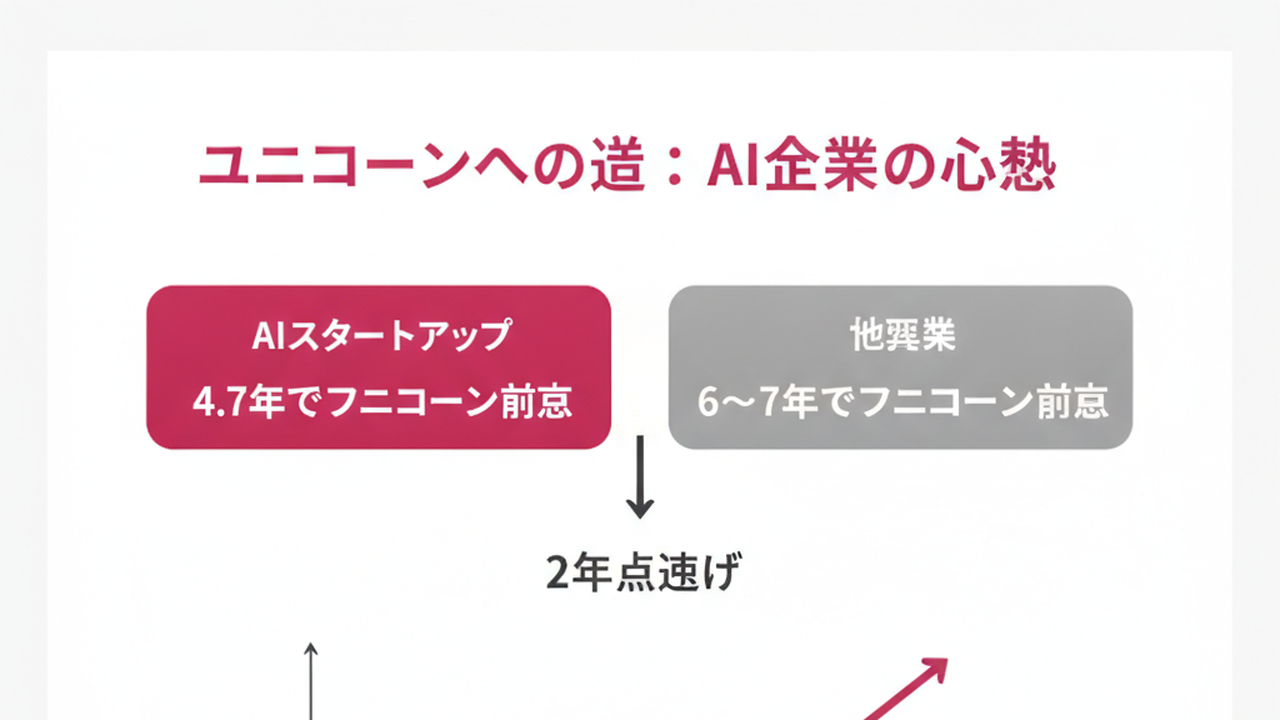
Antler’s report: AI startups reach unicorn status in an average of 4.7 years. Other industries average 6–7 years. More than two years faster.
What that means in practice:
If you’re 29 today and start an AI company, Antler’s 4.7-year average puts the “$1 billion valuation” milestone at roughly 34. With a non-AI average, you’d be looking at 36–38. Two years might seem small, but in life planning it matters a lot.
“Start in your late 20s, build through your 30s” has become a realistic timeline in AI. That wasn’t true a decade ago.
The “4.7 years” number is derived from the full 1,629-unicorn, 3,512-founder dataset Antler analyzed, tracking each company’s founding-to-unicorn timeline — not a cherry-picked success subset.
The pace of unicorn creation itself has also transformed. From 2003–2013, the world averaged 4 new unicorns per year. From 2014–2024: 148 per year. Forty times more.
This doesn’t mean unicorns are less valuable. In my read, it means the market expanded enough that opportunity flows to more people, including younger founders. Ten years ago, investors were betting on a handful of “next unicorn” candidates. Now they’re finding 148 a year.
Crunchbase data sharpens this further. In May 2026 alone, 29 new unicorns were created. As of the Crunchbase Unicorn Board updated June 14, 2026, the global total stands at 1,794. About 25% of new unicorns created in 2025 — 47 companies — were AI-native. One in four. That ratio is holding into 2026.
Note: Antler and Crunchbase are separate organizations running separate analyses. Antler covers 2014–2024 longitudinal data; Crunchbase covers recent monthly and annual figures. Both are pointing the same direction.
What Three 22-Year-Olds Building a $10B Company Tells You
Statistics without examples don’t land. Here’s a concrete case.
Mercor is an expert network for the AI economy. Three founders: Brendan Foody, Adarsh Hiremath, Surya Midha. All 22. When their valuation crossed $10 billion, none of them had held a corporate job.
That still hits me every time. Three people who had never worked a single corporate day built something valued at the equivalent of trillions of yen.
What Mercor does: efficiently connects specialists — doctors, lawyers, engineers — to companies, AI labs, and research institutions that need them. As their Series C framed it: an expert network purpose-built for the AI economy.
The insight: “Even AI needs human experts behind the scenes.” An older founder might have pitched “the future of AI.” These three noticed what the AI-building world was missing and shipped it immediately.
More examples:
Cognition was founded in 2023. CEO Scott Wu unveiled Devin — billed as “the world’s first AI software engineer” — in March 2024. The company reached unicorn status within a year of founding. As of May 2026, the valuation stands at $26 billion.
Suno builds generative AI music. CEO Mikey Shulman’s team created a system that produces complete songs — lyrics, vocals, and instrumentation — from a text prompt. Reached a $2.45 billion valuation as of November 2025, cited in the Antler report as a representative AI-native unicorn.
What these three companies share: they used not knowing how industries work as an asset. Someone from the staffing industry would have defaulted to human-matched processes. Someone from the music industry would have worried about artist rights first. Ignorance freed them to build something new.
For you in your late 20s, that’s actually encouraging. “Lack of experience” in AI translates directly to “absence of prior assumptions” — which is a real asset.
One important caveat: none of these stories are actually “zero experience.” Mercor’s founders were deep in AI research during college. Scott Wu was world-ranked in competitive programming. Suno’s team had spent years on open-source AI music research.
The profile isn’t “young and zero experience.” It’s “young and deeply specialized in AI.” Don’t misread this part.

3 Reasons the Old “Work First, Start Later” Path Is Breaking Down in AI
Taking all of the above, here’s how the old playbook looks now.
The old playbook:
- After college, join a major company or strong startup
- Spend 3–5 years building management experience, industry knowledge, and connections
- Get an MBA or start a side project in your early 30s
- Go independent at 32–35
It was logical. More experience meant lower failure rates. Investors valued it.
In AI, three things are breaking that logic.
Reason 1: Knowledge expires faster. In 2026, the cutting edge in AI shifts every 3–6 months. What you learned about “how to use LLMs” in 2023 may be a baseline assumption that’s been superseded by 2026. “Build 3 years of experience” often means “internalize 3-year-old assumptions” in AI.
Reason 2: Tools have been democratized. Fundraising, MVP development, early-stage marketing — all dramatically shortened by AI. What used to require company budget and headcount can now run on a few hundred dollars a month in subscriptions. The need to “get experience inside a company” has thinned out.
Reason 3: Investor preferences have shifted. As Fortune and CNBC both reported, multiple top VCs have concluded that younger founders outperform in AI. Appetite for funding founders in their early-to-mid 20s has visibly increased over the past two years.
So how should someone in their late 20s move?
Option A: Compress the old playbook. Don’t reject “work → experience → start” — compress the steps. Get assigned to an AI-related project at your current company, build an AI prototype on the side, and have independence in view by 2027.
Option B: Enter via co-founding. Don’t carry everything alone. Pair “you with your industry knowledge” with “a same-generation person with strong AI implementation.” The Mercor three-founder structure. The Stanford AI Index 2026 gives good grounding on the investment environment — useful context before conversations with potential co-founders.
Option C: Make AI agents your first employees. Start as a solo operator, built from the start with AI handling 50% of operations. How to Build AI Agents maps out three practical routes that work as first moves for a solo founder.
Which of the three fits your situation. What they all share: drop the premise that “I need three more years at this company before I can move.”
Get this wrong and three years of your life get used in a way that’s hard to recover from.

3 Actions for Late-20s You This Week
Translate everything above into movement. Three things for this week.
Action 1: Write down 3 unsolved problems in your industry × AI (60 minutes)
In whatever industry you’re in — sales, marketing, accounting, HR, education, healthcare, retail, logistics — write down 3 tasks that haven’t been automated with AI yet. The same kind of noticing Mercor’s founders did: “what’s the bottleneck behind the AI?”
One tip on how to write them: not “improve sales efficiency” — more like “the task of drafting a proposal from meeting notes.” Get to the level of a single concrete action.
Once you have three, pick the one where you have the deepest knowledge. That’s your starting point.
Action 2: Build an AI prototype in 6 hours (1 day)
Take that one task and use Claude, ChatGPT, or another generative AI to build a prototype that semi-automates it. 60% completion is fine. It just needs to run.
If “I can’t code” comes to mind: as of 2026, generative AI can help you build automation logic without writing code. Write what you want in plain language and you’ll have a working prototype.
If it doesn’t work in 6 hours, that task isn’t the right AI startup angle. Move to the next candidate without sentiment.
Action 3: Have a 60-minute conversation with a potential co-founder peer (60 minutes)
If AI implementation is your weak spot, find someone the same age with strong implementation skills. If your industry knowledge is thin, find someone with deep domain expertise.
Where to look: LinkedIn search for “AI engineer” or “Product Manager” filtered to the 25–30 age range. Follow same-generation people actively posting in AI-related spaces. Join spaces on X with “AI startup” or “generative AI” hashtags.
One thing to confirm in the 60 minutes: “Could I move with this person as a co-founder next year?” No need for an immediate answer. Talk to 3–5 people and find the best fit.
These three actions complete within a week. The shift from “do this someday” to “do this week” is the only change being asked for.
Honestly, the era of “accumulate 3 years before moving” is over. Whoever moves first, wins.
The Conclusion: A World of 29-Year-Old AI Unicorn Founders — What’s Your Reason to Wait?
Three numbers:
- Average AI unicorn founder age: 40 (2020) → 29 (2024). Source: Antler “The Anatomy of Greatness” report, Fortune January 7, 2026 coverage
- Average time for AI companies to reach unicorn status: 4.7 years (vs. 6–7 year industry average). Source: same Antler report
- Roughly 25% (47 companies) of 2025’s new unicorns were AI-native (source: Crunchbase Venture research); 1,794 total global unicorns as of June 14, 2026 (Crunchbase Unicorn Board)
All three are data points pushing someone in their late 20s to move.
Three things not to misread:
Misread 1: “Being young means succeeding.” Mercor, Cognition, and Suno’s founders were young and deeply specialized in AI. Youth helps only when paired with real depth in the AI space.
Misread 2: “You should aim to be a unicorn.” What I’m saying is that the reasons not to start in your late 20s are disappearing at the data level. A solo operation generating sustainable income is completely viable and doesn’t require unicorn ambitions.
Misread 3: “I’m saying not to get a job.” Option A — compressing the playbook — is completely valid. Running a company job and startup prep in parallel is sound risk management.
I spent three years hesitating before going independent. Telling myself “just a bit more experience first.”
What I learned after: experience is something you build while running. What I got in three months of doing outweighed three years of waiting.
If you’re 29 now, you’re the same age as the average AI unicorn founder. “Not enough experience” is no longer a reason. It’s become an excuse.
Have you written down your three actions for next week?
Stop hesitating and move. Failure is not as bad as you think. I’ve already started writing about what I’m doing. Your turn has already come.

女性だからこそ、AIを使いこなさなきゃって思ってる。仕事も、副業も、推し活も、旅行も、全部やりたい。人生一度きりなのに時間は足りないじゃん?だからAIに任せられることは全部任せる。浮いた時間で本当にやりたいことをやる。それがあたしのスタイル。ここにはあたしが実際にやったことをまとめてるだけ。誰かのためになったらいいなって思って書いてるよ。