Stanford AI Index 2026: Investment Doubled, 88% Adopted, Agents Still Early
Stanford HAI's 2026 AI Index Report dropped June 10. Investment doubled, 88% of organizations have adopted AI, 70% use gen AI, but AI agent implementation is still early-stage. 10 key numbers to map where your organization actually stands.
What you'll learn in this article
- The key point to grasp before reading the full article
- How the issue changes practical decisions after reading
- Which follow-up article is worth opening next

Is your company in the “88% group,” the “70% group,” or still on the sidelines?
On June 10, 2026, Stanford HAI (Stanford University’s Human-Centered AI institute) released “The 2026 AI Index Report” — a 9-chapter annual report covering the major metrics of the AI industry. The opening line sets the tone:
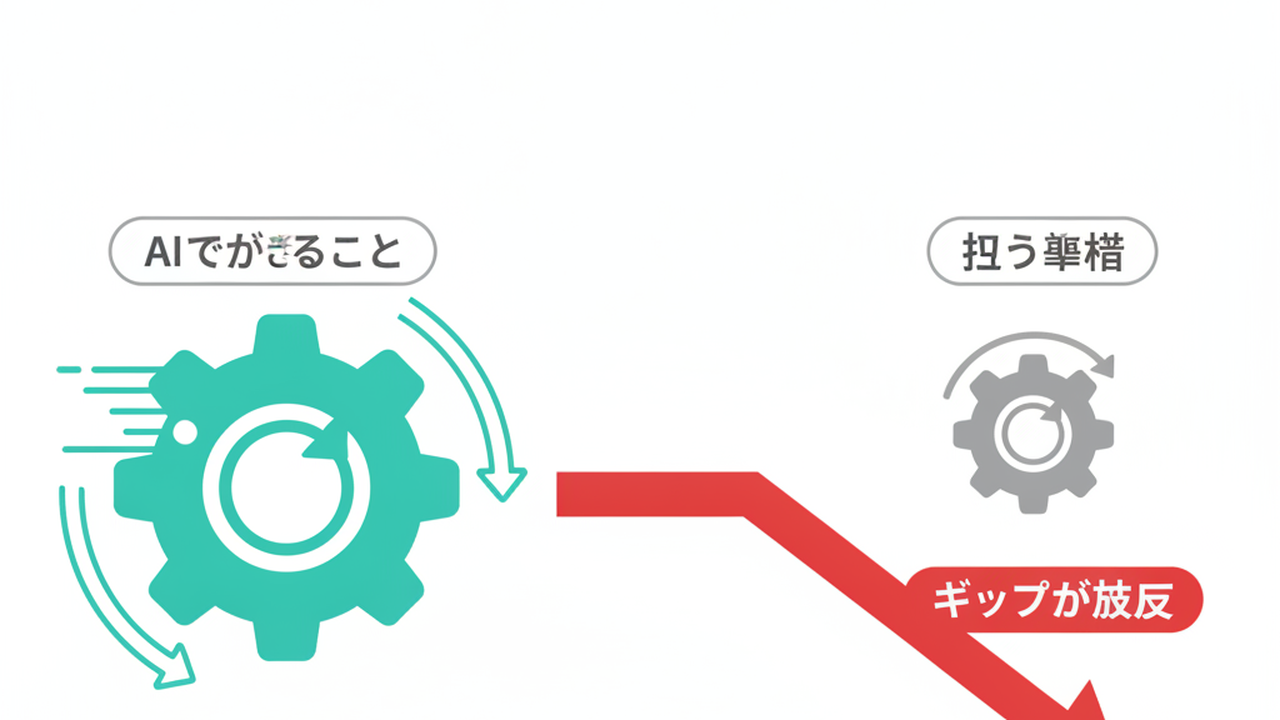
This year’s Index reveals a widening gap between what AI can do and how prepared we are to manage it. Source: Stanford AI Index 2026, https://hai.stanford.edu/ai-index/2026-ai-index-report
By the time you finish this article, you’ll know where your company sits on the AI map (which of 3 layers) and the one thing to move on in 2026.
Most people read authoritative reports and stop there. The reason is simple: too many numbers, hard to see how they apply to you.
This report is too valuable to read that way. The moment you map one number to your own situation, you instantly see where your company sits on the AI landscape.
I’ve pulled the 10 numbers I find most useful — organized as a map for marketers and business leads to locate their current position. By the end, you should have the one thing in your AI strategy to move on next.
What Stanford AI Index 2026 Is — Why This Annual Report Matters Right Now
The Stanford AI Index is an independent annual report Stanford HAI has published since 2017. This is the 9th edition (source: Stanford HAI official, https://hai.stanford.edu/ai-index).
The 2026 edition covers 9 chapters:
- Research and Development
- Technical Performance
- Responsible AI
- Economy
- Science
- Medicine
- Education
- Policy and Governance
- Public Opinion
Why is this different from other industry reports? It comes from a university with no commercial stake in the outcome. Gartner and McKinsey reports are useful, but there’s a consulting-revenue incentive behind them. Stanford HAI is different: collect data, minimize interpretation, present it in charts — that’s it.
That opening line about “the widening gap” summarizes the entire 2026 edition.
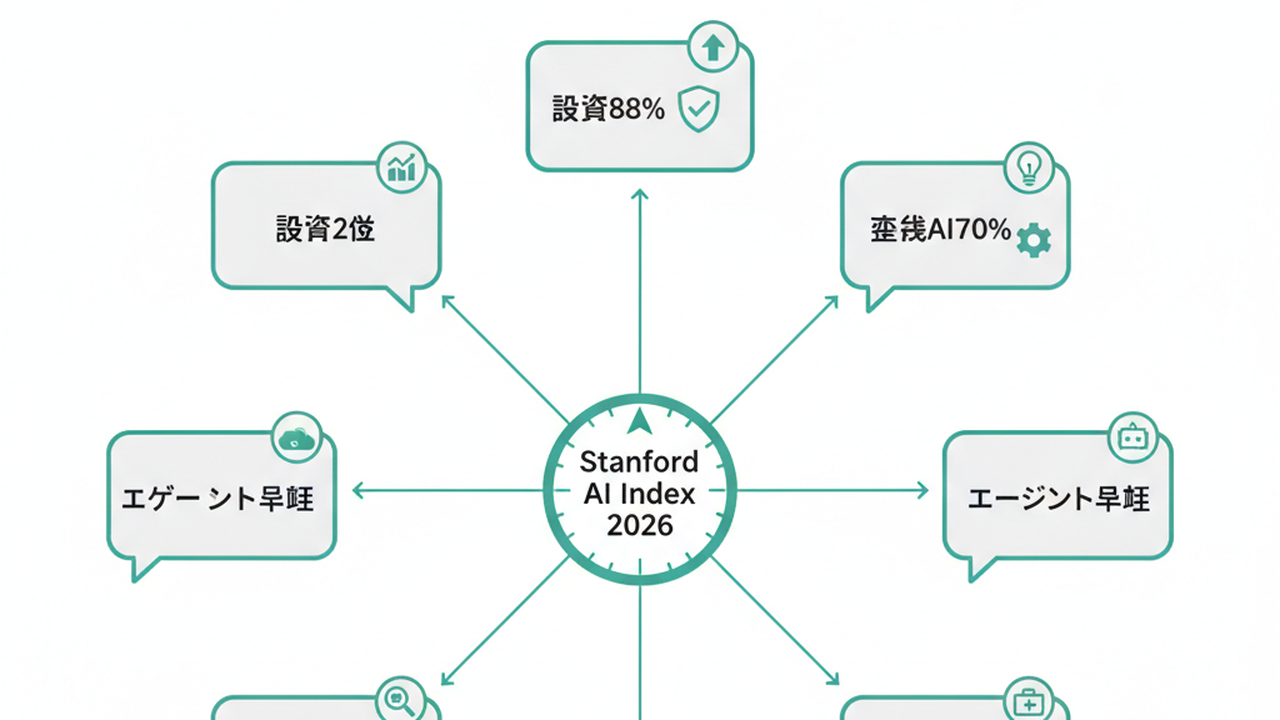
The 10 numbers I’ll cover:
- Corporate AI investment doubled
- Generative AI funding up 200%+
- New AI companies up 71%
- Organizational AI adoption: 88%
- Generative AI business use: 70%
- Gen AI reached 53% adoption in 3 years (faster than the PC)
- Benchmark error rates up to 42%
- Hallucination rates 22–94% (across top 26 models)
- 64% of Americans expect AI to reduce jobs
- 31% of Americans trust their government to regulate AI responsibly
Let me break each one down, with your situation in mind.
Number 1: Investment Doubled — “The Year Money Showed Up”
The Economy chapter opens with a striking statement:
Global corporate AI investment more than doubled in 2025
Source: Stanford AI Index 2026, Economy chapter, https://hai.stanford.edu/ai-index/2026-ai-index-report/economy
Generative AI was the standout:
Generative AI led the surge, growing more than 200% and capturing nearly half of all private AI funding
New AI companies that raised capital were up 71%. Funding events at the $1 billion+ scale “nearly doubled.”
The report also flags something important about China:
Private investment figures likely understate China’s total AI spending, as government guidance funds have deployed an estimated $184 billion into AI firms between 2000 and 2023.
Bottom line: 2026 is “the year money showed up.” The market shifted from the validation phase to the investment phase.
One of the most common things I hear from marketers and business leads: “We’re told it’s not time to budget for AI yet.” This is the year that changes. “Investment doubled” is the number you need for internal approvals — “According to Stanford HAI’s report, global corporate AI investment more than doubled in 2025.” Nothing more needs to be said.
If you’re trying to create a new annual AI budget line, quoting the Stanford AI Index 2026 Economy chapter directly gives decision-makers the material they need to act. That’s the right way to use an authoritative report.
Number 2: 88% Adoption, 70% Gen AI Use — But “Agent Use Is Still Early”
The other must-read data point from the Economy chapter is organizational adoption:
Organizational AI adoption continued to rise in 2025, up to 88% of surveyed organizations, though AI agent use remains early
88% of organizations have adopted some form of AI. Continuing from the same chapter:
Generative AI is now used in at least one business function at 70% of organizations
And the defining number:
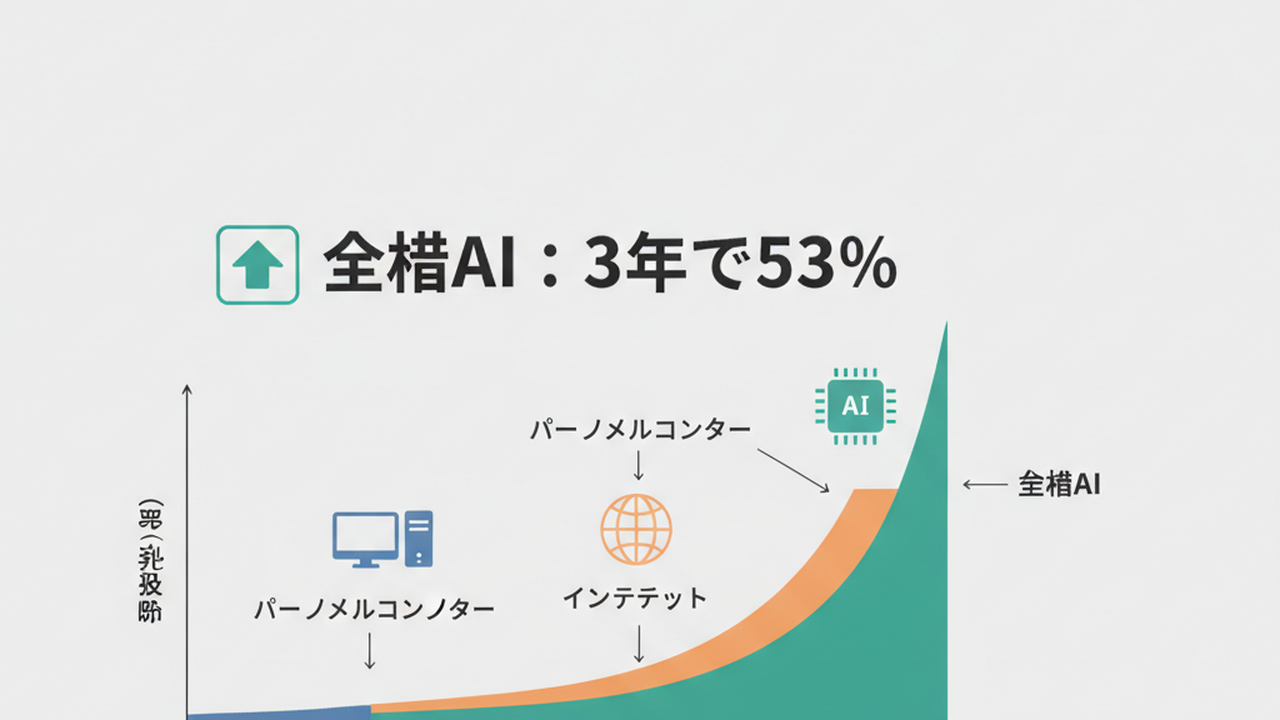
Generative AI reached 53% adoption in three years, faster than the personal computer or the internet
Faster than the PC. Faster than the internet. That comparison sticks.
Here’s the part not to misread: the same sentence contains “though AI agent use remains early.” Structure it out:
- Overall organizational AI adoption: 88%
- Gen AI in business functions: 70%
- AI agents (AI that autonomously runs multi-step tasks): still early stage
Technical Performance chapter data on OSWorld (a benchmark for agents running tasks on an OS) makes this concrete. OSWorld scores went from roughly 12% to 66% accuracy — a major improvement in one year, but 66% isn’t “ready to delegate real work” territory yet.
If you miss this distinction, you make bad internal decisions — like concluding “we use gen AI, so we’re ready for the agent era.” The reality: “gen AI in a business unit” and “autonomous agents embedded in operations” are different phases.
When I consult on enterprise AI adoption, this is the first thing I check. “We distributed ChatGPT access to employees” and “AI agents handle initial sales conversations” have completely different design philosophies. The former is a “use AI” project; the latter is a “redesign operations” project. The design thinking required for agent implementation is something I covered in 3 Routes for Building AI Agents.
2026 is the year this distinction becomes undeniable.
Number 3: 42% Benchmark Errors, 22–94% Hallucination — AI Evaluation Reliability
The Technical Performance chapter contains another critical note:
The benchmarks used to measure AI progress face growing reliability and gaming concerns, with error rates up to 42% on widely used evaluations
And from the Responsible AI chapter:
In a new accuracy benchmark, hallucination rates across 26 top models range from 22% to 94%
Hallucination — where AI confidently generates content that isn’t factually accurate — ranges from 22% to 94%. Even among the top 26 models, there’s a 3–4× spread.
This is what’s called “benchmark fatigue.” Well-known benchmarks like SWE-bench, MMLU, and HumanEval are “saturating,” and new metrics keep appearing. A 42% error rate in the benchmark itself is Stanford HAI’s warning: don’t over-trust the metrics.
Progress in professional domains is a different story:
AI models are expanding into professional domains, showing performance ranging from 60 to 90% in evaluations in tax, mortgage processing, corporate finance, and legal reasoning
Tax, mortgage processing, corporate finance, legal reasoning — all “human professional” territory. That 60–90% range contains both “reaching human-level” and “not there yet” domains mixed together.
The practical takeaway: separate “tasks you can fully delegate to AI” from “tasks where AI proposes and a human reviews.” Treating AI as “do everything” or “do nothing” both carry real risk.
Number 4: Jobs and Social Acceptance — “64% Expect Fewer Jobs, 52% Say It Makes Them Nervous”
The Public Opinion chapter is the one technical people most need to read.
Nearly two-thirds of Americans (64%) expect AI to lead to fewer jobs over the next 20 years, while only 5% expect more
64% vs. 5%. Most people are pessimistic about employment.
The gap between this and expert views is telling:
Experts were less pessimistic (39% fewer, 19% more) but forecast far faster adoption
Experts are more moderate about employment impact but more bullish on adoption speed. That temperature difference is the source of social anxiety.
And the global survey from the same chapter:
Globally, the share of respondents who say AI products and services offer more benefits than drawbacks rose from 55% in 2024 to 59% in 2025, even as the share saying these products make them nervous increased to 52%
“More benefits” and “makes me nervous” are both going up. I read this as normal behavior for an AI adoption wave — using it makes it feel more useful, and more consequential, at the same time.
Actual usage rates are also interesting:
In 2025, 58% of employees globally reported using AI at work on a semiregular or regular basis, but in India, China, Nigeria, the United Arab Emirates, Egypt, and Saudi Arabia, the share exceeded 80%
Global average at-work AI use: 58%. Emerging economies: 80%+. Japan isn’t called out in these numbers, but from what I observe, “semiregular work AI use” is below the global average. The gap between “AI adoption rate” and “AI actual use rate” in Japanese organizations shows up right here.
One more social acceptance number worth noting:
The United States reported the lowest trust in its own government to regulate AI responsibly of any country surveyed, at 31%
US: 31%. People and companies have started using AI on the assumption that government regulation isn’t going to function. In Japan, many companies are still in “wait for regulations” mode. That gap becomes a competitive gap in three years.
5 Questions to Map Where Your Company Stands — Deciding the One Thing to Move On
After 10 numbers, let’s return to the opening question: is your company in the 88% group, 70% group, or not yet?
To turn numbers into action rather than just “interesting,” use these 5 questions to map your position. Answer Yes or No.

Question 1: Has your company created or increased an AI-related budget in the past 12 months?
- Yes → You’re moving with the “investment doubled” flow. Next: prioritize what you spend it on.
- No → You’re missing “the year money showed up.” Use Stanford AI Index 2026 as your internal approval evidence.
Question 2: Is generative AI being used daily in at least one business function (sales, marketing, customer support, finance, etc.)?
- Yes → You’re in the 70% group. Next: embed it deeper in workflows.
- No → Start with one department × one use case to establish regular gen AI use.
Question 3: Have you started piloting AI agents (AI that autonomously runs multi-step tasks) in any business process?
- Yes → You’re in the top 5% of “early implementation.” Next: workflow redesign.
- No → You may be in the “think we’ve adopted” zone. Recognize that agent implementation is a different phase.
Question 4: Do you track the hallucination rates and evaluation metrics of the AI models you use as a business risk?
- Yes → You’re past “accuracy faith.” Next: design acceptable error rates by use case.
- No → Model selection is being driven by vendor sales. Start with evaluation design.
Question 5: Have you created a formal internal space for employees to discuss AI anxiety and job concerns?
- Yes → You’re equipped for an adoption wave where benefit and anxiety coexist.
- No → Anxiety is building below the surface. Design dialogue spaces alongside AI training.
If you answered No to 3 or more: focus your top priority on the single most delayed item in “investment → adoption → implementation → evaluation → dialogue.” Trying to advance all of them at once leaves all of them half-done.
“AI strategy isn’t a checklist” is my core position. Move one thing. Get it to results in 2026. That alone puts you in the top tier. If your organization is moving toward deploying AI agents, AI Agent Organization Design is worth reading alongside this.
Wrap-Up — Stanford AI Index 2026’s Top 10 Numbers and Your “One Next Thing”
- Investment doubled, gen AI up 200%, AI companies up 71% — the numbers to break through “we don’t have an AI budget yet.” 2026 is the budget year.
- 88% adoption, 70% gen AI use, 53% in 3 years — “thinking we’ve adopted” and “actually implemented” are different phases.
- 42% benchmark errors, 22–94% hallucination — move past accuracy faith; design evaluation standards per use case.
- 64% expect fewer jobs, 52% say it makes them nervous — build internal dialogue spaces for a world where benefit and anxiety coexist.
- 31% US government trust — stop waiting for regulations. The gap with companies that are already moving is widening this year.
Authoritative reports aren’t for reading and knowing. They’re for using as a map to locate your current position. The Stanford AI Index 2026 is the most substantive “map” of the first half of 2026.
The full report is free (https://hai.stanford.edu/ai-index/2026-ai-index-report). The chapter highlights alone can be scanned in 30 minutes.
Today, run the 5-question check for your company on your own. Then share the result with one person in next week’s meeting. That alone moves your AI strategy one concrete step forward.
I do the same thing in client work — “here’s where your organization sits on the latest Stanford Index” is how I open discussions. It immediately aligns the baseline. That’s the highest-leverage way to use the Stanford AI Index 2026.
The map for the AI agent era is already in your hands. All that’s left is confirming where you stand on it, and taking the next step.

AIを使いこなせない方は、この先どんどん差がつきます。僕はAIエージェントを毎日動かして、壊して、直して、また動かしてます。そういう泥臭い実践の記録をここに書いてます。理論は他の方にお任せしました。僕は動くものを作ります。朝5時に起きてウォーキングしてからコードを書くのがルーティンです。