2026 Unicorns: AI Is Only 1 in 4 — The 75% Gap Is Where Your 30s Experience Wins
Digital Journal counted 98 new unicorns in 2026 — only 25 are AI. Robotics, HealthTech, and Fintech make up 28 more, and they all need seasoned operators in their 30s and 40s.
What you'll learn in this article
- The key point to grasp before reading the full article
- How the issue changes practical decisions after reading
- Which follow-up article is worth opening next
“Ninety-eight companies became unicorns in 2026 already.”
Did you skim past that? I stopped cold. When I looked at the breakdown Digital Journal compiled, AI companies came to 25. The other 73 were in different sectors. That’s just over one quarter.
In an era everyone keeps calling “AI-everything,” three out of four unicorns aren’t AI. That’s a number you can’t afford to miss.
Back in April, when I covered Fortune’s “25 is the New 30” piece, I wrote that it’s about speed, not age. Today isn’t a follow-up to that — it’s a 180-degree flip.
AI is getting locked up by younger talent. But the 75% gap? That’s wide open for people in their 30s and 40s with real industry experience.
I’m going to walk through every number Digital Journal, Crunchbase, and CNBC reported. And I’m going to answer the question: “If I’m in my 30s and not in AI, what exactly am I competing for?“
98 New Unicorns in 2026 — AI Is 25. Here’s the Full Picture from Digital Journal
The takeaway: AI is #1, but Robotics + HealthTech + Fintech together add up to 33 companies — more than AI.
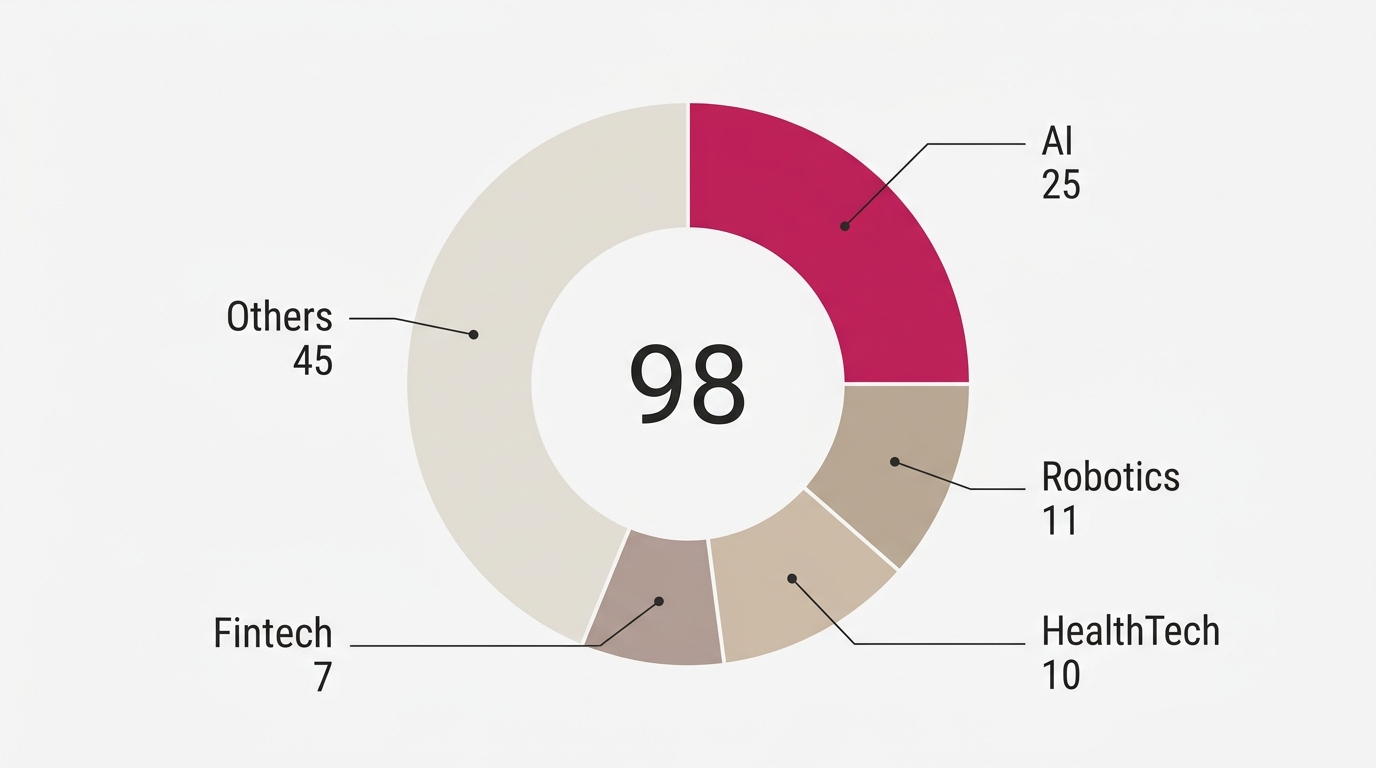
According to Digital Journal’s May 18, 2026 analysis, 98 startups crossed the $1 billion valuation mark so far in 2026. The breakdown by sector:
- AI: 25 companies (25.5%)
- Robotics: 11 companies
- HealthTech: 10 companies
- Fintech: 7 companies
- Other: 45 companies
Look at those numbers. AI leads, but it’s only a quarter. More than two in three new unicorns are in something other than AI.
The geography is interesting too. The US dominates at 60 companies, but the UK comes in second at 7. The highest-valued AI unicorn is Ineffable Intelligence, a London-based company at a $5.1 billion valuation. Founder David Silver is ex-DeepMind, and the company raised $1.1 billion in seed funding — the largest seed round in European history.
At this point, if you’re thinking “see, AI is incredible” — hold on. Ineffable’s $1.1B seed is what the industry calls a “coconut round” — a massive seed that comes together purely on the strength of a star researcher’s name. This is not a world that regular solopreneurs (people running their own one-person businesses) can compete in.
In other words, the top tier of AI unicorns has become a “researcher brand game.” The layer you and I should be watching is completely different.
37 Unicorns in March Alone — a 4-Year High. What Crunchbase’s Monthly Data Really Shows
The takeaway: Track it month-by-month and you’ll see a different sector leading every single month — not AI every time.
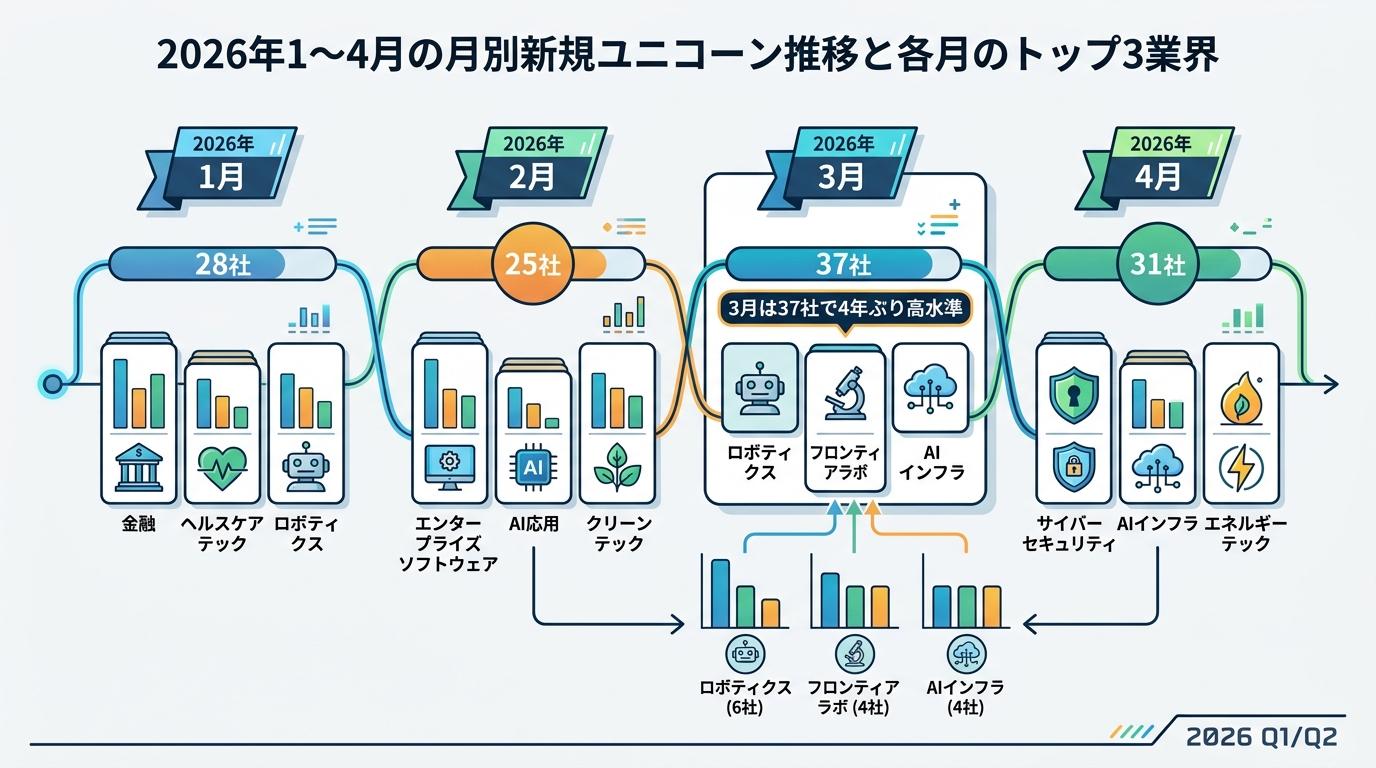
Crunchbase’s March 2026 analysis showed 37 new unicorns in a single month — a 4-year high.
March’s top 3 sectors:
- Robotics: 6 companies (including 3 from China)
- Frontier Labs (foundation model AI): 4 companies
- AI Infrastructure (data center tech and procurement): 4 companies
Look carefully. Robotics, not AI, took the top spot. Three Chinese companies made the list. Geographically: 20 US companies (11 of them from the San Francisco Bay Area) and 6 from China — showing that the US-China divide has reached the startup stage.
And March’s highest valuation? Not an AI company. OKX, a crypto exchange based in the Seychelles, at $25 billion. The biggest fundraise of the month went to Advanced Machine Intelligence, founded by Yann LeCun (Meta’s former Chief AI Scientist), pulling in $1.1 billion.
What this tells me is that lumping everything under “AI company” is sloppy thinking. The real breakdown is:
- Frontier Labs: Foundation model development. Requires researcher brand + billion-dollar capital. Almost no individual can enter this.
- AI Infrastructure: Data centers, chips, procurement. Capital-intensive. Also not for individuals.
- Applied AI: Applying AI to existing business operations. This is where individuals and small teams can play.
Robotics, HealthTech, and Fintech are continuous with applied AI. They’re sectors where “domain expertise + AI tools” creates real differentiation.
AI Unicorns Come in 3 Tiers. Individuals Can Only Touch One of Them
The takeaway: Lumping all “AI companies” together makes you misjudge where individual entry is actually possible.
Crunchbase’s April AI unicorn coverage makes the three-tier structure explicit.
| Tier | What it is | Examples | Can individuals enter? |
|---|---|---|---|
| 1. Frontier Labs | Foundation model development | Ineffable Intelligence, Recursive Superintelligence | ❌ Not possible |
| 2. AI Infrastructure | Compute, data centers | March’s 4 new entrants | ❌ Capital-intensive |
| 3. Applied AI | AI-ifying existing business operations | Industry-specific SaaS | ✅ Open to individuals |
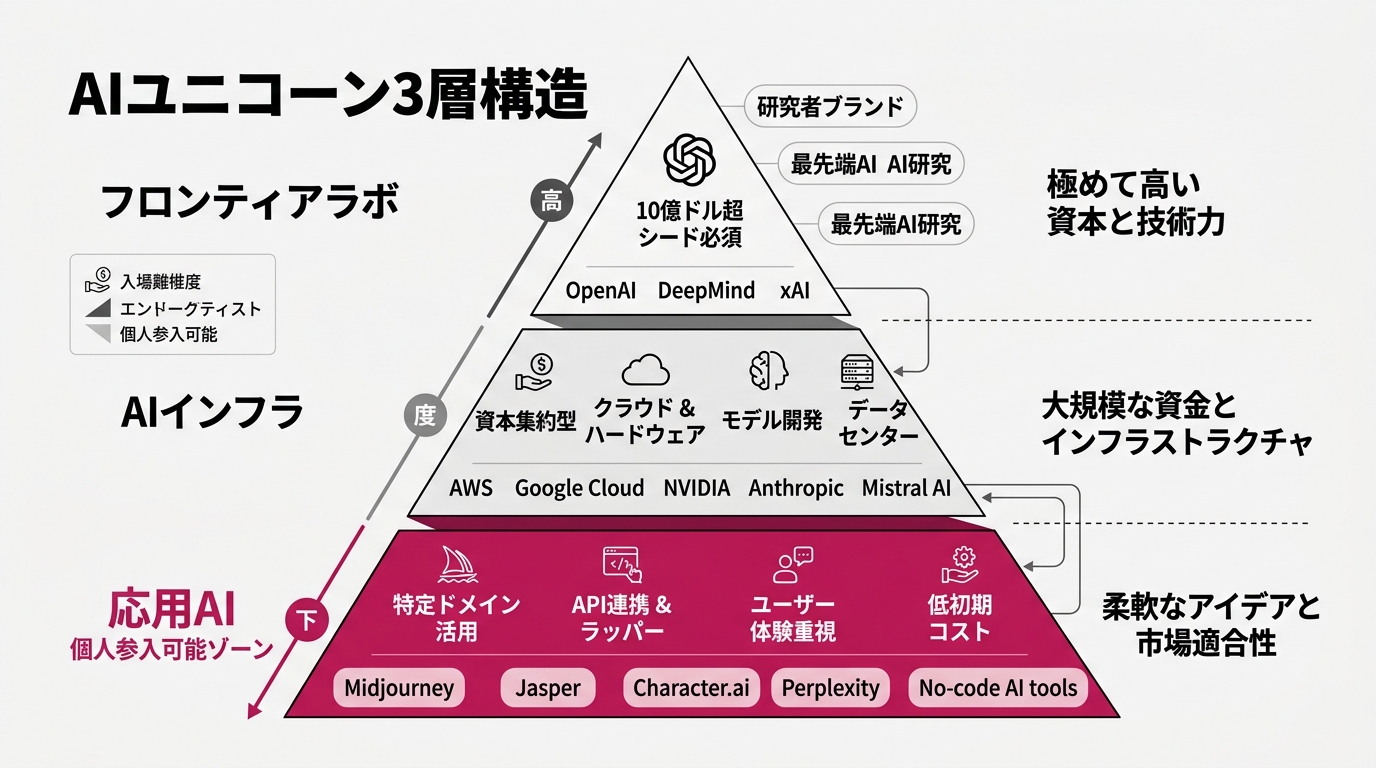
When media says “AI unicorns keep coming,” the majority of that coverage is about Tiers 1 and 2. People in their 30s and 40s don’t need to panic about “falling behind” in those tiers.
Even most 20-somethings can’t enter Tiers 1 or 2. If you weren’t a DeepMind researcher or didn’t implement scaling laws at Anthropic, you’re not even at the starting line — and neither is almost anyone else.
I covered Anthropic’s rise in The AI That’s Out-Earning ChatGPT a while back, but the point stands: the upper tier of AI is now a war of capital and talent. It’s not the battleground for individual solopreneurs.
What we should be looking at is Tier 3 — Applied AI — and the adjacent sectors of Robotics, HealthTech, and Fintech. Those are places where experience matters. Where age is an asset.
3 Gaps for People in Their 30s and 40s Right Now — How to Find Where Your Experience Is a Weapon
The takeaway: HealthTech, Fintech, and Robotics cannot be built without industry insiders. That’s why 30s-and-beyond have the edge.
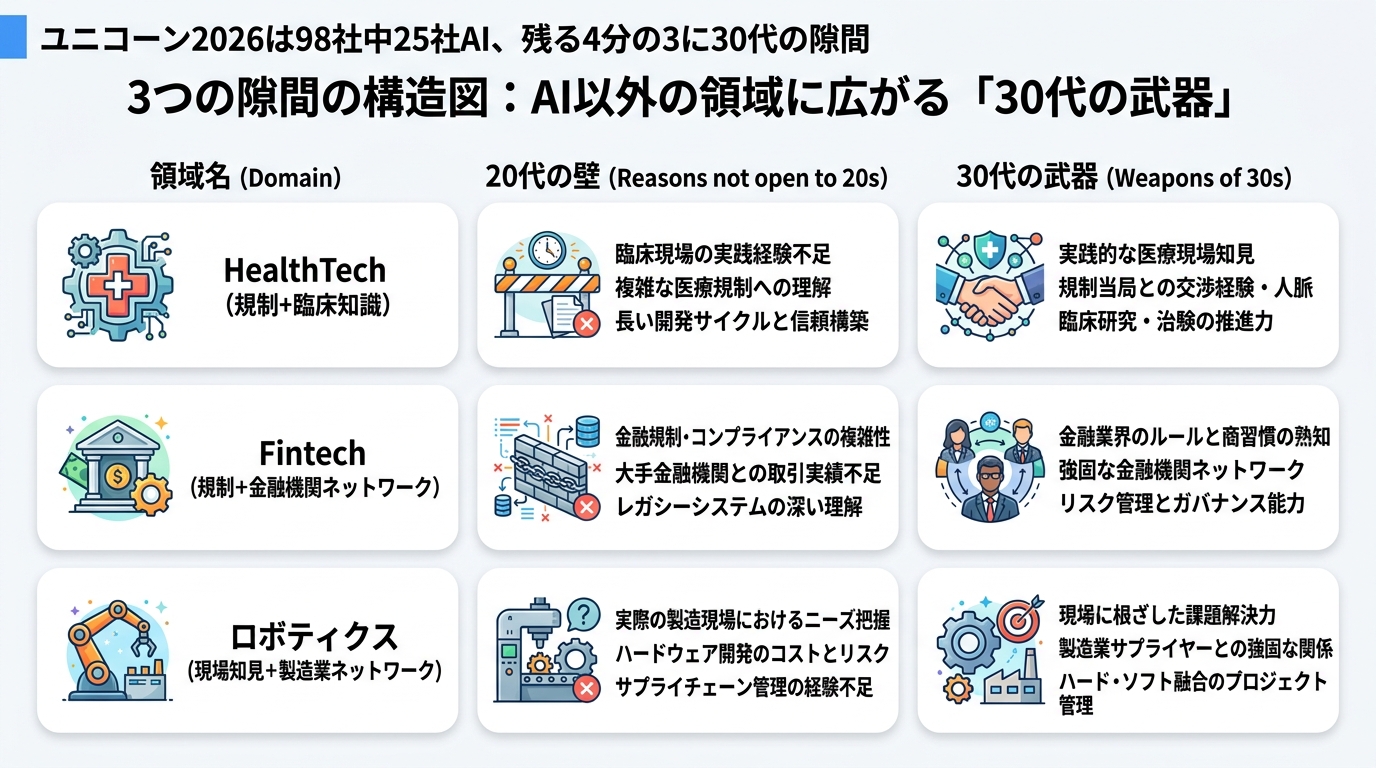
Now for the practical part. Here’s why the 28 companies from sectors 2–4 in Digital Journal’s ranking — Robotics (11), HealthTech (10), Fintech (7) — are wide open for people in their 30s and 40s.
Gap 1: HealthTech — Regulatory and Clinical Knowledge Keeps 20-Somethings Out
There’s a clear reason healthcare startups don’t get dominated by founders in their 20s: almost no one in their 20s can navigate medical regulations.
- FDA device classifications and 510(k) submission processes
- Japan’s PMDA (Pharmaceuticals and Medical Devices Agency) approval categories
- HIPAA healthcare privacy law and its medical exceptions
- Clinical workflow realities: EHR systems, medical billing, how physicians actually move through their day
None of this can be absorbed without direct field experience. AI tools can write the code. But knowing exactly where to apply that code so physicians actually want it — that judgment only comes from people who’ve been in the room.
If you have five or more years in pharma, hospitals, or medical device companies, this is your gap.
Gap 2: Fintech — Regulatory Expertise and Financial Institution Relationships
The 7 new Fintech unicorns span payments, lending, and insurance, but they all share one requirement: either existing financial institution relationships or deep regulatory knowledge.
- Banking, securities, and insurance industry practices
- Regulatory registration categories (money transfer licenses, payment facilitation, broker-dealer)
- Anti-money laundering and KYC (Know Your Customer) implementation experience
- Navigating partnerships with legacy financial institutions
This is also a territory most 20-somethings simply cannot reach independently. Years spent in banking sales, compliance, or financial systems translate directly into Fintech founder assets.
Gap 3: Robotics — Field Knowledge and Manufacturing Networks
Three of the 11 Robotics unicorns are Chinese companies — that’s because deep manufacturing floor expertise is concentrated there. The 8 US companies are largely built around partnerships with manufacturing, logistics, or agriculture operations.
- Factory layouts, material handling flows, MES (Manufacturing Execution Systems) and SCADA controls
- Warehouse picking and sorting operations
- Agricultural planting, harvesting, and sorting workflows
Again, the technology is secondary. Knowing where to use it is decisive. Former plant managers, logistics directors, and agribusiness operators are the people who are strongest here, right now.
3 Concrete Steps Solopreneurs Can Take Starting Today
The takeaway: Forget unicorn-building. Win your first customer with an “operations-automating SaaS” or an “industry-specialized consultancy.”
If you read this far and thought “I can’t build a HealthTech unicorn” — you’re right. You don’t have to. What you’re aiming for is a small company that gets acquired by a unicorn, or a focused SaaS product in a narrow vertical.
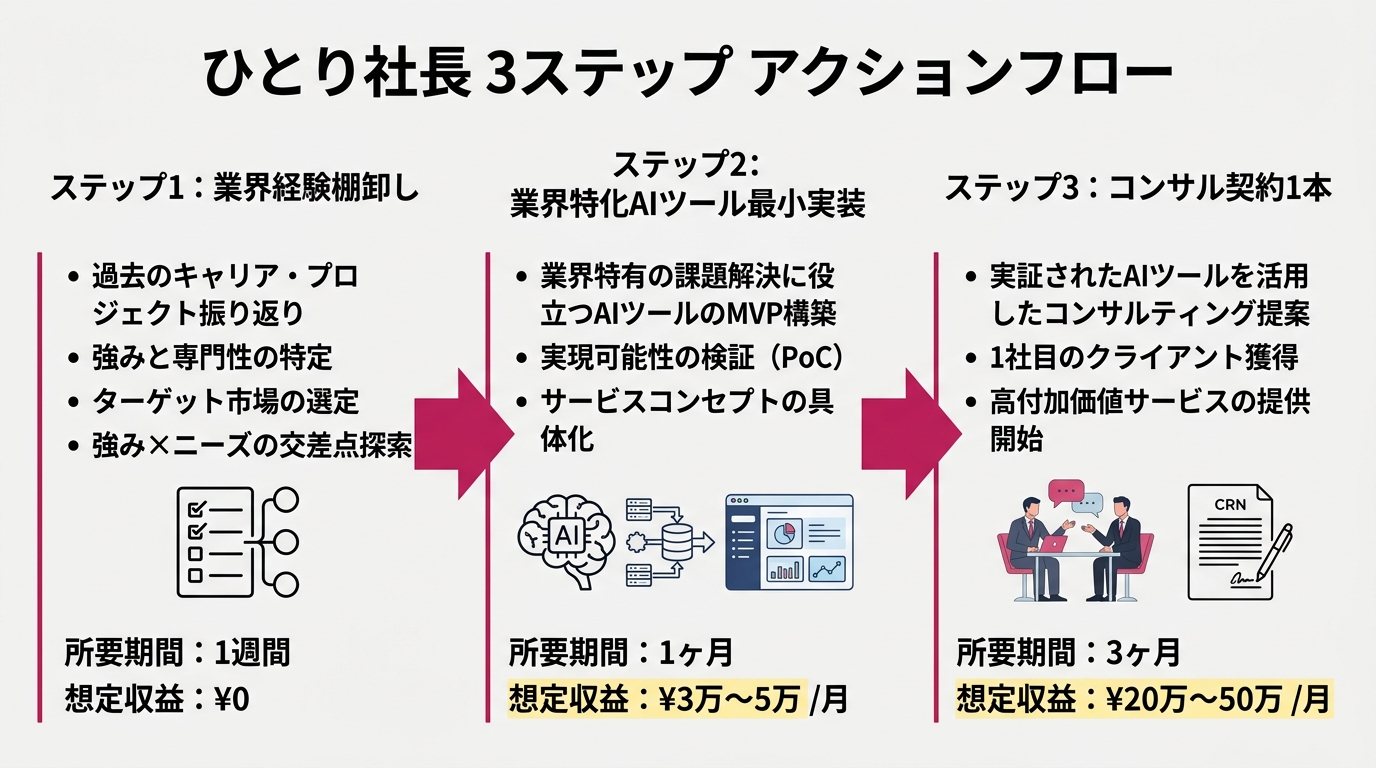
Three steps to get moving:
Step 1: Do a 10-Year Audit of Your Industry Experience
Grab paper and a pen. Write out:
- Every industry you’ve worked in over the last 10 years (list all of them)
- For each one: a task you do (or did) every day that you think AI could handle
- Whether people struggling with that task would pay for a solution right now
When you write this out, you start to see the market value of what you know — as others perceive it. When I went independent, I did exactly this exercise. Within social media marketing, cutting to “for solo business owners” and “for women entrepreneurs” was the move that finally gave me a real differentiation.
Step 2: Build One Industry-Specific AI Tool (Minimum Viable Version)
Take the workflow you identified and implement it using a no-code AI tool — GPTs, Claude Projects, Dify, or similar. The right scope is something you could offer as a SaaS for under $70/month to start.
Your first customers can be former colleagues or past clients. Get 3–5 of them using it and you’re already bringing in $200–$400/month. That’s your prototype revenue validation.
Step 3: Land One Consulting Contract Before You Hit 10 SaaS Customers
Once the SaaS is running, pitch a mid-sized company in the same industry on “AI operations efficiency consulting.” Start at $1,500–$3,500/month for a 3-month engagement.
SaaS revenue grows slowly. Consulting pays now. Running both in parallel, a one-person business doing $50,000–$100,000 annually is realistically in view within 6 to 12 months — though actual results vary considerably by industry and experience. That’s the realistic target for someone in their 30s or 40s with domain expertise.
You don’t need to aim for a unicorn. Aim to be the smaller company that one of those 98 unicorns acquires — and your life changes completely.
Summary: The 75% Gap Is Only Open to Those Who Move
In 2026, AI led the new unicorn rankings at 25 out of 98. But the remaining 73 are in sectors where industry experience is the deciding factor.
When I covered How Anthropic Reshaped 3 Industries in 8 Days in May, a lot of people felt overwhelmed by the pace of AI disruption. But look at which industries are actually being disrupted: healthcare, finance, logistics, manufacturing. Every single one requires deep field knowledge.
AI is genuinely powerful. But the people who know the inside of the industries AI is disrupting? That’s not 20-somethings — that’s people in their 30s and 40s. That’s what I wanted to say today.
Stop assuming “AI is for young people now” and take a real look at what a decade of your work has built. The 75% gap Digital Journal revealed is only open to people who can translate their industry experience into something valuable.
Google Marketing Live 2026 Speed Report is worth reading too, but honestly — your own firsthand experience in a specific industry is a far more reliable differentiator right now than following marketing trends.
I almost talked myself out of going independent the year before I turned 31. In retrospect, the things I’d seen inside companies in my late 20s — I could only start translating them into real value once I was in my 30s. Action beats hesitation. The only people who get into the 75% gap are the ones who move.
References:
- Digital Journal “AI companies account for over a quarter of 2026’s 98 newly minted unicorn start-ups” (2026-05, Digital Journal)
- Crunchbase “The New Unicorn Count Reached A 4-Year High In March, Led By Robotics, Frontier Labs And AI Infrastructure” (2026-04, Crunchbase News)
- Crunchbase “Frontier Labs And Robotics Companies Again Top List Of New Unicorns In April” (2026-05, Crunchbase News)
- CNBC “Former Google DeepMind researcher’s AI startup raises record $1.1 billion seed funding to pursue superintelligence” (2026-04-27, CNBC)

女性だからこそ、AIを使いこなさなきゃって思ってる。仕事も、副業も、推し活も、旅行も、全部やりたい。人生一度きりなのに時間は足りないじゃん?だからAIに任せられることは全部任せる。浮いた時間で本当にやりたいことをやる。それがあたしのスタイル。ここにはあたしが実際にやったことをまとめてるだけ。誰かのためになったらいいなって思って書いてるよ。