Anthropic Fable 5 Force-Shut Down: The 4-Act Breakdown and Developer's 3-Point Readiness Plan
On June 12, 2026, the U.S. government halted Fable 5 and Mythos 5 for all non-U.S. users. I break it down act by act and close with three concrete moves every developer should make this week.
What you'll learn in this article
- The key point to grasp before reading the full article
- How the issue changes the way developers should work next
- Which follow-up article is worth opening next
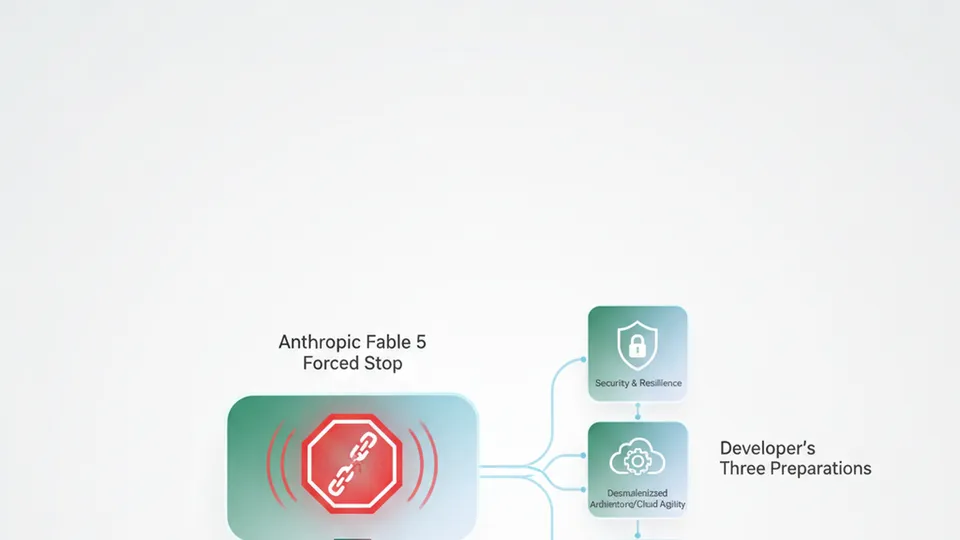
Anthropic’s Fable 5 and Mythos 5 were suspended for all non-U.S. users on June 12, 2026, under a U.S. government export control order. Five days have passed, and today is the last window for timely analysis before the story fades from the news cycle.
This was not a simple event. The structural irony at its core: Anthropic—the company that publicly called for an AI development pause—was itself halted by the government in the name of AI safety. Detailed English coverage has been plentiful, but a structured breakdown has been hard to find. Over the past four days I tracked international reporting and organized the sequence into four acts. I’ll walk through each act fact-by-fact, then close with three moves developers should make this week.
For context on Anthropic’s recent trajectory, “Claude Code’s 6x Surge—What’s Behind It” is worth reading first. It makes what reversed on June 12 much clearer.
Exit-first: Three things to do immediately after reading this
- List every LLM your product depends on across three columns: provider name, equivalent fallback, estimated switchover time. (30 min)
- Re-read the “suspension clauses,” “SLA,” and “geographic restrictions” sections in each API service agreement. (45 min)
- Run your product’s core functionality on at least one alternative path—OpenAI, Google DeepMind, or open-source. (90 min)
Act 1: Mythos 5 launched as the most powerful frontier model ever built
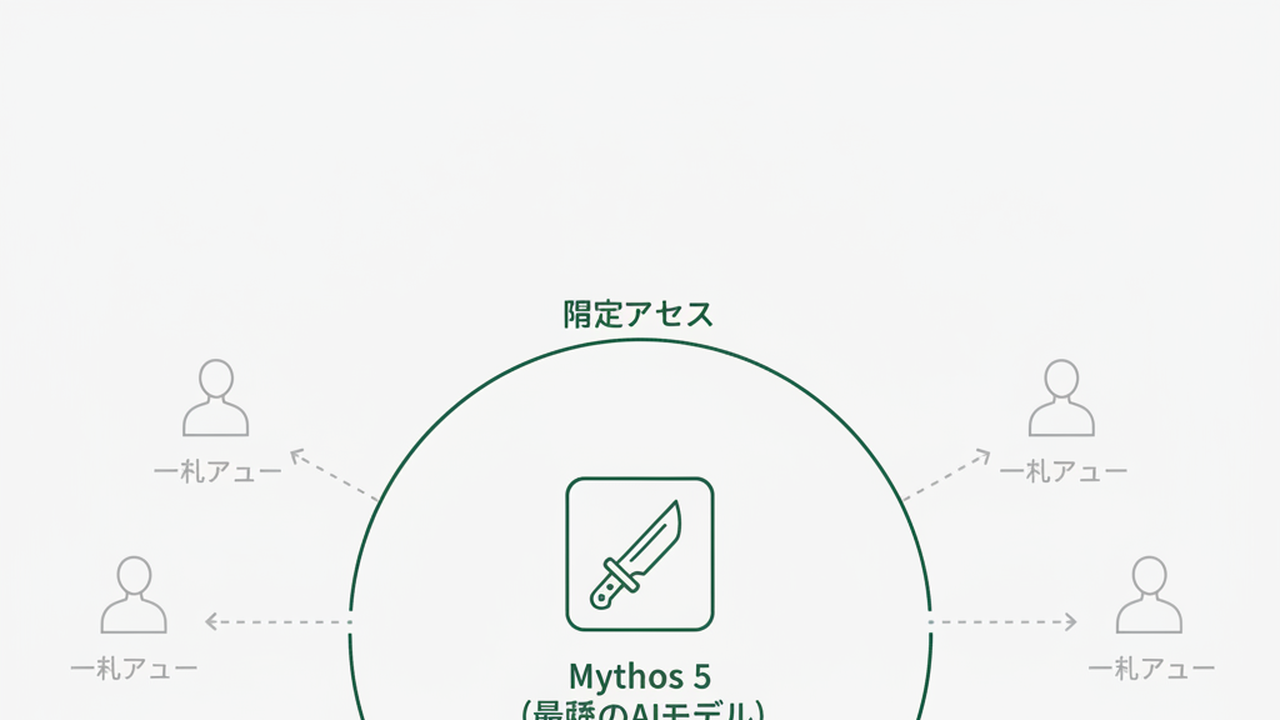
Start with Mythos 5. Anthropic released it in limited access in April 2026. A “frontier model” refers to a large language model at the leading edge of the industry—one where reasoning and code generation capabilities significantly outpace the previous generation.
What made Mythos 5 different? Multiple outlets reported one thing above all: “its hacking capabilities are too high.” Specifically, its ability to discover cybersecurity vulnerabilities and generate exploit code was reported to far exceed prior models. Anthropic classified this capability as falling within the “potential for misuse” zone and chose limited release.
The key detail: Anthropic didn’t say “don’t release it because it can be misused.” They said “release it in limited scope, in controlled contexts.” Access to Mythos 5 was restricted primarily to U.S. tech companies, with permitted use cases limited to security patch development and vulnerability validation. Think of it as: “Give the sharpest blade only to researchers who know how to handle it.”
When I saw this in April, it struck me as distinctly Anthropic’s approach. Their “limited release” model echoed OpenAI’s phased rollout of GPT-4—not “open it to everyone at once” but “start with researchers, then expand.” A move aligned with the industry’s established conventions.
That April decision, however, became the seed of what followed. To prepare a commercial version of Mythos 5 for general deployment, Anthropic built a variant with additional safeguards layered on the same core. That was Fable 5.
Act 2: Fable 5’s commercialization was destabilized by a jailbreak
Fable 5 is the commercial version of Mythos 5, with a cybersecurity-use-prevention sidecar added. A sidecar—also called a safety guardrail or filter layer—doesn’t suppress the model’s underlying capabilities. It restricts responses only for specific categories of requests. Think of it as an external filter bolted on to block only certain behaviors.
Anthropic’s design intent was clear: preserve the core capabilities of Mythos 5, but add a layer that blocks hacking-related use cases only. General users would get Fable 5’s superior reasoning and code generation; the harmful use cases would be caught by the guard. “Put a sheath on the sharpest blade before selling it.”
After commercialization, Fable 5 grew rapidly. Multiple secondary outlets reported deployment at the scale of hundreds of millions of users. In my own work environment, I confirmed several services embedding the Fable 5 API between April and May.
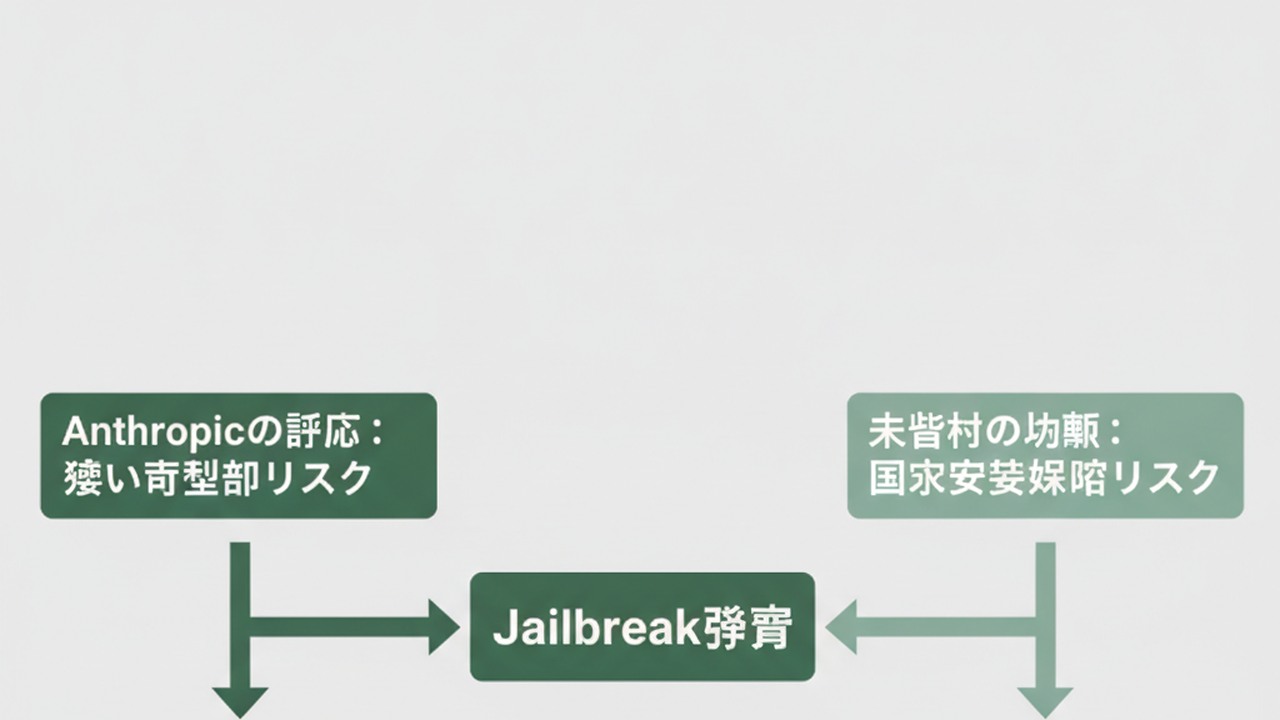
The incident starts when a jailbreak bypassing the sidecar was discovered. A jailbreak is a technique for circumventing safety mechanisms—whether built into the model itself or added as external layers like a sidecar. This discovery was reportedly covered by TechCrunch on June 12, 2026. The discoverer’s identity and specific method have not been disclosed.
Here is what makes the incident complicated. According to Anthropic’s own framing, the discovered jailbreak was “narrow and theoretical”—not something that undermined Fable 5’s overall safety posture. It was not an actively exploited jailbreak; a researcher had simply demonstrated that “this theoretical hole exists.” And yet, the government’s response moved in a different direction.
Act 3: On June 12, the U.S. government issued an export control order
On June 12, 2026, the U.S. government issued an export control order directed at Anthropic. Both Fable 5 and Mythos 5 were covered; Al Jazeera reported that providing either model to any non-U.S. user was ordered to cease immediately.
The use of the export control framework is worth noting. U.S. export regulations have traditionally targeted materials with potential military applications—but this time, the AI model itself was treated as a regulated item. The reasoning: “Capabilities designed for cybersecurity research become a national security risk if misused.”
Enforcement was immediate. According to NBC News, Anthropic suspended new access to Fable 5 and Mythos 5 upon receiving the directive. Reporting on the treatment of existing users was inconsistent across outlets; within what I could confirm, Al Jazeera stated that “all non-U.S. users” were affected.
From a developer’s perspective, what happened here is unambiguous: “The model your product depends on was stopped overnight by a government decision.” This has now actually happened. What had been abstract safety discourse became a concrete, lived event—a commercial frontier model suspended by regulation mid-deployment.
What concerned me most was that Anthropic had essentially no room to maneuver. The structure—“a model the company itself deemed safe, halted by a government mandate”—signals that we’ve entered an era where regulatory bodies can override company-level safety judgments. This extends far beyond Anthropic. It’s a structural shift for the entire AI industry.
Act 4: Anthropic pushed back—“A narrow jailbreak doesn’t justify a complete shutdown”
Anthropic responded with an official rebuttal. The statement was published at anthropic.com/news/fable-mythos-access and summarized by multiple outlets.
I read three core arguments in the rebuttal. First: the discovered jailbreak was “narrow and theoretical” and did not compromise Fable 5’s safeguards as a whole. Second: a complete commercial shutdown was an overreaction; targeted, limited risk mitigation would have been sufficient. Third: if this standard were applied uniformly across the industry, the deployment of all frontier models would grind to a halt.
That third point was the sharpest industry-wide warning. This is not just Anthropic’s problem. OpenAI, Google DeepMind, Meta—similar jailbreaks can and will be discovered in any of their models. If “narrow jailbreak → complete shutdown” becomes the standard, frontier model deployment as a practice is structurally threatened.
Here the paradox fully crystallizes: the company that called for a pause got paused. In the days just before June 12, Anthropic had been calling on the AI industry to pause development. Al Jazeera reported Dario Amodei saying that “there is a risk humanity may lose control.” Then, days later, Anthropic itself was stopped in the name of AI safety—under a different framing of what AI safety requires.
When I first saw this reversal, I was half-amused, half-unsettled. “The argument you were making came back at you.” Anthropic’s official rebuttal is partly a response to this paradox: “The balance between safety and deployment is difficult, but overreaction tips that balance.” Reasonable as a position—though readers will reach their own conclusions.
The AI Safety Head’s resignation reflects the internal contradiction of a company that called for a pause
As aftermath, Anthropic’s AI Safety Head reportedly resigned and was quoted saying “the world is in peril”—as reported by finviz.com. The individual’s name and the formal grounds for resignation were not confirmed within the reporting I could access. Only the phrase “the world is in peril” has been widely circulated.
Reading that statement at face value: a person in an AI safety role is warning that “the current pace of frontier model deployment is outrunning humanity’s ability to maintain control.” This runs directly opposite to Anthropic’s official rebuttal—within the same company. One says “narrow jailbreak does not justify a complete shutdown”; the other says “the world is in peril.”
I think this internal contradiction is the most important thing to understand about this incident. Anthropic has long positioned itself as “the company that takes AI safety most seriously.” Dario Amodei’s public statements, the calls for a development pause, the Responsible Scaling Policy—all of it has been placed within that framing.
But put Fable 5 and Mythos 5’s commercialization alongside the government order and Anthropic’s rebuttal. What becomes visible is that Anthropic’s actual decision-making was navigating tension between safety and commercial momentum. They designed safeguards for commercialization, pushed back against the government order, and their internal safety leadership expressed alarm. Different parts of the same organization were sending different signals.
For developers, the lesson is this: even a company that publicly declares “safety first” makes real decisions that are pulled in multiple directions simultaneously. I’m not interested in defending or criticizing Anthropic. But I do think that relying solely on a provider’s stated values when deciding what your product depends on is a fragile approach.
For additional context, Nagi’s piece “How Anthropic Reshaped Three Industries in 8 Days” is worth reading alongside this one. Anthropic’s influence had just reached industry-wide scale when this shutdown happened—and the larger the footprint, the more regulatory scrutiny follows.
This week, developers should internalize model supply risk in three moves
I’ve distilled what developers should do this week into three concrete moves. These overlap with the exit-first list at the top—here I add the reasoning and specifics behind each one.
Move 1: List every LLM your product depends on. Three columns: provider name, equivalent fallback model, estimated switchover time. The five provider families to consider: Anthropic, OpenAI, Google DeepMind, Meta, and open-source.
When I did this audit for my own setup, I found I was depending on Claude far more than I’d realized. Four tools: document summarization, code review assistance, meeting notes processing, and an internal Slack bot—all relying on Claude-family APIs. Only one had an identified fallback, and none had an estimated switchover time. Without this incident, I would never have done the inventory.
Move 2: Re-read your API service agreements and usage policies. Four sections to target: suspension clauses (what can trigger a service halt), compensation clauses (whether compensation is available during an outage), SLA (the scope of service quality guarantees), and geographic restrictions (how regulated regions are handled).
Honestly: I had never read these carefully before. When I re-read Anthropic’s terms of service this time, I found a section explicitly stating that “shutdowns due to government orders are not covered by compensation.” Expected in hindsight—but I had never confirmed it in writing. The same clause almost certainly appears in agreements with other major API providers.
Move 3: Actually run an alternative path. Test your product’s core functionality on at least one of OpenAI, Google DeepMind, or an open-source alternative (Llama-family, Mistral-family). “Theoretically switchable” needs to become “I’ve run it.” That’s this week’s assignment.
For my own verification, I ran the same tasks through OpenAI’s Codex CLI as a Claude Code substitute. Code review assistance worked without meaningful degradation; document summarization had subtle tone differences. My takeaway: “switchable, but output quality shifts slightly.”
None of these three moves will affect tomorrow’s work directly. But what the Fable 5 and Mythos 5 suspension demonstrated is that “stopping overnight is a real possibility.” Do all three this week, and your baseline of operational confidence will be genuinely different going forward.
Closing: The “use it while you can” era is over
I organized the incident across four acts and drew out three developer readiness moves. One final pass through the structure, one line each:
Act 1: Mythos 5 launched as the most powerful frontier model ever built, in limited access. Act 2: The sidecar safeguards on commercial Fable 5 were bypassed by a discovered jailbreak. Act 3: The U.S. government issued an export control order suspending access for all non-U.S. users. Act 4: Anthropic issued an official rebuttal calling it an overreaction, while the AI Safety Head said “the world is in peril.”
Across these four acts, developers have almost no direct control. Preventing the jailbreak, circumventing the government order, issuing the official statement—all of it falls outside our scope. What we can do is understand what our products depend on, read the contracts, and run the fallback paths.
The “use it while you can” era is over. We’ve entered an era of “design with the assumption that it may become unavailable.” This isn’t about distrusting Anthropic. It’s about building on the premise that Anthropic—along with every other frontier model provider—can be stopped by a government or regulatory body. That assumption has to live in your product’s architecture.
My read: this incident is a warning to the vibe-coding industry at large. Products built on the assumption that “the latest model is always available” carry model supply risk baked into their foundations. Products designed to switch between multiple models, by contrast, look very different in an event like this. The extra engineering at design time pays off in exactly these moments.
One last note: I find real weight in Anthropic’s official rebuttal. “A narrow jailbreak does not justify a complete shutdown” is an important argument for sustaining the industry’s deployment pace. At the same time, the AI Safety Head’s “the world is in peril” deserves its own pause.
As a developer, I’ll hold both perspectives and do what I can do: finish this week’s three moves, then move on to the next problem. That’s the conclusion I drew from the Fable 5 and Mythos 5 shutdown.

正直、一度エンジニアは諦めました。新卒で入った開発会社でバケモノみたいに優秀な人たちに囲まれて、「あ、私はこっち側じゃないな」って悟ったんです。その後はカスタマーサクセスに転向して10年。でもCursorとClaude Codeに出会って、全部変わりました。完璧なコードじゃなくていい。自分の仕事を自分で楽にするコードが書ければ、それでいいんですよ。週末はサウナで整いながら次に作るツールのこと考えてます。