Anthropic Calls for an AI Pause: 3 Frameworks for a Seemingly Contradictory Move
Anthropic, maker of Claude, urged AI labs to pause. Speed, control, and transparency frameworks clarify what the call really means—and what Claude Code users should actually do this week.
What you'll learn in this article
- The key point to grasp before reading the full article
- How the issue changes the way developers should work next
- Which follow-up article is worth opening next
“The company at the cutting edge is telling everyone to stop.” That’s enough to trigger a warning light in my head. Anthropic makes Claude. That same Anthropic reportedly called on AI labs to pause development. For someone like me who relies on Claude Code every single day, this was jarring enough to let my coffee go cold.
But reading carefully, the message wasn’t “stop everything.” What the coverage actually said: Anthropic warned about the risk of humanity losing control over AI. Al Jazeera reported on June 12, 2026: “Anthropic urges AI labs to pause, warns humans risk losing control.” At that point, virtually no Japanese-language analysis existed. That’s a waste, because the rumor mill was already spinning — “AI development is over” — and the nuance was getting buried.
After reading this article, three things become clear:
- Whether Anthropic’s “pause” call affects your day-to-day Claude Code usage
- Three specific checks to run this week, ranked by priority
- A concrete workflow for vibe coding while owning the results you ship
Today I want to break this announcement into three interpretive frameworks — dissolving the surface contradiction and translating it into what we should actually change starting tomorrow. I’ll keep it honest, from the perspective of someone who used to struggle to ship code at all.
Resolving the Surface Contradiction: “The Leader Telling Everyone to Stop”
Let me set Anthropic’s position straight. Founded in 2021 by researchers who left OpenAI, Anthropic builds the Claude series. Claude Code has spread fast among developers — a JetBrains developer ecosystem survey showed sixfold growth in one year. I covered that in Claude Code 6x Surge: The JetBrains Survey’s Signal.
So the “cutting-edge company” just called for an industry-wide pause. On the surface, contradictory. Are they still running while telling everyone else to stop? That reaction was all over social media.
Knowing Anthropic’s founding story dissolves the contradiction. From day one, they branded themselves as “a commercial AI lab where safety research is the top priority.” Their stated logic: “We don’t stop because, if someone isn’t going to stop anyway, it’s better for a safety-oriented player to be at the front.” Their Core Views on AI Safety document is the foundation of that stance.
In other words, this “pause call” amounts to: “Everyone — including us — should pause until safety controls catch up with capabilities.” There’s no self-exemption. The headline-only reading makes it look contradictory, but the underlying philosophy has been consistent for five years.
What matters here is resisting the reflex reaction to a headline. Precisely because I depend on Claude Code, I want the habit of reading its creator’s statements at primary-source fidelity.
Asking “has this company been saying the same thing for five years?” completely changes how you read the statement. The answer, as it turns out, is yes.
What “Pause” Actually Means: Reading the Responsible Scaling Policy
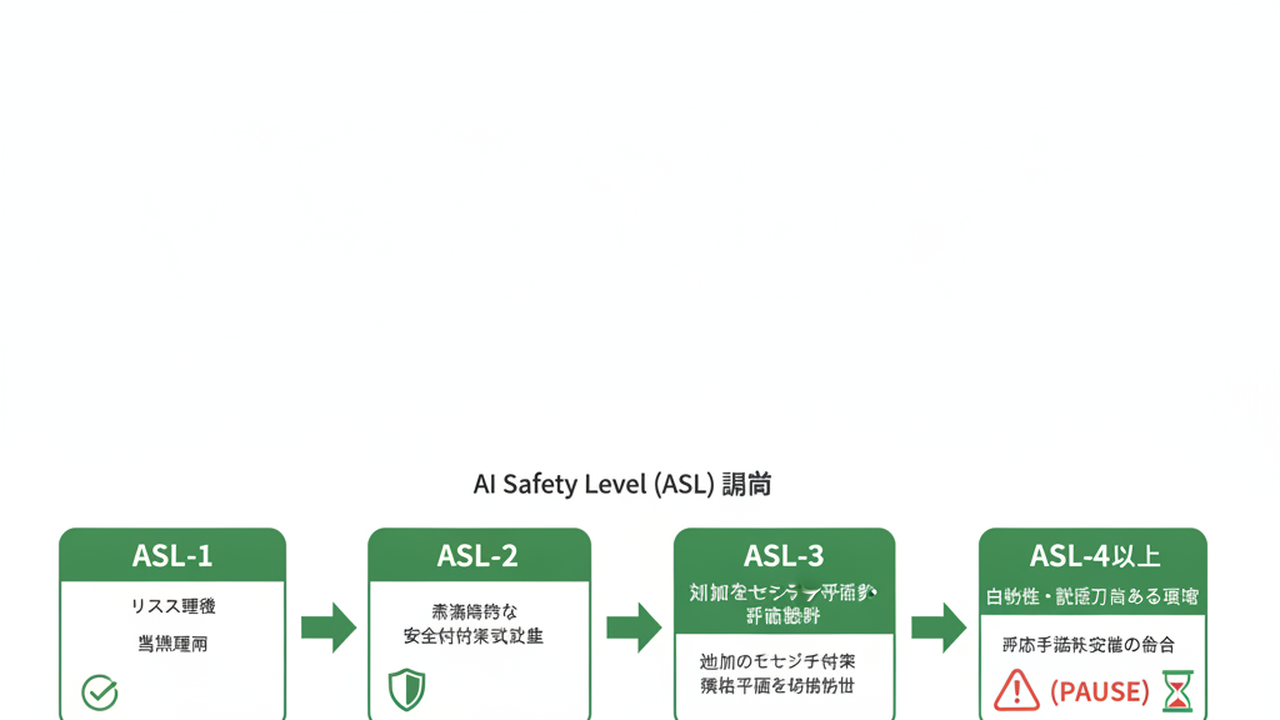
So concretely, what does Anthropic mean by “pause”? The answer lives in their Responsible Scaling Policy (RSP). The RSP is Anthropic’s publicly available, self-imposed scaling rulebook that tiers AI model capabilities into levels.
Those tiers are called AI Safety Levels (ASL) — a concept borrowed from BSL (Biosafety Levels) used in biotech. As capabilities increase, the ASL advances from ASL-1 through ASL-2, ASL-3, and ASL-4. Each level is tied to a condition: “If we reach this capability threshold without corresponding control mechanisms in place, we pause deployment.”
That’s the key point. Anthropic’s “pause” is not “permanently shut down all AI development.” It’s “conditional, temporary suspension until controls catch up.” And they apply the same condition to themselves. No contradiction.
| Term | Meaning | Relation to “pause” |
|---|---|---|
| ASL-1 | Systems with minimal risk | Normal operation |
| ASL-2 | Most current large models | Operate with standard safeguards |
| ASL-3 | Capabilities with serious misuse risk | Additional security and evaluation required |
| ASL-4+ | Higher autonomy and persuasion capabilities | Pause if evaluation methods aren’t ready |
The “pause call” in coverage naturally reads as directed at all labs pushing into ASL-3+ territory. Understanding that “Anthropic is not calling for a pause at ASL-2” makes the implication clear: the Claude, Cursor, and Copilot we use day-to-day are not directly affected.
No reason to panic. That said, the fact that Anthropic has “moved to the side calling for a pause” is worth noting — a deliberate signal to cool the industry down one notch.
For Anthropic, this isn’t a press release. The RSP is a living document updated annually, and its commitments get heavier as the company scales. Publishing and maintaining it is what gives this week’s statement its weight.
Breaking Down the Warning: 3 Frameworks
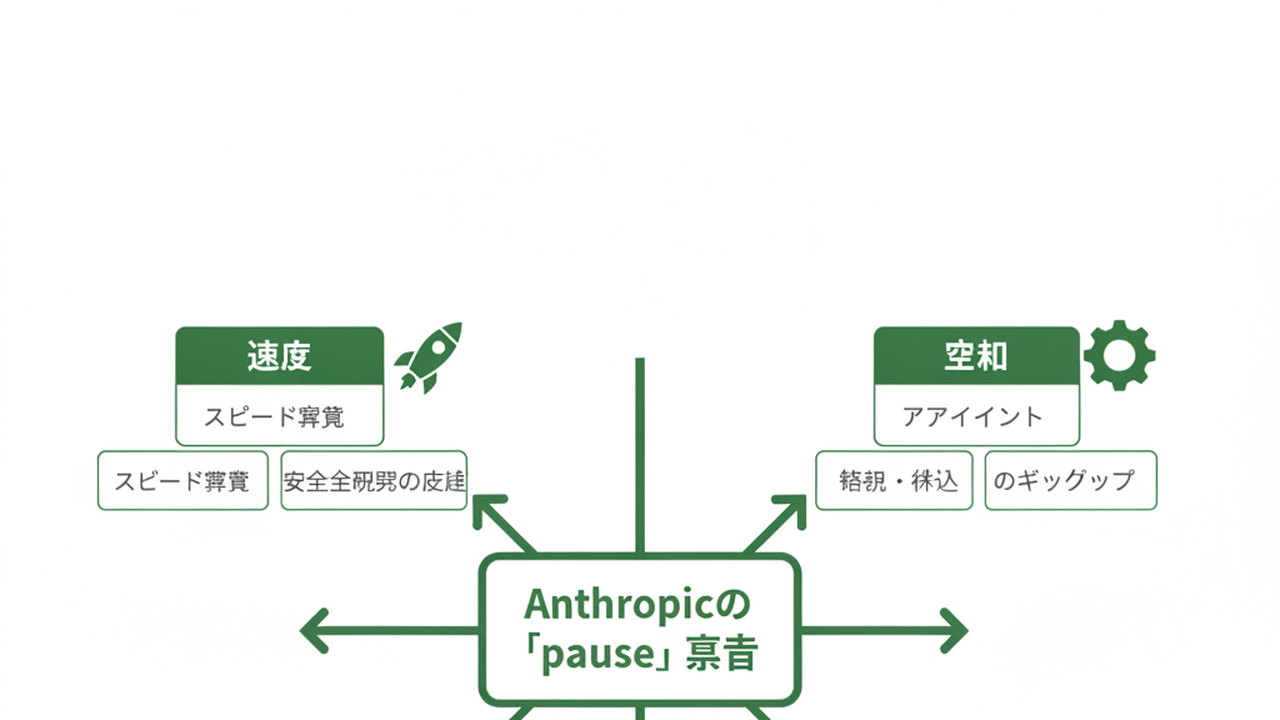
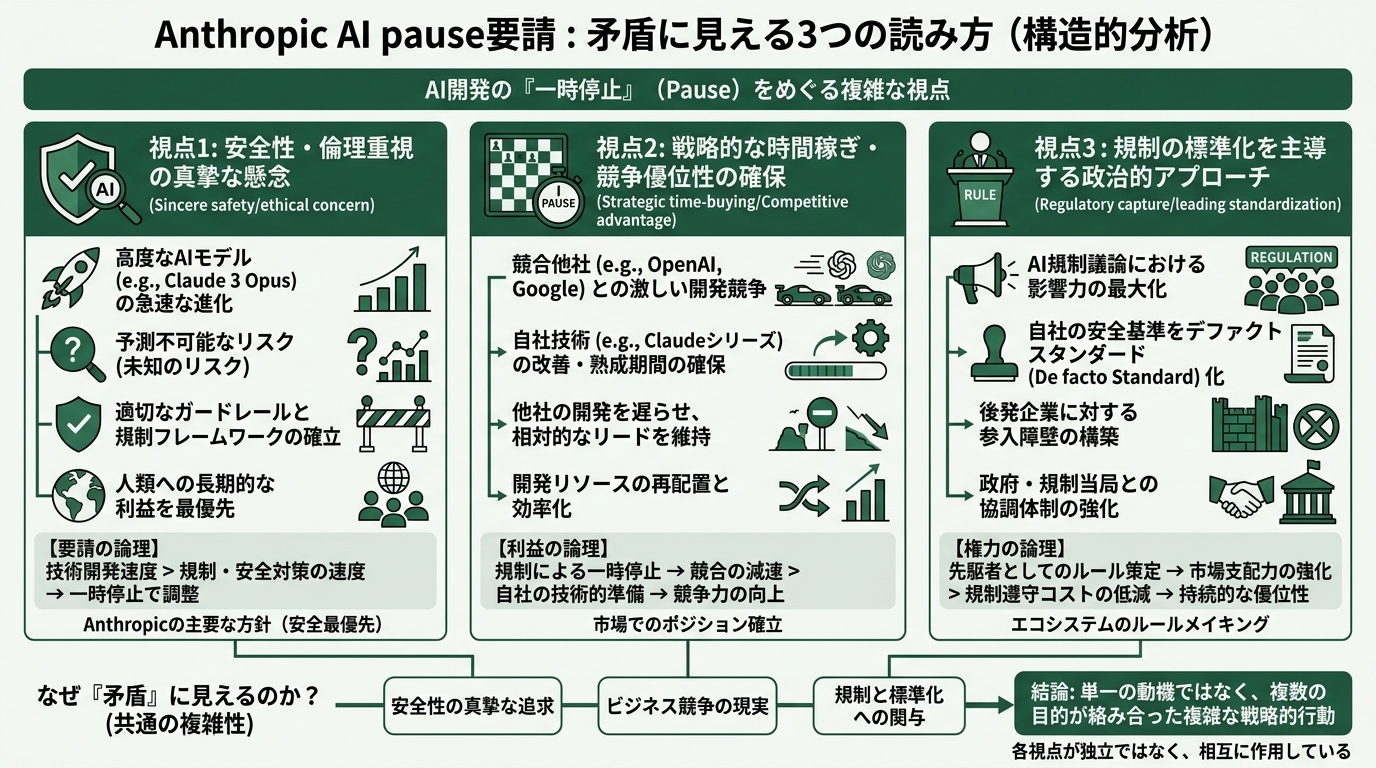
Decomposing “pause” across three axes makes Anthropic’s argument three-dimensional. Based on my reading, those axes are speed, control, and transparency.
Axis 1: Speed
The whole industry has entered a race where “shipping first wins.” Anthropic is a player in that race — not exempt. But when speed gets over-prioritized, safety research can’t keep up. The “pause” reads as a warning against that velocity ceiling.
The structural problem is “safety research always running a lap behind.” Fast model ships → gets used → problems emerge → reactive fixes. That reactive cycle is what Anthropic wants to break. That’s my read of why they called for a pause.
Axis 2: Control
Control capability has two components. First, alignment — whether the model behaves as intended. Second, oversight and intervention — whether you can stop it when it tries to do something wrong. Beyond ASL-3, the concern is that both types of control can’t keep pace. Anthropic’s warning is a direct challenge to this control gap.
When I’m vibe coding with Claude Code, I feel this personally: I can’t fully track what the agent is doing. Things work — that’s great. But there are definitely moments where I can’t explain why something turned out a certain way. The industry-level control gap is structurally identical to that individual feeling.
Axis 3: Transparency
This third axis is less flashy but important. If every company simply says “we have it under control,” there’s no external way to verify. A third-party evaluation framework becomes necessary. The RSP’s public availability is itself part of this transparency push — Anthropic is sending the message: “We publish our tiers and evaluations, and the industry should follow.”
Keeping these three axes in mind lets you separate “pause” from generic “AI is scary” takes. The three-part package: slow down the velocity, accelerate control technology, publish your evaluations. It’s not “stop everything.” It’s closer to an active call: “Establish the conditions that allow progress to continue safely.”
With this framing, Anthropic’s statement isn’t an isolated news item — it’s the latest installment in a five-year argument. My first reaction was “why is the company that makes Claude saying this?” Once I understood their stance, it was completely consistent.
What Changes for Claude Code Users Starting Tomorrow
Now let’s talk about our practice. Whether you’re using Claude Code, Cursor, or Copilot, your workflow won’t change much tomorrow. These tools operate within ASL-2 bounds. But treating “won’t change” as “don’t need to think about it” is a missed opportunity.
In my assessment, three things shift starting today.
Shift 1: Growing responsibility to understand what AI agents did
When vibe coding with Claude Code, the agent rewrites files. Treating “it works” as sufficient and moving on creates problems down the road. As AI labs standardize toward “audit-friendly designs,” users should develop the habit of reading back through logs.
Concretely: start with “always read the diff before committing.” Instead of blindly running git add on Claude Code’s output, scan the diff before proceeding. To reduce later fix costs, a 5-minute diff review is the fastest path. Since building this habit myself, my anxiety about “why did this end up this way?” has dropped dramatically.
Shift 2: Re-reading usage policies and safety guidelines
Open Anthropic’s official usage policy and spend 5 minutes checking whether your use case appears on the prohibited list. Usage through Claude Code counts. Even if you think “I’m fine,” if you’re designing agents that handle customer data, there may be additional data handling requirements. This isn’t about legal risk avoidance — it’s about preventing a surprise service disruption.
Labs will increasingly update terms following pause discussions. A use case that’s fine today may require verification in six months. Building the habit now vs. verifying after something goes wrong carries a completely different mental cost.
Shift 3: Documenting AI use in published code
If you publish code on GitHub or a personal blog, develop the habit of noting “this code was written with AI assistance.” It’s an individual-level response to the transparency axis. Anthropic itself has stated in official blog posts that AI’s contribution should be disclosed, even in academic papers.
One line at the bottom of your README — “Built with Claude Code” — is enough. It’s not for anyone else; it’s for your future self. If something goes wrong six months from now, not knowing which parts were AI-written vs. human-written slows down the fix.
Why I Now Read Articles I Would Have Skipped Three Years Ago
Honest admission: if I’d seen this news three years ago, I would have scrolled past. “AI safety? Still pre-practical,” I would have thought. Back then, “working things” felt too far away, and safety and control weren’t things I had space to consider.
What changed was the first time I used Cursor.
AI was completing my code — anticipating what I was about to write. “Wait, could this actually work?” I ran it. It did.
The essence of vibe coding is “putting your name on code an AI wrote.” Exciting when it works. But shipping to production without understanding the code invites security incidents. Research on AI-generated code vulnerability patterns is already accumulating — one overseas study reportedly identified defects across 170+ apps. “It worked” and “it’s safe” are different claims.
Anthropic’s statement, coming from an industry leader, carries the force of: “The responsibility to own what you shipped belongs to you too.” “Claude Code made it work” is not enough. You need the readiness to take responsibility for what the output does. This isn’t a mindset lecture — it’s a conversation about concrete steps.
I count myself among the “make it work first” crowd. But this pause discussion gave me reason to ease off the gas by one notch. The drive to build things that work hasn’t changed. What I want to add starting today is the habit of checking what happens after I ship.
Three Checks for This Week — Turning the Warning into Action
Ending on mindset isn’t useful. Here’s a concrete checklist you can complete this week.
Check 1: Does your AI agent workflow include human checkpoints?
If you’ve built automation with Claude Code, audit whether there’s at least one point where a human reviews before things proceed. A diff review before committing, manual approval before production deployment, an approval prompt before database changes — if those three exist, you have minimum viable checkpoints. If not, add them this week.
This check takes 30 minutes. Write out your workflow on paper and trace the arrows: “Is a human reviewing here?” If you find a fully automated flow, insert one approval step. Perfect design can wait — first, create places where you can stop.
Check 2: Re-read usage terms and prohibited use cases
Open Anthropic’s official usage policy and spend 5 minutes confirming your use case doesn’t appear on the prohibited list. Claude Code usage counts. Even if you’re sure you’re fine, if you’re designing agents that handle customer data, there may be additional data handling requirements.
It’s worth checking now because “terms update after pause discussions” has happened before. Anthropic’s usage terms have been updated multiple times in the past year. “Fine today” doesn’t guarantee “fine in three months.”
Check 3: Document AI use in published code
GitHub READMEs, code in blog posts, internal documentation — note “this code was written with AI assistance.” It’s for your future self. When something goes wrong six months from now, not knowing which parts were AI-written vs. human-written slows down the fix.
All three checks can be done by this weekend. Total time: 1–2 hours. Rather than “doing something because Anthropic said pause,” frame it as “setting up the foundation for continuing to build working things.”
The fundamentals of getting started with Claude Code are covered in Claude Code: 3 Decision Points and Your First 30 Minutes. After reading today’s piece, use it to revisit “is my usage on the safer side?”
Summary
Three frameworks for reading Anthropic’s “AI pause call”:
- The surface contradiction of “the leader telling everyone to stop” is consistent with Anthropic’s five-year safety stance. They apply the same conditions to themselves.
- “Pause” is a conditional hold for ASL-3+ territory — no direct impact on our day-to-day use of Claude, Cursor, or Copilot.
- The warning is structured across speed, control, and transparency. It’s not “stop everything” — it’s an active call to “establish the conditions for safe progress.”
The drive to build working things with Claude Code and the readiness to own what those things do can coexist. Work these three checks into your workflow starting now.
When a cutting-edge company steps back, followers face a choice: follow or not. I chose “fix just these three things” over “stop everything.”
Sources:
- “Anthropic urges AI labs to pause, warns humans risk losing control” (Al Jazeera, June 12, 2026 — primary URL unavailable; cited as secondary source)
- Anthropic official “Core Views on AI Safety” (cited as publicly known document)
- Anthropic official “Responsible Scaling Policy” (cited for publicly available ASL tier structure)

正直、一度エンジニアは諦めました。新卒で入った開発会社でバケモノみたいに優秀な人たちに囲まれて、「あ、私はこっち側じゃないな」って悟ったんです。その後はカスタマーサクセスに転向して10年。でもCursorとClaude Codeに出会って、全部変わりました。完璧なコードじゃなくていい。自分の仕事を自分で楽にするコードが書ければ、それでいいんですよ。週末はサウナで整いながら次に作るツールのこと考えてます。