Why Claude Code Is Winning: Three Evidence Layers Land on the Same Day
WIRED reports on OpenAI playing catch-up. JetBrains Survey shows Claude Code's usage surge. KDDI rolls it out company-wide. Three evidence layers — press, data, named case study — converged today. What it means for your tool choices.
What you'll learn in this article
- Where pricing and adoption questions around Claude Code stand right now
- Which plan or rollout stage fits the reader's situation
- Which follow-up article to open next for setup, cost, or bigger-picture context

Three sources converged on the same day.
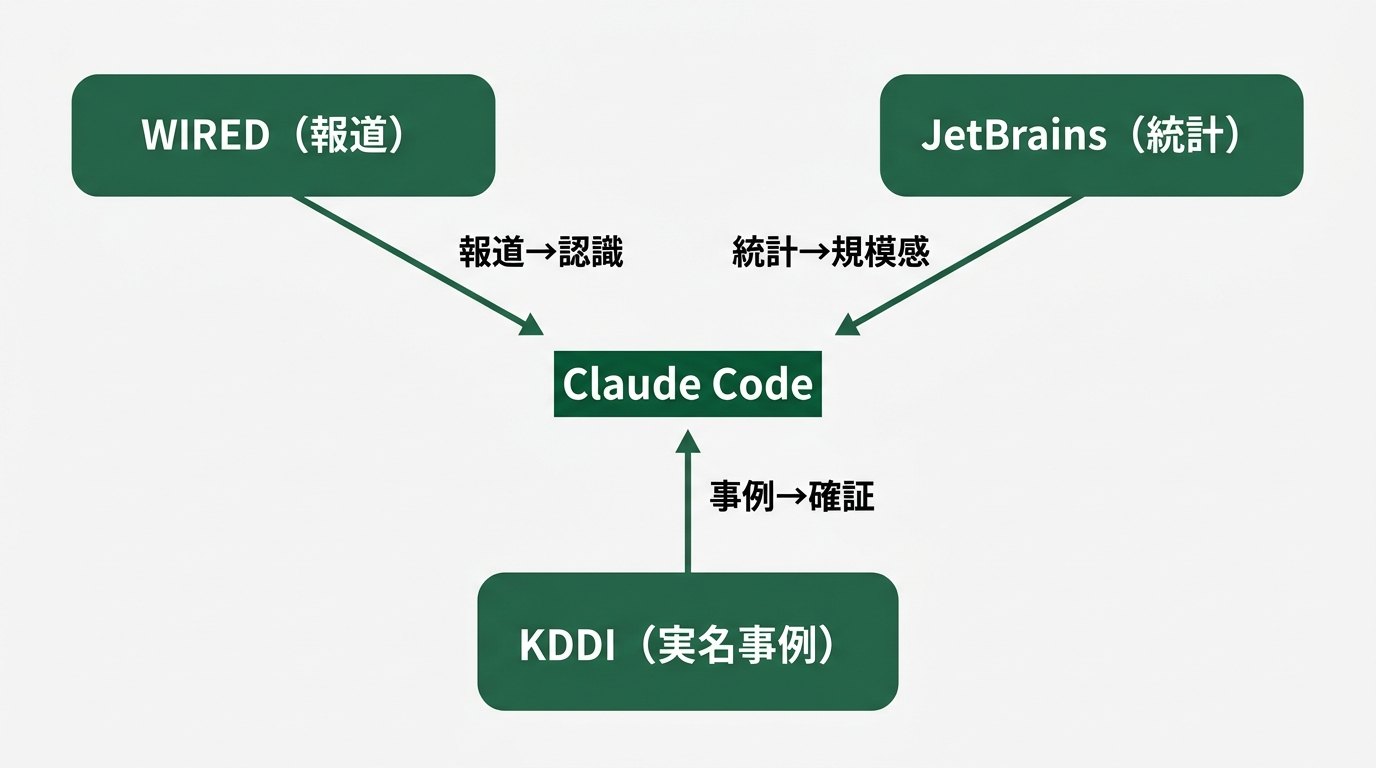
WIRED reported on the inside story of OpenAI playing catch-up (June 2026). JetBrains published developer survey data showing sharp growth. KDDI Agile Development Center announced company-wide deployment of Claude Enterprise (PR TIMES, June 1, 2026).
“Claude Code is surging” is no longer a gut feeling. Press coverage, developer survey data, and a named enterprise case study — three layers of evidence — all landed in the same place today.
As someone who came from a CS background and once hit a wall with coding, days like this make me want to step back and sort out my tool choices. What actually changed, and what does it mean for how I work? Let me trace it through real examples.
WIRED’s “Gravity Shift in the Competitive Landscape”
WIRED reported on the inside story of OpenAI racing to catch up with Claude Code (June 2026). The core of the piece: the pursuer and the pursued have switched positions.
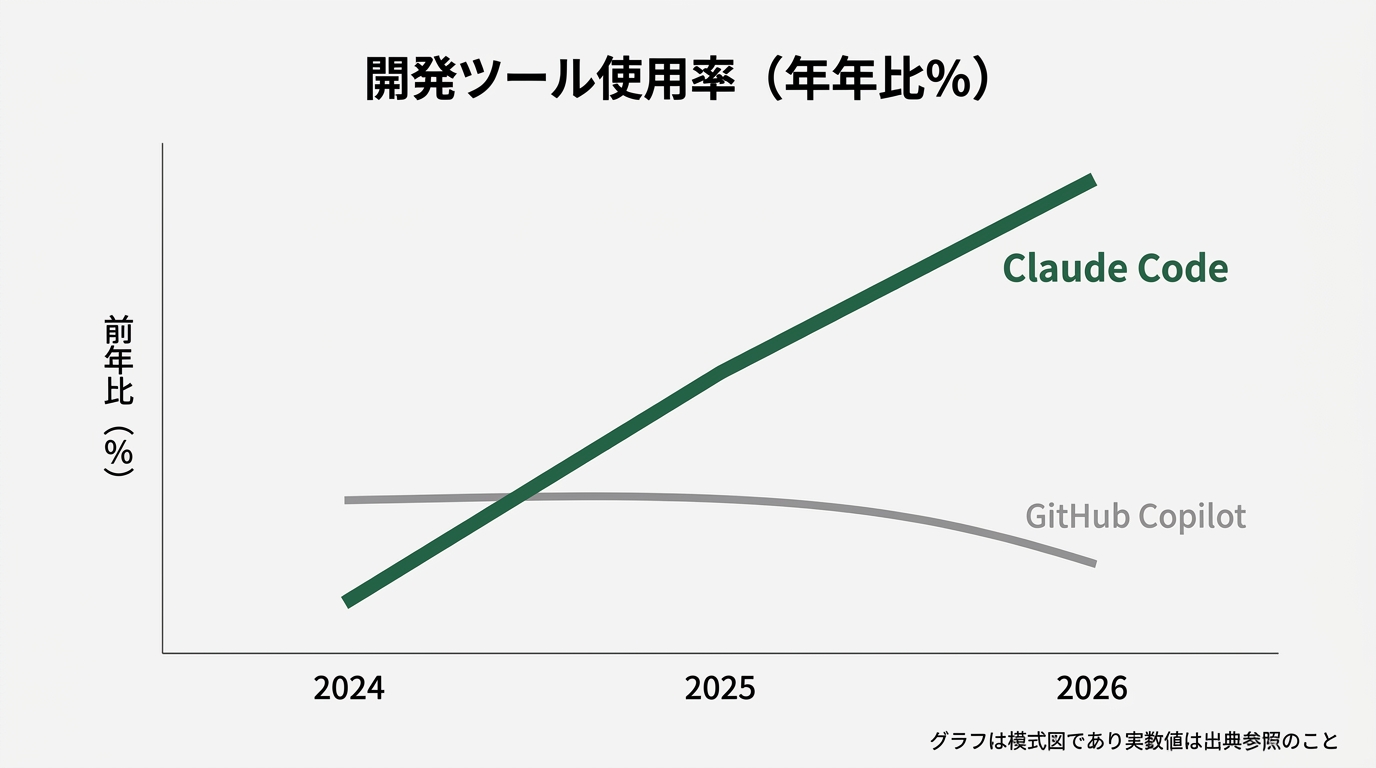
A year ago, GitHub Copilot and Codex-based tools were the “default” in developer circles. There was a period when saying “I use Copilot” was the assumed baseline in any conversation. That has changed.
I moved my primary workflow from Cursor to Claude Code in late 2025. Right after the switch, I got “Wait, not Cursor?” a few times. Now the reverse is happening. A vibe of “Still only running Cursor?” has started to drift through the developer community.
The way tools come up in study groups has shifted. The “Claude Code badge” is showing up more in Slack tech channels. When I look at GitHub Actions config files, Claude Code steps are being added in. These changes surface before the data does.
When a publication like WIRED takes on a topic, it signals that “an industry phenomenon” is entering the stage of becoming “general awareness.” WIRED reaches a technically literate audience — but those articles also land in front of CTOs, managers, and HR. The fact of being reported is itself fuel that accelerates the next shift.
The biggest effect of competitive press coverage is “permission to choose.” The framing of “even OpenAI is chasing them” becomes a psychological safety valve for “it’s okay to switch to Claude Code.” When you’re proposing a new tool internally, having “the whole industry is moving” in the background helps proposals clear internal approval. That’s the real value of a WIRED piece.
JetBrains Data: Visualizing the Results of Choice
The JetBrains Developer Ecosystem Survey is an annual survey of developers worldwide. It sits alongside the Stack Overflow Survey (90,000+ respondents annually) as one of the most reliable data sources in the industry.
Nagi covered the full picture in Claude Code 6x Surge Analysis published the same day. According to that piece, Claude Code’s adoption rate recorded a sharp year-over-year jump. For the comprehensive breakdown, I’ll point you there; in this article I want to focus on what the statistics mean in practical terms.
Developers are normally conservative about changing tools. Some people spend a year deciding whether to switch from VSCode to Neovim. When statistics show that conservative adopters moved in a short window, it’s not a simple popularity vote — it’s evidence of how many developers concluded “this works in production.”
Two things I prioritize when reading numbers.
Prioritize growth rate over current market share
To judge which tool has the most momentum, growth rate is more informative than current absolute share. A tool at 5% share but 3x year-over-year is, in practice, “rising.” The sharp growth rate Nagi’s article shows changes the framing away from “Claude Code share is still lower than Copilot’s” — the direction the next 12 months are heading matters more than today’s absolute number.
“Tried it” and “replaced my existing tool in production” are entirely different
When user count grows, “I tried it out” and “I replaced my existing tool in my actual work” carry completely different weight. A high proportion of the latter means “it passed production evaluation.” If the JetBrains data can confirm this distinction, the meaning of “surge” increases considerably.
In my own experience, the move from “tried it” to “made it my primary tool” happened when the nature of my work changed. For single-file scripts, Cursor covered me fine. When I started building a CRM integration tool spanning multiple files, Claude Code’s context management strength became unmistakably clear.
The survey numbers reflect the accumulated result of people whose work has shifted in the same way. When individual experiences aggregate into data, that’s no longer “trend” — it becomes what you should call “structural change.”
KDDI’s Decision to Go Company-Wide
KDDI Agile Development Center announced company-wide deployment of Claude Enterprise (PR TIMES, June 1, 2026).
Enterprise decisions carry weight. When a company goes from “piloting to see what happens” to “full company rollout,” it has cleared multiple thresholds.
First: cost. Claude Enterprise carries monthly fees, and at company-wide scale the total grows with headcount. KAG choosing full-company deployment means the pilot phase produced measurable work-speed improvements — ROI numbers had to be in hand before scaling up.
Next: security. Sending code from a telecom carrier to Anthropic’s servers requires substantial legal and security review. This is a fundamentally different decision from a startup “just trying it.” Clearing this hurdle means Anthropic’s enterprise security standards passed an enterprise-level audit.
Finally: training cost. Getting an AI tool into productive use requires more than learning the interface — it requires changing how people think about working alongside AI. Company-wide rollout means building the training infrastructure for that change. Clearing all three hurdles to make this call is what gives the decision its weight as a market signal.
In my CS days doing CRM implementation consulting, I watched exactly how named case studies propagate. When we added a single line to a proposal — “Company X deployed this and achieved Y% efficiency gain” — the evaluation phase would suddenly accelerate. When a decision-maker said “if that company is doing it,” the technical explanation had already finished doing its job.
The fact of KAG’s company-wide deployment becomes a device that makes internal approvals easier at other enterprises. When you’re proposing Claude Code at a mid-sized company, “KDDI is using it company-wide” carries force. It can shave weeks off the approval process — fuel that lifts “the team wants to try it” into “we’re moving forward company-wide as an executive decision.”
For the full enterprise adoption lifecycle, see The Turning Point When Claude Code Enterprise Became a Product.
What Happens in the Market When Three Sources Converge
Press coverage alone tends to end at “sounds like a thing, I guess.” Data alone gets “the numbers are hard to follow.” A named case study alone gets “sounds like their specific situation.”
When all three arrive together, something shifts. “This is a problem happening at my company too” — that sense of recognition emerges. Press defines the problem. Data provides the scale. A named case study provides the assurance that “we could do this too.” After passing through all three stages, the pace of decision-making changes.
In my CS work supporting software adoption, I watched this structure play out repeatedly. Before a new tool becomes recognized as “the industry’s answer to this problem,” there are always three stages: press (problem framing), research (scale confirmation), case study (proof that it applies to us). In that sequence.
Claude Code cleared all three stages today.
What comes next is the “majority migration phase” — the larger wave that follows after early adopters have moved. While early adopters were moving, you could still search for reasons not to use something. Once three layers of evidence have accumulated, the cost of finding “reasons not to use it” rises sharply. “There’s not enough information yet” no longer holds as a reason.
I’ve watched “majority migration” begin in developer tool markets before. After VSCode emerged, the editor market shifted. After npm became mainstream, package management changed. After Docker standardized, container environments changed. Each time, acceleration happened after three evidence layers accumulated. Claude Code is entering that stage — that’s my read.
Where Are You Right Now? Three Axes for Your Tool Decision
Three axes for deciding how to act on this convergence.
| Axis | Question to ask yourself | Where Claude Code stands out |
|---|---|---|
| Code granularity | Do you often work across multiple files? | ✅ Strong at maintaining project-wide context |
| Team temperature | Is the team ready to migrate together? | ✅ KDDI company-wide case supports internal proposals |
| Cost tolerance | Can Pro plan ($20/mo) pay for itself in efficiency gains? | Depends on usage and job type |
Axis 1: Code Granularity
Whether you’re writing single-file scripts or driving multi-file projects determines which tool fits you better.
Claude Code is strongest in the latter case. It maintains project-wide understanding through long conversations. When I built a CRM integration tool, I could direct it to “connect this part to the logic in that other file” across 5 files. Cursor can approximate this, but the sense of context cutting out is real.
If most of your work is single-file processing, Cursor may be plenty for many situations. If you’re taking on more mid-size and larger projects, the case for switching grows.
Axis 2: Team Temperature
Solo development: you decide alone. Team development: whether everyone uses the same tool affects efficiency.
The fact that KDDI chose the phrase “company-wide” is telling. Their conclusion: aligning everyone at the company level produces better results than partial adoption. In a team context, a single early mover can create friction — if a reviewer is still on Copilot, aligning on quality standards takes extra back-and-forth.
The way I measured team temperature: at a weekly standup, I just asked “who’s tried Claude Code?” Watching the count of raised hands change over three months tells you when the time is right to move to a team-level discussion.
Axis 3: Cost Tolerance
Claude Code starts with Claude Pro ($20/month); heavy usage may require the Max plan ($100/month). Check current pricing on Anthropic’s official site — the numbers here are as of writing and may have changed.
Running Cursor and Claude Code in parallel versus consolidating on Claude Code is a function of your usage and job type. My current setup: Claude Code for primary agentic work, Cursor for inline completion and quick edits. I check monthly whether “the efficiency gains justify running both.”
This Week’s Next Step: Shortest Path to Trying Claude Code
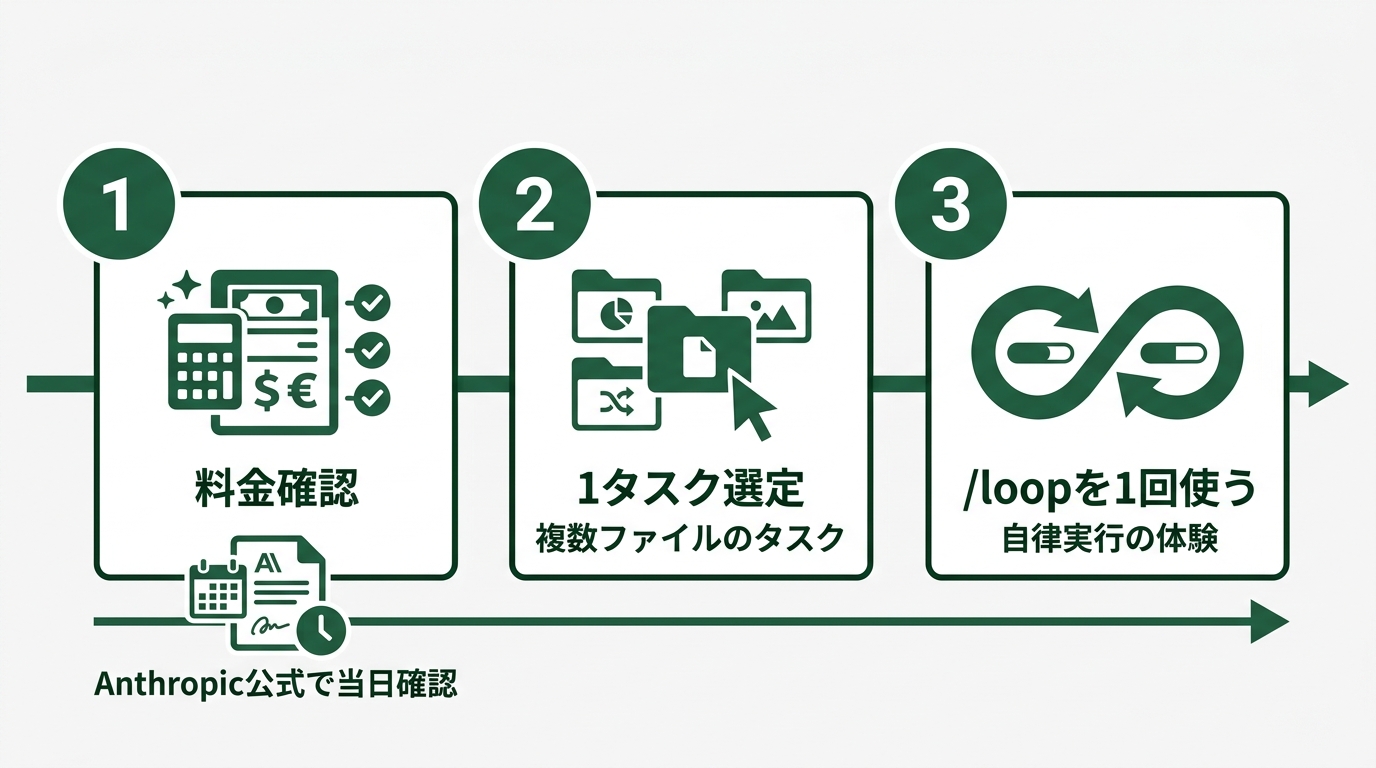
With three sources now converging, here are actions you can take this week.
Step 1: Check today’s pricing and set a budget
Check Claude Code Pro plan pricing at anthropic.com/pricing on the day you’re reading this. At time of writing, the minimum is the Pro plan at $20/month, but this may have changed. Decide your monthly cap upfront — “one month trial, up to Pro plan limit” — so you’re not second-guessing later.
Step 2: Pick one multi-file task from your current work
Claude Code performs best on work that spans multiple files. Scan your recent task list for something you’ve had to redo multiple times in Cursor. That’s your test case. Single-file modifications won’t show the difference clearly. “Adding a feature across multiple files” or “reflecting a spec change with tests included” are the best first candidates.
Step 3: Run /loop once
Claude Code has a /loop command for repeated execution. Issue the instruction “keep going until all tests pass” once and watch Claude Code work autonomously.
# Launch Claude Code
claude

# Loop mode (repeating task execution)
/loop "keep going until all tests pass"
With that single command, Claude Code runs “check → fix → recheck” on its own. Time I used to spend staring at an editor thinking “why won’t this pass” becomes wait time. You can feel that difference on the first try.
Finishing these three steps within the week dramatically speeds up your judgment on “does Claude Code work for my job?” One step taken because “three sources converged and I tried it” could change your work efficiency six months from now.
Wrapping Up
Competition sharpens tools.
OpenAI is in pursuit. JetBrains makes it visible in data. KDDI goes all-in with their name attached. That structure explains the current developer tool market.
In an intensifying competitive landscape, users benefit the most. Claude Code’s capabilities have expanded dramatically over the past year. /loop, skill-building, and Computer Use integration all emerged from competitive pressure. When Anthropic considers “what do we ship next,” JetBrains data and KDDI’s company-wide deployment are pressure. The judgment that “we need to maintain this standard or we’ll be caught” accelerates product development.
What developers should be doing right now is not “pick a winner.” It’s “given the tools this competition has produced, how do I use them to move my work forward.”
“Intensifying competition” means more tools, better performance, broader choice for the user. A year from now, there will likely be better tools than today’s. That’s exactly why to move now. Trying something and concluding “not the right moment for me” is itself a valid outcome. The gap between “couldn’t judge because information was missing” and “tried it and made a call” changes what your next action looks like.
WIRED reported it. JetBrains put numbers on it. KDDI went company-wide. All of that landed today. Coming from someone who once hit a wall with coding and found their way back: the most honest thing I can say is — the tools are there, there’s no reason left not to try.
For the detailed JetBrains survey analysis, see Claude Code 6x Surge: The Full Breakdown.

正直、一度エンジニアは諦めました。新卒で入った開発会社でバケモノみたいに優秀な人たちに囲まれて、「あ、私はこっち側じゃないな」って悟ったんです。その後はカスタマーサクセスに転向して10年。でもCursorとClaude Codeに出会って、全部変わりました。完璧なコードじゃなくていい。自分の仕事を自分で楽にするコードが書ければ、それでいいんですよ。週末はサウナで整いながら次に作るツールのこと考えてます。