Ahrefs Goes Social: Day 8 and the 3 Layers Collapsing SEO-Social Silos
Eight days after Ahrefs entered social media management, no deep Japanese analysis exists. In the AI search era, separating SEO and social is structurally broken. Three layers explained and one 90-minute action for this week.
What you'll learn in this article
- The key point to grasp before reading the full article
- How the issue changes practical decisions after reading
- Which follow-up article is worth opening next

“It’s been eight days since Ahrefs entered social media management.”
And I haven’t seen a single Japanese article that really digs into it. Launch overviews and initial reports from March and May existed. But a deep analysis — “why did Ahrefs move in this direction, and why now” — is essentially absent in Japanese as of June 13.
This isn’t just a content gap. The same gap is happening in how people design their SEO and social stacks.
Separating SEO and social management in the AI search (GEO/AIO) era is structurally broken. Ahrefs moved now because they’re standing at the exact point where that structure collapses.
Reading this article, you’ll be able to do three things:
- Understand why “SEO × social separation” breaks in the AI search era, through a 3-layer structure
- Read the 3 market signals that triggered Ahrefs’ move
- Know the single 90-minute action to start integrating your stack this week
Day 8 With No Deep Japanese Analysis. What’s Happening?
First, let’s establish the facts.
Since Ahrefs announced their social management feature, initial trade press coverage has come out — Commerce Pick and PR TIMES-sourced announcements are findable. But analysis beyond the headline: “why did Ahrefs move in this direction now, and what does it mean for your entire marketing stack?” — I found nothing in Japanese in my search scope (as of June 13 morning).
The English-language coverage moved faster. Ahrefs’ official blog, Search Engine Land, and Search Engine Journal started framing the move as “entering the integration phase” almost immediately after the announcement.
Two reasons for the Japanese delay, I think.
First, most Ahrefs users are SEO practitioners. Social management is someone else’s job — there’s an implicit division of responsibilities. “It’s not my specialty, so I won’t write about it.” “Social managers don’t use Ahrefs, so they won’t read it.” Both sides pass on it.
Second, the entry wasn’t a “surprise.” Ahrefs has been gradually expanding social features since their January 2026 official launch. The June developments look like “the expected next step.” Without novelty, it doesn’t fit the breaking-news template.
But in my view, stopping there means missing something. That something: why has the English-language marketing community already organized this as a 3-layer structural argument within eight days?
Eight days is the window for converting a single-tool announcement into a “structural market shift.” English-language marketers are using that window to share the idea that “the era of separation-first marketing stacks is ending.” If Japanese discussion hasn’t reached that position yet, there’s first-mover space here.
Which brings the question: what is that structural shift? That’s what I want to get into.
AI Search Era: 3 Layers Why “Separate SEO and Social” Breaks
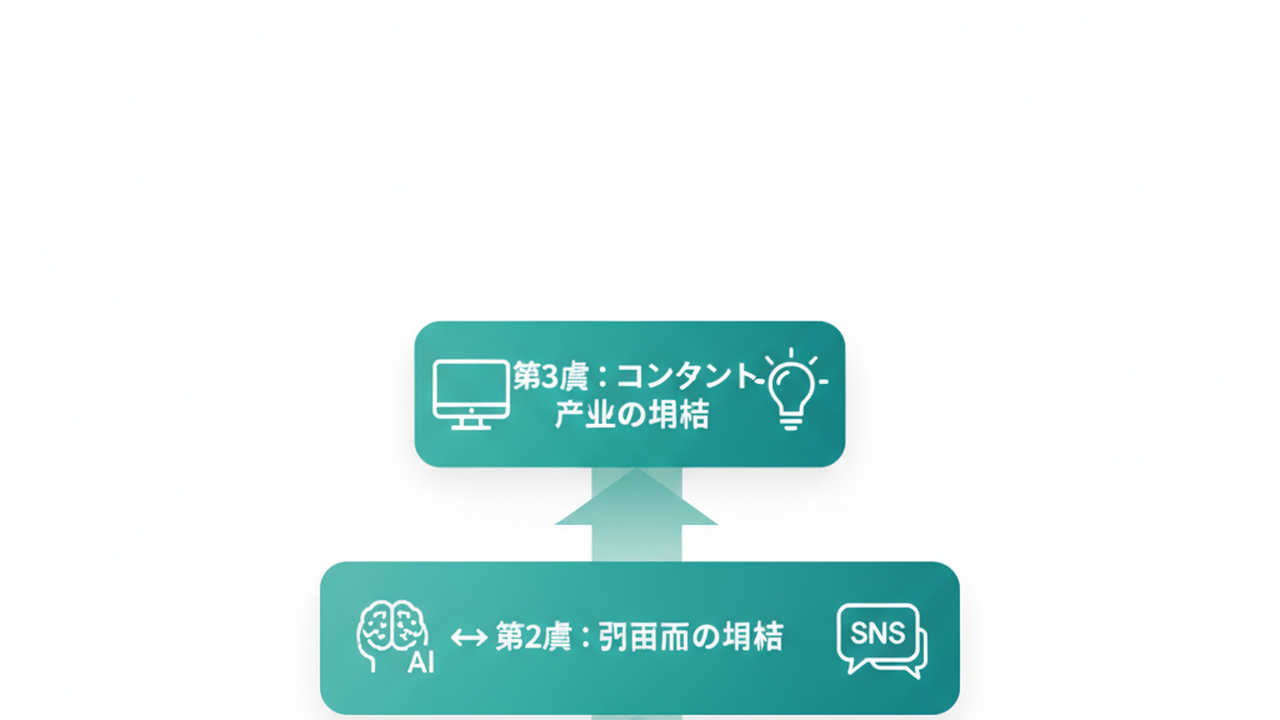
In my framework, the reason separation fails in the AI search era becomes immediately clear when you break it into three layers.
Layer 1: Search behavior integration
Users’ search behavior no longer completes inside Google’s search box.
Someone researching “Claude Code enterprise deployment” searches Google — and also looks for practitioner experience on X, reads vendor case studies on LinkedIn. The same information-seeking goal spans three surfaces. In the user’s mind, Google and social media are already part of the same “search experience.”
This is consistent with what Pew Research has been observing for years in younger demographics’ information-seeking behavior shifts. In Japan too, my sense of things changed in 2026. The rate at which X, LinkedIn, and YouTube are built into the search paths of business professionals in their 20s and 30s has clearly increased (from personal professional observation).
If the search experience has integrated, the tools used to design it also integrate. That’s Layer 1.
Layer 2: Citation source integration
AI search engines — Google AI Overviews, Perplexity, ChatGPT search, and others — are starting to pull from social media posts as citation sources.
This is an extension of the argument I made in GEO Is Over: AI Visibility Is the New Game. AI search engines aren’t only looking at “authoritative domains.” X, LinkedIn, Reddit, YouTube comment sections — all are being referenced as citation sources.
Which means: social posts are not “outside of SEO.” In the AI search context, social posts are starting to be treated as part of the SEO content landscape. If you’re competing to be cited, managing SEO and social separately is a design contradiction.
Layer 3: Content production integration
When Layers 1 and 2 are in place, the upstream of content production has to integrate too.
“The decision to write an article on this topic” and “the decision to post on social about this topic” should be made at the same table. If article topic selection and social post topic selection are managed in separate spreadsheets, you’re giving up integration opportunities.
This is where an SEO-native integration tool like Ahrefs becomes effective. When search volume and post engagement live in the same dashboard, topic selection becomes a single decision. Layer 3 integration lands here.
Reading the three layers in sequence: “search behavior integrated → citation sources integrated → content production integrated.” Ahrefs moved now to secure a position at Layer 3 of that chain.
Why Now: 3 Market Signals That Triggered Ahrefs’ Move
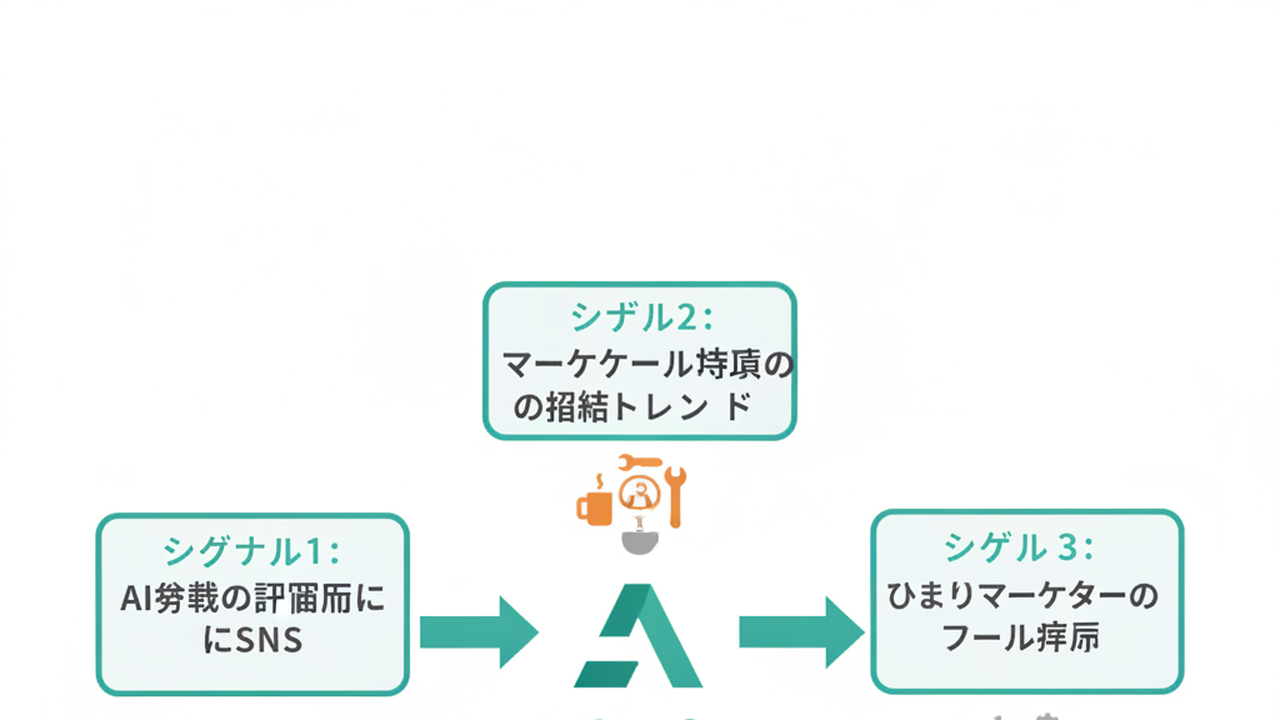
My Day 8 read: three signals explain why Ahrefs moved now.
Signal 1: The inflection point where AI search pulls from social
In 2026, Google AI Overviews, Perplexity, and Microsoft Copilot Search are all live. The proportion of social posts in their citation sources is reportedly increasing — particularly X, Reddit, and LinkedIn. Specific numbers are available from sample studies and proprietary analyses, but single high-confidence figures aren’t publicly available yet.
Still, looking across the AI search moves from each company, the shift from “domain-based ranking” to “context-based citation” is happening. Cross-SEO-and-social content strategy is becoming necessary. The read that Ahrefs came to claim “the entry point for data integration” here is a reasonable one.
Signal 2: The marketing tool market’s consolidation trend
For the past two years, the marketing tool market has been swinging back from “function-specialized” toward “integrated platform.” HubSpot covers SEO, social, and ads in one view. Semrush has pulled in social analytics and local search. Ahrefs is expanding from site audit to content planning.
Solo marketers and small marketing teams can no longer absorb the management overhead of too many tools. Ahrefs’ move reads as an attempt to clearly claim the position of “SEO-native integrated tool” within this consolidation trend.
Signal 3: Solo marketer tool fatigue
Less about numbers, more about what I’m feeling on the ground.
What I’m hearing more and more from solo marketers and small-team marketing folks in 2026: “I have too many tools and I want to quit some.” SEO tools, social management tools, email, ad management, analytics, AI assistance. Monthly subscription totals in the ¥30,000–¥60,000 band have become normal.
This segment doesn’t move on feature-by-feature comparisons. They move on “can this replace three of what I’m already using?” Ahrefs is coming for this demand as the “consolidate into an SEO tool” option. The reverse direction — social tools like Hootsuite building out SEO capabilities — faces high barriers; SEO data depth takes years to build. Ahrefs has a structural advantage here.
Reading the three signals together: “AI search structural shift,” “tool consolidation trend,” and “user tool fatigue” all converged at the same moment in spring–summer 2026. Ahrefs’ timing wasn’t coincidence. It was inevitability.
The Competitive Map: SEO Tools Going Social

Let me step back and map the competitive landscape. What does the market between SEO tools and social tools look like?
Put “SEO-native ⇄ Social-native” on the vertical axis and “Analytics-focused ⇄ Operations-focused” on the horizontal, and the tools scatter like this:
| Quadrant | Representative Tools | Position |
|---|---|---|
| SEO-native × Analytics | Ahrefs / Semrush / Moz | Search keywords, backlinks, content planning as core. Social analytics added as extension |
| SEO-native × Operations | Ahrefs Social / Semrush Social | Routing SEO data into social posting decisions for integrated ops |
| Social-native × Analytics | Sprout Social / Brandwatch | Social mention and sentiment analysis as core |
| Social-native × Operations | Buffer / Hootsuite / Later | Post scheduling, publishing, and team collaboration as core |
In this map, Ahrefs currently sits in “SEO-native × Operations.” Semrush is moving in the same direction, but Ahrefs is generally seen as leading on SEO data depth and backlink database accumulation.
The reverse move — Buffer and Hootsuite building SEO functionality in-house — requires years of investment and faces high barriers. Short-term, the realistic scenario is Ahrefs and Semrush claiming the “SEO-native integrated ops” quadrant while Buffer and Hootsuite survive on “posting operations usability.”
For solo marketers, the decision axis simplifies. “Is my stack’s starting point SEO data or social operations?” If the former, Ahrefs and Semrush’s integration proposals are worth serious consideration. If the latter, keeping an operations-focused tool like Buffer while getting SEO data separately remains a valid choice.
My own current stack judgment is in Ahrefs Social: An Honest 4-Month Report — a piece that sorts out “who can and can’t cut a tool” based on actual operations. Combining the structural argument here with that piece should make it easier to determine which side you’re on.
3 Workflows Integration Rewrites
Let’s bring the structural argument down to solo marketer practice. What does Ahrefs’ social integration actually change? Three workflows make the shift visible.
Workflow 1: Topic selection decision-making
Before, I’d open my SEO tool and social management tool separately each week and make two separate decisions: “what article topic to write this week” and “what social topic to post this week.” The article side: check search volume in Ahrefs. The social side: continue last week’s well-performing topics in Buffer’s calendar.
In an integrated tool environment, this becomes one decision. Open Ahrefs’ dashboard, select the topic where “search volume is trending up AND social engagement is up 1.4x week-over-week.” Design both the article and the social posts around the same theme. My felt sense of time for weekly decision-making has dropped to well under half (from personal operational logs, Jan–May 2026).
A fair concern: “doesn’t this make topics uniform?” Half right, half wrong. Topic selection does become more uniform. But SEO-facing language and social-facing language still need to be designed separately. In fact, having a single through-line in the topic frees up more time to differentiate the expression.
Workflow 2: KPI integration
In the separation-stack era, KPIs were fully separate: “search traffic” on the SEO side, “engagement rate” and “follower count” on the social side. Weekly reports built separately.
In an integrated environment, the KPIs are still technically separate — but you look at them at the same time. “Search traffic on this topic is flat while social engagement is climbing.” “Both are up.” “Both are down.” These patterns appear side by side on one screen. Prioritizing next moves becomes cleaner.
For example: topics where “both are down” — skip them. Topics where “only social is up” — consider adding SEO article supplementation. Topics where “both are up” — extend the winning path to video or LinkedIn. Your decision mesh suddenly gets finer.
Workflow 3: Content sequencing
In the separation stack, “publish the SEO article first, then repurpose it for social” was the dominant order. For organizations where the article writer and post writer are different people, this order is natural.
In the integrated environment, the order becomes rearrangeable. “A topic that performed on social gets written up as an SEO article afterward” — the reverse order works. “Publish the article and the social post on the same day on the same topic, then compare reactions” — the simultaneous path works too. And in both cases, you have the decision data to proceed.
For solo marketers, this flexibility in sequencing is a direct competitive advantage. In weeks you can’t write an article, focus posts on only the topics with social traction. In weeks you can write, pull the priority topic from two weeks of social reaction data. The stack design problem converts into an operational rhythm design problem.
That’s the structural and practical argument wrapped up. What’s left is converting it into your own movement this week.
This Week’s Single Move: 3 Steps to Score Your Own SEO × Social Integration

Here are three steps so you don’t finish reading and stop there. Estimated total: under 90 minutes.
Step 1: Run a 30-day “search traffic × post engagement” correlation check (30 min)
Start with Google Search Console for your site. Pull the top 20 search queries for the past 30 days. Pull the top 20 posts by engagement from your social accounts over the same 30 days.
Put these two lists side by side and look for theme overlap. Exact matches aren’t required. The question is whether the same meaning appears in both. “Claude Code enterprise deployment” and “using Claude Code at work” are different words but overlapping themes.
Three or more overlaps: you’re already at the entry point of integration. Zero to two: your SEO and social operations are likely siloed. Either result gives you a clear picture of where you stand.
Step 2: Confirm whether AI search is citing social in your space (20 min)
Run your top 3–5 keywords through Google AI Overviews, Perplexity, and ChatGPT search. Manually check the citation source list under each answer.
If X, Reddit, LinkedIn, or YouTube appears even once, that’s evidence that the AI search citation logic includes social context in your space. If it’s zero — depending on your industry and keywords, there’s still a high likelihood it will appear soon. It’s worth starting now to consciously design your social posts for SEO purposes (title, opening, proper nouns).
This step takes 20 minutes. About 3–4 minutes per keyword.
Step 3: Sign up for a trial of one integration tool (30 min)
Pick one from Ahrefs, Semrush, or HubSpot and try the free trial or smallest paid plan. With Ahrefs specifically, the feel of the social management feature — and how tightly it’s connected to SEO data — is something you can experience directly.
What matters here: don’t make an immediate switch decision. Over 1–2 weeks of trial, note which decisions change in your own stack. Make the switch decision after that.
When the three steps are done, the structural argument will have converted into “my stack’s story.” Whether you can take these 90 minutes this week determines the precision of your marketing stack design going forward.
”The Separation-First Marketing Stack” Is Ending Quietly
One final thing for everyone who read this far.
The design of separate SEO and social management is quietly moving toward its end — right now. There’s no dramatic turning point. Ahrefs’ entry won’t be “that day” that everything changed. But the AI search structural shift, the tool consolidation trend, and user tool fatigue are all converging in the same place.
The marketer who claims their position there first versus the one who repositions three months or six months later — the operational efficiency gap compounds. A 20% productivity difference in three months, 40% in six months, isn’t implausible given the structure (personal estimate).
Ahrefs’ move is the Day 8 view of that tectonic shift. Don’t just look at the view — turn it into movement in your own stack.
Some adjacent reading to place alongside this:
- Ahrefs Social: An Honest 4-Month Report — the operational reality check for this piece’s structural argument
- GEO Is Over: AI Visibility Is the New Game — the premise for content strategy in the AI search era
- Why People Siloing SEO and Social Are Quietly Losing Ground — the first piece arguing the limits of separation stacks
- How Tool Selection in Marketing Is Changing — the full picture of the integrated platform trend
- Google Marketing Live 2026: AI Marketing’s Main Battlefield — Google’s response to the integrated platform shift
Whether you turn Day 8’s view into Day 9’s action is your decision. The 90 minutes this week is an investment in next month’s version of you.

AIを使いこなせない方は、この先どんどん差がつきます。僕はAIエージェントを毎日動かして、壊して、直して、また動かしてます。そういう泥臭い実践の記録をここに書いてます。理論は他の方にお任せしました。僕は動くものを作ります。朝5時に起きてウォーキングしてからコードを書くのがルーティンです。