JPMorgan's 7 Billionaire Habits: Read the 3-Layer Structure, Not the List
JPMorgan's 111-family survey identified 7 habits. But reading them as a list is why you're back to baseline in 3 days. Here's the 3-layer framework—and a 30-minute minimum implementation version—to build habits that actually stick.
What you'll learn in this article
- The key point to grasp before reading the full article
- How the issue changes practical decisions after reading
- Which follow-up article is worth opening next

How many “7 habits of billionaires” articles have you read by now? I’ve read plenty. The moment I finish reading, I think “okay, early mornings starting tomorrow”—and I’m back to baseline in three days.
JPMorgan Private Bank’s Principal Discussions Report (2025). I went back and read it properly. Interview records from 111 family lines, combined net worth over $500 billion. The 7-habit list is everywhere, but what’s rarely talked about is the structure behind “why wealthy families don’t slide back in three days.”
I’m going to break that structure down across three layers—time, decision-making, and information—and compress it all the way to a “minimum implementation version you can start in 30 minutes.” That’s what today is about.
What JPMorgan’s 23 Wall Survey Actually Shows
First, verify the source itself. Questioning the citation before writing is basic practice.
The research came from a team within JPMorgan Private Bank called “23 Wall”—the group handling the highest tier of wealth management clients. In 2025, they conducted direct interviews with representatives of 111 family lines. Combined net worth: over $500 billion, roughly ¥75 trillion. This was not a sample of “rich people”—it was heads of families who have maintained wealth across generations.

In English-language media, Fortune picked up this report on December 29, 2025. Business Insider, Entrepreneur, and AOL followed with consecutive coverage of the “7 habits.” References in English-language media are still ongoing six months after release. That’s why it functions as a reliable “evergreen topic”—that’s my read.
The seven habits:
- Reading
- Exercise
- Consistency
- Waking up early
- Prioritizing tasks
- Setting goals
- Deep thinking time
Written out, they seem unremarkably ordinary. “I know these.” I had the exact same reaction. But reading these seven as “just seven items” is almost guaranteed to send you back to baseline in three days. Today I’m unpacking the structure in how they’re arranged.
Entrepreneur cited an anonymous billionaire from the report: “The currency of life is time. It is not money.”
That one line is the key to reading these seven not as a scattered list but as a single unified structure. Fortune also mentioned that JPMorgan Private Bank puts out an annual summer reading list. The 2026 edition spans biographies to financial history. Reading isn’t entertainment in this context—it’s training to sharpen decision-making. That’s the wealthy family’s frame for “reading.” Same word, different purpose, entirely different weight.
The report also revealed data on AI usage among wealthy families: about 80% said they use AI in their personal lives, 69% in business. They’re not using AI “because it’s convenient”—they’re using it “to reclaim time.” The gap between people who pile up tools and people who sequence tools by priority opens right here. The trap of assembling tools before deciding priorities is essentially the same pattern described in the article about marketers who tried every tactic in the book.
Rereading the 7 Habits as a 3-Layer Structure
When you list all seven in parallel, you can’t tell where to begin. But look closely—the seven aren’t independent. They build upward in a “3-layer structure.”

Layer 1 is time. This is the foundation. Waking up early and consistency go here.
Layer 2 is decision-making. Prioritizing tasks, setting goals, and deep thinking time. These are the layer that decides what to do with the time secured in Layer 1.
Layer 3 is information. Reading and exercise. Exercise might seem like a stretch for “information,” but if you read it as “monitoring and calibrating your own state,” it belongs here.
The order is critical. If Layer 1 collapses, Layers 2 and 3 become impossible. People who feel “I have no time to read” or “I can’t set priorities” are almost always missing Layer 1.
When I first went independent, I tried starting from Layers 2 and 3 and failed. Made a reading list. Set goals. Stopped everything within three weeks. The reason was simple: I had no foundation that let me move at the same time every day.
When I fixed just Layer 1—early rising and consistency—the remaining five built themselves in under two months. Once the foundation is set, what gets built on top moves faster than you’d expect.
One clarification on what “consistency” means here. The report doesn’t spell this out directly, but this is my read: when wealthy families say consistency, they mean “doing the same habit at the same time in the same place.” Not “just keep going,” which is what you see on social media—but closer to “lock it in as a pattern.” When you lock in the pattern, the daily decision cost drops to zero. The question “should I do this today, or not?” stops existing.
This is the entry point to currency thinking—treating time like money.
Decision cost is quiet but the single biggest time thief. When I fixed my morning into a 3-step pattern—wake at 6am, drink water, go to the desk—I gained roughly 1.5 hours of focused time per day. Before, I was debating every morning: “should I check email first, or get coffee first?” Just eliminating that debate added 1.5 hours. That’s how quietly powerful locking in a pattern is.
The three elements of Layer 2—prioritizing, setting goals, deep thinking time—are designed to run on top of Layer 1. They only function when sufficient time has been secured.
Layer 3—reading and exercise—are less about “investing in yourself” and more about “information behaviors that sharpen decision-making accuracy.” Reading borrows other people’s brains; exercise reads your own body’s signals. Both exist to sharpen the judgments in Layer 2.
Once you see this, the 7 habits shift from “I have to do all 7” to “I build the 3 layers in order.” The burden drops dramatically.
What “Time Is Currency” Actually Means
“The currency of life is time. It is not money. You think carefully about how you spend one dollar. You should think just as carefully about how you spend one hour.”
Read this as motivational inspiration and you’ll forget it in three days.
Here’s how I read it: money decreases when you spend it, but can be grown. Time decreases when you spend it, and can’t be grown. So time deserves higher priority as a “scarce resource.”
Money has accounting—some people track every household expense monthly. But almost no one applies the same precision to time. How many people around you could tell you, to the hour, how they spent their time this week?
Wealthy families do time accounting. That’s my read—a thread that runs through all seven habits. Waking up early secures time. Consistency eliminates decision cost. Prioritizing decides where the time is spent. Setting goals plans large allocations (multi-month investments). Deep thinking time confirms the direction of judgments. Reading buys other people’s time (experience). Exercise maintains your own productivity.
All of it is about “how to manage time as a currency.”
Once you see this, the self-judgment of “I’m bad at habits” disappears. Wealthy families operate under the same time constraints. The only difference is the precision of their accounting.
And accounting precision can be improved starting tomorrow. Here’s how.
Converting the 7 Habits to a 30-Minute Minimum Version
If anyone reading this is about to say “okay, I’ll start all 7 tomorrow,” I want to stop you. You’ll be back to baseline in three days.
The 7 habits are a 3-layer structure. So I’m compressing each layer into a “minimum implementation” that takes 30 minutes or less. Build the foundation first, then add Layer 2, then Layer 3—in that order.
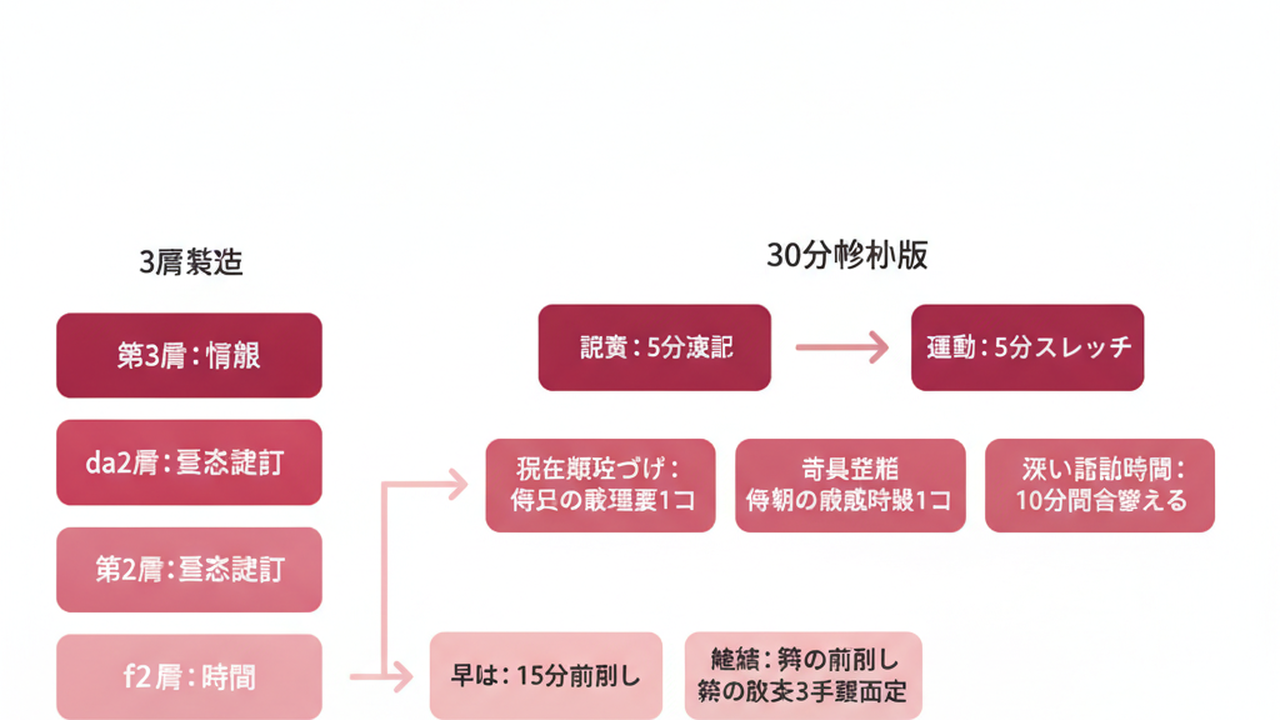
Here’s each habit’s 30-minute version:
Layer 1 (time foundation)
- Early rising: Move your wake-up time 15 minutes earlier. Not “I’ll start waking at 6”—if you’re currently waking at 6:45, go to 6:30. Shift 15 minutes at a time over two weeks.
- Consistency: Lock your morning into 3 steps. “Drink water, stretch, go to desk”—a sequence you can run without thinking. Decide the order now.
Layer 2 (decision-making operations)
- Prioritizing: At the start of each day, write your “3 things today” on paper. Not a task management app—paper first. Writing by hand forces you to narrow the list.
- Setting goals: Decide your “one thing this month” on the first day of the month. Not weekly—monthly. Weekly gets too granular and the direction gets lost.
- Deep thinking time: Reserve 15 minutes before bed as “thinking time.” Phone in another room. This one has the highest leverage.
Layer 3 (information investment)
- Reading: On the morning commute or lunch break, “just 10 pages.” Not a full book—chunk it into 10-page units.
- Exercise: 5-minute morning stretch right after waking up. No gym required. Just build the “moving” habit.
Total: a little over one hour per day.
Reframe this from “7-habit marathon” to “30-minute minimum implementation” and you stop sliding back in three days. The reason is simple: the cost of stopping is low. Quitting 15 minutes of earlier rising vs. quitting a 5am routine is psychologically different by orders of magnitude.
Start with the minimum, then expand the time per habit after 3 weeks based on what fits your body. Build the pattern first, then extend. Reverse the order and you’ll almost certainly break.
In my case, I started with just 10 pages on the morning commute. Three weeks later it expanded to 20, and now I read 30 minutes at a café in the morning. I couldn’t do 30 minutes from the start. But 10 pages? That I could do.
The important point: don’t start everything at once.
Wealthy families almost certainly didn’t start all 7 simultaneously either. They answered “this matters” in an interview—they didn’t have all 7 running from day one. We tend to look at “the current list” and miss the process that built it.
The sequence: fix the 2 habits in Layer 1 in the first 2 weeks. Add the 3 in Layer 2 over the next 2 weeks. Add the final 2 in Layer 3 in the final 2 weeks. All 7 embedded in 6 weeks.
Six weeks sounds long. But if you get a “pattern that doesn’t revert in 3 days” from 6 weeks, that’s an overwhelming return on the time invested.
Why Wealthy Families Don’t Quit
Two reasons, as I see it.
First, wealthy families have external pressure. Family, business partners, employees, investors. Failing to make certain decisions at certain times creates problems for the people around them. So they can’t let their patterns collapse based on personal convenience.
Second, wealthy families treat maintenance time as an investment cost. Reading, exercise, deep thinking time aren’t “is this making me money” calculations—they’re the cost of maintaining decision-making precision. So they don’t quit.
Solo founders have weak external pressure. Even with clients, there’s wide latitude to operate on your own schedule. “I’ll get to it tomorrow” becomes too easy to say.
To compensate, you have to create your own external pressure. Specifically: tell one person “I’ll share my progress every Monday.” That’s it. Early rising stops fluctuating. Consistency follows. Not having anything to say at the next check-in naturally drives priority-setting.
In my third year of independence, I set a weekly meeting with a fellow consultant. Monday mornings at 8am, fixed. The moment that went on the calendar, how I used Sunday evenings changed. I needed something to talk about Monday at 8am, so a reflection window naturally appeared on Sunday. Deep thinking time and consistency sprang from one commitment simultaneously.
One external anchor can launch multiple habits at the same time. That’s closer to the design philosophy JPMorgan’s survey surfaced—not “work at 7 things separately,” but “use one mechanism to stand up multiple.” The instinct for picking the right first task when 8 things are piled up is the same thing covered in the piece on choosing which of 8 articles to work on first.
External pressure plus maintenance time. Those two things are the structure that moves the 7 habits into “don’t quit” territory. When you start with the 30-minute minimum implementation, rope in “one person” in the first week—the odds of continuing improve significantly.
Anyone who has tried to sustain habits on willpower alone knows: willpower runs out in two weeks. Systems last.
Closing
I unpacked JPMorgan’s 7 habits not as “7 items to check off” but as a “3-layer habit design.” Time as the foundation, decision-making as the operations layer, information as the investment layer.
Don’t start all 7 at once. Build from Layer 1 in order. Start each habit in a 30-minute-or-less minimum version. Lower the abandonment cost so you don’t revert in 3 days. Install “external pressure” yourself. Treat “maintenance time” as an investment cost.
That was the substance inside the substance of what JPMorgan’s wealthy families call “7 habits.”
Today’s 30 minutes probably isn’t early rising or reading—it’s writing down tomorrow’s 3-step morning sequence on paper. Water, stretch, desk. Three things, on a piece of paper, left on the desk before you sleep. That’s the first step of Layer 1.
If that paper is there when you wake up tomorrow morning and the pattern starts running—you’re already halfway. The remaining 6 weeks are just confirming “so this is how it builds” with your body.
Stop overthinking and move. Failure is no big deal—if you haven’t hit all 7 in 6 weeks, reset and start again. The ones who actually did it win. So I’m putting a piece of paper on my desk tonight too.
JPMorgan’s 7 billionaire habits aren’t special behaviors of special people. Build the 3 layers in order and anyone can assemble them. What today’s version of us is going for is “a pattern that doesn’t revert in 3 days.”
Sources
- J.P. Morgan Private Bank, Principal Discussions Report (primary source) https://privatebank.jpmorgan.com/nam/en/insights/reports/principal-discussions
- Fortune, “The world’s wealthiest families adopt these 7 key habits for success, according to JPMorgan” (December 29, 2025) https://fortune.com/2025/12/29/best-habits-for-success-among-billionaires-worlds-wealthiest-families-jpmorgan-report/
- Entrepreneur, “Billionaires Credit These 7 Ordinary Habits for Success, According to JPMorgan” https://www.entrepreneur.com/business-news/billionaires-credit-these-7-ordinary-habits-for-success-according-to-jpmorgan
- AOL (via Business Insider), “7 habits JPMorgan’s billionaire clients attribute to success” https://www.aol.com/articles/7-habits-jpmorgans-billionaire-clients-121501921.html

女性だからこそ、AIを使いこなさなきゃって思ってる。仕事も、副業も、推し活も、旅行も、全部やりたい。人生一度きりなのに時間は足りないじゃん?だからAIに任せられることは全部任せる。浮いた時間で本当にやりたいことをやる。それがあたしのスタイル。ここにはあたしが実際にやったことをまとめてるだけ。誰かのためになったらいいなって思って書いてるよ。