Running a Business with 27 AI Agents: The Solo Founder's Team Design Guide 2026
Business Insider reported a solo entrepreneur running a full business with 27 AI agents. The same week, six major US media outlets covered the same shift. A 3-step framework for designing your AI team — not just using AI tools.
What you'll learn in this article
- What AI agents mean in plain language and why the term matters now
- Which real-world workflow patterns are already becoming practical
- Which next article deepens pricing, rollout, or implementation context
“Without a team, this is as far as I can go.”
That’s what I told myself for a long time.
I went freelance, then founded a solo company. The more clients I gained, the bigger the walls got. Time is finite. The cost and effort of hiring people was heavier than I expected. The “24-hour ceiling” followed me everywhere.
Something started shifting about a year ago.
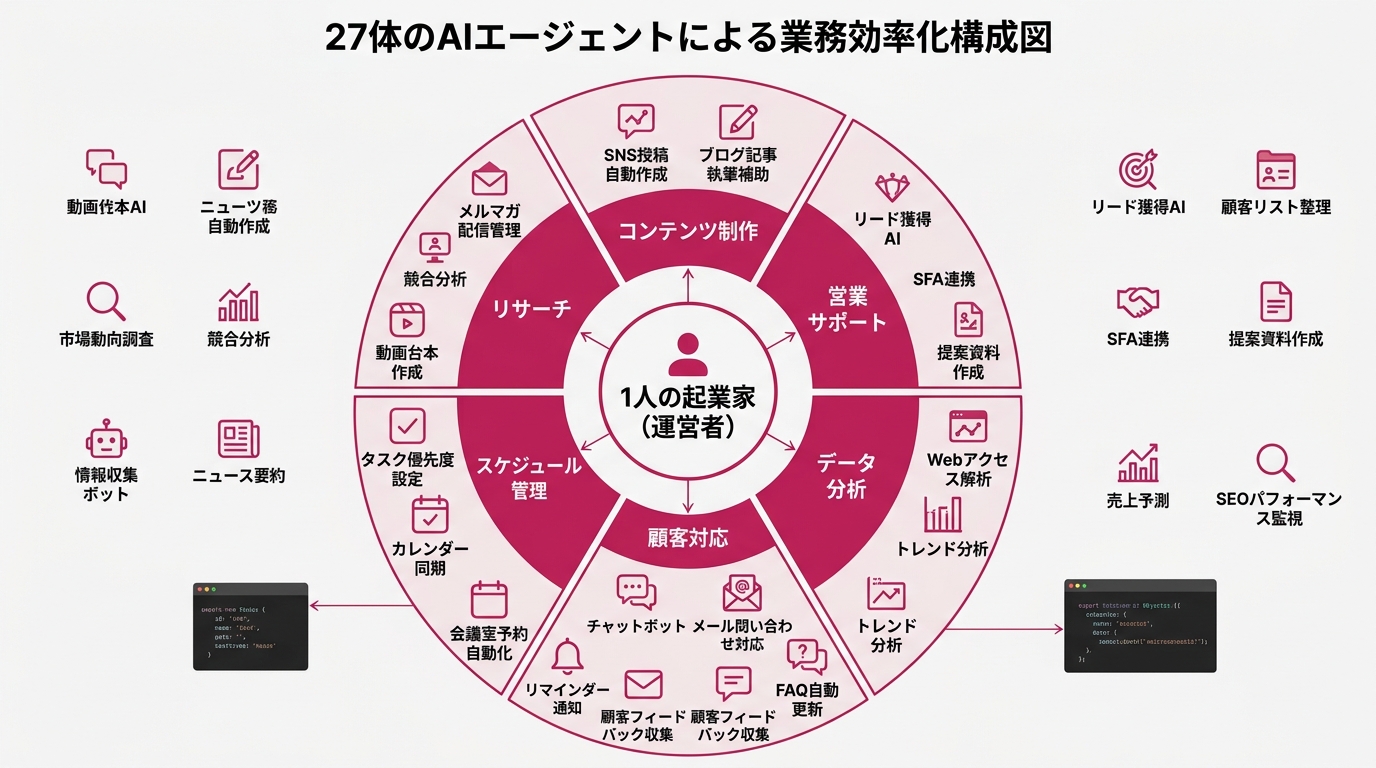
Business Insider ran a story about a solo entrepreneur operating a business entirely on their own. They were running it with 27 AI agents — AI systems that execute tasks autonomously. No staff hired, outsourcing kept to a minimum. AI agents handling different business functions, keeping the whole operation running.
When I saw that number, my first thought was: “Whoa. The era just arrived.”
This isn’t a story about AI being a “handy tool.” It’s a story about the era when AI becomes your team.
The Reality of “27 Agents” — What Business Insider Reported
In June 2026, Business Insider reported that a former eBay employee was running a business using 27 AI agents — with their real name and specific operational details. This was coverage at a time when Japanese-language media had barely touched the story.
What deserves attention isn’t just the fact of “using 27 agents” — it’s the structure that makes “a setup with 27 agents” viable in the first place.
An AI agent, unlike a simple “AI that answers questions,” is an AI that completes tasks spanning multiple steps. “Compile competitive intelligence every morning and share it.” “Send first replies to new inquiries.” “Draft three social posts per week and schedule them.” These are tasks that run without continuous human involvement.
27 agents means 27 of these “role-assigned AIs” running simultaneously.
Traditional solopreneurs — people running a business entirely on their own — had no one to share the workload with. The ceiling on what you could accomplish was determined by your total available time and focus. The spread of AI agents is starting to dismantle that premise.
One person can now hold 27 positions at the same time.
It might sound like science fiction, but this is a real case reported by a global-scale publication with the person’s real name attached. That weight is real.
The important thing isn’t the number 27 — it’s the message: “the era when a solo entrepreneur can actually have a team has arrived.” Agent count is an outcome, not a goal. I read “27” as a state arrived at through accumulation, not a target you aim for on day one.
One thing worth clarifying upfront: when people hear “using 27 agents,” many assume “that must be a big company operation.” It’s not. The subject of this story is an individual entrepreneur. Instead of building a team of employees, they made 27 AI agents function as team members.
Solo founders have the constraint of “can’t hire people.” But AI agents can be deployed within that same constraint. Because you’re “designing” rather than “employing,” there are no fixed costs. Want to scale? Add more agents. Want to cut costs? Remove some. This flexibility is something a human team can never deliver.
For a solo founder, this is the moment when “having a team” became cost-rational for the first time.
What It Means That Six Major Media Outlets Moved the Same Week
There’s context behind this coverage.
Beyond Business Insider, USA Today, The New York Times, Forbes, Fortune, and Time all published pieces within the same week on the themes of “one person × AI” and “small business × AI agent operations” — six major outlets in total.
Multiple major media outlets covering the same theme in the same week is hard to explain as coincidence. It signals that “this is a turning point” is spreading through newsrooms at the ground level.
Time’s coverage caught my attention in particular. Their angle was that U.S. small businesses are beginning to replace hiring with AI. What Time was describing isn’t just a temporary cost-reduction move — it’s a structural shift toward “designing businesses that don’t hire people in the first place.”
Six major outlets moved in the same week. What I took from that: “the legitimization phase has arrived.” The era of being asked “you’re really letting AI handle that?” is over. We’ve entered the phase of designing how to actually make AI function as a team.
This is not someone else’s problem for Japanese solo founders. If U.S. small businesses are “replacing hiring with AI,” the same option becomes real in Japan too. For Japanese solopreneurs specifically, this is an opportunity — the chance to have a team without the burden of employment.
Right now, the number of people thinking in terms of “designing a team with AI” is still small. Small is exactly when you can capture first-mover advantage. That’s my read.
What’s the Difference Between a “Subordinate” and a “Team”?
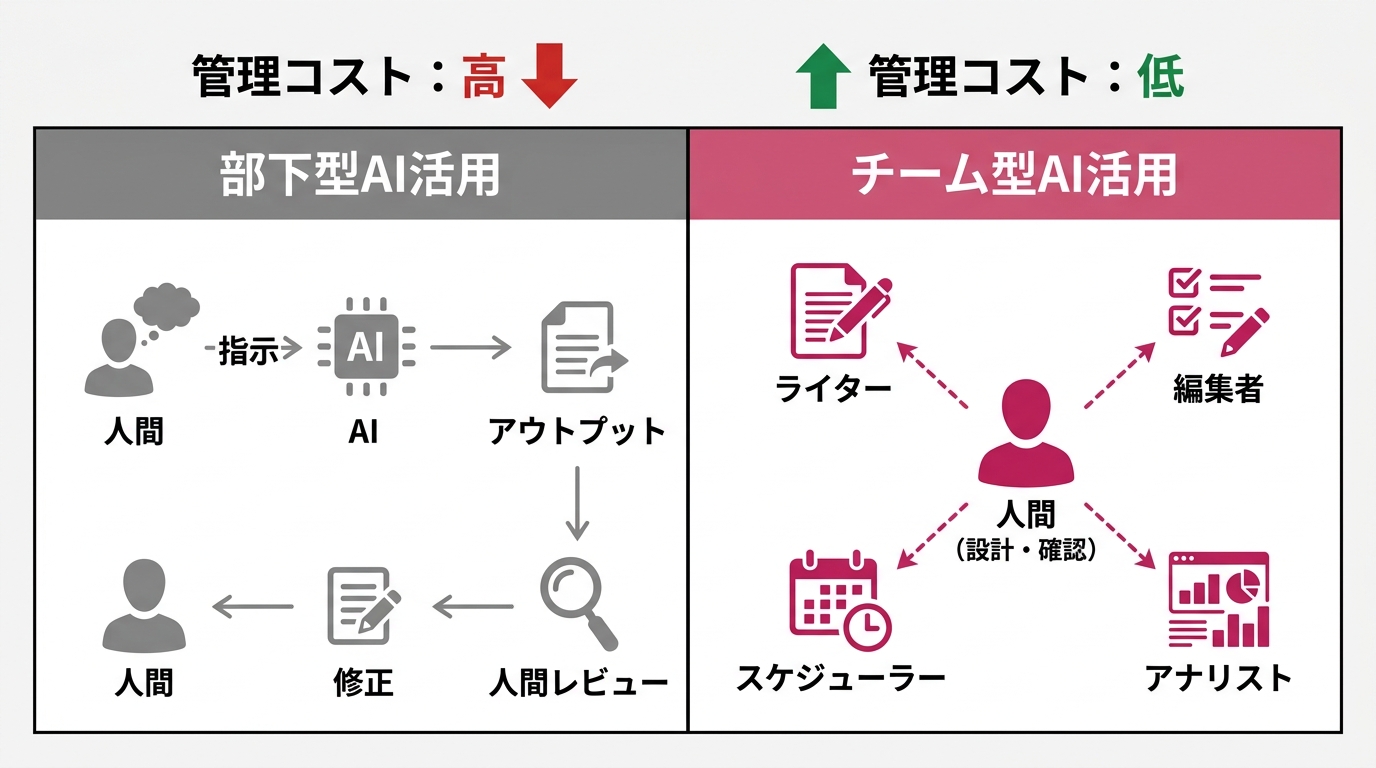
Until recently, most AI use was “subordinate-style.” You give instructions, review what comes back, revise it, then use it. The cycle continues.
The problem with subordinate-style is high management overhead. If a human is reviewing every AI output, your own time still gets consumed. The tool that was supposed to make things easier was generating a different kind of work. I burned out on exactly this in my first six months of AI use.
Team-style is different. Each member has a defined role and decision criteria, operating autonomously within set boundaries. The human’s job shifts from “giving instructions” to “designing and checking.” That difference is not small.
A concrete example makes it clearer. Suppose you’re building a content production team. The “writer” AI produces three drafts per week. The “editor” AI reviews those drafts and returns revision suggestions. The “scheduler” AI auto-posts the final version on the designated day. The “analyst” AI compiles the post-publish engagement data weekly.
With those four agents running, weekly updates become something the team runs — not something you write.
The critical element is designing the roles and decision criteria. How much autonomy does each agent get? Which decisions stay with the human? If that design is loose, the team falls apart fast.
“Give a subordinate instructions” or “design a team” — this shift in thinking alone completely transforms how you use AI.
Most Japanese solo founders and freelancers who say “I tried AI but couldn’t keep it up” are still stuck in subordinate mode. “It’s annoying because I have to instruct it every time” is a sign that you haven’t done the team design. Once you properly define roles and decision criteria, you don’t need to start from zero every time. Save your prompt as a “role definition document” and just call it up. Two to three hours of upfront design investment dramatically reduces ongoing management overhead. Not skimping on that “upfront investment” is the key to making the team-style transition.
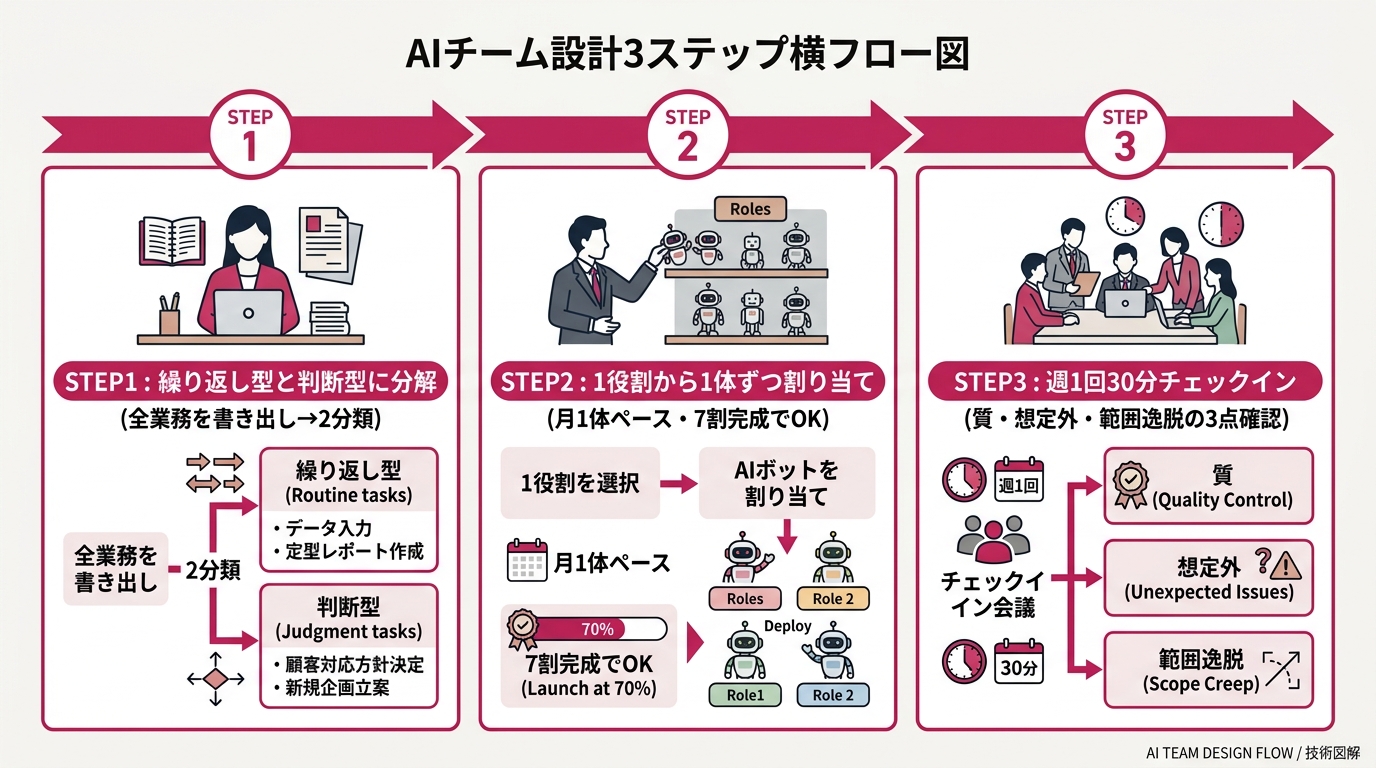
AI Team Design in 3 Steps — Start This Month
Step 1: Break Down Your Work into “Roles”
Start by listing out one week of your own work.
“Replying to emails.” “Creating materials.” “Social media posts.” “Client proposals.” “Issuing invoices.” “Responding to new leads.” When you line them up, there are usually more than you expected. Then split them into “recurring” and “judgment” tasks.
Recurring tasks are work that follows the same pattern every week or every day. Initial reply emails, social post drafts, regular report summaries, scheduling — these become AI agent candidates.
Judgment tasks involve content that changes with each case, or decisions with external implications. Final reviews of proposals, relationship-building with new clients, strategic pivots — these stay with the human for now.
Just listing out your recurring tasks reveals the full picture of “what can be handed to AI.” When I first did this exercise, I realized there were more recurring tasks than I’d thought. “I thought I was making a judgment call, but actually I was giving the same answer every time” — this came up more often than expected.
For example, “progress update emails to clients” looks like a judgment task, but 70% of it is templateable. “Competitive monitoring” is a recurring task if you’re following the same steps every week. Sorting through this lets you see how your time is actually being used.
Step 2: Assign an AI Agent to Each Role
Once you have your list, choose tools and try running one role at a time.
One key watch-out: don’t try to do everything at once.
Start with one role, get the feel of “OK, this actually works” — then move to the next. “27 agents at once” is not the day-one goal; it’s the state arrived at through accumulation. Once the first agent is running, add the next role. If you add one agent per month, you’ll have a 12-agent team in a year.
Conversational AI options include ChatGPT, Claude, and Perplexity. Combined with Make (a tool that automates connections between multiple apps) or Zapier, you can design agent-like workflows. For creative production, Canva; for document work, Notion’s AI features can also be incorporated.
The key point: don’t try to build a perfect team from the start. Rough is fine. Getting something running is what matters. Starting at 70% completion beats aiming for perfection and stopping — you’ll improve far faster by moving first.
A concrete example of task assignment: for “3 social posts per week,” a realistic design is:
- Information gatherer: Use Perplexity to compile industry news every morning
- Drafter: Instruct Claude to “write 3 patterns of 200-word X-ready posts based on this news”
- Scheduler: Auto-schedule posts using Buffer
Those three agents make a complete “social media team.” What I’m actually running right now is essentially this structure. Starting with just “have Claude create the draft” is enough. As you get comfortable, automate the information gathering and scheduling too. That accumulation becomes the team.
To share my own experience: my first agent got the role of “summarize the key points from a client email and draft 3 reply options.” I thought “I’d be faster doing it myself” — but when I actually delegated it, my morning email processing finished in half the time. The mindset of “try it, and if it doesn’t work, revert” is what matters.
How to build AI agents without code is also worth referencing.
Step 3: Schedule a Weekly “Check-In”
Human teams have weekly meetings for a reason: left unattended, performance degrades. AI teams are no exception.
Set aside 30 minutes once a week to review each agent’s output. Three things to check: “Is output quality holding?” “Is anything behaving unexpectedly?” “Is it doing things outside its defined scope?”
Those 30 minutes keep the team from rotting. Skip them, and gradually the outputs become unusable. By the time you notice, you’re in “the AI started saying weird things” territory.
“Building a team” and “maintaining a team” are separate skills. Great design can still fall apart in operations. The 3 decision rules for AI agent operations is worth reading alongside this.
Check-in frequency can be monthly or weekly — just not zero. Teams only function when they’re managed.
What I actually check during my check-ins:
- Output quality: Any change in quality compared to last week?
- Scope drift: Has it started doing things I didn’t ask for?
- Improvement opportunities: Any “I wish it worked differently” observations? If so, update the prompt.
Keeping a simple running note of this means “why did I design it this way?” is recoverable later. As the team grows, this makes reviews far easier. Thirty minutes a week is the minimum investment to keep a team from deteriorating.
3 Risks to Know Before You Overdo It
There are risks to building an AI team. Knowing them before you design beats discovering them afterward — the outcomes are completely different.
Quality variance
AI output isn’t always consistent. The same prompt can produce varying quality depending on timing or model version. “Full delegation” is dangerous. The weekly check-in exists for exactly this reason. Final accountability for quality stays with the human — always.
Data leakage risk
As you input more client information and personal data into AI tools, information management becomes a real concern. You need to decide upfront which tools get what kind of input. Turn off data training in paid plans, or anonymize inputs before they go in. This isn’t something to defer.
Cognitive atrophy
Delegating too much to AI reduces the opportunities to think for yourself. Especially after handing off all recurring work, when a “judgment task” suddenly arrives, your response capacity may have quietly degraded. Hold judgment tasks intentionally. Don’t let “it’s easier to just delegate it” pull you toward giving up all the judgment calls.
What I learned from my own mistakes: consciously decide the scope of what you hand to AI. Go with the flow and you’ll eventually find yourself in a state where the human isn’t really thinking anymore.
Summary: The Era When AI Becomes a Team — I’m Going to Meet It
“I’m delegating to AI. That’s it. …OK that’s too vague, let me be specific” — that’s basically my signature line.
What I pulled together here was the idea of “designing AI as a team.” Not using a tool — building a team. That shift in thinking is what dramatically expands what’s possible for a solo founder.
The case Business Insider reported — 27 agents — stands as a record of “this is how far one person can go right now.” More cases like it will keep appearing, I’m certain. But 27 isn’t the destination. “Creating a structure where recurring work runs on AI so I can focus on judgment work” — that’s the destination. Agent count is just the outcome.
When I launched my solo company, I thought “operating alone is scary.” Now I think differently: “precisely because I’m alone, I can design my team freely.” Human teams require relationship management. An AI team, if properly designed, has shockingly low maintenance overhead.
To anyone stuck thinking “solo work has limits” — in this era, those limits are breakable through design.
The fact that a solo founder can have an AI team means the biggest constraint — finite time — has been partially lifted. Not entirely. But even handing off recurring work alone visibly changes how much time is available for actual decision-making. What I experienced was the value of being able to focus on “what to think about.”
When I went independent in SNS marketing, “having to do everything alone” was my heaviest burden. Create content, talk to clients, write proposals, issue invoices — all of it, solo. “Solo has limits” was the lived feeling at the time.
Now, most of the recurring work is handled by my AI team. What I focus on is “relationship design with clients” and “direction judgment on strategy.” That this is what I actually wanted to be doing — I only understood that after building the AI team.
“Have to do everything alone” was just a fixed idea. “Creating a structure where I can focus on what I should actually be doing” — that’s the real job of a solo founder.
Stop deliberating and start moving. Failure is no big deal. Just try Step 1 — “break your work into roles” — today. That’s all.

女性だからこそ、AIを使いこなさなきゃって思ってる。仕事も、副業も、推し活も、旅行も、全部やりたい。人生一度きりなのに時間は足りないじゃん?だからAIに任せられることは全部任せる。浮いた時間で本当にやりたいことをやる。それがあたしのスタイル。ここにはあたしが実際にやったことをまとめてるだけ。誰かのためになったらいいなって思って書いてるよ。