The Medvi 6-App AI Stack Decoded: A 3-Axis Framework for Picking Your First Tool
Two brothers, $20K seed money, $401M in first-year revenue. Breaking down Medvi's 6 AI tools across 3 decision axes — weekend-testable, monthly cost, and learning curve — to help you choose where to start.
What you'll learn in this article
- The key point to grasp before reading the full article
- How the issue changes practical decisions after reading
- Which follow-up article is worth opening next

Have you heard of Medvi?
New York Times reporter Erin Griffith covered them on April 2, 2026. Matthew Gallagher (41, Los Angeles) and his brother Elliot built a telehealth startup together. Starting capital: $20K (roughly ¥3 million at ¥150/dollar). Full-time employees: just the two of them. First-year revenue in 2025: $401M.
The NYT verified those numbers. There’s no official valuation or external fundraising. The “$1.8B company” framing that’s been circulating is actually $1.8B as a revenue trajectory target — not a confirmed figure. But the $401M is on the record as a real number.
Recently, this article caught renewed attention on Hacker News. “Two brothers, AI, $401M” landed as a concrete picture of what solo operators can actually build with current tools.
That said, if you read this story and walked away thinking “impressive” and nothing else — I’d say you left the most useful part behind.
The one thing I want to organize today: “Of the 6 AI tools Medvi used, where do I start?” I’ll borrow the framework from Entrepreneur’s “7 tools for a weekend startup” piece alongside the Medvi stack and narrow down the first tool by business type.
Medvi’s 6-App AI Stack: What Each Tool Was For
Start with the facts.
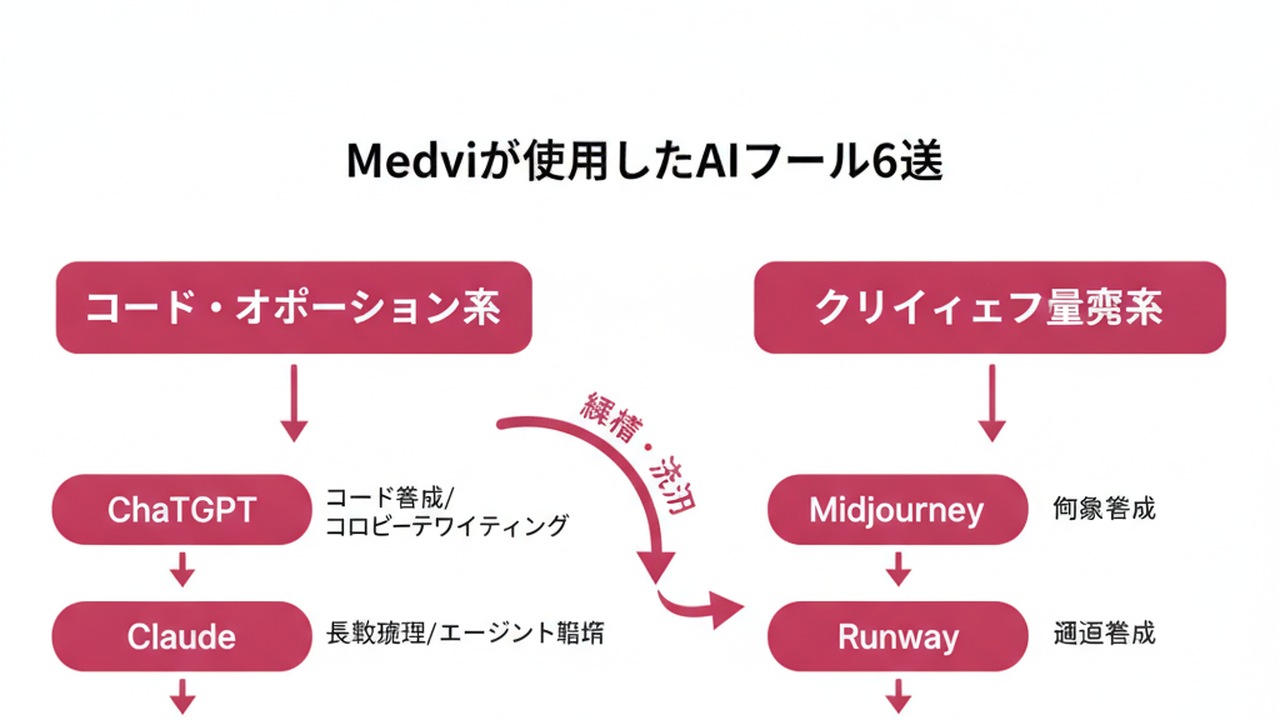
Based on multiple media reports, Medvi’s AI tools fall into two categories.
Code and Operations: 3 apps
First: ChatGPT (OpenAI). Used for writing website copy, generating code drafts, and designing the AI agent workflows that automated their operations. Matthew has essentially no engineering background. Yet ChatGPT’s natural-language interface let him generate code through plain instructions.
Second: Claude (Anthropic). Leveraged for processing long documents and building agents that bridge multiple systems. Claude performs well when you’re building the kind of complex automated workflow Medvi ran — the kind where “AI connects the pieces.”
Third: Grok (xAI). Data analysis and research support. Competitor research, market data organization.
These three covered the roles of engineer, copywriter, and data analyst. Functions that would normally require three or more people were run through AI instructions.
Creative Production: 3 apps
Fourth: Midjourney (image generation AI). Ad banners, website visuals — all generated at scale. No designer hired. Images created from text prompts.
Fifth: Runway (video generation AI). Ad videos and landing page video assets, all AI-generated. Reports say Medvi ran more than 5,000 ads on Meta. Runway is how they produced that volume of video creative without a video editor.
Sixth: ElevenLabs (voice synthesis AI). Narration audio generation. Natural-sounding voice content at scale, no human narrator required.
What AI Didn’t Handle
This is the most important part. Matthew didn’t do everything himself — and he didn’t try to.
Medvi’s business is a remote prescribing service for GLP-1 medications (glucagon-like peptide-1 receptor agonists, used to treat diabetes and obesity). That means physicians, pharmacies, logistics, and regulatory compliance are all in the picture. This part was entirely outsourced to external partners — CareValidate and OpenLoop Health.
The design from day one: a clear line between “what AI can do” and “what requires specialized professional expertise that AI can’t replace.” This is what made Medvi operate as a two-person company.
Net margin in 2025: 16.2%. Higher than major competitor Hims & Hers. The result of keeping fixed costs minimal by not hiring.
Worth noting: this case isn’t without controversy. The FDA issued warnings about compounded GLP-1 medications (custom-formulated drugs) during a period overlapping with Medvi’s operations, and there has been critical coverage of their practices. Opinions on the long-term viability of the business remain divided. Read this as a reference for operations design — not as a flawless blueprint.
Beyond “That’s a Different World”: The Entry Point Entrepreneur Shows
If you read the Medvi story and thought “well, $401M is a different scale” — in one sense, you’re right. Telehealth is a large market, and external partners were part of the equation.
But the lessons from their tool choices can travel regardless of scale.
Entrepreneur’s 2026 article “7 Tools to Start a One-Person Business on the Weekend” lays out a framework for choosing AI tools to launch a solo business — no staff, no coding. It reads as the beginner-level counterpart to Medvi’s “professional-level” stack.
If Medvi’s 6 apps are “the choices that power $401M,” Entrepreneur’s 7-tool framework is “the first choices for getting a business running this weekend.”
Overlaying these two layers shows where you’re standing right now — and where to start.
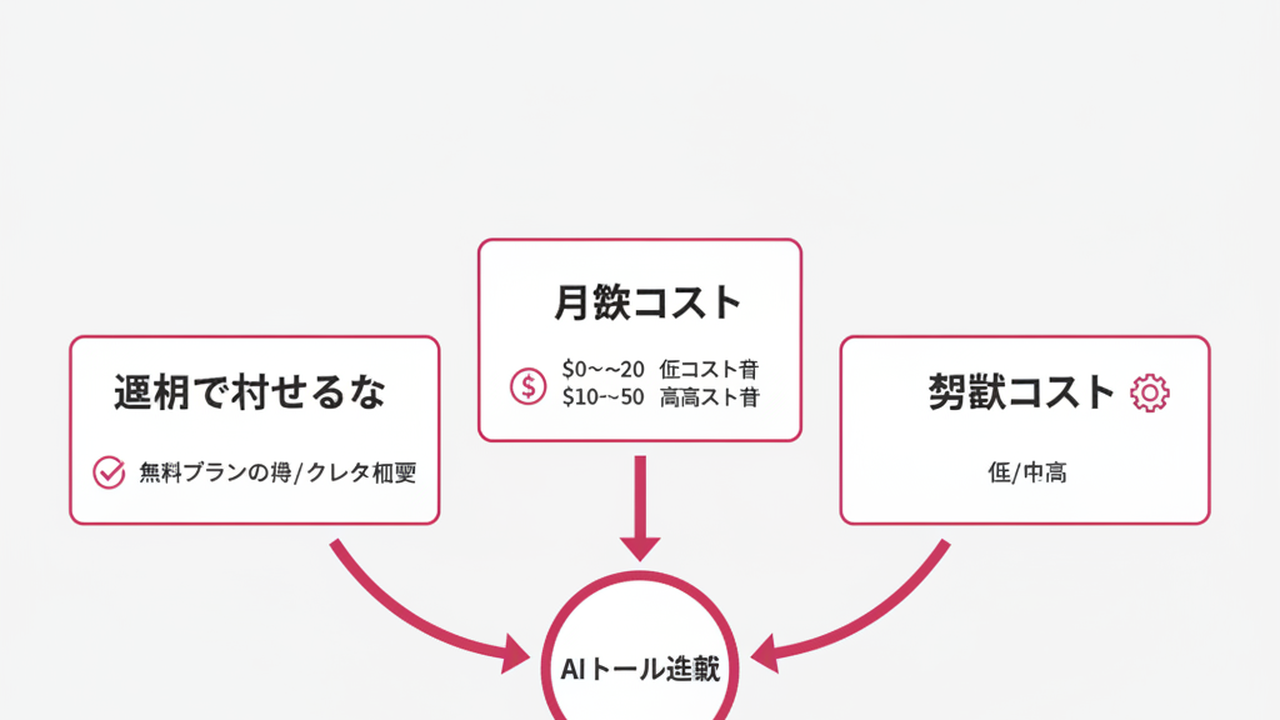
The 3-Axis Framework for Choosing Your Stack
Most people who get stuck on tool selection are asking “which one has the most features?” The real question is “given my current situation, which one do I choose?”
Three axes I use.
Axis 1: Weekend-Testable?
“Has a free plan,” “can start without a credit card,” or “core features are available for free” — if any of these apply, I call it weekend-testable.
Breaking down Medvi’s 6 apps: ChatGPT and Claude both have free plans (with feature limits). Grok’s basic research functions are accessible with an X.com account. Midjourney starts at $10/month for the Basic plan (check midjourney.com/pricing); no free plan. Runway and ElevenLabs both offer free plans.
Your first tool should be something you can test before deciding to pay. That brings your exit cost to zero if it’s not for you.
Axis 2: Monthly Cost
Keep fixed costs low in the early stages of a solo business. Grouping by monthly cost range:
- Low cost ($0–$20/mo): ChatGPT Plus is $20/month (openai.com/chatgpt/pricing/), Claude Pro is $20/month (anthropic.com/pricing). Verified June 2026.
- Mid cost ($10–$50/mo): Midjourney Basic plan starts at $10/month. Runway Standard plan starts at $12/month (runwayml.com/pricing). ElevenLabs — check each company’s official pricing page.
- Higher cost ($50+/mo): Applies to upper-tier plans or multi-seat usage.
Prices change. Don’t rely on the numbers here — check each company’s official pricing page before committing.
The key cost question is whether you can simulate ROI on a single tool before paying. If you’re spending $20/month, that tool needs to generate $20+ in value (time saved, quality improved, or revenue) every month. Work that out during the trial period.
Axis 3: Learning Curve
“How long does setup take,” “how do I write prompts,” “can a complete beginner start immediately?” These three determine learning cost.
Text-based tools — ChatGPT and Claude — respond to plain language. No specialized knowledge needed. Lowest possible learning curve. You can figure out how to use them just by asking questions.
Midjourney’s image generation requires learning prompt design to get results that match your vision. Getting a feel for “what to write and how to write it” can take days to weeks.
Runway’s video generation often requires intermediate to advanced skills — how to feed in source material, what parameters to set, how to manage output quality.

Putting the 3 Axes Together
- “First tool”: text generation AI (ChatGPT or Claude) — no contest. The only category that checks all three boxes: weekend-testable, low cost, minimal learning curve.
- “Second tool onward”: choose by business type and specific goal.
- Midjourney and Runway: deprioritize for ease of entry. Add them once the use case is clear and the learning cost is justified.
Choosing Your First Tool by Business Type
The 3-axis framework narrows the first tool to text generation AI. But many people still get stuck between ChatGPT and Claude. Breaking it down by business type.
Type 1: Content and Publishing (blog, newsletter, social, course sales)
First tool: Claude
Strong at structuring writing, analysis, and processing long documents. Social caption brainstorming, article structure workshopping, newsletter body drafts. Built for queries like “read this long piece and summarize it” or “give me 5 structural options for this article.”
Second tool candidate: Midjourney (for thumbnails and header images at scale)
One important caveat: having Claude write full drafts is a temporary phase. Claude is excellent at generating drafts. But your voice, your empathy for your readers — that’s not replicable by AI. The right workflow is “Claude as a drafting assistant, you do the final pass in your own words.” Lean on AI for the scaffolding, not the finish.
Type 2: SaaS and Digital Products (apps, tools, template sales)
First tool: ChatGPT
The most widely-tested tool for code generation across the board. Describe an interaction in plain language — “when this button is pressed, X should happen” — and get a working code draft. Combine with Cursor (an AI-powered code editor) for even more development efficiency.
Second tool candidate: Runway (for demo videos and LP creative)
Important caveat: code ChatGPT generates may “work” but whether it’s “secure” or “scalable” is a separate question. Like the structural challenge the FDA raised with Medvi, you need to design upfront which parts are handled by AI automation and which require human specialists. Get a sense of your outsourcing needs early.
Type 3: Consulting and Service Businesses (coaching, advisory, freelance, done-for-you)
First tool: Claude
Immediate value in proposals, summaries, and analysis. Paste in client meeting notes and ask “turn this into a 3,000-word proposal” — the result translates directly to client deliverables. “From a 30-minute meeting recording to a proposal draft” happens in 2–3 minutes.
Second tool candidate: Automation tools (Make.com or Zapier to automate routine communication, follow-ups, invoicing)
In consulting and services, your time is the product. The highest-leverage AI use is eliminating the three time drains: documentation, organization, and communication. Freeing up those hours lets you focus entirely on the human-side work. This is the same thinking as Medvi’s design — draw a clear line between “what AI handles” and “what requires professional expertise.”
The First 3 Moves to Make This Weekend
Getting from “I’ve picked a tool” to “what do I actually do first.”
Saturday (2 hours): Try it on one real task
Skip the tutorial. Tutorials are designed to show you how to use the tool — they’re not designed to tell you whether the tool fits your business. That requires a real task.
Pick one from your actual work this week. A proposal draft. Social caption options. Newsletter structure. Product description copy. Doesn’t matter which. Testing with a real task tells you “does this work for me?” in 30 minutes.
The key: pick a task where failure costs you nothing. Drafting next week’s one social post carries less risk than finalizing a proposal for an important client.
Sunday (1 hour): Make a verdict — worked or didn’t
Simple evaluation: “If this tool hadn’t existed, how long would this task have taken?” Compare that to the actual time.
If you saved 50%+ of the time, call it “works.” If there was little difference — or it actually took longer — consider two possibilities. First: your prompt (the way you wrote your instruction) may have been the issue. Revise and try again. Second: this specific task may not be the right fit for this tool. Don’t switch tools yet — try a different task first.
Monday (30 minutes): Commit to one next action
Based on the weekend’s results, decide your next move. If text generation AI saved you significant time, set a specific plan: “next weekend I try an image generation AI.” Create your Midjourney account and spend 30 minutes getting oriented.
If it didn’t work, write a one-line note: “what kind of prompt would have worked better?” Carry that into the next test session.
Total: 3.5 hours across three days. Enough to reach a verdict on whether one AI tool fits your business.
When I first tried Claude, I tested it on drafting 20 social captions. A task that used to take me 2 hours finished in 15 minutes. I subscribed the next day. “Weekend-testable” is exactly that kind of story.
In The 4 Design Choices That Put Solo Operators in the Top 10%, Stripe research showed that the top 10% focus on retention from month one. But you need to pick a tool and actually start moving before you can design retention. Testing comes first, design comes after.
Wrapping Up
What Medvi proved is not “you can make $401M with AI tools if you have no special skills.” It’s this: “design the operational parts that AI can replace, hand the parts that require expertise to external specialists, and build a structure from day one that a two-person team can run.”
Trying that “structural design” at your own business scale starts with tool selection.
The 6 AI tools are organized into two categories: Code and Operations (ChatGPT, Claude, Grok) and Creative Production (Midjourney, Runway, ElevenLabs). You don’t need all six at once.
Choose by 3 axes: weekend-testable, monthly cost, learning curve. Run those three checks before you start — that’s how you avoid accumulating tools you bought and never used.
Your first tool narrows down by business type: content and publishing → Claude; SaaS and products → ChatGPT; consulting and services → Claude. If you’re undecided, starting with Claude is currently the most versatile choice.
The first weekend only takes 3.5 hours to reach a verdict on one tool — “does this work for my business?” Trying on a real task beats running tutorials for speed of judgment.
The Medvi brothers went from $20K to $401M. You can end the story at “a different scale entirely” — or use it as a design reference. That choice determines what your stack looks like a year from now.
You don’t need to implement all six at once. This weekend, try the first one. That’s where I’m starting too.

女性だからこそ、AIを使いこなさなきゃって思ってる。仕事も、副業も、推し活も、旅行も、全部やりたい。人生一度きりなのに時間は足りないじゃん?だからAIに任せられることは全部任せる。浮いた時間で本当にやりたいことをやる。それがあたしのスタイル。ここにはあたしが実際にやったことをまとめてるだけ。誰かのためになったらいいなって思って書いてるよ。