The 4 Design Choices Behind the Top 10% of Solo Founders: Decoding Stripe's 61x Gap
Stripe analyzed thousands of solo-founded companies. The median-to-top-10% gap grew from 34x to 61x in 4 years. The cause: 4 specific design choices — AI-native, sell globally from day one, B2B, and early retention. Includes implementation steps you can start this week.
What you'll learn in this article
- The key point to grasp before reading the full article
- How the issue changes practical decisions after reading
- Which follow-up article is worth opening next

Did you see the report Stripe dropped on May 28?
“The gap between median solo founders and the top 10% widened from 34x to 61x in four years” — that number flashed across social media and disappeared. I spent two days chasing it down.
In the article I wrote on June 1 about the loneliness ceiling for solopreneurs, I argued that “the median falling is a structural problem.” This new Stripe report gave me a level deeper.
The gap between the median and the top 10% isn’t about hustle — or even AI stack. It’s about 4 design choices.
And every single one is a decision you can make this week. No coding required. You can start laying the groundwork from zero revenue.
Today I’m breaking down the Stripe research as 4 design choices — for anyone “wanting to start solo” and anyone “already started but stuck in median territory.”
The Stripe Survey: The Most Granular Dissection of Solo Founder Performance to Date
Let me set up the data first.
Stripe’s analysis was published on May 28, 2026 on the official Stripe blog. Written by Jesse Carey of Stripe. Source data: Stripe Atlas — Stripe’s service for registering US companies. From thousands of solo-founded companies established in 2022–2023, they extracted those with at least 2 years of sales data. They compared the median cohort (middle decile) to the top 10% (top decile) by total revenue in the first two years.
“Solo founder” here means someone who incorporated through Stripe Atlas without co-founders. Side businesses and full-time ventures both qualify.
Key numbers:
- 63% of new C corp filings in Q2 2026 were solo founders. An all-time high on Stripe Atlas
- Median solo-founded company revenue in the first 6 months of 2025: -23% year-over-year
- Top 10% solo founder revenue in the first 6 months of 2025: +19% year-over-year
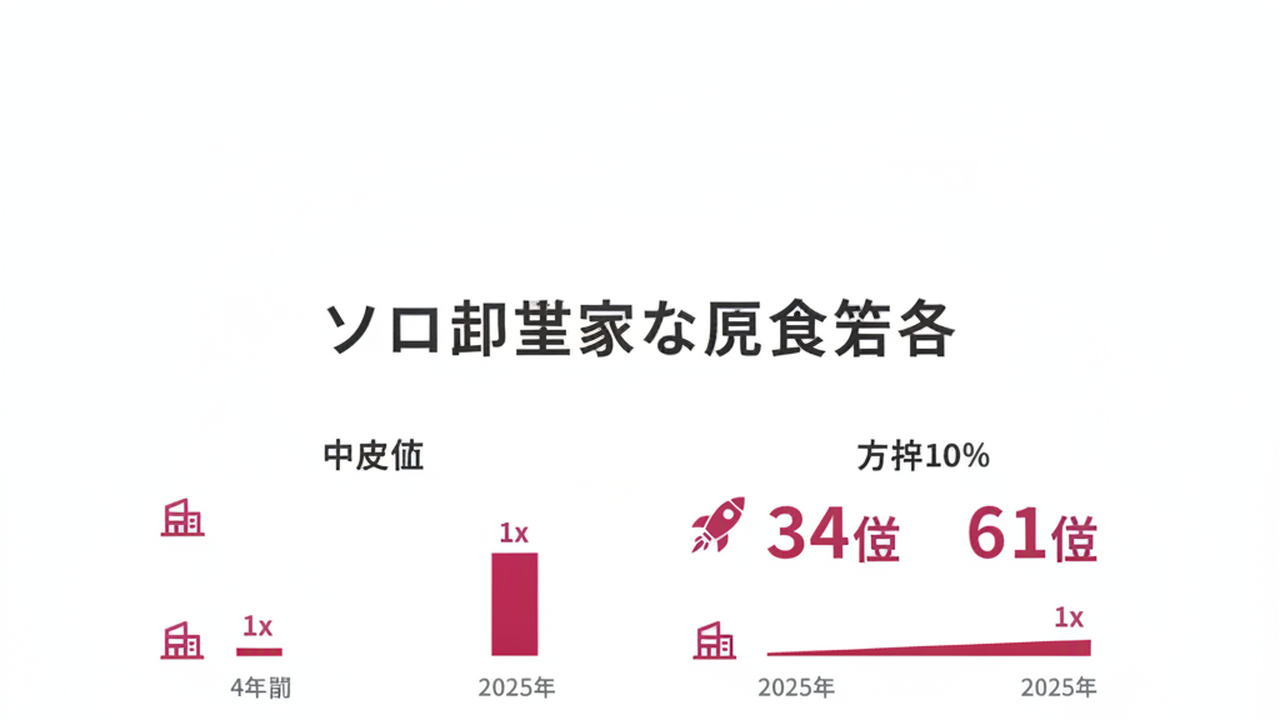
- 4 years ago: top 10% revenue = 34x the median
- 2025: top 10% revenue = 61x the median
- Solopreneurs earning $100K+ annually: up one-third since 2022
So: more people are entering. But the group that can win is getting narrower. In Stripe’s own words: “the gap between the typical company and top performers is widening.”
I touched on this in the June 1 article. What makes this Stripe report compelling is what comes next. “What specifically do the top 10% do differently?” — they frame the answer as 4 design choices.
Let’s go through each.
Design Choice #1: Go AI-Native. This Is About Speed, Not Technical Skill
Stripe’s first item: “AI-native products.” Definition: “a product whose core functionality depends on an AI model.” Not using AI as a tool — but a product that couldn’t exist without AI at its center.
Numbers from the Stripe report (2026-05-28):
- Top 10% solo founders are ~2x as likely to build AI-native companies as the median
- At the 2-year mark, AI-native solo companies generate nearly 2x the revenue of non-AI-native solo companies
- This isn’t driven by outlier hits. The 99th percentile numbers are virtually identical. AI-native wins across the full distribution, from the 50th to 95th percentile
That last point is critical. The objection “it’s just outliers like Cursor or Lovable dragging up the average” doesn’t hold. Normal AI-native companies are normally beating normal non-AI companies.
Marc Lou’s comment in this section captures the industry temperature. He’s a serial solo founder who has built 34 companies:
“The next generation of solo founders will be defined by speed, not technical background. They’re no-code people, focused on solving problems, shipping products at superhuman speed with AI, and cracking distribution through social media.”
That’s exactly what I’ve been saying. “In an era when anyone can build, an engineering background is no longer the prerequisite.” Stripe’s data just validated it.
One caveat: “using AI as a tool” doesn’t qualify here. AI-native means the product would die if you removed the AI. Think AI-written newsletters, AI-matched platforms, AI-personalized learning tools. AI isn’t an optional feature; it’s the heart of the product.
What follows is the author’s implementation hypothesis — not a direct conclusion from Stripe data
Judgment call: for your current or planned business idea, ask “would it still work if you removed the AI?” If yes to all core features, it’s not AI-native. Consider redesigning from a higher layer. “Sending queries to ChatGPT” isn’t enough. You need AI doing the judging, generating, or matching at the core.
Design Choice #2: Sell Globally From Day One. 10 Countries vs. 3 Countries
This one hit me hardest. “Sell globally from launch.”
Numbers from the Stripe report (2026-05-28):
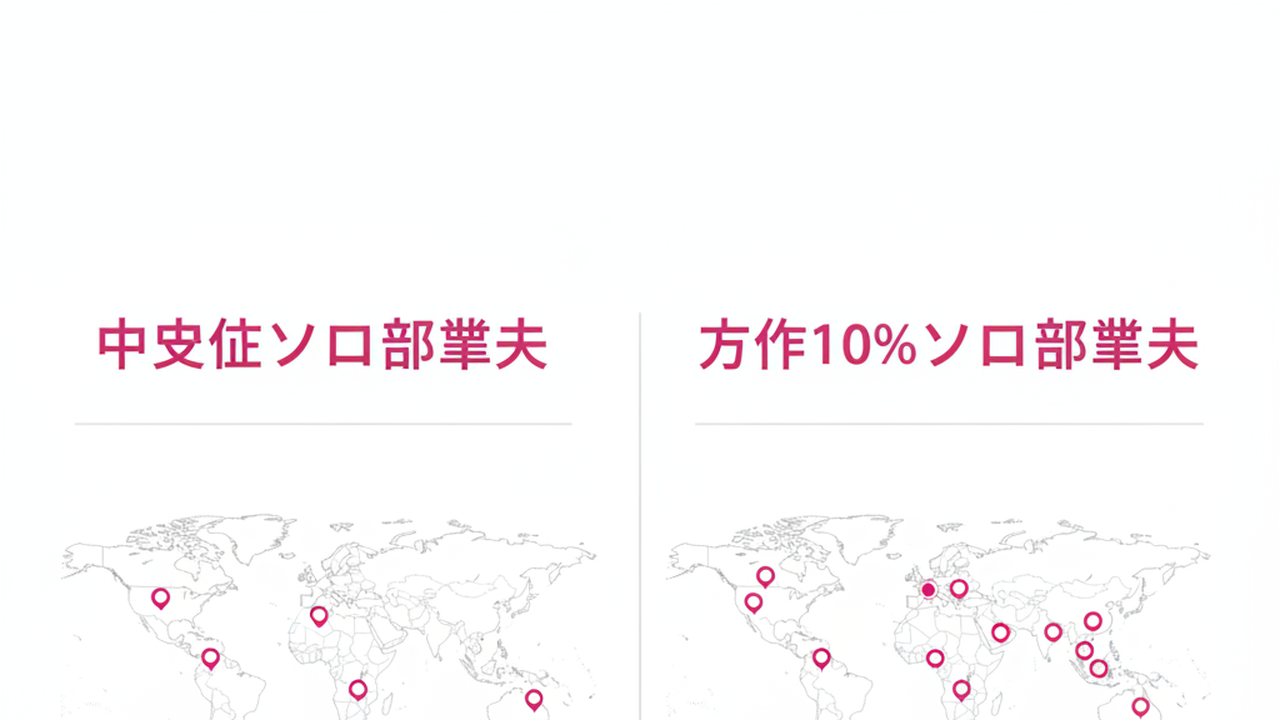
- Countries sold to in month 1: top 10% averaged 10 countries, median averaged 3 countries
- By month 24: top 10% averaged 40 countries (ex-US), median averaged 6 countries
- International revenue share: top 10% get 51% of revenue from outside the US; median gets just 2%
The difference comes down to not artificially restricting countries from the start. The median playbook: go domestic first, then think about international once things are rolling. The top 10% are selling to multiple countries in the very first month.
Stripe’s analysis: “Top 10% include a slightly higher proportion of people based outside the US, and they’re going after the US market early.” Since the US is the largest, highest-priced software market, entering it early compounds growth.
This directly applies to Japanese solo founders. If you’re based in Japan, designing to target the US market from day one puts you on the top 10% pattern.
The implementation is lighter than you’d expect:
- Show pricing in USD alongside local currency from day one
- Have English versions of your terms and privacy policy ready (templates are fine)
- Use Stripe for payments — multi-currency support is built in
- Publish an English landing page (DeepL is fine for a first draft)
That’s one day of setup. While Japanese solo founders are “perfecting the domestic version before going global,” the top 10% are choosing “launch to both from day one.” That design choice creates a 3–4x gap in countries sold to from month one.
Design Choice #3: Choose B2B. B2B Median Earns 4x B2C Median
Third item: “build for businesses.”
Numbers from the Stripe report (2026-05-28):
- Top 10% solo founders are ~30% more likely to build B2B businesses than the median
- Median 24-month revenue: solo B2B median is 4x+ the solo B2C median
- Same pattern at the top: solo B2B top 10% earns nearly 2x solo B2C top 10%
The knee-jerk reaction: “B2B has easier fundraising, so the gap makes sense.” But Stripe explicitly rules that out. “Even limited to bootstrapped startups, solo B2B outperforms B2C.” It’s not a funding difference — it’s the business model itself.
Pauline Clavelloux’s quote is grounding. She’s a solo founder of 4 companies including Refindie:
“I grew to €10K MRR with zero advertising. I talked to users every day, built only the features multiple customers were asking for, and focused on becoming the best service in my niche.”
B2B is a world where “zero ads, €10K+ monthly recurring revenue” is achievable through niche mastery. Instead of “broad and shallow” like B2C, you go “deep on specific problems for specific companies.”
Author’s implementation hypothesis below
I’ve felt this personally. In my first year of going independent in social media marketing, I tried B2C content management and struggled. The moment I narrowed to “social media management for companies in specific industries,” my unit price tripled. No advertising. Same pattern as Pauline.
Judgment call: if you’re designing a service that assumes “people will find me through ads,” you’re leaning B2C. “It’ll spread through word of mouth within an industry” is B2B territory. The latter is the structure that makes it easier to reach the top 10% as a solo founder.
Design Choice #4: Win on Month-1 Retention
The fourth item stopped me cold. “Higher customer retention early on.”
The Stripe data (2026-05-28):
- Month-1 customers who continued to month 2: top 10% ~30%, median ~8%
- Top 10% achieved customer win-back roughly 3 months earlier than the median
- Monthly spend by the first cohort at the 2-year mark: top 10% is at +47% vs. original; median is roughly half that
- B2B gap is sharpest: top 10% solo B2B has 6x the retention rate of the median for first-month customers
The implication: whether you hold your very first customers in the very first month largely determines your growth trajectory over the following two years. Stripe frames this as top 10% reaching PMF (product-market fit) earlier.
Pauline again:
“Validate with paying users before you invest time and money. Progress over perfection. Ship fast, iterate often.”
“Validate with paying users” — that’s the key. 100 free-trial users who say “this was helpful” are worth less than 10 paid users still active one month later on the path to the top 10%.
This is a real blind spot for solo founders. “Number of users,” “downloads,” “signups” tend to become the default metrics. But Stripe’s data shows those are median-layer metrics. What the top 10% watch is the single metric of “month-1 retention rate.”
Author’s implementation hypothesis below
Build the measurement infrastructure before launch. From user signup, make sure you can see month-over-month retention in a dashboard every week. If you’re using Stripe Billing, retention charts are a built-in feature. If not, create a by-cohort retention table in Google Sheets. Look at it every week. Track where people are dropping off and fix one thing at a time. Retention improves → growth compounds.
4 Moves for This Week

With all four Stripe data points absorbed, here are 4 moves compressed for this week.
Monday (30 min): AI-native audit
Paper, notes app, doesn’t matter. Write out the 3 core features of your current or planned business. For each: “would this work if you removed the AI?” If all 3 are yes, it’s not AI-native. Generate at least one redesign candidate where the core can’t function without AI.
Tuesday (half day): International MVP
(1) Create an English draft of your landing page using DeepL. (2) Add USD pricing alongside local currency. (3) Download English templates for terms and privacy policy and customize them. (4) Unify payments on Stripe with multi-currency enabled. Half a day.
Wednesday (1 hour): B2B or B2C reassessment
List out who’s currently paying for your service. What percentage are corporate clients? Are you growing through ads or word of mouth? Ask whether revenue can grow without advertising. If no, write out one option to shift the design toward B2B.
Thursday (2 hours): Retention measurement setup
Build a dashboard where you can see month-over-month retention for users registered the prior month every week. If you’re on Stripe Billing, it’s visible by default. Otherwise, create a by-cohort retention table in Google Sheets. Set “paid user validation” as your top metric, Pauline-style.
Total: one day of work. Next Monday, review how far you got and diagnose anything where you stalled.
One more root-cause note.
Why does the 61x gap exist?
Stripe’s conclusion is simple: “the gap between typical cases and top performers is widening in the AI era.” But Stripe doesn’t call it a hustle gap or a talent gap. They frame it as 4 design choices.
This connects to what I wrote in the June 1 article: “loneliness is a design problem, not a willpower problem.” Today’s Stripe data validates that from a different angle.
The median layer isn’t there because they lack ability. It’s because they’ve been grinding within the conventional frame — “go domestic first, then international,” “B2C ad-based acquisition,” “measure progress by download count.” Those are median-layer design choices.
The top 10%, conversely, aren’t necessarily geniuses. They make 4 specific choices at founding: “sell to 10 countries in month 1,” “target a B2B niche,” “track only month-1 retention.” Choices that deviate slightly from industry convention.
In the May 31 article, I wrote that “3 out of 4 AI unicorn slots are still empty.” Next to today’s Stripe data, what comes into focus is: the difference between “people who can claim one of those empty seats” and “people watching them stay empty” is also those 4 design choices.
Summary
I broke down Stripe’s solo founder survey published May 28, 2026. The gap between median and top 10% widened from 34x to 61x in 4 years — the cause is 4 design choices.
- Choice #1: Go AI-native. Put AI in a position where removing it kills the product
- Choice #2: Sell to 10+ countries in month 1. Enter the US market early
- Choice #3: Choose B2B. “Zero ads, growing revenue” is structurally easier to achieve
- Choice #4: Track only month-1 retention. Downloads and signups are median metrics
All four are doable without coding skills. Startable from zero revenue. These are the design choices to make at the business planning stage — before you’ve started.
Combine today’s “top 10% design choices” with the “3 levers for structuring around loneliness” from the June 1 article and you have a complete starter decision set for solo founding. Loneliness architecture + business architecture. Build both from day one.
The 61x gap isn’t a hustle gap. Stripe proved it with thousands of data points. “The top 10% are geniuses” is no longer an excuse we can use.
Drop it to design and anyone can start laying the groundwork this week. I’m rebuilding my next project with all 4 moves right now.
Check where you stand on each choice today. AI-native, global design, B2B shift, retention tracking. Change even one intentionally and the numbers a year from now look different. Stripe’s data proves it. I’m moving on that conviction — no excuses.
References
- Stripe 2026-05-28 — Solo founding is at an all-time high: Top performers have these traits in common
- Fortune 2026-05-18 — Solo founders are using AI to do the work of entire teams—but going it alone has limits
- CTech 2026 — Base44 founder Maor Shlomo “Yes, absolutely I felt lonely”
- TechCrunch 2025-06-18 — 6-month-old, solo-owned vibe coder Base44 sells to Wix for $80M cash

女性だからこそ、AIを使いこなさなきゃって思ってる。仕事も、副業も、推し活も、旅行も、全部やりたい。人生一度きりなのに時間は足りないじゃん?だからAIに任せられることは全部任せる。浮いた時間で本当にやりたいことをやる。それがあたしのスタイル。ここにはあたしが実際にやったことをまとめてるだけ。誰かのためになったらいいなって思って書いてるよ。