7 Billionaire Habits From JPMorgan's 111-Person Survey — Translated Into 3 Monthly Actions
JPMorgan's 2025 Principal Discussions: 111 ultra-wealthy individuals, $500B+ in assets. Seven habits that cost nothing to start. Here's how to pick 3 and make them stick this month.
What you'll learn in this article
- The key point to grasp before reading the full article
- How the issue changes practical decisions after reading
- Which follow-up article is worth opening next

“Copy billionaire habits” — I never knew where to start with advice like that.
Then I read a JPMorgan report published in December 2025. The title: “Principal Discussions Report.” It documents JPMorgan’s private banking division conducting multi-hour conversations with 111 individuals holding assets above $10 billion. Combined assets of participants: over $500 billion (J.P. Morgan Private Bank primary source: https://privatebank.jpmorgan.com/nam/en/insights/reports/principal-discussions).
My first thought reading it: “There’s nothing special here.”
Every single habit is something you can start this week. The divide between people who say “I know this already” and people who actually move on it comes down to one thing: intentionality. That’s what I walked away with.
What JPMorgan’s Survey Found: The 7 Habits
“Principal Discussions” means conversations with people who matter — high-stakes dialogue. JPMorgan’s 23 Wall team runs deep annual conversations with the world’s ultra-wealthy and publishes the results.
The interviews go far beyond investment strategy. They dig into daily habits, family values, and how decisions actually get made. For a financial institution report, it has unusual human depth. Fortune, Business Insider, and other major outlets covered the findings (Fortune, 2025-12-29: https://fortune.com/2025/12/29/best-habits-for-success-among-billionaires-worlds-wealthiest-families-jpmorgan-report/).
The 7 habits the 2025 edition surfaced:
- Reading
- Exercise
- Consistency
- Waking up early
- Prioritizing tasks
- Goal-setting
- Deep thinking time
If your reaction is “I’ve heard all of this before,” you’re right. Wealthy people’s habits aren’t exotic. They’re ordinary things done with extraordinary intentionality. But listing seven doesn’t make them usable. Here’s what I found when I broke down why each one actually works.
One quote from this report gets cited more than anything else. A wealthy family patriarch, unnamed:
“The currency of life is time, not money. You think carefully about how to spend a dollar. You should think just as carefully about how you spend an hour.”
(Source: JPMorgan 2025 Principal Discussions Report / Fortune 2025-12-29: https://fortune.com/2025/12/29/best-habits-for-success-among-billionaires-worlds-wealthiest-families-jpmorgan-report/)
“Time as currency.” That’s the root of all seven habits. Reading, exercise, goal-setting — strip them back and they’re all expressions of intentional time use.
One more data point worth noting. Reading gets positioned as the top success habit. But in this same report, when respondents ranked their most passionate hobbies and interests, reading came in 7th. Outdoor activities ranked 1st. Time with family and friends ranked 2nd. Their work itself ranked 3rd.
7th in passion, 1st in success habits. Why? Because the discipline to continue doing something for results — without passion being the fuel — is precisely what intentionality means. “I keep going because I love it” is different from “I keep going because it delivers outcomes.” That difference, compounded over years, creates the gap.
”Wealthy People Are Different” Is the Wrong Frame
Not one of the 7 habits requires money. No special training, no connections, no unusual talent. Everything is startable today.
“But I can’t stick with anything.” I’ve failed at habit formation more times than I want to count. Three days of morning reading, then nothing. Two weeks of early rising, then collapse.
The difference wasn’t how I started. It was how I designed the habit.
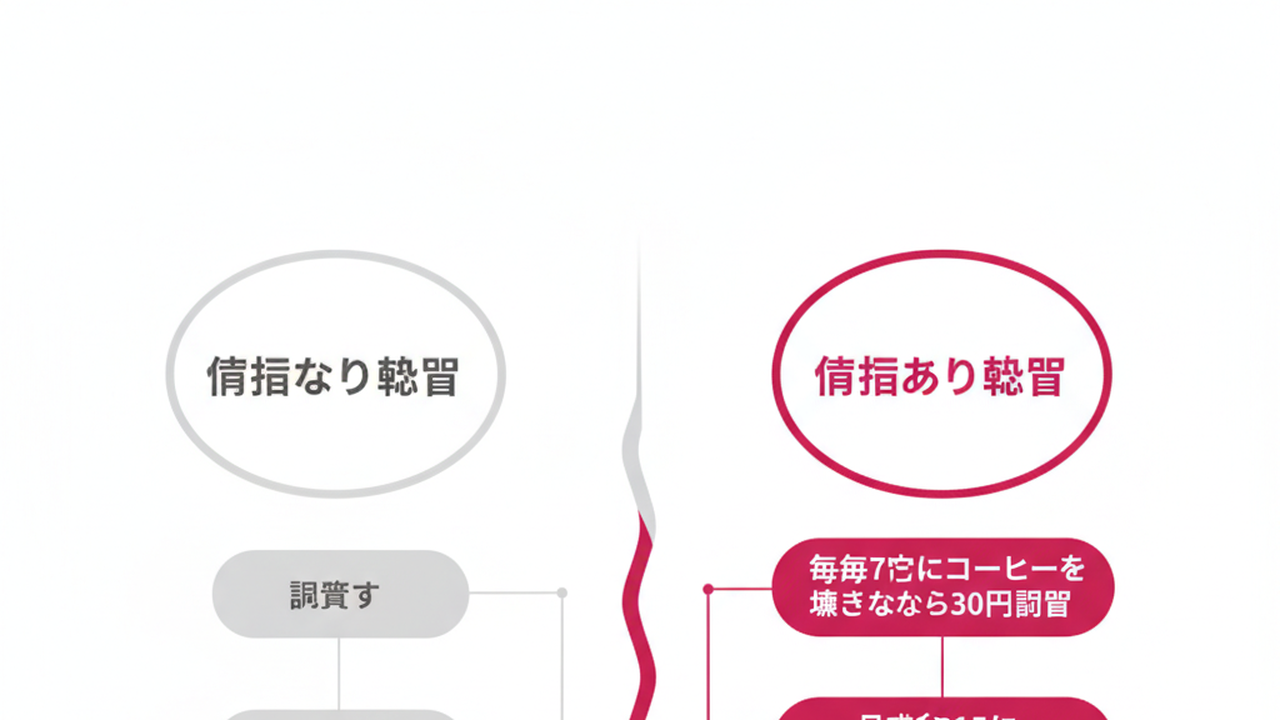
Left side: habits without intention. Right side: habits with intention. The activities are identical — reading, exercise, early rising. But the right side has a specific time and specific location locked in.
“Read more” and “open a book every morning at 7 while making coffee, for 30 minutes” are completely different things. The first has no scheduled time, so it gets pushed. The second is concrete enough to put on a calendar, so it gets done.
Ultra-wealthy people produce extraordinary results from ordinary habits not because of the habits themselves but because of how they’re designed. Intentionality means having “when, what, how long” fully specified. Vaguely deciding to “exercise” doesn’t move a body. Deciding “Monday, Wednesday, Friday at 3pm, 15-minute walk” does. They apply this to every habit.
One more point. None of them started all seven habits simultaneously. At some point in their lives, they recognized “this one works for me” and stacked habits one at a time.
Trying to start all 7 at once almost guarantees failure. Pick 3 per month. That’s the whole framework. “3 done perfectly” beats “7 halfway” every time.
And build in the assumption that habits will break down. “Consistency” in this report doesn’t mean “never miss a day.” It means “the ability to return after you break the streak.” Stopping self-blame when habits slip is itself part of the habit system. If you punish yourself every time a habit breaks, the feeling of “I can’t do this anymore” kicks in and things stop entirely. Decide in advance: “Yesterday’s failure stays yesterday. Today I restart.” My habits that have held since I went independent all have a recovery mechanism built in alongside them.
Breaking the 7 Habits Into 3 Categories
Trying to remember all 7 at once is harder than sorting them. I think of them in three buckets.
Physical (2 habits): Exercise and waking up early
A functioning body is the foundation everything else rests on. Exercise creates mental clarity. Early rising secures “time that belongs to you” at the start of each day. Both are designed not for health but for performance. You don’t need to cut sleep to wake up early — moving bedtime 30 minutes earlier creates 30 minutes of personal time the next morning.
Time (3 habits): Task prioritization, goal-setting, and consistency
Consistency is less a standalone habit and more the ability to sustain other habits. Task prioritization and goal-setting are the core of “deliberate time allocation.” Review goals monthly, narrow daily priorities to three. That combination reshapes how you use time at the root level.
Consistency is built through the loop of breaking and returning. “Never miss a day” isn’t the ask. “Always return the day after you miss” is.
Mental (2 habits): Reading and deep thinking time
Reading ensures quality of input. Deep thinking time is where you process what you’ve read and experienced — turning it into your own framework. Wealthy people often protect this as a “solo weekly strategy session.” Input with an output commitment differs fundamentally from passively consuming information.
Deep thinking time is the habit most people defer longest. “I don’t have time to think” usually means “I haven’t carved out time to think.” Days consumed by meetings and responses will stay “zero mental habits” unless you make a deliberate cut. Once a week, 30 minutes, notebook and pen, review what happened. That alone starts turning reading inputs into actionable principles.
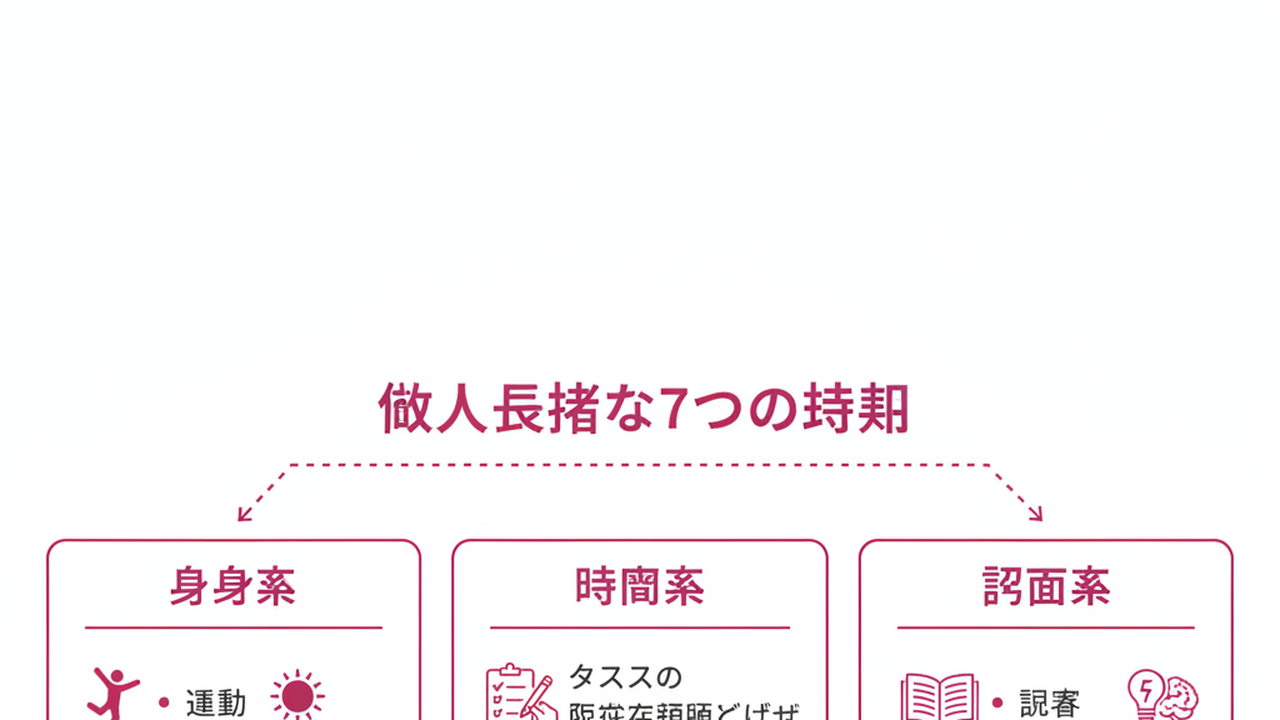
With three categories, “where am I weakest?” becomes obvious.
Perpetually busy with no space to reflect? Mental category is empty. Important things perpetually deferred by urgent ones? Time category is the gap. Body feels heavy, concentration won’t hold? Physical category needs attention first.
For your monthly 3 actions: instead of one per category, try two from your weakest category plus one from the second weakest. Concentrated investment over even distribution produces faster felt results.
The Monthly 3-Action Translation Method
Let’s do the translation work — turning 7 habits into “actions I can start this week.”
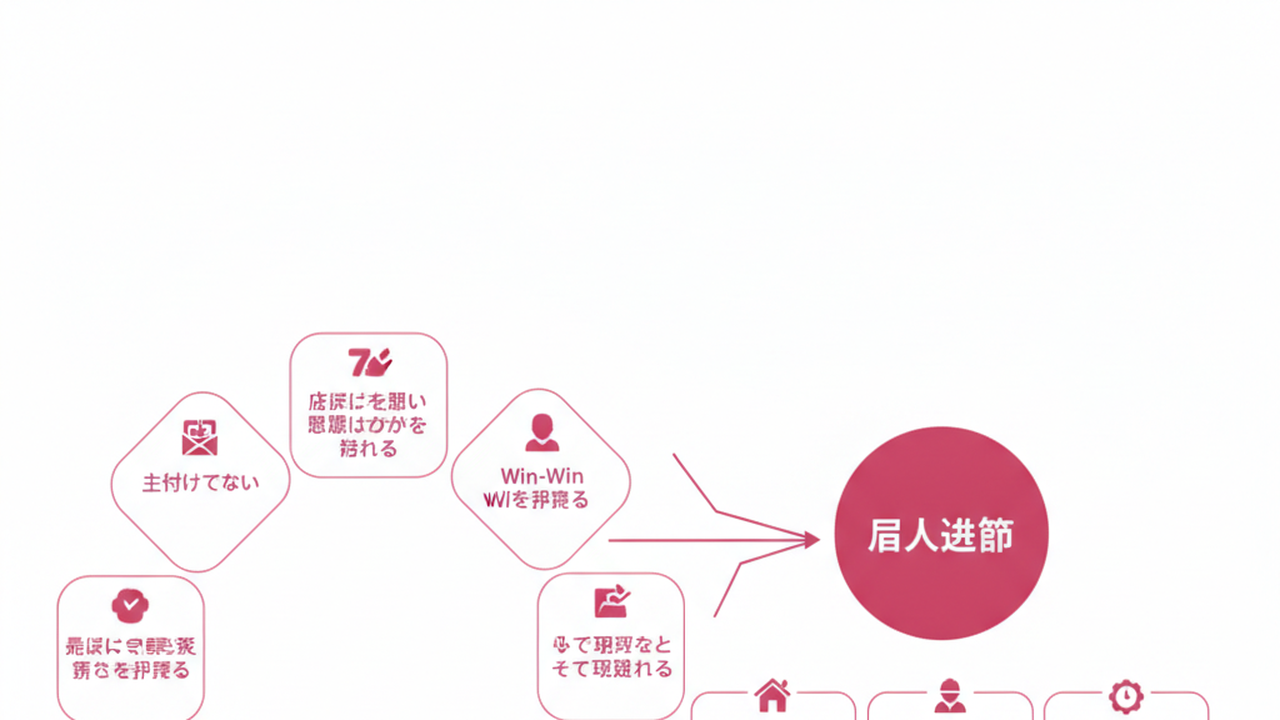
Physical category translations
“Exercise” → “Monday, Wednesday, Friday at 8am: 20-minute walk near home. Added as recurring block in Google Calendar.” “Wake up early” → “5:30am weekdays. First 5 minutes: make coffee and sit at desk. No going back to bed.”
Time category translations
“Prioritize tasks” → “Every morning at 9am: write 3 tasks on paper. Don’t add new tasks to the list until those 3 are done.” “Set goals” → “First Monday evening of each month, 30 minutes: review this month’s 3 goals. Mid-month changes allowed.” “Maintain consistency” → “Don’t blame myself when habits break. Just return the next day. Make the reset small.”
Mental category translations
“Read” → “Open a book during morning coffee (20 minutes). Prioritize consistency over content. One page counts.” “Protect deep thinking time” → “Every Sunday evening, 30 minutes: write this week’s insights in a notebook. No audience needed.”
Three rules for the translation:
1. Decide “when.” “Do it when I have time” never works. Specify day, time, and location. Design it so “I was too busy” can’t be the excuse.
2. Decide “how long.” Start short. 15 or 20 minutes is fine. Setting “1 hour” means the moment you only have 30 minutes, you quit. Short targets mean short time still counts as done.
3. Make it binary: did it happen or not. “I studied” is harder to verify than “I opened the book.” “I exercised” is harder than “I went outside.” Drop perfectionism. Track only yes/no.
One caution in the translation process: don’t aim for a perfect design on the first try. “I planned Monday but it happened Tuesday” is a signal for adjustment. Change the day next week. Review your translated actions every 3 months. If something isn’t continuing, replace it. If it is continuing, add one more.
Once 3 monthly actions are solid, add one more. The 7 habits aren’t “do simultaneously.” They’re “stack over years.” Completing all 7 perfectly today is slower than adding one at a time reliably.
Why “Intentionality With Time” Is the Starting Point
After everything I’ve covered about the seven habits, the seven habits themselves aren’t what matter most to me.
Here’s the quote again:
“The currency of life is time. You think carefully about how you spend a dollar. You should think just as carefully about how you spend an hour.”
Intentionality with time is the prerequisite for every habit. Without it, anything you try to build will hollow out.
Example: you decide to read every morning, but stay up late the night before and lose sleep — it won’t happen. You decide to prioritize tasks, but keep deferring the important for the urgent — the system collapses. Without intentionality with time as the foundation, every habit stays at “I’d like to do that eventually.”
Whether you have intentionality with time is visible in one place: your calendar. Open your week. How many hours have you protected for yourself? Not meetings, not tasks, not responding to others — hours dedicated purely to your own growth or thinking. Most people, when they actually check, find that number is close to zero.
Where to start: “blank 30 minutes.”
Protect the first 30 minutes of every morning for yourself.
Phone away. No email. Everything else waits. Those 30 minutes are exclusively yours.
What you do in them can be decided later. This week: read. Or write down your goals. Or just sit with coffee and not think about anything. Any of those is fine.
The point is the habit itself — “30 minutes that nobody can take from you, secured at the start of each day.” This looks like early rising. But the substance is different. It’s not “wake up early to do something.” It’s a declaration of time sovereignty. Owning the first 30 minutes of your day. That’s the foundation all 7 habits build on.
When I was an employee, I constantly felt “I want to do things but there’s no time.” After going independent, I realized: time wasn’t absent. I just wasn’t using it intentionally. That distinction took me years to see.
The 111 people in the JPMorgan report built their wealth on top of “how they used their time” before anything else. One hour at a time with intention looks different from one hour without it. Those differences compound. Thirty intentional minutes daily becomes 182 hours in a year. That’s enough to read 50 books. Enough to cement 3 new habits.
Much of what gets called “someone has it and someone doesn’t” traces back to this difference in time intentionality. People who spend 30 minutes each morning with their own thinking diverge from those who don’t — visibly, within a year. Three years in, “how are they so different?” becomes the question people ask about them.
I confirmed this not through theory but through living it. From the point when intentional time use started, the quality and volume of my work changed.
Conclusion: 3 Monthly Actions, Starting This Week
JPMorgan’s 2025 Principal Discussions revealed 7 habits any of us can start today: reading, exercise, consistency, early rising, task prioritization, goal-setting, and deep thinking time.
The goal isn’t to do all 7.
Identify your weakest category across the three buckets (Physical, Time, Mental). Translate 3 habits into the format “when, how long, binary yes/no.” Before anything else, protect 30 minutes every morning as your own. Without intentionality with time, habits don’t hold.
“Just do it” is my constant refrain — but “design it” comes before “do it.” Starting without a design guarantees breakdown. Breakdown means you never become someone who “just did it.”
One action for this week. Pick one habit from the 7. Write down “when and how long.” Block it in your calendar. That’s it. Add one more next week. Three weeks later, you have 3 actions. Three months later, one of them will be “the thing I’ve been keeping up.”
This isn’t far away. It starts with deciding how to use your time differently, today. Only the people who decide that will notice, six months from now, that something has stayed.
Primary Sources
- J.P. Morgan Private Bank: Principal Discussions Report 2025 https://privatebank.jpmorgan.com/nam/en/insights/reports/principal-discussions
- Fortune 2025-12-29: The world’s wealthiest families adopt these 7 key habits for success https://fortune.com/2025/12/29/best-habits-for-success-among-billionaires-worlds-wealthiest-families-jpmorgan-report/

女性だからこそ、AIを使いこなさなきゃって思ってる。仕事も、副業も、推し活も、旅行も、全部やりたい。人生一度きりなのに時間は足りないじゃん?だからAIに任せられることは全部任せる。浮いた時間で本当にやりたいことをやる。それがあたしのスタイル。ここにはあたしが実際にやったことをまとめてるだけ。誰かのためになったらいいなって思って書いてるよ。