47 companies hit unicorn status in Q1 alone. 1 in 4 is an AI company. Any reason not to ride this wave?
47 companies joined the unicorn club in Q1 2026. 1 in 4 is an AI company. Is starting a business risky? The data shows the exact opposite.
What you'll learn in this article
- The key point to grasp before reading the full article
- How the issue changes practical decisions after reading
- Which follow-up article is worth opening next
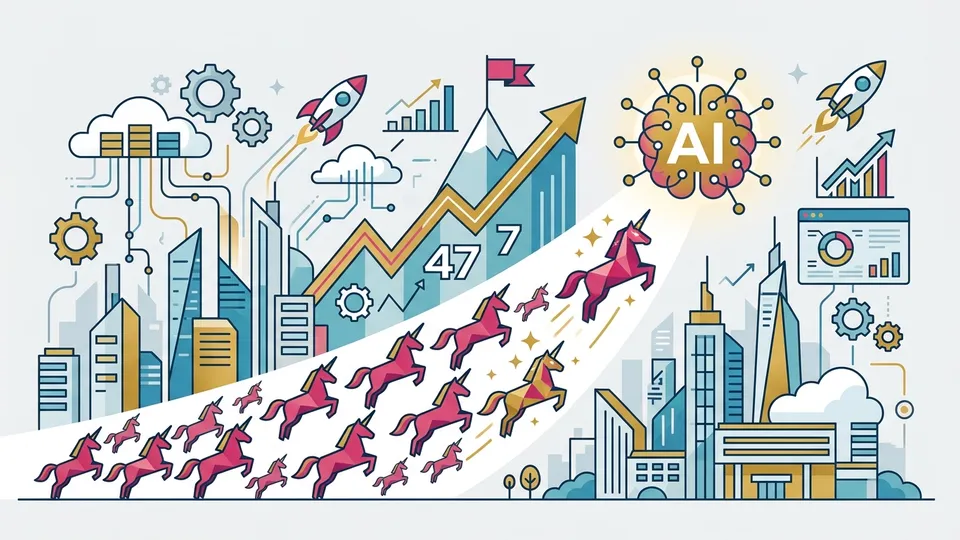
47 companies hit unicorn status in Q1 alone. 1 in 4 is an AI company. Any reason not to ride this wave?
If you’re someone who thinks “starting a business is too risky” or “now’s not the time,” hear me out for a sec.
In just the first three months of 2026, 47 companies surpassed $1 billion (about ¥150 billion) in valuation. That’s what we call unicorns. Privately-held startups valued at over $1 billion, you know. And 1 in 4 was an AI company.
Thinking “cool story, but it has nothing to do with me”? Nope, it has everything to do with you. In this article, I’ll break down the Q1 unicorn stats in my own way. What you should do if you’re “thinking about starting a business or on the fence.” I’d love it if you stuck with me to the end.
47 companies in Q1. Just how abnormal this number is
Let me lay out the facts first.
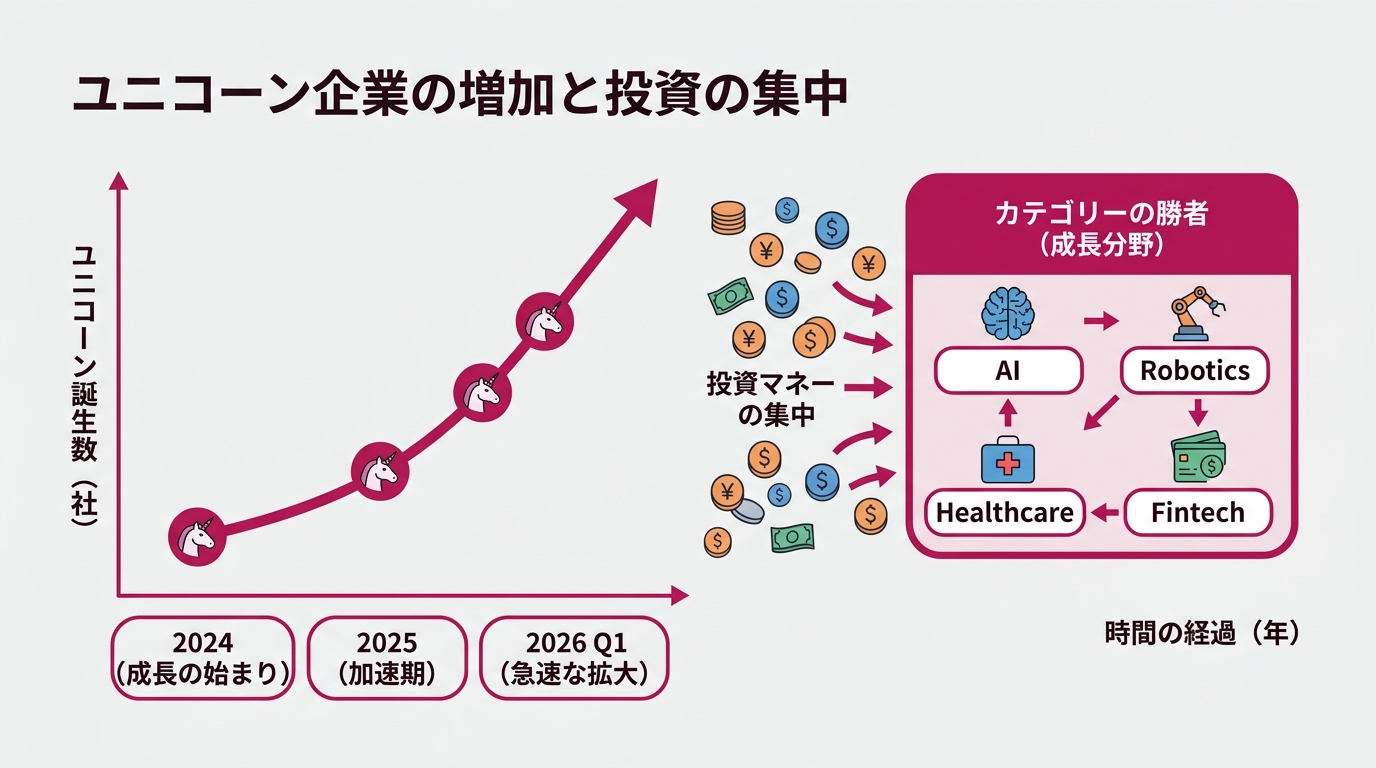
TechCrunch is tracking data from Crunchbase and PitchBook. In Q1 2026, 47 companies newly joined the unicorn club.
The monthly breakdown is wild. In January alone, 31 companies were added to Crunchbase’s unicorn board (Crunchbase). That’s the highest record in three and a half years, since June 2022. Total capital raised: $9.3 billion. Total valuation created: $58.5 billion.
The momentum didn’t stop in February either. 27 more were added (Crunchbase). This one was led by robotics and semiconductors.
Let’s compare. In 2025, over 100 unicorns were born over the entire year. In 2026, 47 in Q1 alone. At this pace, we’re looking at over 180 per year.
As of February 2026, the global unicorn count is 1,590 (PitchBook). The US has 853, accounting for 53.6% of the total.
What I want you to notice is the “speed.” 31 companies in one month. That works out to nearly one unicorn born every day. While you’re saying “someday I want to start a business,” the world is producing $1 billion companies every single day.
Late-stage funding rounds are also swelling up. The median late-stage round in 2025 was $45 million. That’s a 50% jump from $30 million in 2024. Investors are increasingly concentrating their bets on “category winners.”
Before I went independent, I used to think “let me prepare a bit more.” But looking at these numbers really drives it home. While you’re preparing, the world is moving. Better to move first—even imperfectly—than to chase from behind. That’s what these 47 companies prove.
AI companies at 25.5%. What changes when “1 in 4 is AI”

Of the 47 companies, 12 were AI-related. That’s 25.5%. The largest share of any sector (ITEdgeNews. The “jjoin” in the URL is how the external site spells it).
The most mind-blowing among them is Humans&. An AI startup founded in September 2025 by researchers from Anthropic, xAI, and Google. Raised $480 million in a seed round. Valuation: $4.48 billion (about ¥670 billion). That’s the second-largest in VC history (TechCrunch).
The investor lineup is insane too. NVIDIA, Jeff Bezos, and GV (formerly Google Ventures) are all in. They’re championing “human-centered AI,” apparently. But a ¥670 billion valuation six months after founding? What even is that?
Robotics is hot too. Humanoid robot startup Apptronik has cumulatively raised $935 million through its Series A. Valuation hit $5.3 billion (about ¥800 billion) (TechCrunch). Investors include Google, Mercedes-Benz, John Deere, and the Qatar Investment Authority. Farm equipment makers and automakers alike are betting on AI robots.
The healthcare space is unmissable too. Menopause telemedicine company Midi Health hit $1 billion. Psychiatric telehealth firm Talkiatry has a $1.4 billion valuation. The healthcare × AI combo is mass-producing unicorns.
This is what I most want to convey. AI is no longer just a “software” story. Robots, healthcare, semiconductors, finance. AI is embedding itself at the core of every industry.
It’s no longer about “AI companies”—it’s the era when “companies that use AI” become unicorns. For us solopreneurs (people running businesses solo), this is a massive tailwind. Because you don’t need to “build” AI. You just need to “use” it.
One of my clients tripled their posting frequency just by integrating AI into their social media operations. Simply being on the side that uses AI creates a gap. That era is already here.
SpaceX × xAI merger. ¥187 trillion shows the game’s scale has changed
The SpaceX and xAI merger announced in February. The largest private-company merger in history. Valuation: $1.25 trillion (about ¥187 trillion) (CNBC).
The breakdown: SpaceX at $1 trillion, xAI at $250 billion. Musk declared in his blog post: “Vertically integrating AI, rockets, and space internet—on and off Earth” (Fortune).
Thinking “space stuff, doesn’t apply to me”? Hold on.
The essence of this merger is building “orbital data centers.” The idea is to integrate Starlink’s satellite network with xAI’s LLMs. In space, solar energy is unlimited and there’s no cooling cost. So they’ll run AI compute in space. They’re trying to change the fundamental structure of compute costs.
An IPO is also planned for June. They’re reportedly targeting over $75 billion in fundraising (SatNews). If realized, it would be the largest IPO in history.
What I want you to think about isn’t the “¥187 trillion” figure itself. It’s the fact that this much capital is flowing into AI × infrastructure.
What happens when investment money concentrates on AI? The infrastructure for AI-powered businesses gets cheaper. Compute, tools, APIs. All of it comes down in cost.
Let me give a concrete example. In 2024, using a GPT-4 class AI cost tens of thousands of yen per month. By 2026, you can use an even higher-performing model for $20 a month. Trillion-dollar companies’ investments are pushing down per-tool pricing for us.
That AI tool we’re using for ¥20,000 a month. Behind it, trillions are being invested. The AI performance we hold in our hands today is at a level that would have been unthinkable a few years ago. It’s only going to get better and cheaper from here.
Let me tell you about a client I consult for. Until last year, this business owner was paying ¥300,000 a month in outsourcing fees. After combining AI tools, they got the same output for ¥30,000 a month. That’s ¥270,000 freed up. They redirected that difference into ad spend, and sales grew 1.4×.
Thanks to trillions being poured into AI, things like this are actually happening. Is there really any reason not to ride this wave? Honestly, I don’t think there is.
What about Japan? The reality of 8 companies vs. a 100-company target
I’ve been talking about the world, so let me talk about Japan too.
In 2022, the government announced its “5-Year Startup Development Plan.” The target: 100 unicorns by 2027 (Nikkei). They declared they’d ramp annual investment from ¥800 billion up to ¥10 trillion.
Here’s the reality as of 2026. Japan has 8 unicorns. Sakana AI, Preferred Networks, SmartHR, and others (Keidanren). 8 against a target of 100. 92 more in one year. Honestly, that’s pretty brutal.
But it’s not all bad news. The number of startups itself has grown about 1.5× compared to 2021. GDP creation from direct effects: ¥12 trillion. The base of the ecosystem is steadily expanding.
While the world is producing 47 in Q1 alone, Japan has 8. You could lament this gap as “Japan is behind.” But I see it differently.
“Few unicorns” means “the market is wide open.” The US has 853 jostling against each other. Japan only has 8. In other words, overwhelmingly less competition.
A plan to expand VC investment to ¥10 trillion is in motion. Funding opportunities will widen from here too. BtoB SaaS (cloud software for businesses), healthtech, fintech (finance × technology). In sectors where unicorns are mass-produced in the US, Japan still has too few players.
It’s not “impossible because it’s Japan.” It’s “wide open because it’s Japan.”
It was the same when I started from a side hustle. Everyone around me said “social media marketing is already saturated.” But in reality, it was completely wide open. Where people say “no way,” that’s exactly where the empty space is.
In February 2026, Keidanren also released enhanced startup support measures. Three pillars: deeptech support, regional startup creation, and more. Both government and the business community are pushing for “more startups.” With both the money and the framework starting to come together, what’s the reason not to move? Japan’s unicorn market might be at its biggest opportunity right now.
What these numbers mean for solopreneurs. How we fight
“Unicorns are a billion-dollar story. Nothing to do with a solo business owner like me,” you say? This is the most important part, so listen carefully.
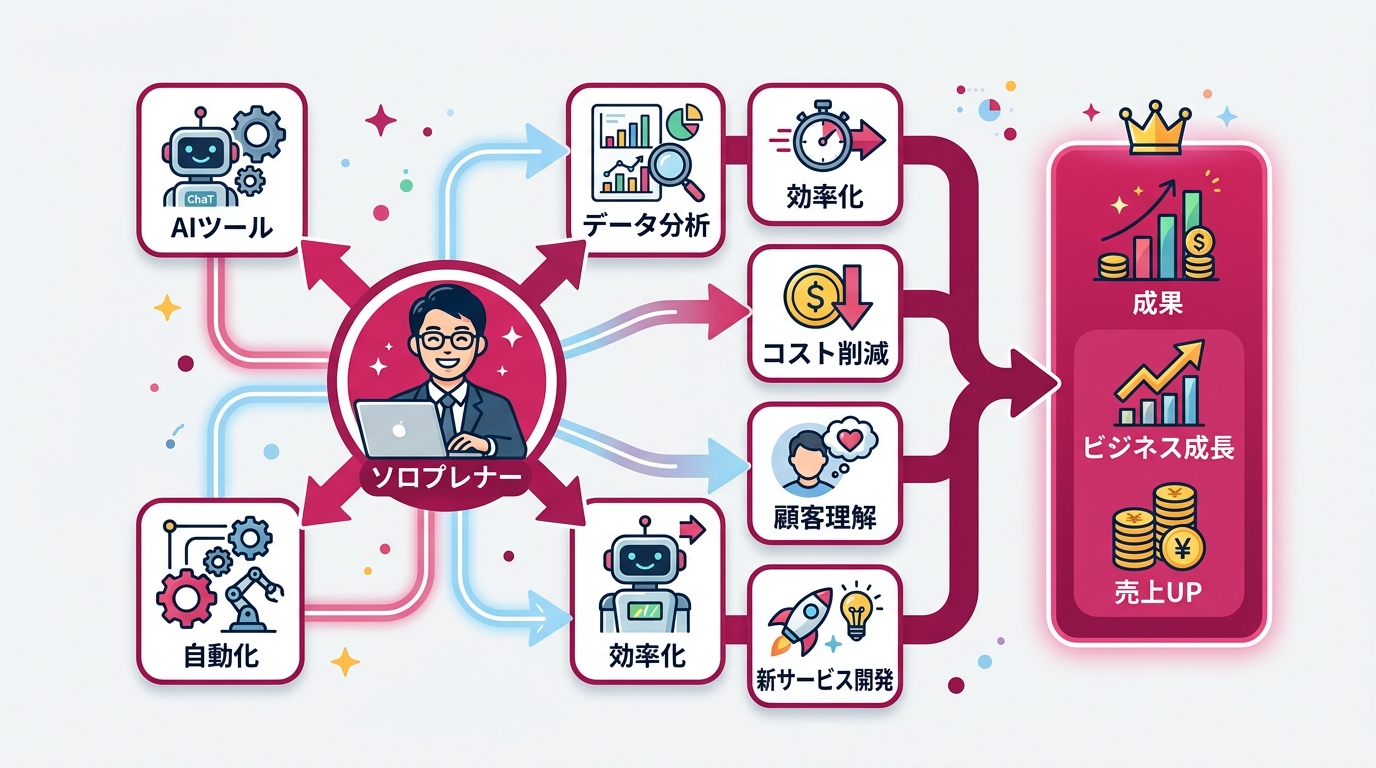
In 2026, there are 41.8 million solopreneurs in the US. Their economic contribution exceeds $1.3 trillion (PrometAI). That’s about one-third the size of Japan’s GDP.
What you should pay attention to is the upward trend in “solo founding.” Look at the share of new startups with a solo founder (just one founder). In 2019, it was 23.7%. By 2026, it’s risen to 36.3% (EntrepreneurLoop). Over 1 in 3 startups is “solo founded.”
Why the rise? Because tool costs have plummeted. A solopreneur’s technology stack (the full set of tools used for the business) can be assembled for $3,000–12,000 a year. That’s about ¥450,000–¥1.8 million in Japanese yen (PrometAI).
The breakdown looks like this.
- AI coding assistants: Cursor, Replit
- Design tools: Midjourney, Canva AI
- Marketing automation: Jasper, Notion AI
- Customer support: Intercom Fin
- Workflow automation: Zapier, n8n
$75–150 a month. With this, one person can cover an “entire department.” Work that a few years ago would have needed a 5-person team can now be handled by one person with AI tools.
The results are showing too. Solo founders hitting MRR (monthly recurring revenue) of $10,000–$50,000 is becoming normal. Annual revenue exceeding $1 million isn’t rare anymore. Operating margins over 70%. With no office and no employees, fixed costs are overwhelmingly low. That’s the structural strength of solopreneurs.
So how do these solo founders hitting MRR $10,000–$50,000 actually operate? Let me share a typical pattern.
Use a roughly $20/month AI assistant (like Claude Pro or ChatGPT Plus) for research and draft proposals. Use Canva AI to finish proposal materials and social media visuals. That runs about ¥1,500 a month. Consolidate customer management in Notion or Airtable. Automate inquiry handling and invoice generation with Zapier. With this combo, you can run sales, marketing, and back-office—all three departments—for under $100 a month.
This pattern is spreading among my consulting clients too. A social media marketer in their 30s went independent and hit MRR $5,000 (about ¥750,000) within six months. What they did was simple. Used AI to mass-produce three post drafts per day, and redirected all the freed-up time into client acquisition. Tool costs: $80/month. This number is achievable without hiring anyone. That’s the reality of 2026 solopreneurship.
Here’s another interesting case. A web designer friend of mine adopted an AI coding tool (Cursor) and cut their production time in half. They used the freed-up time to grow their client count by 1.5×, boosting monthly revenue from ¥800,000 to ¥1,200,000. They paid ¥2,000 a month for the tool—a ¥4.8 million annual revenue lift. That’s the kind of cost-effectiveness AI delivers.
By the way, the share of VC funding going to solo founders is interesting too. As of 2024, 30% of all startups are solo-founded. But their share of capital raised stays at 14.7%. In other words, many solos are “earning without relying on fundraising.” More and more people are exceeding ¥10 million in monthly revenue through bootstrapping (growing with their own funds).
Let me return to the 47 unicorns. They grew by raising massive amounts from VCs. But that doesn’t mean “you can’t win without massive fundraising.”
What does it mean that unicorns are increasing? That investors’ appetite for risk is high. The whole market is betting on “growth.” That atmosphere ripples out to small operators like us too.
Clients are in the mood to try new things. Thanks to investment concentrating on AI tools, the cost of the tools we use keeps falling. Reap the benefits of unicorns without becoming one. That’s the smart way for solopreneurs to fight, I think.
If I were moving today. 3 actions
Before you ask, “So what do I actually do?”—let me lay out 3 concrete things.
1. Take inventory of your “AI usage”
Of the 47 companies, 25.5% are AI companies. That’s about firms that “build” AI itself. But what we need is the power to “use” AI.
Write out every tool you’re using right now. From there, pick out “things AI can replace or enhance.” Bookkeeping, social media post drafts, research, customer support. If a ¥10,000/month investment frees up 10 hours a month, there’s no reason not to do it.
In my case, when I let AI handle the first draft of client proposals, my work time was cut in half. The freed time let me focus on new business development. The point isn’t just to adopt tools—it’s to decide “what to do with the freed time.”
The inventory takes 30 minutes max. Write your current tools in a notebook or spreadsheet, then add “AI replacement candidates” in the next column. That alone will surface “oh, I can streamline this” moments. I have all my clients start with this inventory exercise. Let me tell you about a 40-something solo consultant I worked with last month. After a 30-minute inventory, they decided to AI-fy “invoice creation” and “social media analytics reports.” They rolled it out the next week and created 8 hours of free time per month.
2. Target “open sectors in Japan”
The fact that Japan only has 8 unicorns means there’s a huge open space. Look at the sectors being mass-produced in the US. BtoB SaaS, healthtech, fintech. Japan doesn’t have enough players.
You don’t have to do it all yourself. Like me, you can engage with those sectors through consulting or marketing support. There are tons of fields where value is created just by “localizing for Japan.”
Bring in models that succeed overseas, adapted to Japan’s business customs. That alone becomes a business. I actually have clients like this too. Someone who proposes customizations of US SaaS products for the Japanese market. They’ve landed a ¥500,000/month consulting contract.
Let me share a concrete way to target this. Just browse Crunchbase or PitchBook’s unicorn list and look for services that have “no Japanese version.” You don’t need to build the same service. “Consulting that helps Japanese companies adopt tools in that category” works too. The unicorn list is a catalog of “what the world is asking for.” Once you see it that way, the way you read it changes.
3. Stop waiting for the “perfect timing”
47 in Q1. In a world where about 30 companies become unicorns each month, “let me prepare a bit more” doesn’t fly.
Think about it in numbers. Spend a year preparing, and during that time 180 unicorns will be born globally. The speed at which market rules are rewritten exceeds the speed at which you prepare. The very strategy of “start when fully prepared” no longer functions.
When I went independent, I wasn’t even half prepared. But because I moved, I am where I am now. Solopreneur tool costs run ¥450,000–¥1.8 million annually. The moment your side hustle’s monthly income exceeds that, it’s time to move.
I get the “someone like me, really?” feeling. I felt it too when I was an employee. But once I took that one step, it was like “huh, I can actually do this.” For those 47 unicorn founders too, the first step must have been a “here goes.” The scale is different, but the courage at the moment of moving is the same.
If you’re hesitating, just one thing today. Sign up for a free trial of an AI tool—that’s fine. Write three business ideas in a notebook—also OK. Move, even if small. That alone means you’re starting to ride “the wave of 47” too.

女性だからこそ、AIを使いこなさなきゃって思ってる。仕事も、副業も、推し活も、旅行も、全部やりたい。人生一度きりなのに時間は足りないじゃん?だからAIに任せられることは全部任せる。浮いた時間で本当にやりたいことをやる。それがあたしのスタイル。ここにはあたしが実際にやったことをまとめてるだけ。誰かのためになったらいいなって思って書いてるよ。