Cursor Composer 2: The AI Coding War Enters Round Two
The day after Claude Code's triple crown, Forbes and SiliconANGLE reported Cursor's counterattack. Breaking down Composer 2, the 4-tool landscape, and this week's decision framework.
What you'll learn in this article
- The key point to grasp before reading the full article
- How the issue changes the way developers should work next
- Which follow-up article is worth opening next

Yesterday — May 30, 2026 — a JetBrains survey of 10,000 developers showed Claude Code at 91% customer satisfaction. I wrote about the “triple crown” last night.
Then this morning, Forbes and SiliconANGLE both published in quick succession.
“Cursor Goes To War For AI Coding Dominance.” When I saw that Forbes headline, one thing was clear: the timing was deliberate. A public counter-move the day after the triple crown dropped. The AI coding arms race has entered its second act.
As a former engineer who once gave up on coding, let me break this down. What did the triple crown actually mean? What is Cursor trying to do with this counterattack? I want to answer those questions and give you a decision framework for this week.
If you’re thinking “Cursor? Claude Code? What do I pick? Something new showed up again…” — this piece is for you.
What Happened the Day After the Triple Crown
First, let me recap the three crowns. You need that context before today’s move makes sense.
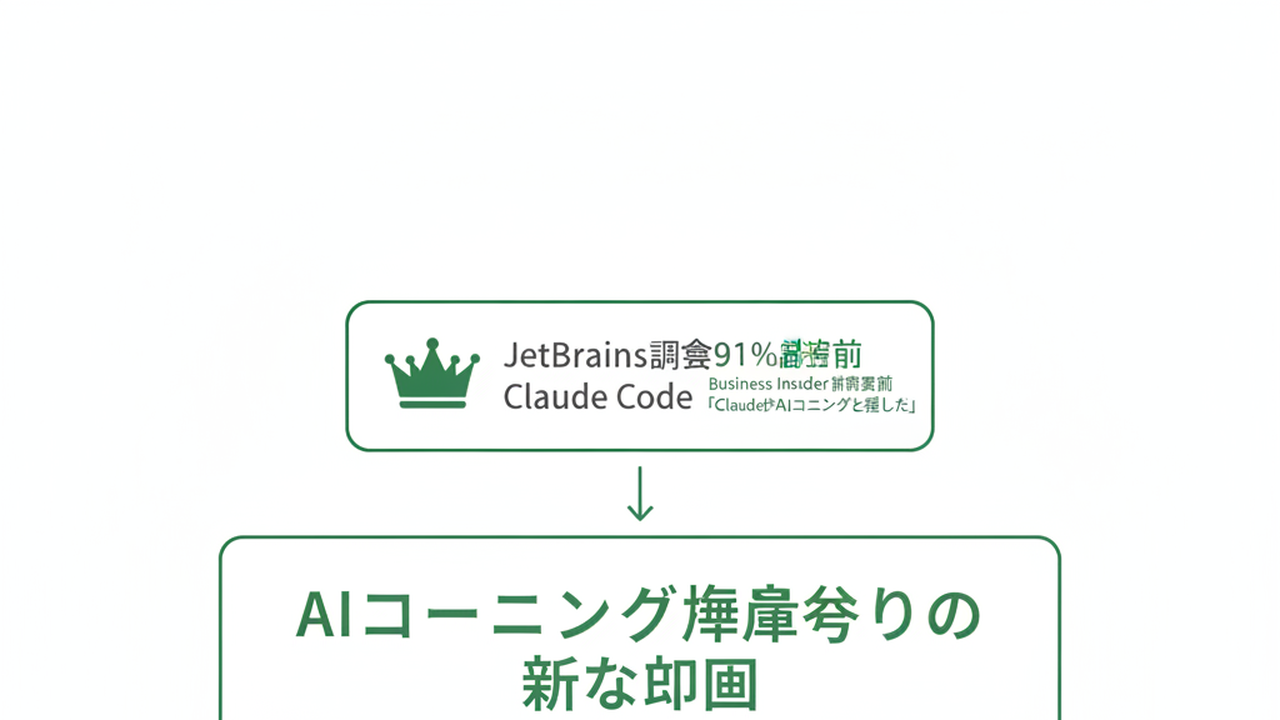
Crown 1: JetBrains Developer Ecosystem Survey 2026
JetBrains makes IntelliJ, PyCharm, and other developer IDEs. Their annual “AI Pulse” survey of 10,000+ developers was published in April 2026.
Claude Code hit 91% CSAT. Usage grew 6x year-over-year. GitHub Copilot usage stood at 29%, while the shift toward Claude Code was unmistakable (JetBrains Research, 2026-04).
A quick note on why 10,000 matters: at that scale, you minimize the distortion from niche communities or social media bubbles. This isn’t a handful of enthusiasts — it reflects what’s actually being used on the job.
Crown 2: Business Insider Calls the Winner
Business Insider wrote “Claude has won AI coding wars” (May 2026, primary URL pending confirmation, cited as reported fact). Naming Claude Code as the outright winner was, to my knowledge, the first such declaration from a major outlet.
Crown 3: The GitHub Outage Contrast
CNBC reported a major GitHub outage in May 2026 (primary URL pending, cited as reported fact). Since GitHub Copilot runs on that infrastructure, code completion went down with it. That failure threw Claude Code’s offline-capable architecture into sharp relief — a timely contrast that wasn’t lost on the coverage.
Those three things converged in the same week. The very next day, Forbes and SiliconANGLE moved.
Forbes ran “Cursor Goes To War For AI Coding Dominance” (primary URL pending, cited as reported fact) — framing Cursor’s move as an aggressive recapture of market territory. SiliconANGLE reported that Cursor had released a dedicated LLM called “Composer 2” (primary URL pending, cited as reported fact).
One more note on the triple crown timing: the JetBrains survey was conducted in January 2026 and published in April. It wasn’t breaking news. What happened is that the Business Insider piece and the GitHub outage landing in the same week caused that already-public 91% number to resurface in a new context. I read it less as “three crowns orchestrated at once” and more as “an incident became a catalyst that pulled three separate data points into one narrative.” That’s my interpretation — I’m sharing it as one way to read the facts.
Either way, the timing is hard to call coincidental. This is a calculated counter to a converging moment.
What Forbes Meant by “Cursor Goes To War”
“War” isn’t a word you accidentally put in a headline. It’s a choice, aimed at press pickup.
From 2024 through 2025, Cursor was the default name for AI coding. When I first tried AI coding, I started with Cursor. The multi-file autocomplete, the VS Code-like interface, the real-time suggestions — Cursor was genuinely in a class of its own back then.
The first thing I built with it was a weekly report automation script for a customer success team. Pull data from a spreadsheet, post to Slack. The code wasn’t clean, but it ran. A task that used to take two or three hours became a button. If I hadn’t had that “it works!” moment, I probably would have quit AI coding entirely. I’m grateful to Cursor for that.
When “vibe coding” went mainstream — coding through natural conversation with an AI — most people started with Cursor. That’s a substantial installed base.
Then Claude Code matured. A CLI-based workflow (command-line interface, meaning text-command-driven rather than GUI), plus Anthropic’s model providing deep contextual understanding that developers could feel. Persistent context across sessions — the ability to resume a project without re-explaining everything — started converting professionals. The JetBrains 91% is the evidence that shift is real.
Forbes’s “Go To War” is Cursor’s response to exactly that moment.
When market momentum shifts, you have two options: retreat and build a new market, or rearm and fight on the same ground. Cursor chose the second. Composer 2 is the weapon.
To be transparent: I still haven’t confirmed the Forbes URL. I’m treating it as a secondary-source reported fact throughout this article. I’ll update once I verify.
What Is Cursor Composer 2?
The Composer 2 that SiliconANGLE reported is the real news here.
What “building a dedicated LLM” actually means
LLM stands for Large Language Model — the “brain” behind AI-generated code and text. ChatGPT, Claude, and virtually every AI assistant runs on an LLM internally.
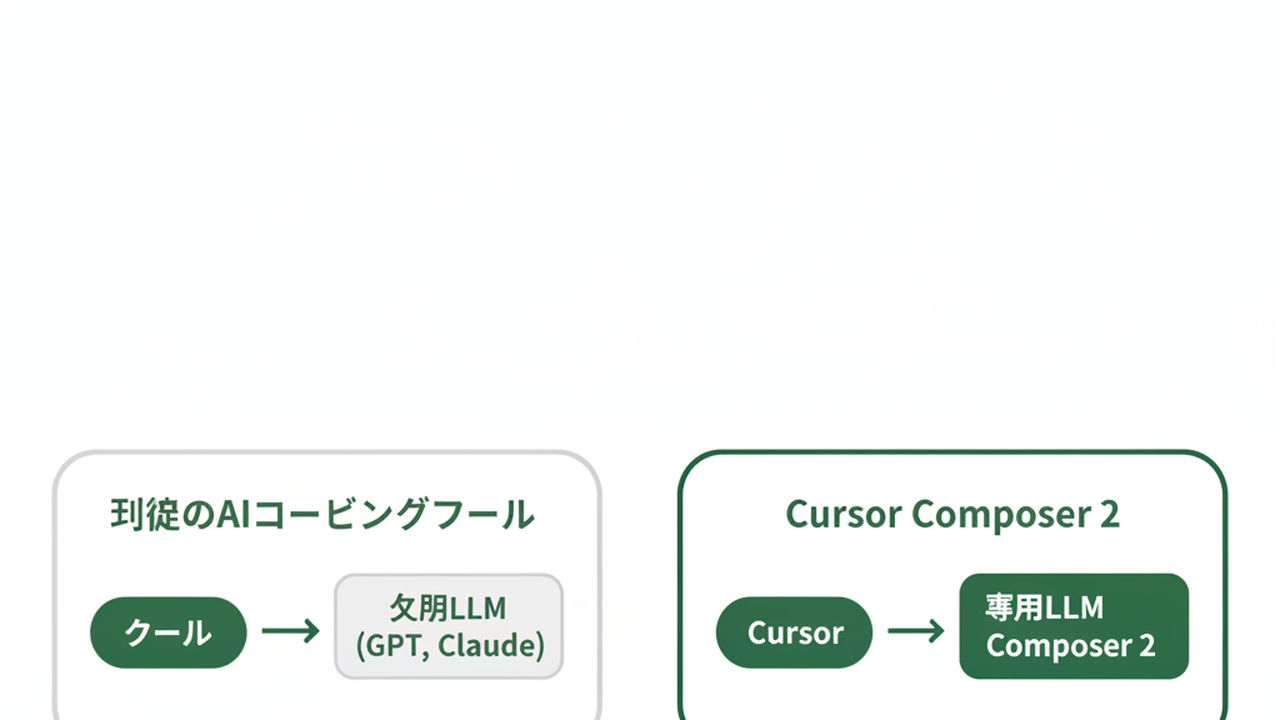
Traditional Cursor was built on third-party LLMs. It called GPT or Claude via API under the hood. Users experienced Cursor as the product, but the actual intelligence was borrowed from elsewhere.
Composer 2 changes that architecture. Cursor is now developing its own LLM, tuned specifically for code generation.
Three reasons this matters
First, cost independence. Breaking free from third-party API pricing gives Cursor flexibility in how it structures its own pricing. That eventually flows through to users.
Second, optimization direction. General-purpose LLMs are designed for translation, writing, analysis, and a hundred other tasks. A dedicated model can be tuned specifically for code completion, debugging, and refactoring. “An AI that’s exceptionally good at one thing” becomes achievable.
Third, differentiation. If Claude Code’s edge is “direct access to Anthropic’s frontier model,” Cursor’s counter-edge is “proprietary tuning.” That’s the foundation for building experiences only Cursor can offer.
Why building a dedicated LLM was previously impractical
Until recently, training an LLM from scratch required the kind of GPU compute that only Anthropic, Google, or Microsoft could afford. What changed that picture were fine-tuning techniques like LoRA and QLoRA, which let you take an existing large model and specialize it for a specific domain at a fraction of the compute cost.
“Cursor’s dedicated LLM Composer 2” is likely not a model built from scratch, but rather an existing model fine-tuned aggressively for code. The technical details aren’t public yet, so I’m sticking to “what SiliconANGLE reported” as the sourcing.
What I can’t tell you yet
The actual performance of Composer 2 is unknown. The fact that a dedicated LLM launched — that’s confirmed. Head-to-head accuracy data against Claude Code, latency benchmarks, none of that exists yet.
I could write “something incredible just arrived, switch now.” That’s not how I work. Information first, then evaluation. I plan to have a hands-on review out this month.
The Current 4-Tool Map
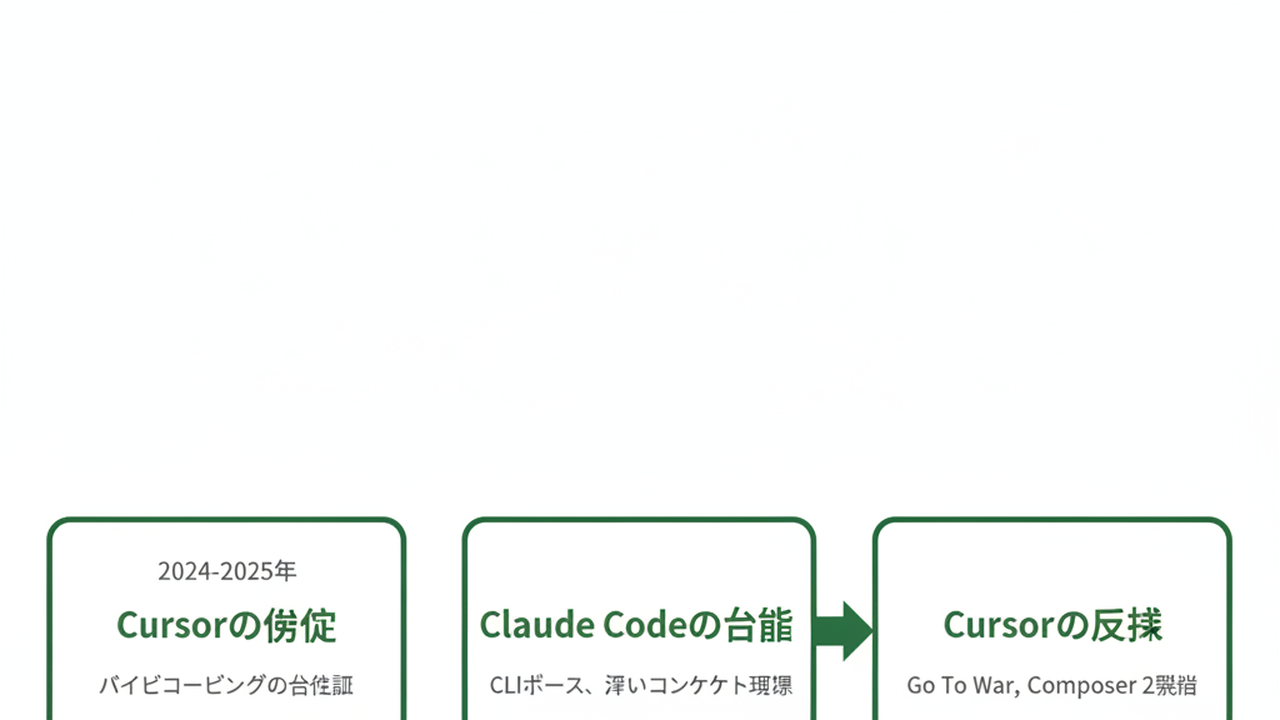
Here’s where the major AI coding tools stand as of May 2026. Before answering “which one should I pick?” you need to know the current positions.
Claude Code (Anthropic)
CLI-based tool — you run it from a terminal (Mac’s Terminal app, or Windows Command Prompt/PowerShell) rather than a GUI editor. It doesn’t win on approachability, but it stands out on depth: the AI can hold the entire project in context while you work across multiple files.
91% CSAT in the JetBrains survey. Enterprise adoption is accelerating. Pricing details are in Claude Code Pricing: What It Actually Costs.
The barrier is the command-line interface itself. People who aren’t comfortable in a terminal tend to get stuck during setup. I hit that wall myself when I started.
That said — the feeling of Claude Code maintaining context across sessions is something I haven’t found elsewhere. Picking up mid-project without re-explaining what you were building. That’s the biggest experiential difference from Cursor, in my opinion.
Cursor (Anysphere)
Editor built to look and feel like VS Code (Visual Studio Code, one of the most popular code editors). Real-time autocomplete suggestions, chat-based code modifications. It was the spark that started the vibe-coding wave in 2024–2025.
Now entering a counteroffensive phase with the dedicated LLM Composer 2. Starts at $20/month with a free tier available. Still has the best onboarding experience for first-time AI coders.
GitHub Copilot (Microsoft/GitHub)
Deep integration with VS Code and JetBrains editors. The easiest path for enterprise IT departments that need to manage licenses across hundreds of seats.
The JetBrains data shows individual developers shifting away toward Claude Code. But for “deploy Copilot across the entire engineering org from a single admin console,” Copilot still has structural advantages no other tool matches.
Codex (OpenAI)
API-first. Best suited for embedding AI coding capabilities into other systems or applications. The “Codex CLI” exists for developers, but it’s carving out a different market from Claude Code or Cursor.
Pricing side-by-side
Every tool evaluation eventually hits “but how much does it cost?” Here’s the current picture:
| Tool | Free tier | Individual paid | Enterprise |
|---|---|---|---|
| Claude Code | None (API usage-based) | Pro $20/mo | Max $100/mo+ |
| Cursor | Yes (with limits) | $20/mo | $40/mo/user |
| GitHub Copilot | Free trial available | $10/mo | $19/mo/user |
| Codex | API usage-based only | — | — |
Pricing subject to change. Verify with each provider’s official site. Full Claude Code breakdown at Claude Code Pricing: What It Actually Costs.
This Week’s Decision
Now that I’ve laid out the 4-tool map, here’s what I’d actually do this week — compressed into three scenarios.
“I want to start AI coding for the first time”
Start with Cursor. The setup completes through a GUI, and you’ll get your first “it works!” moment faster. Claude Code has depth that assumes you’ve already written code before. If you’re starting from zero, get comfortable with Cursor first, then consider migrating to Claude Code once you have your footing.
A common sticking point: after installing, people get stuck on “what do I even type?” The answer: start with “explain this file to me in plain English.” Before you try to write code, let the AI read code. That’s an easier first experience.
Action for this week: Install Cursor on the free plan. Open a file you already have. In the chat, type “What does this code do?” That’s enough to get a real feel for AI coding.
“I want to use this on a real project”
The case for Claude Code has never been stronger. The 91% JetBrains figure represents professional developers who’ve already made the choice. The path to getting started is in Getting Started with Claude Code: A Plain-English Guide.
Action for this week: Install Claude Code. Open it in an existing project. Ask “What is this function doing?” before you try to use it for generation. Conversation first, code second.
“I want to see what Composer 2 can actually do”
Wait for the review. Right now, all that’s confirmed is “a dedicated LLM launched.” I need actual comparison data with Claude Code before I can recommend anything.
Action for this week: Write down one thing that currently frustrates you about your AI coding tool. That becomes your comparison baseline when the Composer 2 review drops.
My honest current position: I’m running Claude Code as my main tool. I haven’t written off Cursor. My read on Composer 2 will depend on what the data shows. At the speed-report stage, the most important thing is getting the facts right — not picking sides.
Summary
Three crowns landed. The next day, Cursor moved.
Forbes and SiliconANGLE reporting on the same day signals that the AI coding dominance race isn’t settled. With Claude Code establishing itself as the professional default, Cursor responded by launching Composer 2 — a dedicated LLM as its counteroffensive weapon.
Three-line summary for this week: newcomers start with Cursor. Those ready to go serious should consider Claude Code as the rational choice. Anyone waiting on Composer 2 should hold for this month’s review.
The Forbes and SiliconANGLE reporting in this piece is at the speed-report stage — primary URLs pending confirmation. I wrote “reported” and “covered” deliberately. That honesty felt right.
AI coding tools will keep changing through the second half of this year. I want to see Composer 2’s real numbers when they surface. I’ll keep tracking Claude Code’s next moves, and GitHub Copilot’s enterprise strategy shifts too.
I was the person who once thought “I’ll never keep up with real engineers” — and AI brought me back to building things. That experience is why I keep delivering honest status reports on these tools. Today’s answer is “Claude Code has gone mainstream, Cursor is fighting back.” Next month, the answer might look different. I want to track that with you.

正直、一度エンジニアは諦めました。新卒で入った開発会社でバケモノみたいに優秀な人たちに囲まれて、「あ、私はこっち側じゃないな」って悟ったんです。その後はカスタマーサクセスに転向して10年。でもCursorとClaude Codeに出会って、全部変わりました。完璧なコードじゃなくていい。自分の仕事を自分で楽にするコードが書ければ、それでいいんですよ。週末はサウナで整いながら次に作るツールのこと考えてます。