Claude Code Claims the Triple Crown: JetBrains 91% CSAT, BI Victory Declaration, GitHub Outage
JetBrains surveyed 10,000 developers. Business Insider named a winner. CNBC reported a GitHub outage. Three signals landed the same week — here's what they mean for your tool choice.
What you'll learn in this article
- Where pricing and adoption questions around Claude Code stand right now
- Which plan or rollout stage fits the reader's situation
- Which follow-up article to open next for setup, cost, or bigger-picture context

I’m Gen. This week, three separate sources delivered a verdict on AI coding tool selection — all at once.
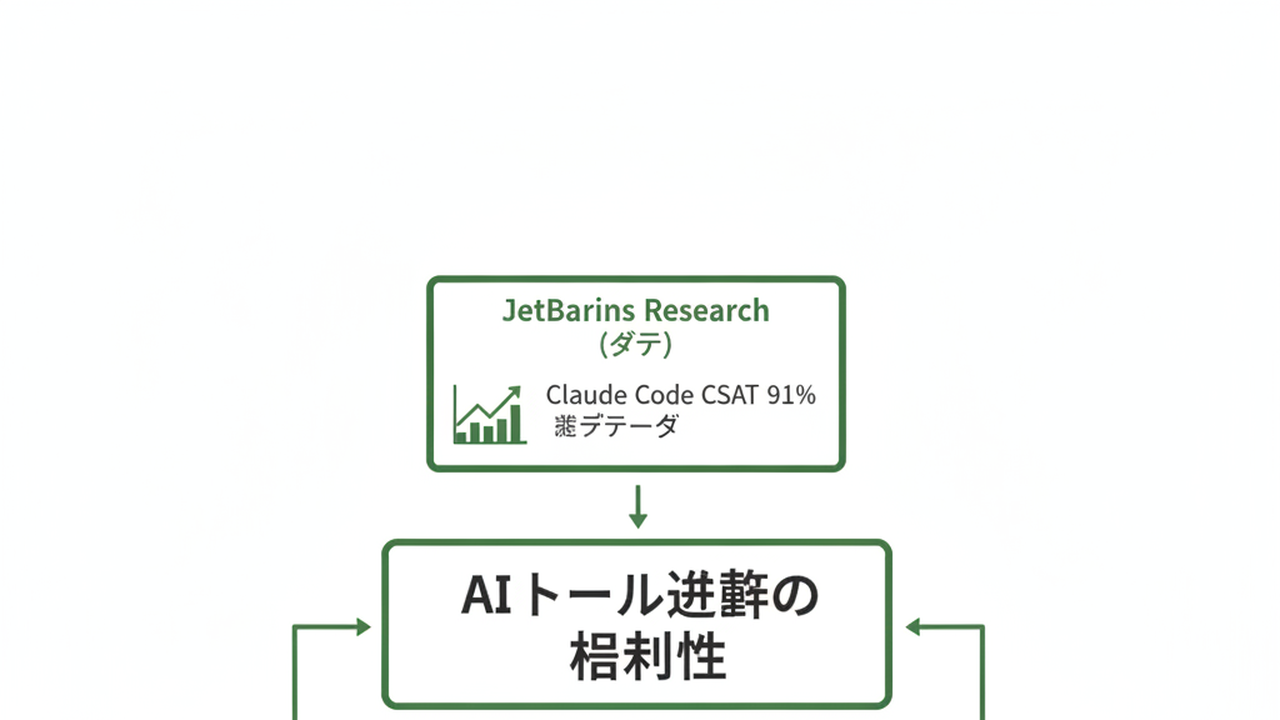
First: JetBrains published survey data from 10,000+ professional developers. Claude Code earned a 91% CSAT score, an NPS of 54, and saw usage grow 6x in one year. These figures come from a survey conducted in January 2026 and published in April (JetBrains Research, 2026-04).
Second: Business Insider ran a piece that flatly named Claude Code the winner of “AI coding wars.” In my observation, it was the first major media outlet to call a winner by name (Business Insider, May 2026. Direct URL not yet obtained — search: “Claude has won AI coding wars Business Insider 2026”).
Third: CNBC covered the fallout from a major GitHub outage. The incident itself was an infrastructure problem — but since Copilot is tightly integrated into that same infrastructure, code completion reportedly went down with it (CNBC, May 2026. Direct URL not yet obtained — search: “GitHub outage Copilot reliability CNBC 2026”).
“JetBrains showed it with data. CNBC exposed it with an incident. Business Insider wrote the conclusion.” Three sources aligning in a single week — I read that as “the week the rational case for Claude Code became complete.”
This article unpacks the triple crown one piece at a time. By the end, you’ll have three concrete actions you can start this week.

What Actually Converged This Week: Three Events, Laid Out
Let me lay out the three events clearly. There’s a lot of information here, so I’ll focus only on the what, when, and scale of each.
JetBrains. Results from the second AI Pulse survey (conducted January 2026) were published on the company’s research blog in April 2026. Sample: 10,000+ professional developers. Claude Code: 57% awareness, 18% workplace adoption, 91% CSAT, NPS 54. Because JetBrains ran the same questions at three time points (April–June 2025, September 2025, January 2026), you can see the direction of movement — not just a snapshot.
Business Insider. In May 2026, a piece ran with the headline “Claude has won AI coding wars.” Naming a specific product as the market winner that explicitly — to my knowledge, this was a first for any mainstream outlet. The argument reportedly rested on four elements: a concentration of large enterprise contracts, developer community word-of-mouth skewing heavily toward Claude, CSAT score leadership, and rapid market share growth (Direct URL not yet obtained — search: “Claude has won AI coding wars Business Insider”).
CNBC. Also in late May, CNBC covered the aftermath of a large-scale GitHub outage. The incident was fundamentally an infrastructure failure. But because Copilot is deeply integrated into that infrastructure, code completion reportedly went down simultaneously (Direct URL not yet obtained — search: “GitHub outage Copilot reliability CNBC 2026”).
Align all three and something becomes clear:
- JetBrains demonstrated it with data
- Business Insider wrote it as a conclusion
- CNBC exposed it through an incident
What I watch — as someone who once gave up on engineering and came back — is when these three layers stack up together. Data alone gets dismissed as “just numbers.” A conclusion alone gets dismissed as “someone’s opinion.” An incident alone gets dismissed as “a one-time fluke.” Three in the same week give the phrase “rational basis for tool selection” some real weight.
Let’s start with CNBC. Incidents create gut-level understanding faster than data.
The GitHub Outage CNBC Covered: What It Actually Exposed About Copilot’s Foundation
The late-May GitHub outage that CNBC reported. The coverage is factual and measured — but for developers, the implications run deeper.
GitHub Copilot is deeply integrated into GitHub’s infrastructure. Repository access, Actions, code history, completion generation — they all run on the same backend. When GitHub itself goes down, Copilot goes with it.
I learned this the hard way. During a GitHub partial outage at work, my Cursor + Copilot setup completely lost code completion. The editor still ran. Files still opened. But not a single suggestion appeared. I spent 30 minutes debugging before I found GitHub outage reports on X (formerly Twitter) and finally understood what was happening.
To be clear: the CNBC coverage isn’t saying Copilot has bad quality. Copilot’s numbers in the JetBrains survey — 76% awareness, 29% workplace adoption — remain the top in their category. That’s an undeniable fact.
The issue is the dependency layer.
Claude Code has a different dependency structure. Anthropic’s model and repository hosting are services from different companies. If GitHub goes down, Claude Code still runs. If the Claude API goes down, your GitHub code is still accessible. From a redundancy standpoint, running Claude Code alongside Copilot creates a “survive on one engine” setup.
This angle doesn’t show up in JetBrains’ survey data. CSAT and NPS measure experience quality, not simultaneous failure risk. CNBC’s reporting made the “single point of failure from infrastructure dependency” visible — as a real incident — in a way that JetBrains’ survey couldn’t capture.
But don’t misread this. I’m not saying drop Copilot. What I’m saying: the tradeoff between IDE integration convenience and single-point-of-failure risk became broadly visible to developers through this incident.

Business Insider’s “Claude Has Won” — the Evidence and Its Limits
Now let me unpack the Business Insider piece.
“Claude has won AI coding wars” is a winner declaration, naming a specific product. The argument reportedly rests on four elements: rapid market share growth, highest CSAT scores among developers, concentration of large enterprise contracts, and community word-of-mouth skewing toward Claude.
My reading is cautious. For a former struggling engineer like me, that “won” framing has three meaningful limits.
Limit one: Copilot’s installed base. JetBrains shows Copilot at 29% workplace adoption — still the undisputed leader. That number doesn’t translate to “everyone switches to Claude Code tomorrow.” Switching costs are a separate dimension from rational tool selection, and a winner declaration doesn’t move them.
Limit two: IDE integration superiority. Copilot lives in your editor. Suggestions appear without thought. For “single-line completion” work, it still delivers a best-in-class experience. Claude Code requires terminal launch, which creates friction for tasks that should stay inside an editor. The “won” claim may be scoped specifically to the agentic coding domain.
Limit three: cost. Claude Code’s pricing may be a barrier for individual developers switching from Copilot. This isn’t reflected in JetBrains’ survey data, so it reads as BI’s independent observation.
In other words, Business Insider’s “won” is a conditional victory. Won in agentic execution, in CSAT leadership, in enterprise contract concentration. Those are genuinely strong conclusions.
But not won in editor completion, existing user base, or cost sensitivity. That’s the realistic line, in my reading.
What matters is that Business Insider published a winner declaration at all. Mainstream business media naming a specific winner signals that the venture capital power map is moving toward finalization. Coverage has shifted from “both are growing” and “the market is still wide open” to calling a specific product by name.
So here’s how I’d read the BI piece: less “Claude Code is overwhelmingly dominant,” more “the market has entered the phase where winners get named publicly.” The latter framing is more accurate.
JetBrains CSAT 91%: What “People Who Used It Don’t Let Go” Looks Like
Let me return to the JetBrains numbers.
CSAT 91%, NPS 54. The highest product loyalty scores in the market, according to JetBrains. Let me translate that into what I actually experience.
I’ve been using Claude Code as a primary tool for building workflow tooling for about seven months now. Before that, I used GitHub Copilot for two years.
The experience gap shows up most clearly when something breaks.
Copilot’s main job is “suggest the next line.” The suggestion quality is high, and the IDE integration is genuinely excellent. But after an error occurs — during the “fix it” phase — I still had to drive. Read the error log. Form a hypothesis. Write the fix. Copilot assists that process; it doesn’t handle it for you.
Claude Code was different. When an error comes up, I paste it into the terminal and ask. It goes to read the relevant files, hypothesizes a cause, writes a patch, runs tests, and brings things back to passing — all on its own. My role collapsed to three commands: “please handle this,” “use this approach,” and “did the tests pass?”
One sentence: Copilot is a partner that works alongside you. Claude Code is a partner that stays until the problem is gone.
CSAT 91% reflects that difference, in my reading. Not “the next line was right,” but “it stayed with me until the error was gone.” Partners who close the distance to completion score better.
That said — this isn’t universal. Copilot’s strengths remain clear. It lives in your editor. Suggestions appear without friction. For work that should stay inside an editor, Claude Code’s terminal launch is slower. In the “single-line completion” world, Copilot still feels strong to me.
So CSAT 91% is telling you: not “Claude Code is better than Copilot,” but “Claude Code does a different job than Copilot.” Editor completion and agentic execution are different tools. CSAT 91% is the evaluation score for that agentic domain.
If you’re curious about getting started with Claude Code or what it actually costs, I’ve already put together articles on both. For usage: getting started with Claude Code in your first 30 minutes. For cost breakdown: a real-cost breakdown of Claude Code pricing.

What “The Rational Case Is Complete” Means — and Where It Stops
So the triple crown is decoded.
JetBrains showed the experience with data. Business Insider named a winner. CNBC exposed infrastructure dependency through an incident. Three sources converged in one week — the rational case for tool selection now has data, market, and infrastructure layers all aligned.
The thing I most want you to take away: “the rational case is complete” and “you should switch right now” are different claims.
Three blind spots to watch for:
One. “Won” in market media and “optimal” on the ground for individual developers don’t necessarily match. Business Insider’s piece is directionally accurate for the overall market. But for someone whose work centers on frontend UI adjustments, Copilot may still be the more rational choice.
Two. Don’t shortcut CNBC’s outage report into “therefore, switch.” GitHub outages happen maybe once every few years. Running Claude Code for infrastructure redundancy has value — but that’s not a reason to abandon Copilot.
Three. JetBrains’ CSAT 91% represents “people who used it.” Eighty-two percent of developers still haven’t adopted AI coding tools for regular professional use. For that 82%, CSAT 91% isn’t the key question. “Can I picture integrating this into my daily work?” and “Will this pass my company’s security policies?” are far more important questions.
“The rational case is complete” means the market map is finalized — not that your action plan is decided. Precisely because the rational case is complete, your judgment about your own work is what gets tested now. That’s the sentence I want you to take away from this week.
This Week’s Move: Translating the Triple Crown into Your Own Tool Choice
Final section — I’ve compressed this down to three actions. All designed to be startable within seven days.
Action 1: Track your coding time split for one week
This week, roughly divide your coding work into three categories and write it down:
- Single-line completion time: Tasks resolved with 1–few line suggestions (stay inside the IDE)
- Agentic execution time: Multi-file fixes, error resolution, adding tests
- Design time (no AI): Spec discussions, requirements, whiteboard work
Paper or a notes app — either works. One week of tracking shows you your own split. That split is the actual content of your “rational case.”
Action 2: Try one task with Claude Code agentic execution
If you haven’t used Claude Code professionally, try one task. Good candidates: multi-file refactoring, asking it to hypothesize causes from a recent error log. Choose something where Copilot’s single-line completion would struggle — that’s where you’ll feel what CSAT 91% is actually measuring.
First: check your company’s security policies. Whether code is sent to external services, and how logs are handled, are checkpoints that come before tool selection. For enterprise adoption planning, Claude Code enterprise adoption: the first 30 days gives you an entry point on setup.
Action 3: Explicitly consider “not switching” as a valid option
If Copilot is working for your workflow, there’s no need to switch. If Action 1 shows single-line completion at 80% of your time, sticking with Copilot is the rational call. The market moving doesn’t mean you need to move.
The triple crown never once said “switch.” It said “the market map is finalized.” A finalized map means it’s time to locate yourself on it. Don’t let hype pieces rush you — that’s what I’m taking away from this week’s triple crown.
Summary
JetBrains’ survey of 10,000 developers. Business Insider’s victory declaration. CNBC’s GitHub outage reporting. Three sources converging in the same week in late May 2026 — I’m calling this “the week the rational case for AI coding tool selection became complete.”
Key points:
- JetBrains 2026 AI Pulse: Claude Code CSAT 91%, NPS 54, 6x usage growth in one year. Copilot still leads with 76% awareness and 29% workplace adoption.
- Business Insider: “Claude has won AI coding wars” — named explicitly. Read it as a conditional victory; that’s still the most accurate framing.
- CNBC: GitHub outage exposed Copilot’s single-point-of-failure through infrastructure dependency. The infrastructure redundancy argument is now publicly visible.
- “Rational case complete” ≠ “you should switch right now.” Measure your own time split first.
- This week’s moves: time-split memo, one Claude Code trial task, explicitly evaluate the “don’t switch” option.
The feeling of “a master engineer taking shape inside me” — I owe that to Claude Code. Coming from a former struggling engineer, take it with appropriate salt — but CSAT 91% isn’t empty.
Still, this article didn’t tell you to switch. If Copilot is working for you, keep it. If you don’t use AI coding tools at all, there’s no rush. The triple crown doesn’t decide your actions. The market map is finalized. How you move across it — that’s answered by the content of your own work.
Numbers work harder as tools for reading structure than as ammunition for hype. When an incident happens, don’t let it become fear — use it to rethink dependency design. Don’t swallow winner declarations whole — check the evidence first, then compare it to your situation. That’s the healthiest way to process the triple crown.
Next week, show me your coding time split memo. Once we see the breakdown, I’ll help you figure out your next move.

正直、一度エンジニアは諦めました。新卒で入った開発会社でバケモノみたいに優秀な人たちに囲まれて、「あ、私はこっち側じゃないな」って悟ったんです。その後はカスタマーサクセスに転向して10年。でもCursorとClaude Codeに出会って、全部変わりました。完璧なコードじゃなくていい。自分の仕事を自分で楽にするコードが書ければ、それでいいんですよ。週末はサウナで整いながら次に作るツールのこと考えてます。