Meta Now Targets Ads Based on Your AI Chats. Two Things Japanese Marketers Must Do This Week
What you ask AI now determines the ads you see.
What you'll learn in this article
- The key point to grasp before reading the full article
- How the issue changes practical decisions after reading
- Which follow-up article is worth opening next

What you ask AI now determines the ads you see.
Most people still don’t realize this. On December 16, 2025, Meta updated its privacy policy (Meta official). Your conversations with Meta AI will be used for ad targeting. The change applies to Facebook, Instagram, and WhatsApp.
You ask Meta AI, “I’m looking for English learning materials for my child.” The next day, your Instagram feed fills with ads for English conversation schools. That mechanism is already running.
This is a tectonic shift in marketing. Not search history, not browsing history, but your “conversations” with AI have become the raw material for ads. I call this “AI chat advertising.”
This is the latest phase in the series I’ve been tracking: AEO (AI Engine Optimization) → GEO (Generative Engine Optimization). Today we dig into this shift. I’ll give you two concrete things marketers should do this week.
What changed: Breaking down the December 16, 2025 policy update
Meta AI crossed one billion monthly active users in May 2025 (DemandSage). That’s a doubling from 500 million in just eight months. A chatbot integrated into Facebook, Instagram, WhatsApp, and Messenger is now used daily by one billion people.
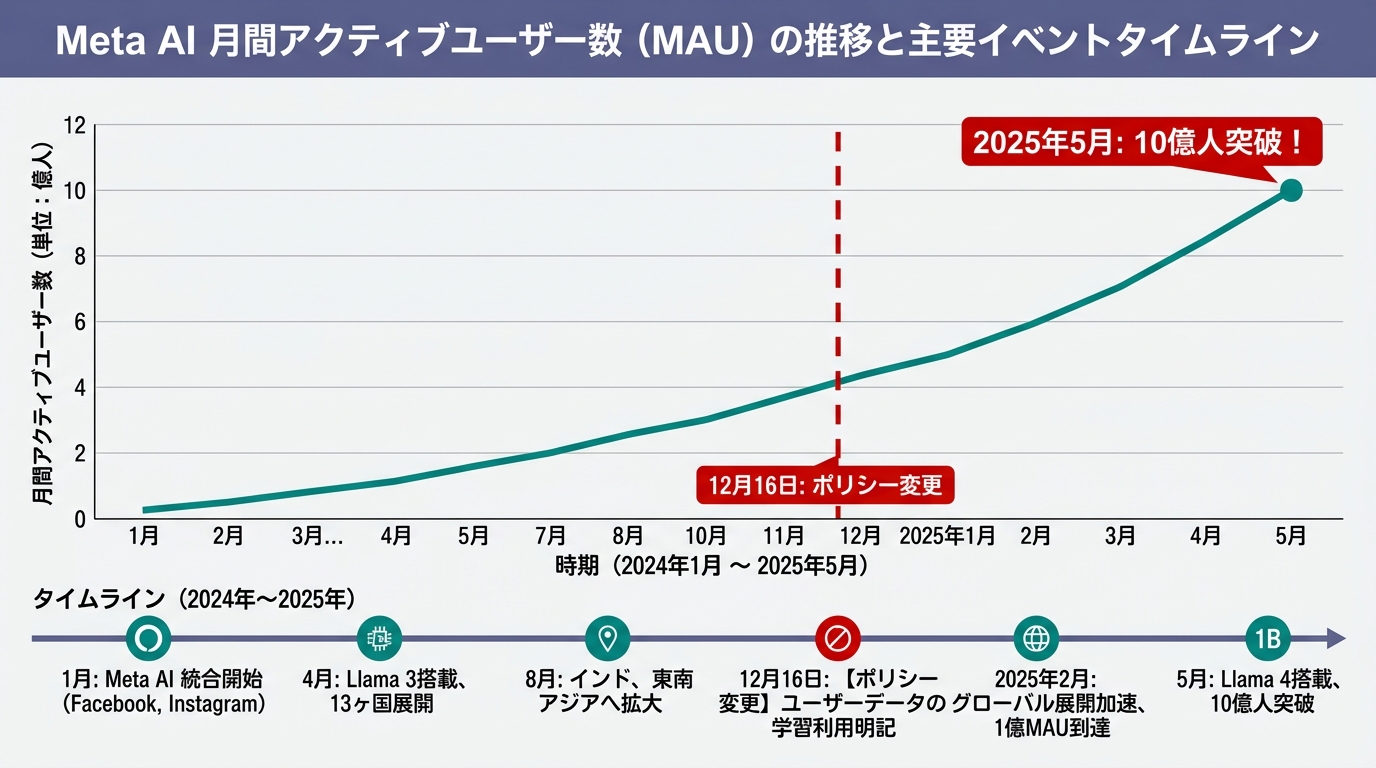
The conversations of these one billion people become ad targeting data. That is the core of the policy change.
What exactly gets collected? Meta’s official documentation states:
“Prompts (questions, messages, media, and other information that you or others share or submit to AI at Meta)”
It’s not just text. Images and audio—anything you hand to Meta AI—can become material for ad optimization. The AI features built into Ray-Ban smart glasses are also included.
Three points to keep in mind here.
- You can’t opt out. As long as you use Meta AI, there is no way to refuse having your conversation data used for ads (Proton). The only workaround is “don’t use Meta AI at all.”
- Sensitive information is excluded. Meta states that conversations about religion, sexual orientation, political views, and health will not be used for ad targeting.
- WhatsApp is conditional. AI conversations on WhatsApp are only used for ads if your WhatsApp account is linked to Instagram or other Meta accounts.
More than 30 digital rights organizations have asked the FTC (U.S. Federal Trade Commission) to block this (EPIC). The biggest point of contention is the lack of even a basic opt-out.
Japan is “in scope.” A geopolitical asymmetry has emerged
This change does not apply in three regions: the EU, UK, and South Korea (Gizmodo).
The reason is the existence of strong privacy regulations like GDPR. Meta is even restricted from using data for AI training in the EU. Repurposing it for ad targeting clears an even higher bar.
Japan, on the other hand, is in scope.
Instagram has 63.2 million users in Japan—51.4% of the total population (DataReportal). Facebook has 72.6 million Japanese users. AI chat advertising is now running across roughly 130 million combined touchpoints.
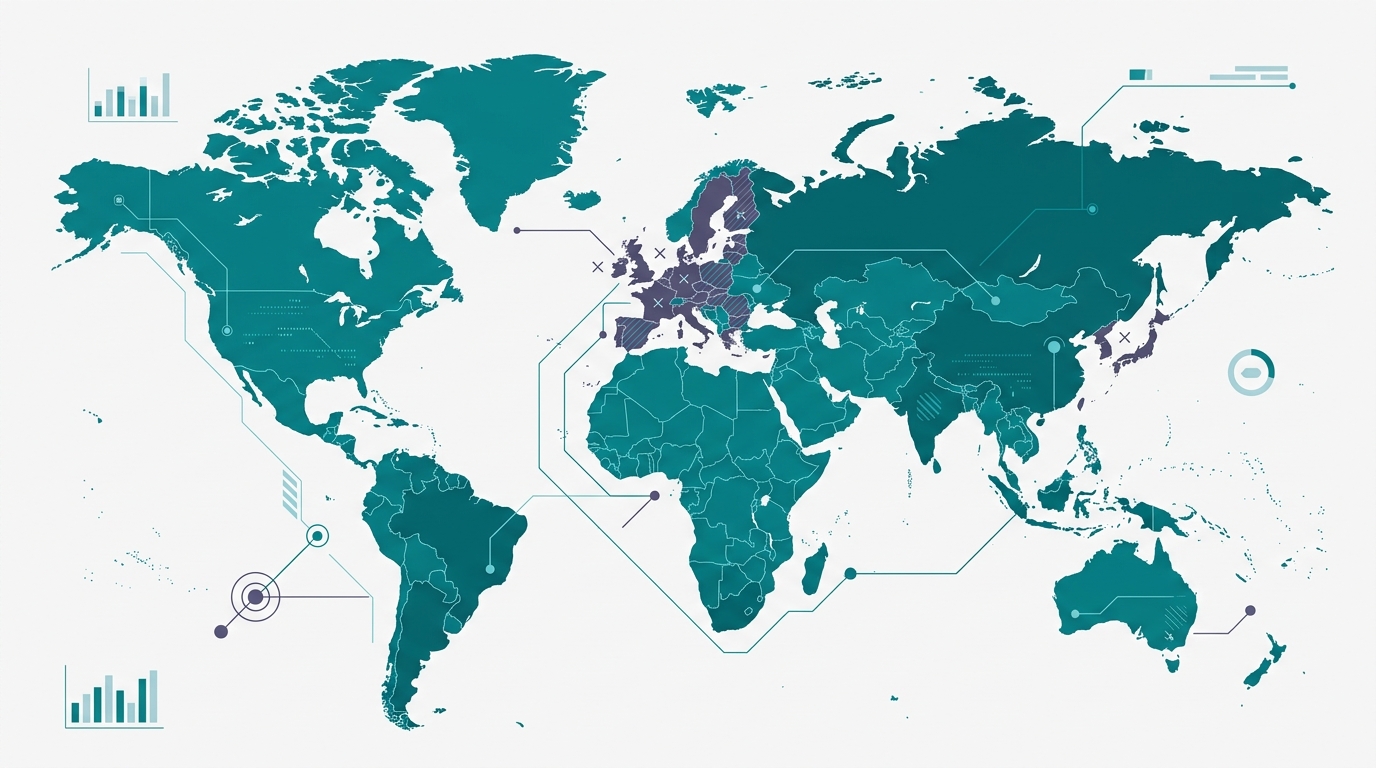
A geopolitical asymmetry has emerged here.
Marketers in the EU cannot run ad campaigns powered by AI chat data. Marketers in Japan can. This is both a constraint and an opportunity.
But we shouldn’t celebrate this “opportunity” unconditionally.
Japan’s Act on the Protection of Personal Information was amended in 2022, but it lacks GDPR-level enforcement power. The legal basis for telling Meta “restrict the use of AI chat data” is currently weak. The periodic report from designated digital platform providers, published by Japan’s Ministry of Economy, Trade and Industry (METI) in December 2025 (METI), included Meta-related information. Even so, there is no direct regulation yet on using AI chat data for advertising.
In short, Japanese marketers are “in an environment where they can use this, but in the grace period before regulation catches up.” That awareness is critical.
What marketers should do this week, #1: Switch to “conversation-driven” keyword design
Now to the practical work.
The essence of AI chat advertising is that user “intent” is captured at a deeper level than ever before.
Someone typing “recommended English learning materials” into Google search is in the comparison stage. Meanwhile, someone asking Meta AI, “I want to teach English to my 5-year-old—where should I start?” is at an earlier, more upstream stage of having a problem.
This difference will fundamentally change the precision of ad targeting.
Traditional ad targeting reads “traces of action.” Which pages you viewed, what you added to cart, which videos you watched to the end. That’s “what you did” data.
AI chat advertising captures “what you’re thinking.” The worries and considerations of users who haven’t yet taken action remain as text. For advertisers, this means a new way to reach users at the very top of the purchase funnel.
Meta’s new ad platform Lattice is a system that consolidates signals from 3.58 billion daily active users (Meta AI Blog). Meta says behavioral prediction accuracy improved 4x compared to previous models. Companies that adopted Lattice reportedly saw 10% revenue gains and 6% conversion rate improvements.
What marketers should do in this environment is clear.
Design “conversation keywords,” not search keywords.
If you run an English conversation school, your traditional SEO keywords were probably “online English conversation comparison” or “cheap English lessons.”
In the AI chat advertising era, you need to add to that—anticipating “the contexts in which users would consult AI.”
- “I need English for a job change. How can I get to conversational level in 3 months?”
- “I want to raise my TOEIC score. Is self-study or going to a school better?”
- “What’s the best age to start English lessons for kids?”
These are long-form consultation queries that people would rarely type into Google search. But people type them into AI chat all the time. By reflecting this “conversational intent” in your content, you make yourself more likely to get picked up by AI chat ad targeting.
Concrete action. Here’s what I want you to do this week:
- Write out 10 patterns of “consultation prompts to AI” related to your service
- Extract the key phrases contained in those prompts
- Reflect the extracted phrases in your Meta ad targeting settings
The exercise of writing 10 patterns takes about 30 minutes. Try writing them as if you were consulting AI yourself. You’ll notice that the words you use when “searching” differ from the words you use when “asking AI.”
What marketers should do this week, #2: Improve the “input quality” for Lattice fully-automated ads
Meta is targeting completion of its “goal-only” advertising system during 2026 (Adtaxi). It’s a system where you input only a URL and a goal, and AI handles everything from creative generation to delivery optimization fully automatically.
Over 4 million advertisers are already using Meta’s GenAI (Generative AI) tools (Meta official). Production time has reportedly been cut by 80% with AI-generated creative.
“If it’s fully automated, do marketers have nothing to do anymore?”
Not quite. With fully automated ad systems, results are determined by “input quality.”

What Lattice references is the information on your website. If your site’s structure isn’t organized, AI can’t generate accurate creative. If your product information is outdated, AI will build ads using outdated information.
In other words, the marketer’s job in the Lattice era shifts from “making ads” to “creating an environment where AI can make the right ads.”
Here’s the second action for this week:
- Audit your site’s structured data. Are product names, prices, descriptions, and images properly described in JSON-LD or Open Graph tags? Lattice reads this metadata to generate creative.
- Update old information. Are there price changes, service changes, or discontinued products still lingering? If AI builds ads with outdated information, it leads directly to customer complaints.
This overlaps with the GEO (Generative Engine Optimization) work I covered in the previous article. Prepare content that AI can read correctly. Whether it’s search engines or AI ads, the fundamental work is the same.
You can audit structured data for free with Google’s Rich Results Test. It takes about 5 minutes per page. Start with just two pages—your homepage and your flagship product page.
How I see “the era when conversations become ads”
To be honest, I have mixed feelings about this change.
As a marketer, I’ve gained a tool that lets me understand user intent more deeply—there’s no reason not to use it. Targeting based on AI chat data could be far more accurate than traditional behavioral data.
On the other hand, as someone who operates AI agents, I have concerns. If I apply the “phased permission design” principle I practice in AI agent management to this advertising system, Meta’s move looks like “rolling out autonomous execution to all users at once.” The lack of an opt-out feels reckless as a design choice.
The reason 30+ digital rights organizations have asked the FTC to block this is, I think, a backlash against this “no phasing.”
Still, I believe this trend won’t stop.
Meta’s Q1 2026 revenue forecast is $53.5–56.5 billion. Annual capex will reach $115–135 billion. To recoup that enormous investment, repurposing AI chat data for advertising was unavoidable. The economic structure compels it.
I think the right stance for marketers is to “use it while remaining critical.” Acknowledge the privacy issues, but advance the practical work that can be done before regulation catches up.
Wrap-up: From search to conversation. The raw material of advertising has changed
We’ve entered an era where the chat content of Meta AI’s one billion monthly users is used for ad targeting. Unlike the EU, UK, and South Korea, Japan is in scope for this change.
Let me recap the two practical actions I shared today:
- Designing “conversation keywords”: Write out 10 patterns of “contexts where users consult AI”—not search terms—and reflect them in your ad targeting. 30 minutes of work.
- Preparing input quality for Lattice: Audit your site’s structured data and content freshness. Start with two pages: the homepage and your flagship product page. 5 minutes per page.
AEO → GEO → AI chat advertising. Readers who’ve followed this series should see it by now. The common thread is the principle of “preparing information that AI can correctly understand.” Search engine optimization, generative engine optimization, and adapting to AI chat advertising—the roots are all the same.
What’s different is that the “raw material” AI reads has expanded from search queries to conversation data. The scale of this change isn’t yet on the radar of most Japanese marketers.
When I wrote the AEO article, I thought “getting cited by AI” was the goal of optimization. With the GEO article, my view broadened to “designing for AI to reference as a source.” With AI chat advertising this time, I’m convinced we’ve entered a third phase: “conversations themselves become the starting point for ad delivery.”
This trend can only accelerate—there’s no going back.
Take 30 minutes this week. Write out 10 patterns of “consultation prompts to AI” related to your service. That alone gets you to the first step into the AI chat advertising era.

AIを使いこなせない方は、この先どんどん差がつきます。僕はAIエージェントを毎日動かして、壊して、直して、また動かしてます。そういう泥臭い実践の記録をここに書いてます。理論は他の方にお任せしました。僕は動くものを作ります。朝5時に起きてウォーキングしてからコードを書くのがルーティンです。