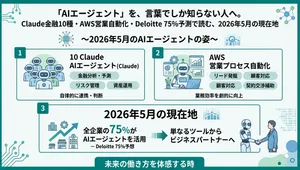
HBR Says 'Treat AI Agents as Team Members': 3 Risk Management Methods That Won't Fail in the Era of 40% Production Deployment
'AI agents—how much can we actually delegate to them, really?'
What you'll learn in this article
- What AI agents mean in plain language and why the term matters now
- Which real-world workflow patterns are already becoming practical
- Which next article deepens pricing, rollout, or implementation context

“AI agents—how much can we actually delegate to them, really?”
My answer to this question has shifted dramatically over the past six months. Six months ago, I’d say, “Start by trying them out on a task-by-task basis.” But today, my answer is different.
In March 2026, Harvard Business Review (HBR) published a proposition: “Treat AI agents as team members.” The argument is that they’re not “tools” you throw tasks at and receive results from. They should be designed as “team members” with defined roles and authority.
Around the same time, a figure released by Gartner was equally striking. Forty percent of enterprise companies are now running AI agents in production environments (Gartner). In early 2025, that figure was just 5%. An 8x leap in a single year.
Forty percent have gone into production. The remaining sixty percent haven’t taken the leap yet. What separates them isn’t technical capability—it’s risk management design.
Nine out of ten stories about “AI agent implementations gone wrong” aren’t about technology. They’re about flaws in risk management design.
Today, I’ll cover this with HBR’s proposition and Anthropic’s safety report as the central pillars. Three risk management methods to keep AI agent implementations from failing. If Mikoto’s article (“AI Team Building”) was the practical guide to agent utilization, this article is the design guide for safe operation. Drawing on my experience running an autonomous agent team in Claude Code, let’s draw the line between “delegating” and “dumping.”
From “Tool” to “Team Member”: The Perception Gap HBR Identified
What the HBR paper struck at was a fundamental perception gap that many companies are committing.
Organizations that introduce AI agents as “convenient tools” tend to stop at writing usage manuals. They consider the job done with just input-output design: “Send this prompt, get this result.”
But that’s not where the essence of autonomous agents lies.

Tools execute only what they’re instructed to do. Type “1+1” into a calculator and you get “2.” The human always holds the judgment.
Agents are different. Given a goal, they choose their own means, judge situations along the way, and adjust their approach as needed. They may even coordinate with other agents. In other words, the number of “judging entities” increases.
HBR called this difference the “delegation gap.” It’s a concept that refers to a state where the design of authority delegation hasn’t caught up.
For example, imagine hiring a new employee. You wouldn’t hand them customer-facing work on day one. First, they shadow operations, read manuals, and gain experience under a senior colleague’s supervision. Authority expands in stages.
The core of HBR’s argument is that AI agents need the same process.
I call this “agent onboarding”—the idea that AI agents, like new hires going through an intake process, deserve a graduated authority design and supervisory structure.
A corporate AI adoption survey released by Deloitte in February 2026 backed up this direction. Many companies that succeeded with agent deployment have established a “graduated authority expansion process.” Companies that failed at adoption tend to have given broad authority from the start and simply “let it run.”
“But AI isn’t human. Their patterns of judgment errors are completely different, right?”
Exactly. Humans learn from experience and refine their judgment over time. AI agents depend on training data and prompt design. The root causes of errors are fundamentally different.
That’s why we can’t simply repurpose human onboarding wholesale. We need three management methods tailored to the unique risks of AI agents.
Risk Management Method 1: Design a “Graduated Escalation” of Authority
A safety report Anthropic released in February 2026 laid out the risk structure of agents with crisp clarity.
The biggest risk the report identified is “over-provisioning of authority.”
When you give an agent broad authority from the start, you can’t control the blast radius when unintended operations occur. You meant to grant only database read permissions, but write permissions came along. You authorized external API calls, and it ended up hitting paid endpoints. Incidents like these are far from rare.
What the Anthropic report particularly raised alarms about was the “chain of hallucinations” (the generation of content that diverges from facts). One agent outputs faulty information, another agent references it for decision-making. When operating in multi-agent configurations, this risk is incomparable to single-agent setups.
The countermeasure is designing a “graduated escalation.”
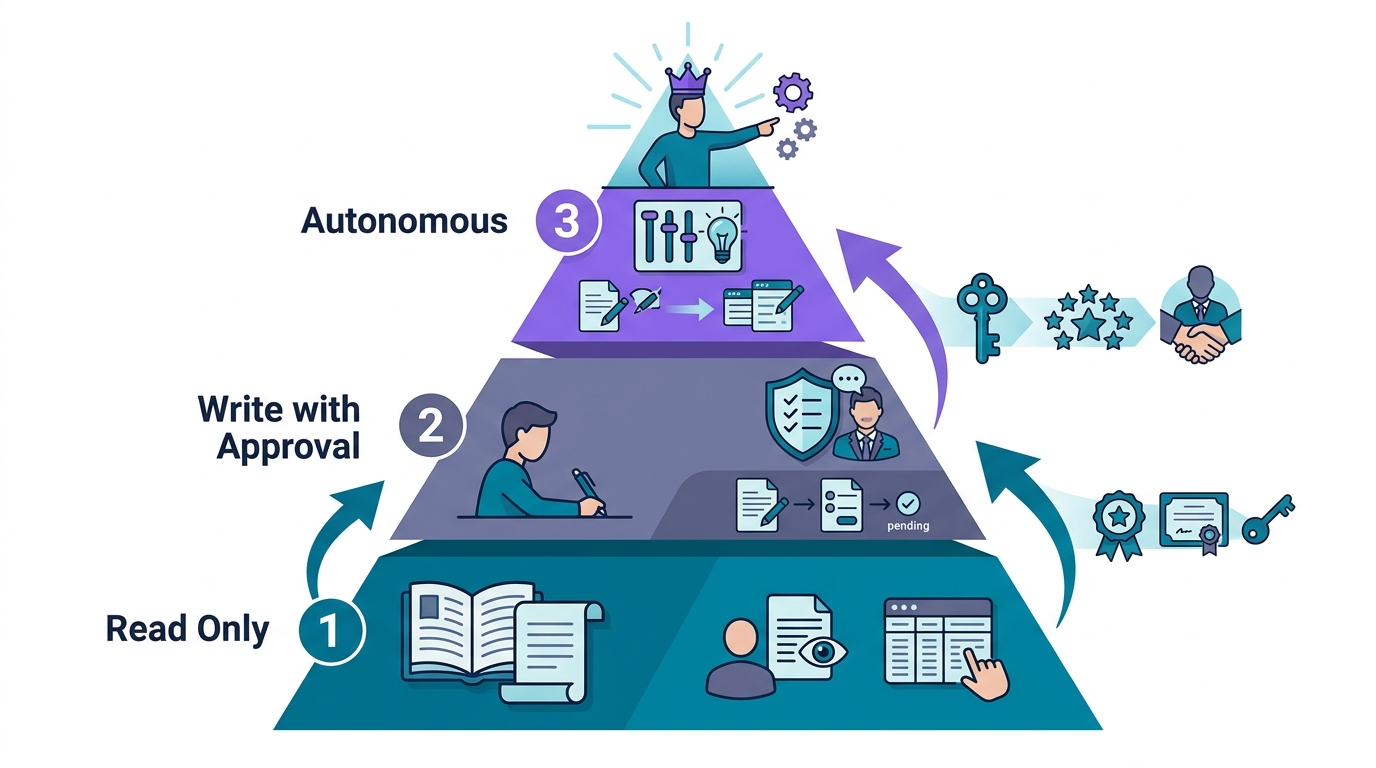
Specifically, divide the agent’s authority into three tiers.
Level 1: Read Only. Referencing data, generating reports, summarizing information. Grant no authority whatsoever to “change” anything. This is the starting line.
Level 2: Write with Approval. Editing files, drafting emails, proposing schedule changes. Always interpose human approval before execution. In Claude Code terms, this is the state where a confirmation prompt appears for every file change.
Level 3: Autonomous Execution. For routine tasks only, execute to completion without human approval. However, anomaly detection triggers must always be set.
Let me share an operational example. In my Izumo system, I apply these three tiers to each AI agent (which I call “Pillars”).
When entrusting a new task, I first request it at Level 1: “Research this and report back.” Once the report quality stabilizes, I move it up to Level 2: “Write a draft and let me review it.” Once the draft quality clears a baseline, I advance to Level 3: “Run on a schedule and share when complete.”
What matters here is “taking your time.” I allow a minimum of two weeks for promotion from Level 1 to Level 2. Run it daily for two weeks and verify output quality. I don’t judge from one or two successes.
The criteria for “promotion” matter too. I use three indicators.
- Accuracy: Were there zero factual errors in the last five outputs?
- Consistency: For the same type of task, is quality variance within acceptable bounds?
- Unexpected behavior: Have any operations occurred that weren’t instructed (file deletion, external communication, etc.)?
Only when all three criteria are met does the agent get promoted to the next level. Conversely, if even one criterion is missed, it gets demoted to the previous level. Applying this rule mechanically prevents the judgment error of “felt fine, so I delegated it.”
Risk Management Method 2: Record an “Audit Log” Alongside the Agent’s Actions
In the HBR paper, the point that hit hardest for me was this:
“The actions of AI agents should be treated as subjects of audit on par with human actions.”
When a human employee files an expense, an expense report remains. When they access a system, logs are generated. When they make a decision, an approval history persists. Organizations build these mechanisms to trace “who did what, when.”
HBR pointed out that a surprising number of organizations have no equivalent mechanism for AI agents.
You might think, “AI did it, so we can’t really log it, right?” Actually, the opposite is true—it’s easier to log AI in detail than humans. Because every input and output remains as text data.
The problem is “we can log it, but we don’t.”
You might think, “We’re a small organization, so we don’t need that level of infrastructure.” But it’s precisely because you’re small that logs matter. At large enterprises, if one agent slips, another check function catches it. In individual or small-team operations, agent outputs often become the final deliverable. The thinner the check layers, the more post-hoc verification through logs becomes the lifeline.
The Anthropic safety report also emphasized the importance of saving agent action logs in a structured form. They specifically recommend recording these four items:
- Input: The full text of the instruction the agent received
- Judgment: The action the agent chose and the reasoning (thought process)
- Output: The result of the operation actually executed
- Context: External information or memory contents referenced at decision time
In my Izumo system, execution logs for each agent are automatically saved to the logs/ directory. I’ve also built a mechanism into the memory system (Mitama) to structurally accumulate “what was learned” and “what was decided.”
This mechanism truly proved its worth when one of the agents incorrectly listed a number within an article. Tracing the logs revealed that the source data itself was correct, but the agent had miscounted digits during unit conversion. Because we knew the cause, we could add a rule to the system to prevent the same mistake.
Without the log, we wouldn’t have known why it erred, and the same incident would have repeated.
This might sound difficult to implement, but starting simple is enough. Just saving agent outputs to date-stamped text files dramatically improves traceability.
If you’re using Claude Code, execution logs are already being saved automatically. Just reviewing those logs once a week starts to reveal patterns in your agent’s behavior. Recognizing tendencies like “It answers this type of question accurately, but accuracy drops on that type” leads directly to adjusting authority levels.
Without a habit of reviewing logs, you end up evaluating every agent output “for the first time.” That breaks the improvement cycle.
What matters is “building a state where you can look back later.” And actually building the habit of looking back. That’s the second risk management method.
Risk Management Method 3: Calculate the “Cost of Failure” in Advance and Set Tolerance
The third method is the most easily overlooked.
The HBR paper had this passage: “The most dangerous organizations adopting agents are those that calculate only the benefits of success, never the costs of failure.”
This perfectly matches my own experience.
When introducing AI agents, many people calculate “how many hours per month we’ll save by automating this task.” That itself is correct. But at the same time, almost no one calculates “what happens in the worst case if this agent makes a wrong call.”
Let’s think through a concrete example.
Case 1: Automating email replies
- Benefit on success: 40 hours/month of work reduction
- Cost of failure: Inappropriate replies sent to customers → damaged trust, in the worst case suspended business
Case 2: Auto-generating data analysis reports
- Benefit on success: 20 hours/month of work reduction
- Cost of failure: Numerical errors in the report → impacts internal decision-making, but correctable in the next report
In Case 1 vs. Case 2, the cost of failure is completely different. Case 1 is the “irreversible” type. Case 2 is the “recoverable” type.
A reasonable question here is: “So can we never delegate irreversible tasks to agents?” The answer is no. At Level 2 (Write with Approval), the human gives final confirmation before execution. With that approval step, the risk becomes sufficiently controllable.
The point is that when deciding “whether to allow autonomous execution,” failure cost must be the criterion. Even a high-risk task like email replies is highly practical at Level 2: “Draft → human reviews and sends.” There’s no need to insist on full autonomy.
This distinction is directly tied to authority-level design.
Keep irreversible tasks at Level 2 (Write with Approval). For recoverable tasks, once accuracy stabilizes, you can shift to Level 3 (Autonomous Execution).
Before entrusting any new task to an agent, I always run a process I call the “Reversibility Check.”
There are only three checklist items.
- If this task’s output is wrong, can it be reverted? (File edit → yes; email sent → no)
- What’s the average time before someone notices the error? (Immediate → low risk; one week later → high risk)
- How many people are affected? (Just me → low risk; 100 customers → high risk)
If all three are “low risk,” delegate at Level 3. If even one is “high risk,” keep at Level 2. If in doubt, drop back to Level 1.
Let me share one common failure pattern. Delegating SNS auto-posting to an agent. People think, “If it can compile internal work reports, it can post to social media too,” and run it at the same authority level. But work reports are internal (small blast radius, correctable), while SNS posts go external (large blast radius, hard to retract). The reversibility is completely different, yet they’re treated the same.
Decide authority not by the content of the task, but by the blast radius and reversibility of the output. Whether you can make this conceptual shift is what separates success from failure in agent utilization.
Just having this criterion has dramatically reduced the time I spend agonizing over “how much can I delegate?”
Why the 40% Took the Leap: They Didn’t Wait for “Perfection”
Back to Gartner’s number. Forty percent of enterprises are running AI agents in production.
The reasons the remaining 60% can’t take the leap, in my experience, are most often: “We’re afraid of the risk,” “We can’t take responsibility for failure,” “The technology isn’t mature yet.”
But the 40% didn’t “wait for risk to reach zero.”
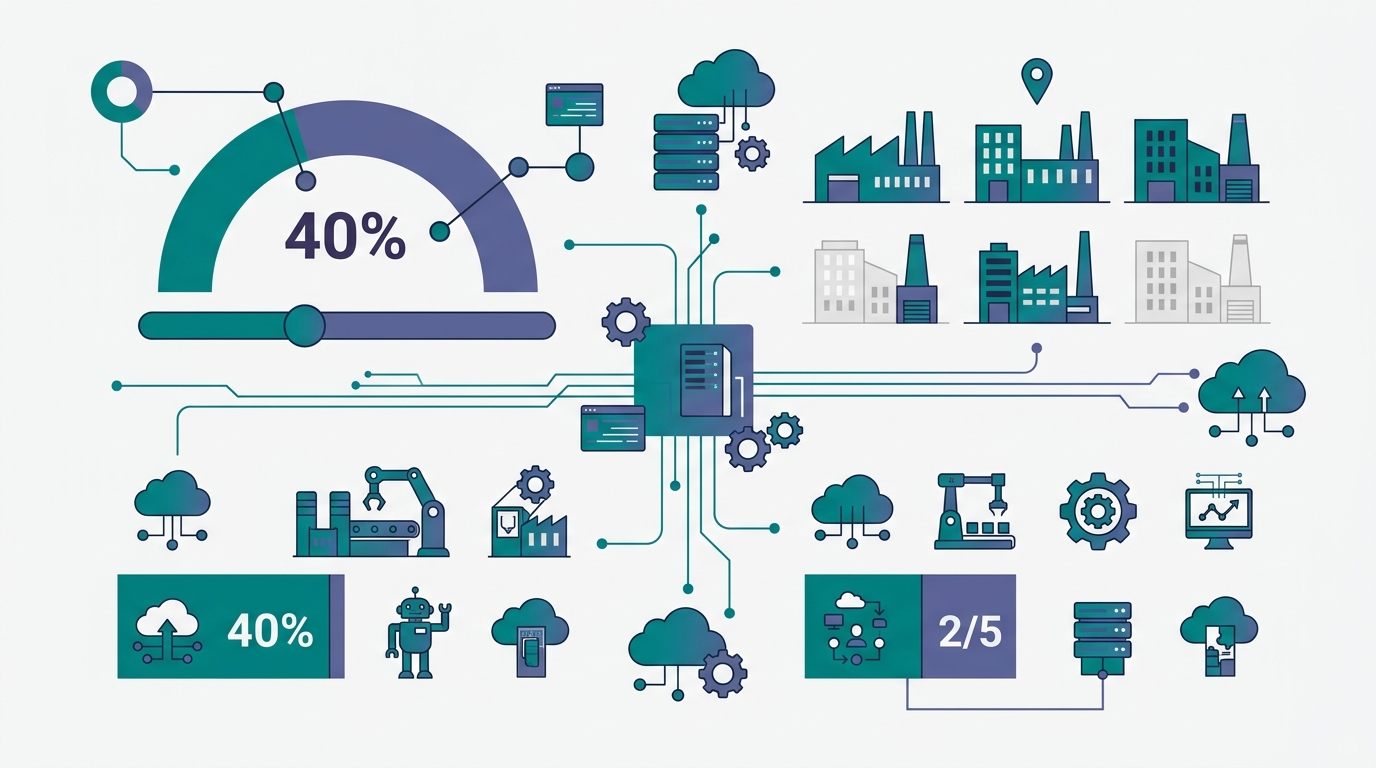
What the HBR paper showed as the common trait of the 40% is this: “They quantified the risk and started moving within their tolerance.” They weren’t aiming for a perfect zero-risk state. They calculated, “For this task, even in the worst case, the cost stays within this range,” and started from there.
Honestly, I have anxieties too. Every time an AI agent makes a judgment error, there’s a moment when I think, “Maybe a human should just do this after all.” But when I calmly review the logs, the agent’s judgment accuracy is steadily improving. More than anything, the time freed up by delegating to agents lets me focus on “work only humans can do.” Whether you can accept this tradeoff is, I believe, the watershed for adoption.
This is structurally identical to hiring new employees. There’s no guarantee a new hire will make zero mistakes. But rules exist: “Don’t hand them major accounts on day one,” “Have a senior colleague backstop them.” The design of “start from tasks where a mistake won’t be fatal” keeps risk within manageable bounds.
The 40% of companies are proving that the same approach works for AI agents.
As Mikoto’s article (AI Team Building) introduced, Relay.app CEO Jacob Bank is a prime example. He’s the person who replaced a marketing department with 40 AI agents. In interviews, he also said, “The first one was a weekly report summary—something where failure wouldn’t cause damage.” It took eight months to reach 40 agents.
Don’t rush. Agent onboarding takes time. But that time is an investment, not a waste.
The Deloitte survey also reported that companies that allocated three or more months for verification in the early adoption phase had lower incident rates after going into production. The impatience of “we need results fast” actually raises the probability of failure.
Summary: Three Mechanisms Between “Delegating” and “Dumping”
HBR’s proposition, “Treat AI agents as team members,” isn’t moralistic rhetoric. It’s about concrete mechanisms.
Let me recap the three risk management methods covered today.
- Graduated Escalation: Design authority in three tiers: Read Only → Write with Approval → Autonomous Execution. Promotion requires meeting three conditions: accuracy, consistency, and zero unexpected behavior. Allow a minimum two-week observation period.
- Simultaneous Audit Logging: Record the four items of input, judgment, output, and context. Make “why it went wrong” traceable after the fact. Make weekly log reviews a habit.
- Calculating Failure Cost in Advance: Use the Reversibility Check (reversibility, time-to-detection, number affected) to judge acceptable risk per task. When in doubt, stay at a lower level.
Remember the concept of “agent onboarding.” Approach it with the same mindset as welcoming a new hire, expanding authority in stages. The presence or absence of this design determines the success or failure of agent utilization.
The reason I can run five AI agents simultaneously in the Izumo system is that these three mechanisms are in place. It’s not a question of technical skill—it’s a question of design.
Start by choosing one task from your current workload that’s “recoverable even if it fails.” Delegate that task to an agent at Level 1 (Read Only). That becomes the first step of “agent onboarding.”
If you’re unsure where to start, try thinking this way: “A routine weekly task whose output, if wrong, wouldn’t inconvenience anyone.” Meeting minute summaries, competitive article roundups, internal data aggregations. Tasks like these are the ideal Level 1 candidates.
AI agents aren’t magic. But operated with the right design, they become partners that reliably transform the quality and quantity of your work. I feel this every single day.

AIを使いこなせない方は、この先どんどん差がつきます。僕はAIエージェントを毎日動かして、壊して、直して、また動かしてます。そういう泥臭い実践の記録をここに書いてます。理論は他の方にお任せしました。僕は動くものを作ります。朝5時に起きてウォーキングしてからコードを書くのがルーティンです。