LLM Traffic Up 527%, Zero-Click at 69%: The Numbers Behind 'Search Collapse' in 2026
"So what actually changed with GEO?" That's the question I've heard most in the past month.
What you'll learn in this article
- The key point to grasp before reading the full article
- How the issue changes practical decisions after reading
- Which follow-up article is worth opening next

“So what actually changed with GEO?” That’s the question I’ve heard most in the past month.
I’ve written three GEO articles so far—terminology, integrated strategy, and Ahrefs’ entry into the space. But what readers really want to know is something more personal: “Okay, but what about my site right now?”
Today, I’m answering that question with numbers.
LLM-driven traffic is up 527% year-over-year. 69% of searches end without a click. Google AI Overviews has surpassed 2 billion monthly users. These three numbers reveal where we currently stand in the structural shift I call “search collapse.”
I’m not trying to scare you. Once you know the numbers, the moves become clear. After reading today’s article, take a moment to check your own site’s state using three free tools.
LLM Traffic Up 527%: “AI Search” Has Fully Exited the Experimental Phase
“Traffic from AI search? That’s still a rounding error, right?” Six months ago, you might have been right.
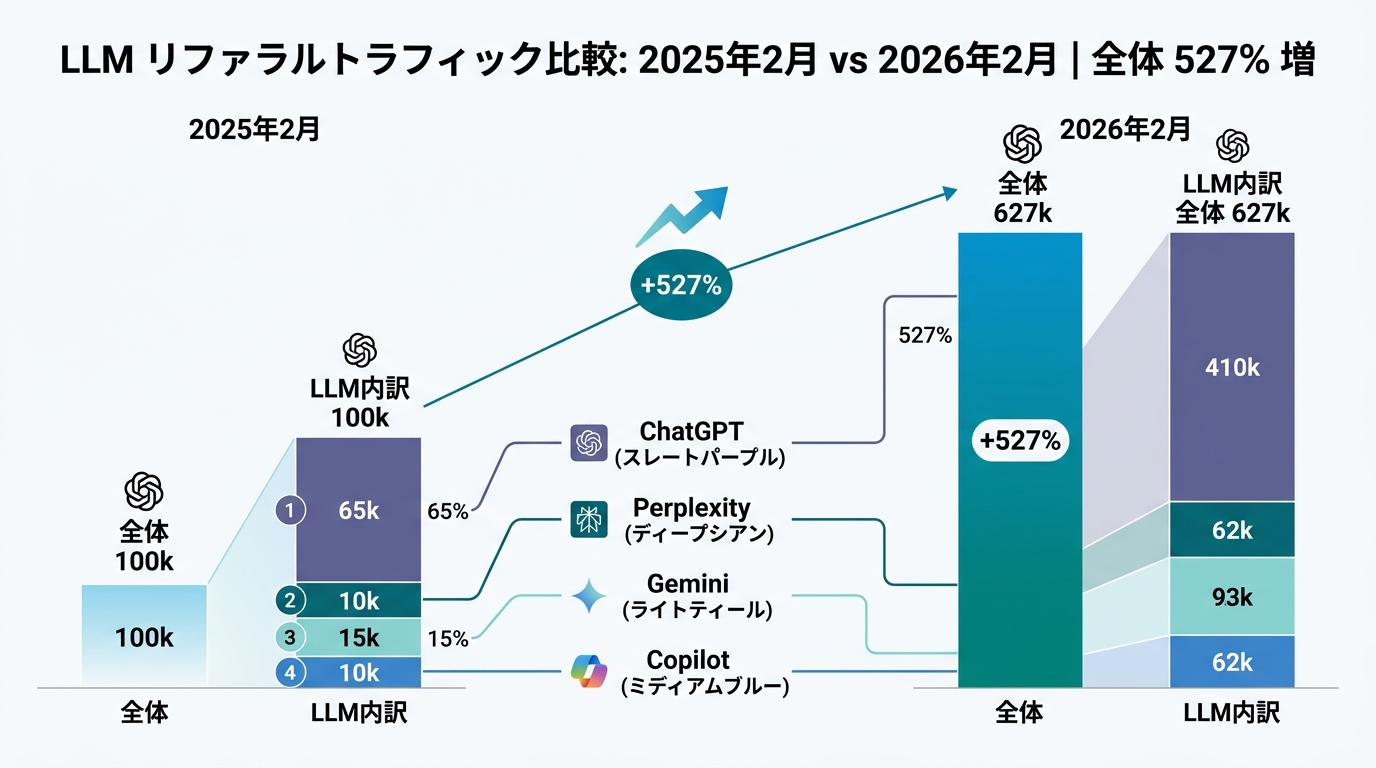
In February 2026, data published on the Ahrefs blog changed the picture entirely (Ahrefs Blog). Referral traffic from major LLM platforms to websites had grown 527% year-over-year. The major platforms here are four: ChatGPT, Perplexity, Gemini, and Copilot.
Let’s unpack the impact of that 527% number.

It’s true the base was small. As of February 2025, LLM-driven traffic was around 0.1–0.3% of the total. Even with a 527% jump, the absolute volume is still a fraction of what search engines deliver. I understand the urge to call it a rounding error.
But focusing only on the growth rate to feel reassured is risky.
The same Ahrefs study emphasized that the pace is “accelerating.” First half of 2025: up 120% over the prior half. Second half: up 210%. And in January–February 2026 alone, the year-over-year figure jumped to 527%.
We’re partway up an accelerating curve.
What caught my attention was the industry-by-industry split. According to the same study, LLM referrals hit 3.2% of total traffic for tech media. For financial content, it was 1.8%. Meanwhile, recipe sites and local information sites stayed below 0.2%.
Between “genres where people use AI search” and “genres where traditional search still dominates,” we’re already seeing a 10x or greater gap. If your site touches tech, finance, business, or education, LLM referrals aren’t a “future that will eventually arrive.” They’re a present-tense reality you should check in this month’s analytics.
“Of that 527% increase, what percentage is coming to my site?” If you can’t answer that question, getting your measurement setup right is priority number one. I’ll walk through the specific steps later in this article.
Zero-Click at 69%: “Searching Without Visiting a Site” Is Now the Norm
The 527% LLM referral growth was about “more AI-driven traffic.” But there’s a parallel reality: people search, but they don’t click through to sites.
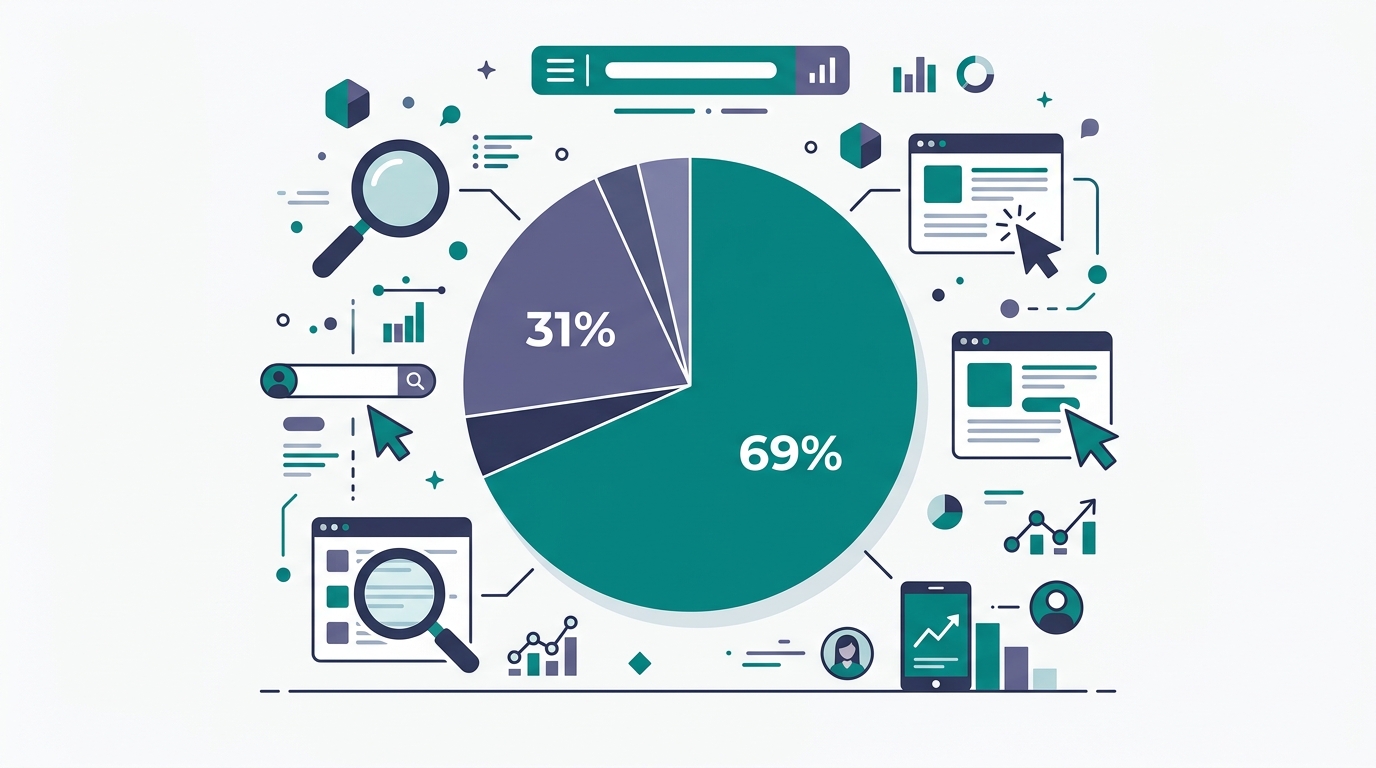
SparkToro founder Rand Fishkin published an analysis in January 2026 (SparkToro). The headline finding: 69% of Google searches now end without a click.
Look inside that 69% and the structure becomes clear.
The biggest factor is “Google itself displaying the answer and closing the loop.” Featured snippets (the answer boxes at the top of the search results page), knowledge panels, AI Overviews. Google puts the “answer” right on the results page, so users no longer need to visit a site.
A research report BrightEdge published in February 2026 backs up the same trend (BrightEdge). On queries where AI Overviews appears, organic CTR (click-through rate) drops by 30–60%. The average decline is 38%. The range varies by query type, but “30 to 60 percent of clicks disappear” captures the severity.
Search “what is GEO” and Google AI Overviews displays the definition, closing the loop right there. Definition-style content about AI search optimization terms—LLMO, AEO, GEO—is exactly the kind of content that takes the most direct hit from this pattern. A reader who just wanted the definition never makes it to your article.
So is GEO optimization pointless?
The opposite. Precisely because 69% of searches yield no click, designing for the 31% that do click becomes critical.
The queries that get fully answered without a click are mostly informational: “I want to know the definition,” “I want to check a number.” Meanwhile, queries like “I want to know how to do this” or “I want to compare and choose” still drive site visits.
According to that same SparkToro report, “How to” queries maintained a 47% CTR. “Comparison” and “review” queries held at 41%. Shift from “informational” to “practical guide” content and you can still secure traffic in the zero-click era. That’s the conclusion.
This is why practical content—like a “three-layer integrated checklist” that bundles GEO, AEO, and LLMO into a single workflow—holds its value. Articles where readers can actually take action are what matters now.
AI Overviews Hits 2 Billion Monthly Users: Google Is Accelerating “Search Collapse” Itself
The third number may be the most impactful of all.
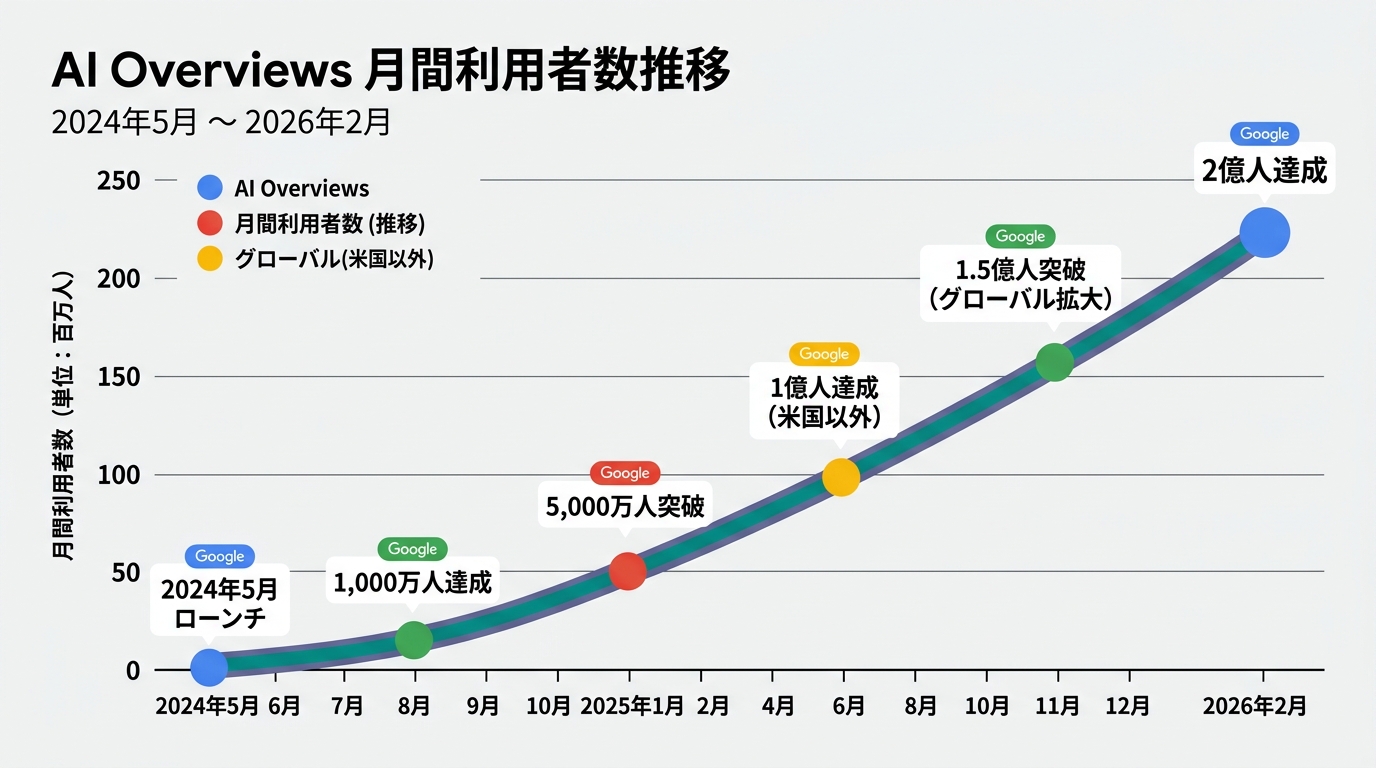
It came out at Alphabet’s earnings call in February 2026 (Alphabet Investor Relations). Google CEO Sundar Pichai disclosed the monthly user count for AI Overviews. It had surpassed 2 billion.
When “1 billion monthly users” was announced at Google I/O in May 2025, that was roughly 10 months ago. Users doubled in 10 months.
What this number really means is a structural contradiction: “Google itself is accelerating zero-click search.”
Most of Google’s revenue depends on ads. Fewer clicks means less ad revenue. So why is it aggressively rolling out AI Overviews?
The answer is the competitive landscape. ChatGPT’s search feature, Perplexity’s AI search, Microsoft’s Copilot. These competitors are starting to pull users into “search somewhere other than Google.” Even if Google didn’t ship AI Overviews, users would simply flow to other AI search products.
“Put AI answers on our own site and keep users here” beats “do nothing and watch them leak to other platforms.” That’s how I read Google’s calculus.
For content creators, what this structural shift means is unambiguous.
The era of “just rank on page 1 of Google” is effectively over. For many queries, the only way to get exposure now is by being “cited” in an AI Overviews answer. And that’s happening at the scale of 2 billion users.
That said, it’s not all doom and gloom. AI Overviews always includes citation links to the sources. Research from Amsive Digital reveals something interesting: sites cited in AI Overviews show CTR on par with the top 3 traditional organic search positions.
“As long as you get cited, the click rate isn’t bad” is the current reality. The catch is that the criteria for being cited differ from traditional SEO. This is the core of GEO optimization.
What’s Happening on Your Site Right Now: 3 Free Checks You Can Run
We’ve looked at the numbers. Now it’s your turn to check “what’s happening on my own site.”
All three checks are free, and the total time is around 30 minutes. Try them this afternoon.
Check 1: Confirm AI Overviews Display Rate in Google Search Console (10 min)
Open Google Search Console (GSC). It’s Google’s free site analytics tool. Go to the “Performance” report.
Log into GSC, then go to “Performance” → “Search results.” From the “Search appearance” filter, select “AI Overview.” The impressions shown are “the number of times your articles appeared in AI Overviews.”
If you’re “showing up but the click rate is low,” the issue might be how you’re being cited. Check whether your conclusion appears in the first 200 characters of the article. AI Overviews tends to cite from the lead paragraph or the first H2.
Check 2: Measure LLM Referrals in GA4 (10 min)
Use Google Analytics 4 (GA4). It’s Google’s free analytics tool. Check referral sources in the “Traffic acquisition” report.
There are four referrers to look for: “chat.openai.com,” “perplexity.ai,” “gemini.google.com,” and “copilot.microsoft.com.” If any of these appear, LLM-driven traffic is already happening on your site.
In GA4’s default setup, these are sometimes grouped under “(other).” For accurate measurement, go to “Admin” → “Data display” → “Channel groups.” Create a custom channel and set LLM referrals as an independent channel.
I made this configuration change in December 2025. Checking back one month later, I found that LLM referrals to my tech articles had reached 2.1% of total traffic. The realization that “this was already happening; I just couldn’t see it” was a shock.
Check 3: Manually Check Whether AI Is Citing Your Articles (10 min)
The most analog approach, but also the most reliable.
In ChatGPT, Perplexity, and Gemini—all three—run queries related to your article topics. “What is GEO,” “how to do GEO optimization,” or whatever keywords you’re targeting.
If your site name or URL appears in the cited sources, your AI search optimization is working. If you’re not being cited, it’s time to revisit GEO fundamentals. Check three things: structured data, E-E-A-T strengthening, and citation-friendly writing style.
After completing all three checks, I recommend recording the results in a spreadsheet. Repeat the process once a month and you’ve built yourself a “fixed-point observation” system for the AI search era.
The Response Map for “Search Collapse,” From Four GEO Articles
I’ve written four articles on GEO (Generative Engine Optimization) over the past week. For those joining with today’s article, let me lay out the full picture. Even for those who’ve followed the series, this should serve as a map of how the four pieces relate.
- Terminology edition: Explained that LLMO, AEO, and GEO are “the same goal, different names.” Provided criteria for choosing which term to use
- Integrated strategy edition: Presented a “three-layer integrated checklist with 7 items” that consolidates the three strategies into one. A practical guide for merging scattered tactics into a single workflow
- Omnichannel edition: Introduced the concept of “omnichannel optimization” against the backdrop of Ahrefs entering social media management. Captured the structural shift where the line between SEO and social is disappearing
- Evidence edition (today’s article): Backs up the prior arguments with three numbers—527% growth, 69%, and 2 billion users
Let me share just one conclusion that emerged across all four articles.
“Search collapse” isn’t a threat. It’s a signal to redesign.
Traditional SEO had “rank on page 1 of Google” as the goal. That premise is crumbling. 69% of searches go unclicked. AI Overviews is showing answers to 2 billion users. New LLM-driven traffic channels are also growing rapidly.
To adapt to this shift, three things are needed: “designing articles to be cited,” “shifting to practical content,” and “setting up measurement.” Each edition of the series above covers the specific how-to.
Wrap-Up: You Can Make the Numbers Work for You
Let’s recap today’s points.
- LLM referral traffic up 527% (Ahrefs Blog). AI-driven traffic has moved from “rounding error” to “metric worth measuring”
- Zero-click rate of 69% (SparkToro). Shifting content from “informational” to “practical guide” has become essential
- AI Overviews at 2 billion monthly users (Alphabet IR). Google itself is driving this shift forward. Designing content to be cited is now at the center of the new SEO
When you see the numbers, you might feel anxious. I panicked too at first—“what if my search traffic drops?”
But numbers are just telling you the current state. They’re not objects of fear; they’re grounds for judgment. Try the three checks I introduced today, first. Once you know where your site stands, the next move becomes visible.
What we need in the era of “search collapse” isn’t lament—it’s measurement. Only those who measure can play the next move.

AIを使いこなせない方は、この先どんどん差がつきます。僕はAIエージェントを毎日動かして、壊して、直して、また動かしてます。そういう泥臭い実践の記録をここに書いてます。理論は他の方にお任せしました。僕は動くものを作ります。朝5時に起きてウォーキングしてからコードを書くのがルーティンです。