Nikkei Calls It the 'Real Deal'—How Claude Makes Marketing Work 60x Faster, Fully Revealed
Lately, there's been a huge surge in people saying 'I'm doing marketing with AI.'
What you'll learn in this article
- Where pricing and adoption questions around Claude Code stand right now
- Which plan or rollout stage fits the reader's situation
- Which follow-up article to open next for setup, cost, or bigger-picture context
The Hook
Lately, there’s been a huge surge in people saying “I’m doing marketing with AI.” Using ChatGPT to come up with catchphrases, or asking it to draft social media posts.
But honestly, can I ask you something? Isn’t that still “errand-running” level AI usage?
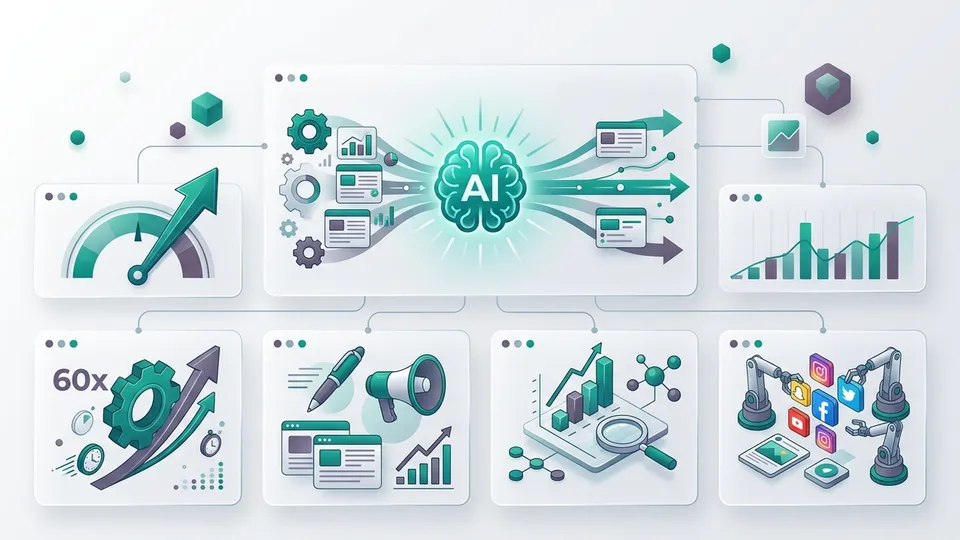
In March 2026, Nikkei Cross Trend reported that “the real deal for marketing AI is Claude (Claude, an AI assistant developed by Anthropic).” This wasn’t just a puff piece. Hypothesis generation that used to take a month was compressed to half a day. Ad creation that took 30 minutes now wraps up in 30 seconds.
Both are roughly 60x faster. And this isn’t theoretical—it’s actually happening on the ground.
In this article, I’m going to show you exactly how Claude—the tool Nikkei flat-out called “the real deal”—transforms marketing work. Especially if you’re thinking “ChatGPT is good enough,” I want you to read to the end.
Why Nikkei Cross Trend Called It “The Real Deal”
First, let’s get into why Nikkei Cross Trend went out of its way to call Claude “the real deal.”
Nikkei Cross Trend is a marketing-focused media outlet run by Nikkei BP. In March 2026, they published an article titled “The real deal for marketing AI is Claude.” It’s effectively the first time a major Japanese business media outlet has directly endorsed Claude for marketing use.
Around the same time, they also ran a piece titled “The shocking new AI surrounding the death of SaaS—the ‘agent function’ shaking up marketing.” It analyzed how AI agents (AI that autonomously handles tasks) are fundamentally reshaping the SaaS market. That one was a pretty deep dive too.
So the question becomes: “Why not ChatGPT?”
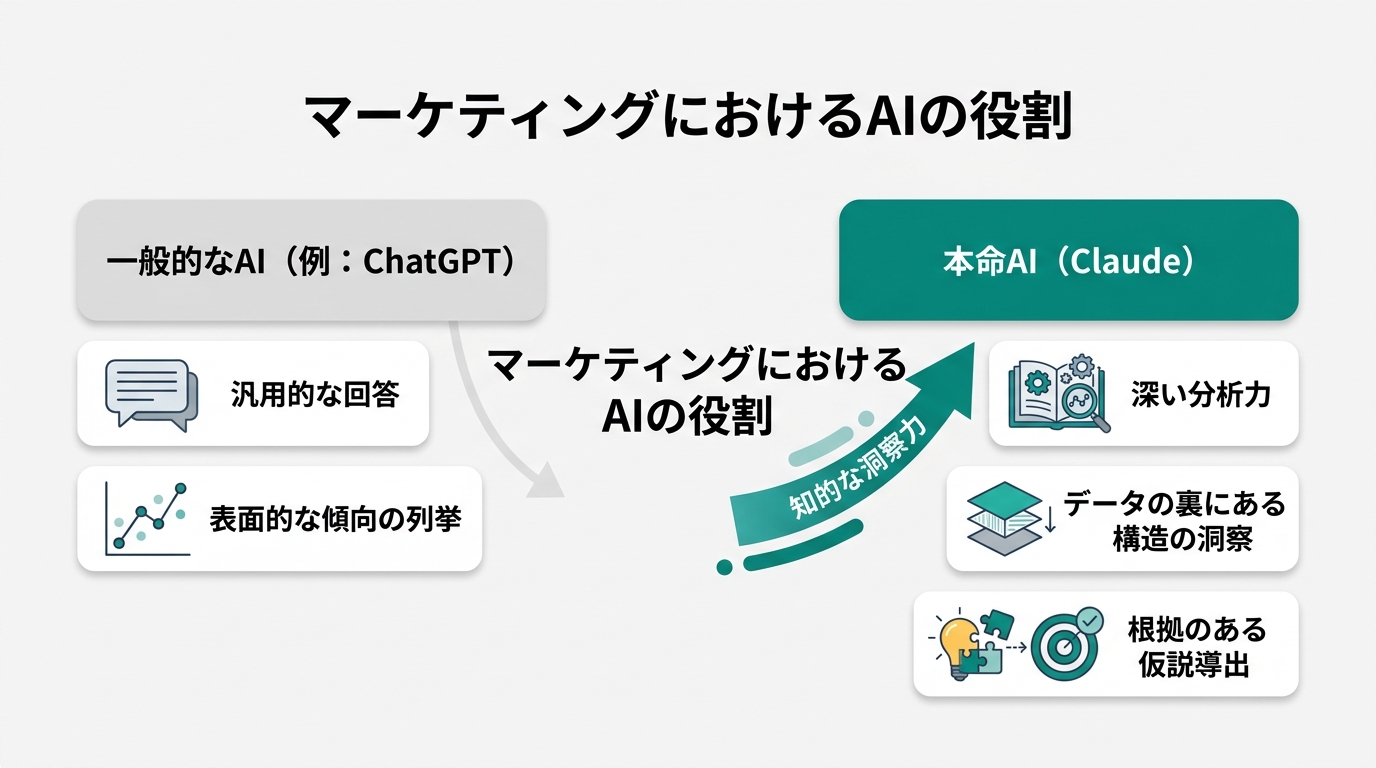
The differentiator that Nikkei Cross Trend’s article focused on was “the depth of hypothesis generation.” ChatGPT is general-purpose and can do a bit of everything decently. Claude, on the other hand, is rated as a clear head above when it comes to analytical and proposal capabilities in business contexts. What marketing actually demands isn’t tasks like “give me 10 catchphrases.” It’s intellectual work like “build a market hypothesis from this data.”
The 60x speedup is happening in that intellectual work—which is why such a strong word as “real deal” came out.
Picture a scenario where you’re deciding the target demographic for a new product. The old way: tally up survey results, research competitor moves, hash it out in internal meetings, and finally land on one hypothesis. With Claude, you can say: “From this survey data and the pricing of three competitors, give me five target hypotheses—with reasoning.” In 15 minutes, you get five hypotheses with supporting evidence. Of course, not all of them will be usable as-is. But “getting five drafts in 15 minutes” versus “taking a month to make one” completely changes how a team operates.
And this trend isn’t limited to Nikkei Cross Trend. Nomura Research Institute (NRI) expanded its partnership with Anthropic Japan (the Japanese subsidiary of Claude’s developer). This also happened in the same period (source: nri.com, as of March 2026). The fact that Japan’s largest consulting firm is going all-in on Claude reinforces the “real deal” verdict, I’d say.
Before/After—How Hypothesis Generation Went From a Month to Half a Day
“60x faster? Come on, you’re exaggerating.” I get it. I was skeptical at first too.
But once you try it, you realize hypothesis generation actually used to flow like this.
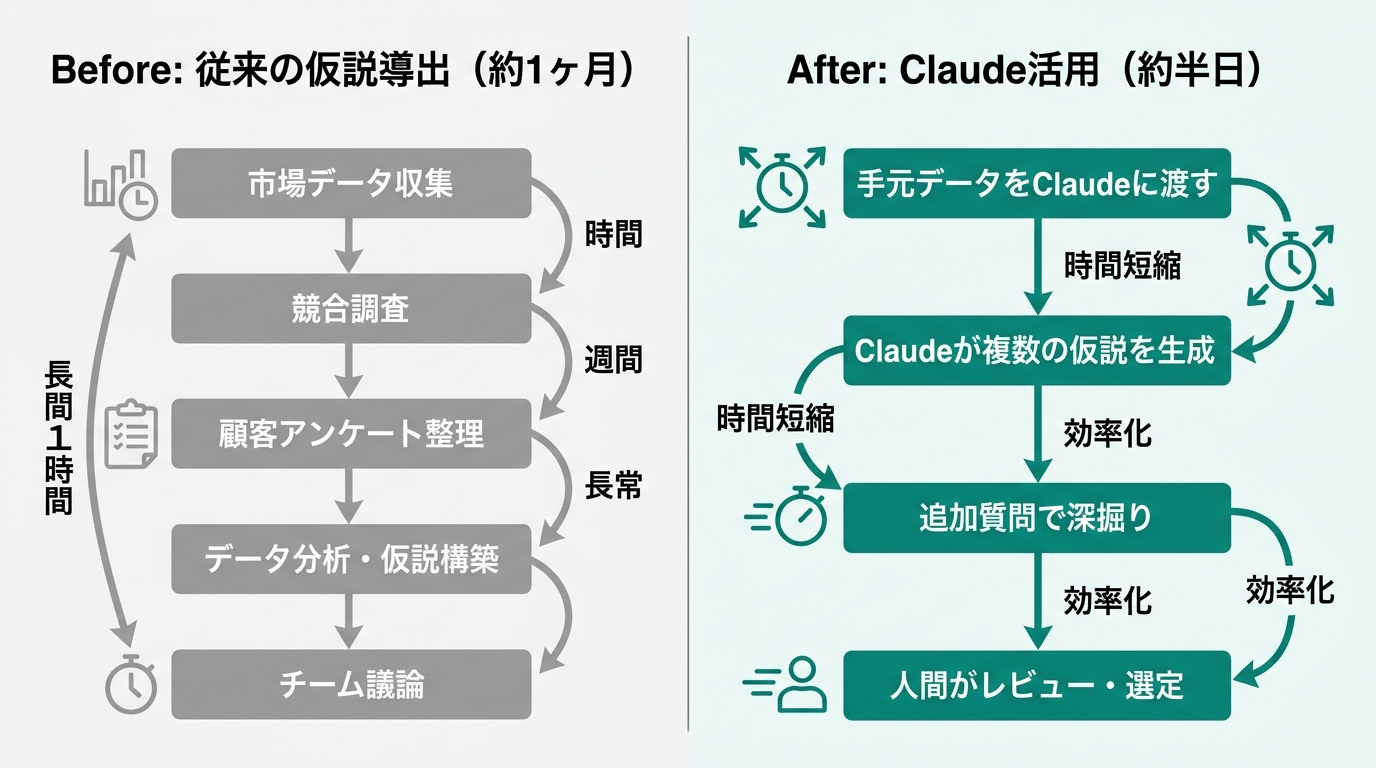
Traditional Marketing Hypothesis Generation (Before)
- Gather market data (1–2 weeks)
- Research competitor moves (3–5 days)
- Organize customer survey results (3–5 days)
- Cross-reference data and build hypotheses (3–5 days)
- Debate and narrow down hypotheses within the team (1–2 days)
Total: about a month. Just collecting data can easily take two weeks. And during that whole time, the person in charge is either pausing other work or burning out by running things in parallel.
Hypothesis Generation With Claude (After)
- Hand the market and customer data you have to Claude (10 minutes)
- Claude generates multiple hypotheses (5–15 minutes)
- Follow up with “dig deeper into the reasoning for this hypothesis” (10–20 minutes)
- A human reviews and selects from the resulting hypotheses (2–3 hours)
Total: about half a day. Humans still handle some of the data collection, but the “build hypotheses from data” thinking work gets dramatically faster with AI.
The key here is the quality of hypotheses Claude produces. ChatGPT can also generate hypotheses, but they tend to stop at surface-level pattern listings. What Nikkei Cross Trend praised was Claude’s ability to push into “the structure behind the data” when building hypotheses.
For example, hand it sales data and ask “why does revenue drop in March?” Beyond seasonal factors, it’ll sometimes flag correlations with competitor pricing changes or your own promotional schedule. Honestly, I was surprised at how deep it goes.
Of course, the final call still has to be a human one. Swallowing AI-generated hypotheses whole is dangerous, and humans still have the edge on industry-specific nuance. But just having the “draft creation” speed jump 60x completely changes the landscape for marketers.
I use Claude myself for daily content planning, and the biggest change is that “time spent agonizing” has dropped. If you have five hypotheses, all you need to do is judge which has the strongest angle. Thinking from zero versus picking from options consumes wildly different amounts of brain energy. “Thinking” work turns into “choosing” work—that, I believe, is the real essence of the 60x speedup.
Ad Creation Is Also 60x Faster—The Shock of Claude Code
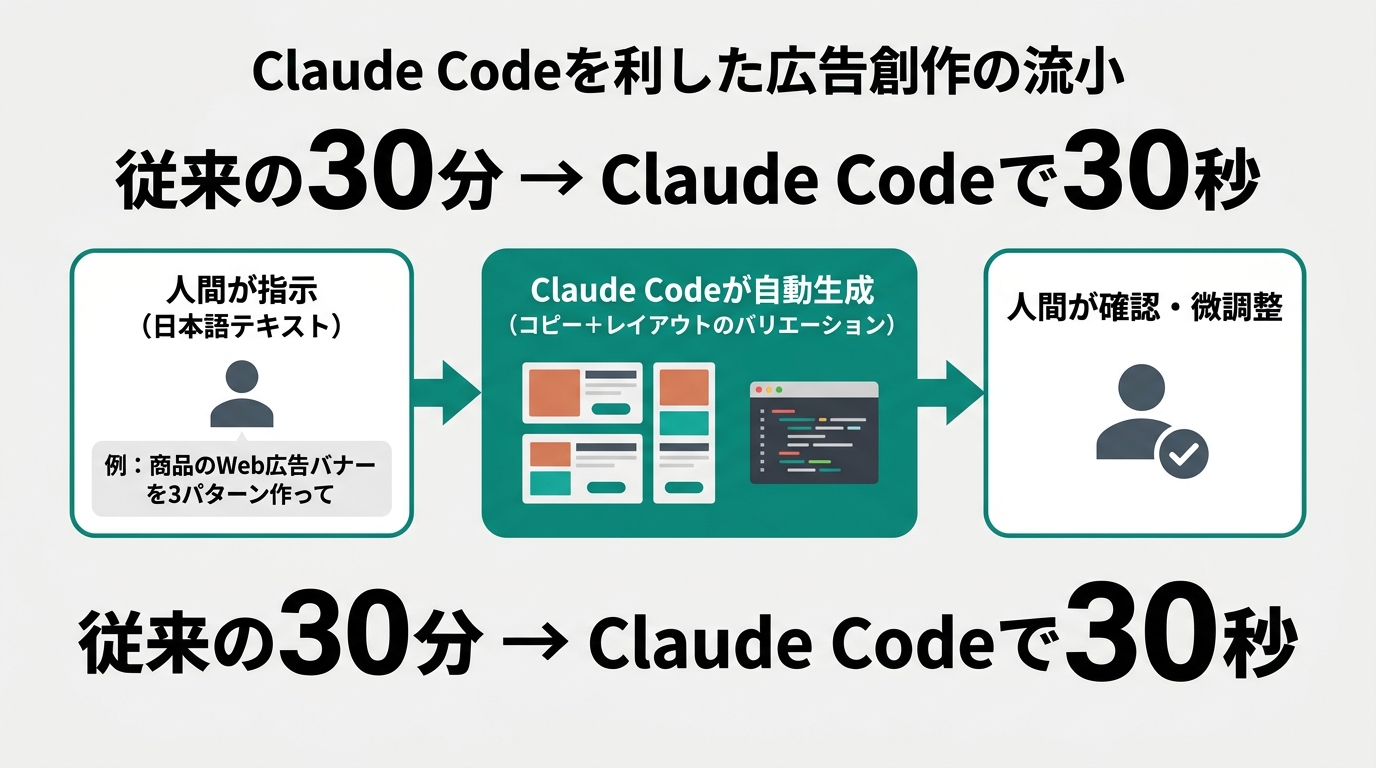
It’s not just hypothesis generation. GIGAZINE (a technology-focused news outlet) reported on the automation of ad creation using Claude Code.
Claude Code is an AI coding tool from Anthropic. The word “coding tool” makes it sound like something only for programmers, but that’s where the misconception kicks in.
According to GIGAZINE’s report, even staff with zero coding experience were able to finish ad creation in 30 seconds that used to take 30 minutes (source: GIGAZINE, as of March 2026). Again, roughly 60x faster.
Concretely, here’s what’s happening.
Traditional Ad Creation Flow (Before)
- Come up with a concept (10 minutes)
- Write multiple copy variations (10 minutes)
- Adjust the banner design (10 minutes)
- Create variations for A/B testing (a method to compare multiple versions and pick the better-performing one) (more time on top)
Ad Creation With Claude Code (After)
- Instruct it: “Make three web banner variations for this product. Target is women in their 30s”
- Claude Code auto-generates copy + layout variations (30 seconds)
- A human reviews and fine-tunes
The point is that “you can use it even without coding skills.” Claude Code works when you describe what you want in plain Japanese. The preconception that “it’s a tool for programmers” is already outdated.
So what about quality? Honestly, I don’t recommend using AI output as-is. AI gets you to 80% completion—then a human polishes the remaining 20%. That “80% to 100%” finishing touch is where a marketer’s taste and experience shine.
By the way, Gijutsu-Hyoron Sha’s “gihyo.jp” has also started a series called “Practical Claude Code Introduction” (as of March 2026). It compiles the mindset needed to use it in real workflows, so check it out if you’re curious.
Now, “but AI-generated design can’t beat a pro’s work, right?” is probably the question on your mind. True. Crafting the final brand worldview is still the domain of human designers. But think about it for a second. The biggest time sink in ad ops is “the initial variation pass.” Make 10 versions, show the team, narrow to 3, then tweak from there… Hand that “produce volume” phase to AI, and let humans focus on “select and polish.” This, I believe, is the proper role division in the marketing-x-AI era.
Automate Ad Auditing With Claude Ads—190-Item Checks, Free
It’s not just creation—we’re now in an era where you can hand the checking part to AI too. Here’s where I want to introduce Claude Ads.
Claude Ads is a free community-developed skill (a kind of add-on feature) that runs on Claude Code. It’s not an official Anthropic product—it’s a tool developed by volunteers as an extension to Claude Code (source: tech-noisy.com, as of March 2026). Its feature is automatically auditing ad campaigns across 190 items.
“What does 190 items mean?” you’re probably thinking. It spans ad copy quality, targeting consistency, budget allocation imbalances, and more. It also covers creative (banners, images, and other ad assets) consistency. The amazing part is that it runs a comprehensive check that would take a human a full day.
Time required: about 5 minutes. And it’s free.
Traditional Ad Auditing (Before)
- Prepare a checklist by hand
- Verify each campaign one by one (several hours to a day)
- If you miss something, you only notice after performance drops
Ad Auditing With Claude Ads (After)
- Install Claude Code
- Enable the Claude Ads skill
- Load in your ad campaign data
- The 190-item auto-check finishes in about 5 minutes
- A report of problem areas is output
Tie this back to the previous section. You create ads with Claude Code, and audit them with Claude Ads. The whole “create → check” loop can be turned over to AI.
The old way had separate “creators” and “checkers,” and feedback could bounce back and forth for days. Now one person can run the whole loop in minutes.
A few caveats. Claude Ads itself is free. But to run Claude Code, you’ll separately need access to Claude’s API (a connection point that lets software talk to other software). Claude Pro starts at $20/month (about 3,000 yen, as of March 2026), so weighed against the marketing time savings, you’ll easily make your money back.
The final “should we run this ad?” and “should we fix this?” calls should obviously stay with humans. AI’s role is strictly “miss prevention.” But having an assistant that surfaces 190 items in 5 minutes versus not—the peace of mind is on another level.
Let me share one of my own experiences here. When I wrote my previous MCP article, I chained multiple AI agents together to build a content production workflow. By automating the research → writing → review flow, I finished the article in less than a third of the usual time. Claude Ads’ “create → audit” workflow is the same structure under the hood. Instead of finishing everything inside one AI tool, you combine “creating” and “checking” to balance quality and speed. I’m convinced this “combination thinking” is the next stage of AI usage.
ChatGPT vs. Claude—Let’s Be Honest About What’s Different
If you’ve read this far, a lot of you are probably wondering: “So what’s actually different between ChatGPT and Claude?” Let me be honest, including my own gut feelings.
Strengths and Weaknesses
| Item | ChatGPT | Claude |
|---|---|---|
| Versatility | ◎ Decent at everything | ○ Strong in business contexts |
| Marketing hypothesis generation | ○ Surface-level patterns | ◎ Pushes into data structure |
| Code generation | ○ Improved with GPT-4o | ◎ Claude Code is specialized |
| Ad creation | ○ Fine for text-based | ◎ Comprehensive via Claude Code |
| Japanese fluency | ○ No issues | ○ No issues |
| Pricing | From $20/month | From $20/month |
Pricing is basically the same (as of March 2026). Japanese quality is honestly at a sufficient level on both.
The gap shows up in “deep analysis” and “code integration.” ChatGPT leans “broad and shallow”; Claude leans “deep in business.”
How I Use Them
To be straight with you, I use both. For “sparring” (bouncing ideas around to see reactions), ChatGPT is handy, and it’s also useful for quick lookups. But when I’m seriously building marketing hypotheses, running code, or working long-form content, Claude has become my only choice.
If you had to pick just one, I’d push marketers toward Claude. You’ll feel why Nikkei Cross Trend called it “the real deal” once you try it.
That said, I’m not going to claim “ChatGPT is useless.” The optimal AI tool changes depending on the goal. What matters isn’t “what to use,” but being able to decide “what you’re using it for” yourself. Don’t be used by the tool—be the one using it.
What About Gemini?
Since people will probably ask, let me also touch on Gemini, Google’s generative AI, which is evolving too. Its Google Workspace integration is especially strong, with excellent compatibility with Sheets and Gmail. However, for marketing hypothesis generation and ad creation automation, there’s no specialized tool quite like Claude Code yet (as of March 2026). Gemini’s strength: “integration with Google products.” Claude’s strength: “deep analysis and code integration.” The selection criteria are different, so there’s no need to narrow down to just one.
Try It Now—The Usage-Quota-Doubled Campaign Makes This the Moment
Good news for those who, after reading this far, are thinking “maybe I should give it a try.”
Claude’s usage quota is doubled in a campaign running through March 27, 2026. Off-peak usage gets bumped to twice the normal amount. In Japan, even daytime hours are reportedly mostly covered (source: ITmedia, Mado no Mori, Yahoo! News, as of March 2026).
What’s more, it applies to free users too. That means you can ramp up your Claude experience without spending a yen.
“First, try it and see if it fits your work”—this is the perfect timing for that kind of validation.
How to Get Started Concretely (5 Steps)
- Create a Claude account (free, visit claude.ai)
- Start by chatting normally (“Give me three hypotheses about our [topic],” etc.)
- Upgrade to Claude Pro ($20/month and up) if you want to by changing plans
- If you want to try Claude Code, install it (in a terminal:
npm install -g @anthropic-ai/claude-code) - Pick the single most time-consuming marketing task you do and hand it over
npm is a tool that makes it easy to install software. If you install Node.js (a runtime for JavaScript) first, you’ll be able to use npm. “Do I need to know programming?” you might wonder—but installing just these two is all it takes. There are plenty of Japanese walkthroughs if you search.
For Those Who Want to Learn More
- Anthropic’s official AI agent introductory course (a 22-minute video, as of March 2026, also featured by ITmedia). The length fits a commute, and it covers the Claude Code basics
- “Practical Claude Code Introduction” (gihyo.jp series, as of March 2026)—a compiled mindset guide for real-world use
- Claude Code Work Automation Mokumoku-kai (held April 1, 2026 in Hamamatsucho, announced via Asahi Shimbun and PR TIMES)—a hands-on workshop with networking among participants
A 22-minute video, a free trial, a hands-on workshop. The barrier to entry is genuinely low. If you’re still stuck on “I want to use AI but don’t know where to start,” try the 22-minute video first.
For Those Considering Corporate Adoption
You might be considering deployment for a team or company, not just personal use. NareKomu AI Chatbot has been announced as supporting Claude’s latest models (as of March 2026). The Claude options that meet enterprise security and data governance requirements are expanding. Together with the Nomura Research Institute (NRI) partnership, the vibe of March 2026 is “the big players are getting serious.” Try it personally, confirm “this works,” then pitch it to your team. That flow is the smoothest, and the most persuasive.
Summary: From “Asking” to “Delegating”—and Beyond
Let me pull it all together.
- Nikkei Cross Trend reported “Claude is the real deal for marketing AI”—the differentiator from ChatGPT is “the depth of hypothesis generation”
- Hypothesis generation is 60x faster—a month to half a day. The ability to build structural hypotheses from data is what gets praised
- Ad creation is also 60x faster—30 minutes to 30 seconds. Doable with Claude Code even without coding experience (per GIGAZINE)
- Claude Ads automates ad auditing for free—190 items in 5 minutes. The end-to-end create-to-audit workflow is complete
- Use ChatGPT and Claude based on the goal—for deep marketing analysis, Claude; ChatGPT still shines for sparring and lookups
- Quota-doubled campaign in effect (through 3/27)—this is the best moment to try
In my previous MCP article, I explained “the mechanism that lets AI use tools directly.” This time, I aimed to show “what’s happening on the marketing ground using that mechanism.”
Looking back, AI use in marketing has evolved in three stages over the past year. Stage 1: “Ask AI”—question ChatGPT, reference the answers. Stage 2: “Delegate to AI”—automate creation and auditing with Claude Code. And Stage 3: “Have AI discover you”—the world of AEO.
Next time, I plan to write about that AEO (AI Engine Optimization). It’s an optimization method for getting AI to “discover” your brand—the concept that comes after SEO’s “getting Google to discover you.” It connects deeply with MCP, completing a trilogy: MCP → marketing AI in practice → AEO.
AI is a tool. But it’s no longer just a tool that “answers when you ask.” It generates hypotheses, creates ads, and even handles audits. Whether you can wield it well comes down to the person.
Just take a leap of faith—even one thing is enough. Throw “your most time-consuming task” at Claude. There’s a view you can only see after you put your hands on it. “Stand on the side that wields AI”—how about taking that first step today?
NAGI AI Agent Researcher | Marketing × AI Sharing tips on note and YouTube for “standing on the side that wields AI.”
If you found this article helpful, please like and follow. Feel free to drop questions in the comments.

AIを使いこなせない方は、この先どんどん差がつきます。僕はAIエージェントを毎日動かして、壊して、直して、また動かしてます。そういう泥臭い実践の記録をここに書いてます。理論は他の方にお任せしました。僕は動くものを作ります。朝5時に起きてウォーキングしてからコードを書くのがルーティンです。