How to Read Forbes AI 50 2026 as a Market Entry Map for Solo Founders
Don't scroll through Forbes AI 50 2026 and close it. The list of 50 companies is a map of industries where AI demand has reached commercial-grade scale—here's how solo founders read it as an entry opportunity.
What you'll learn in this article
- The key point to grasp before reading the full article
- How the issue changes practical decisions after reading
- Which follow-up article is worth opening next

Forbes AI 50 2026 is out. Every year it gets attention. And every year, people scroll through it, think “wow, impressive companies,” and close the tab.
I want to tell solo founders there’s another way to read this list. Forbes AI 50 is not “an honor roll of companies the big players built.” It’s a map of industries where AI demand is about to explode. That single shift in perspective is what makes entry opportunities visible.
Today I’m giving you the full reading framework. The difference between people who just follow the ranking announcement and people who build an entry hypothesis and start moving is not a difference in information. It’s a difference in perspective.
“My Industry × AI Position Check” — 3 Questions
Take 1 minute before you read.
Q1: Do you sense that AI-using competitors are increasing in your industry? Q2: Have you ever thought about building an “AI-ready version” of your service? Q3: When you looked at the Forbes AI 50 list, did you think “that’s a different world from mine”?
The more strongly you answered “Yes” to Q3, the more this article is for you. Feeling like it’s “a different world” is a perspective problem. Change the lens, and the same list becomes a market entry map.
What Forbes AI 50 Is — Starting with the Selection Criteria
Forbes AI 50 is an annual ranking selected by Forbes in partnership with venture capital firms Sequoia Capital and Meritech Capital (Forbes official: https://www.forbes.com/lists/ai50/). Eligibility is limited to private (pre-IPO) companies. The prerequisites: AI must be core to the business, and there must be a commercially operational product.
Selection combines algorithmic quantitative scoring with a panel review by investors, operators, and domain experts. Three main evaluation axes have been reported: business potential, quality of technical talent, and depth of AI integration. “Just calling an API” doesn’t qualify. The question is whether AI is woven into the core business. The 2026 edition includes 20 first-time entrants, drawn from diverse industries including healthcare, legal, finance, HR, and customer service.
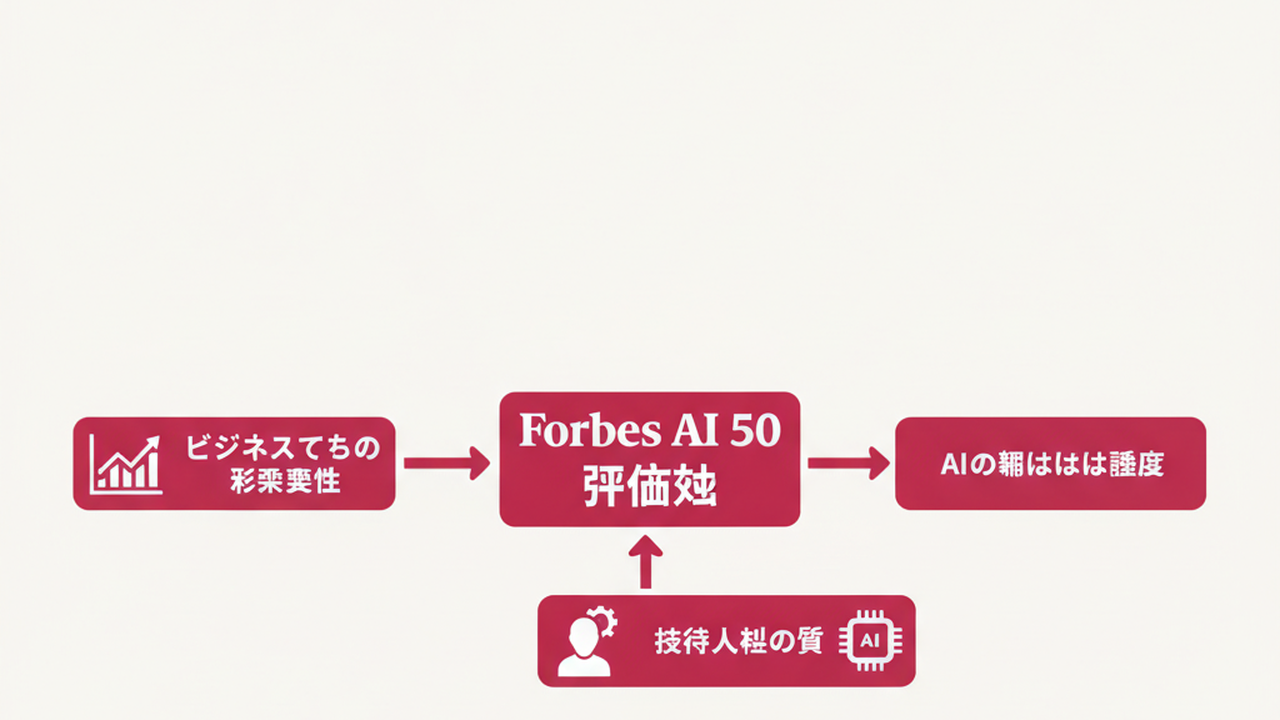
Understanding these three axes changes how you read the list. The industries represented by selected companies are “industries where AI demand and technical maturity have both reached a level that supports full commercial deployment.” In other words, Forbes AI 50 functions as a map of industries where AI has already landed.
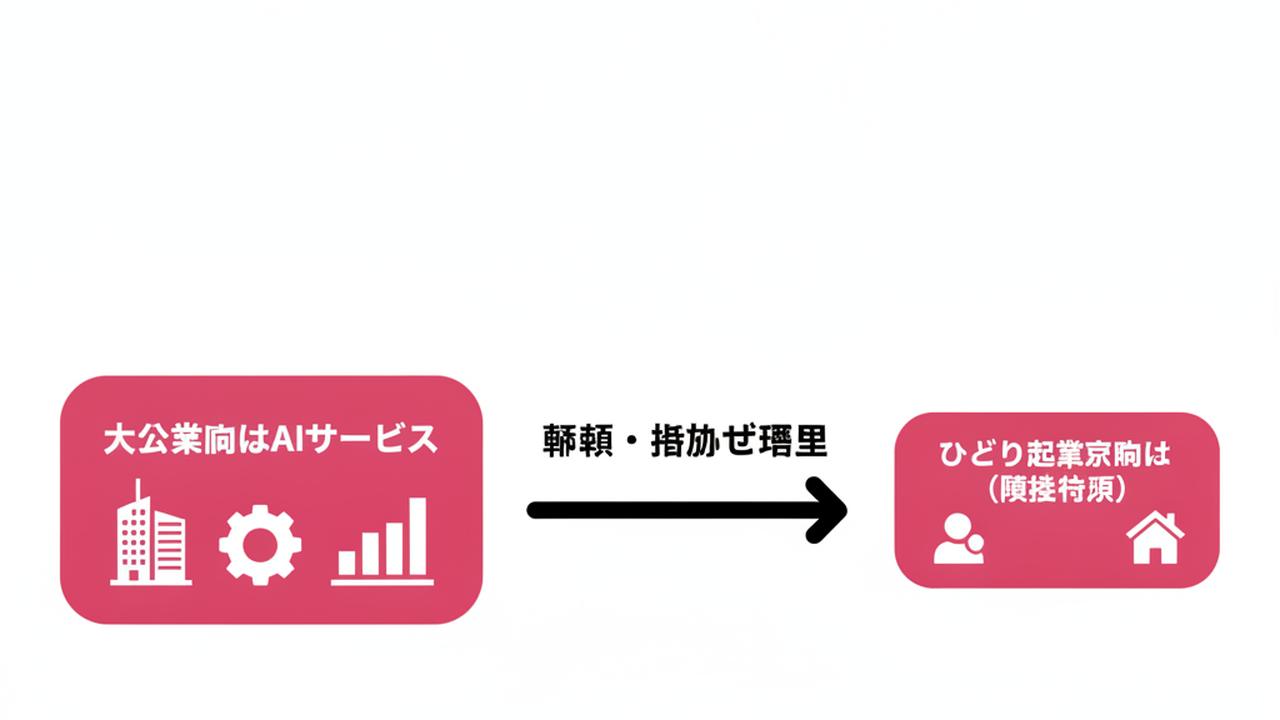
In industries where large enterprises have moved to AI first, there is always a subsequent wave of “translation and bridging demand” for small businesses and individuals. Businesses and individuals who can’t operate full-package enterprise SaaS try to solve the same problems via different means. That demand is the solo founder’s entry point.
Three AI Application Patterns in the 2026 Edition
Organizing Forbes AI 50 2026 by industry reveals three patterns.
Pattern 1: Business Process Automation (HR, Legal, Finance)
AI replacing time-intensive routine work that humans were doing. Contract review, initial resume screening for hiring, automated expense categorization—these are representative examples. In this category, full-featured SaaS for mid-to-large enterprises dominates the top slots.
Harvey, for example, was selected as a Legal AI that automates contract review and regulatory compliance work for large law firms. Rogo (Finance AI) is used by over 25,000 people at major banks and investment firms for financial analysis. Both run on annual enterprise contracts as their core model.
From a solo founder’s perspective, there will always be a gap for “small businesses and sole proprietors who can’t operate full-package SaaS.” Consultants who help small businesses implement legal AI, freelance bookkeepers who handle initial finance AI setup—this “bridging work” exists precisely because the tools exist but the in-house talent to use them doesn’t. That demand will keep growing.
Pattern 2: Prediction and Decision Support (Healthcare, Finance, Real Estate)
Predicting “what happens next”—diagnostic AI, credit score redesign, property price prediction models. This domain is heavily regulated, favoring large enterprise leadership, but the role of “translating AI outputs into human terms” can be played by individuals.
Abridge, for example, was selected as a healthcare AI that automatically records doctor-patient conversations and generates electronic health record documentation. AI handles the recording and organization so doctors can focus on the patient interaction. Supporting small clinics in implementing and running tools like this is a role that can be filled without a medical license in some cases.
AI-assisted healthcare coaching, loan review process consulting, real estate AI data literacy education for investors—“converting what AI outputs into language for decision-making” is where individuals have a role. When large enterprises adopt AI, they create a separate need for people on the receiving end of those outputs. That’s where solo founders fit.
Pattern 3: Content and Communication Automation (Marketing, Customer Support)
AI generating text, voice, and images to handle customer communication. Email automation, chatbots, video production tools. This is the most accessible pattern for solo founders—if you can use the tools, you can produce output at the same level as a corporation.
Sierra, for example, was selected as a platform that fully replaces brand customer support with dedicated AI agents. Decagon is a service focused on maximizing the rate of AI-resolved support requests. Both are enterprise products, but the structure naturally creates demand for individual freelancers who can configure and operate these tools for smaller companies.
In social media marketing specifically, individual freelancers who can integrate AI-generated content “as part of the operating workflow” are multiplying fast. When large enterprises adopt expensive marketing AI, demand follows for individuals who can manage the implementation and quality control.
Looking across all three patterns, the consistent observation is this: there is always a gap between “full-package for enterprises” and “partial optimization for individuals and small businesses.” Forbes AI 50 shows where AI demand has been confirmed—and those gaps are the adjacent markets.
One in Four New Unicorns Is an AI Company — What That Number Means
In 2026, 98 companies achieved unicorn status (private startups valued over $1 billion), and over 25 of them—more than 25%—were AI companies, according to Digital Journal (https://www.digitaljournal.com/business/ai-companies-account-for-over-a-quarter-of-2026s-98-newly-minted-unicorn-start-ups/article). More than one in four.
Three things this number means:
Meaning 1: Starting a business with AI is no longer unrealistic
Ten years ago, AI was something “only Big Tech like Google and Microsoft could handle.” Training models required enormous compute resources; individuals had no way in. Now APIs are standardized, no-code tools have spread, and startup-level founders can build AI-core businesses. The 25%+ unicorn figure is proof that this shift is real.
Meaning 2: The market now rewards AI-applied business models with high valuations
Unicorn valuation means investors gave the company a high mark. AI-applied business models are judged to have high productivity ceilings and to scale well. This is also a critical signal for solo founders. In an era where “whether you use AI” is beginning to influence customer purchasing decisions, services that don’t leverage AI will gradually lose competitiveness.
Meaning 3: Entering now is not “late”—it’s “right as the main event begins”
Some people hear “25%+ unicorns are AI companies” and feel like they’ve already missed it. I see it the opposite way. “Enterprise AI has reached commercial-grade deployment” means the wave of translation and bridging demand for small businesses and individuals is just getting started. Just as the spread of agricultural machinery created demand for “people who teach others how to use agricultural machinery,” AI companies reaching commercial scale signals the opening of the adjacent market.
Switching from “Ranking View” to “Entry Map View”
People who read Forbes AI 50 as a ranking and people who use it as an entry map get completely different things from the same information.
In ranking view: “OpenAI, Anthropic, Cohere… the usual giants. Not my world.” You scroll, you close. You received information without any action following.
In entry map view: “This company was selected as a ‘Legal AI,’ which means AI demand in the legal industry has been confirmed. Is there a bridging role for SMEs or sole proprietors who need help with contracts, where I could connect them to this AI tool?” And from there you start moving.
There’s one pivot: “Don’t look at company names. Look at industry tags.”
You don’t need to memorize the company names on Forbes AI 50. When you open the list, look at each company’s industry tags first. “Healthcare,” “Legal,” “Finance,” “Real Estate,” “Marketing,” “HR,” “Supply Chain”—the tag list is the list of industries where AI demand has been confirmed.
Then imagine the “small business/individual version of the need” attached to each tag. Problems that large enterprises solve with AI are, at a different scale, the same problems small businesses and individuals face. Large enterprises solve them with annual enterprise SaaS contracts. Small businesses and individuals—how do they solve them? That’s where the gap forms, and where the adjacent market opens.
3 Steps to Find the Adjacent Market
Using Forbes AI 50 as an entry map comes down to three steps.
Step 1: Scan industry tags in 5 minutes
Open the Forbes AI 50 official page and write out just the category tags for each company first (https://www.forbes.com/lists/ai50/). “Healthcare,” “Legal,” “Finance,” “Real Estate,” “Marketing,” “HR,” “Supply Chain,” “Education”—these tags will appear throughout.
Once you have the list, check off the industries you’re in now, have experience in, or are curious about. Don’t try to make a perfect selection here. “I vaguely know this space,” “I have clients there,” “I’m interested in it”—any of these is enough. If even one box is checked, proceed to Step 2.
Important note: if you feel like “my industry isn’t here,” pick the adjacent industry. A hair salon owner will find overlapping problems in “Healthcare (wellness).” Someone in education will find adjacent challenges in “HR (human capital).” Industry tags are not a strict classification system—use them as a demand map.
Step 2: Write out 3 “small business/individual versions of the need” (15 min)
For the tag you selected, look at what problem the Forbes AI 50 company in that industry is solving. Then write out three “small business versions” or “sole proprietor versions” of that problem.
One example: say you chose “Legal.” Harvey and similar Legal AI companies are solving “accelerating contract review for large enterprises” and “automating regulatory compliance.” Translated to the small business / sole proprietor version:
- A small business office manager doing a basic check on a service outsourcing contract
- A freelance designer who needs to confirm copyright and IP ownership for every project
- A solo business owner creating and reviewing NDAs with business partners
None of these are solved by an “enterprise legal AI at hundreds of thousands of dollars per year.” Free or low-cost tools exist, but people don’t know how to use them or how to evaluate whether to trust them. That gap is a service opportunity.
One more: say you chose “HR.” Enterprise HR AI is solving “initial resume screening,” “standardizing interview evaluation,” and “churn prediction models.” Translated to small business version:
- A sub-10-person startup hiring for the first time needs help designing their hiring criteria
- A sole proprietor looking for freelance talent needs skill-matching support
- A solo consultant is helping a client company build its hiring culture
Also not served by enterprise HR SaaS.
Step 3: Overlap one point with your skills (30 min)
Looking at the three needs you wrote in Step 2, pick the single one where you could deliver value right now. Don’t try to do all three. Pick one.
Once you’ve picked it, spend 30 minutes drafting a rough service concept. A rough concept means: “what, for whom, at what price”—something you can state in one sentence.
Example: “Simple outsourcing contract and NDA review service for freelancers. ¥10,000/month. AI-assisted, responses within 48 hours.”
At this stage, don’t try to make a perfect service. The goal is to test. Once you have a draft concept, post one thing on social media: “Is there anyone who needs something like this?” If there’s a response, dig deeper. If not, try a different need.
Forbes AI 50 is an index that updates each year telling you which industries have reached commercial-grade AI demand. Run this 3-step process once a year, and your sensitivity to entry timing compounds over time.

Closing: One Action This Week
Return to the 3 questions from the beginning.
Q3: “When you looked at Forbes AI 50, did you think ‘that’s a different world from mine’”?—After reading this article, if you ask yourself the same question again, your answer should be different.
Forbes AI 50 is not a list of honors for large enterprises. It’s a map of industries where AI demand has reached commercial-grade scale. In 2026, with over 25% of newly minted unicorns being AI companies, the barrier to “starting a solo business with AI at the center” has dropped dramatically.
The reading method in three lines:
- Scan Forbes AI 50 industry tags and identify industries where AI demand has been confirmed
- Write out three “small business/individual versions of the need” for that industry
- Overlap one point with your skills, draft a rough concept, and post one test on social media
In industries where enterprise AI has reached commercial deployment, “bridging demand” always follows. People and businesses who can’t operate full-package SaaS try to solve the same problems differently. That’s where the solo founder’s entry point is.
One action this week: open the Forbes AI 50 official page and spend 5 minutes scanning the industry tags (https://www.forbes.com/lists/ai50/). Write down three tags that catch your attention. That’s the first step to “starting to use the entry map.”
In the end, the ones who acted win. Will you close Forbes AI 50 with “impressive,” or will you take home one entry hypothesis? The same five minutes produces that whole difference. Just open it.

女性だからこそ、AIを使いこなさなきゃって思ってる。仕事も、副業も、推し活も、旅行も、全部やりたい。人生一度きりなのに時間は足りないじゃん?だからAIに任せられることは全部任せる。浮いた時間で本当にやりたいことをやる。それがあたしのスタイル。ここにはあたしが実際にやったことをまとめてるだけ。誰かのためになったらいいなって思って書いてるよ。