Side Hustle in 2026: 3 Routes Reverse-Engineered from the U.S. 33% Rate and $1,242/Month Average
LendingTree's 2026 survey: 33% of U.S. adults have a side hustle, averaging $1,242/month — an all-time high. Here's a blueprint reverse-engineered from that data into 3 routes for hitting ¥30,000/month in Japan.
What you'll learn in this article
- The key point to grasp before reading the full article
- How the issue changes practical decisions after reading
- Which follow-up article is worth opening next

“I want to start a side hustle, but I have no idea where to begin.” That’s the line I hear most often from people who come to me.
So here’s something that caught my eye. Last week — May 29, 2026 — USA Today ran a piece titled “Americans are relying on side hustles to pay bills. Which pay best?” The short version: Americans are depending on side income to cover their cost of living, and the question is which type pays the most.
The primary motivation for side hustles has shifted from “pocket money” to “covering living expenses.” That’s the seismic shift of 2026. If it’s happening in America, it’s coming to Japan — or honestly, it’s already here.
Today I’m translating the latest U.S. data into a blueprint for hitting ¥30,000/month as a side hustler in Japan. Three routes, built from the numbers up.
What You’ll Be Able to Do After Reading This
Pick one of three routes — e-commerce, skill-based hourly work, or content — and take your first 60-minute move this weekend.
You don’t need to memorize everything. Choose the one route that fits your situation from the three I’ve laid out: e-commerce, skill hourly, and content. Take one step in 60 minutes this weekend. That’s today’s goal. The rest of this article is the reasoning behind how to choose and how to move.
U.S. 33%: When “Covering Living Expenses” Became the Main Point of a Side Hustle
Let me start by getting the data right. Checking sources before writing is my standard operating procedure.
The survey was conducted by LendingTree — a major U.S. financial comparison site that tracks side hustles and personal loans annually. The numbers came from an online survey run by QuestionPro between March 3–6, 2026, covering 2,049 U.S. consumers aged 18–80.
Here’s what they found:
- 33% of U.S. adults have a side hustle
- Side hustlers earn an average of $1,242/month — the highest since the survey began
- 54% cited “covering living expenses and essentials” as their motivation
- 53% said they would struggle to pay for necessities without their side hustle
The 33% figure is worth examining. In 2022 it was 44%; in 2025, 38%. The share of people with side hustles has actually been falling. Yet monthly earnings are at an all-time high.
What’s going on? Here’s my read: the “making a bit of extra pocket money” crowd has dropped out, and the “seriously going after living expenses” crowd is what remains. That’s why per-person earnings went up. When USA Today wrote about side hustles shifting “from pocket money to covering living expenses,” they were pointing at exactly this structural change.
What does this tell us? If we’re starting a side hustle in 2026, the casual “fun side project” frame doesn’t cut it anymore. You need a real design for hitting ¥30,000, ¥50,000, ¥100,000. That’s the baseline assumption going forward.
Inside the $1,242: Breaking Down Hourly Rates and Categories
“$1,242/month (roughly ¥186,000 at ¥150 to the dollar)” is an average, so individual results vary widely. Without understanding what drives the variance, you can’t tell whether the numbers are replicable for you.
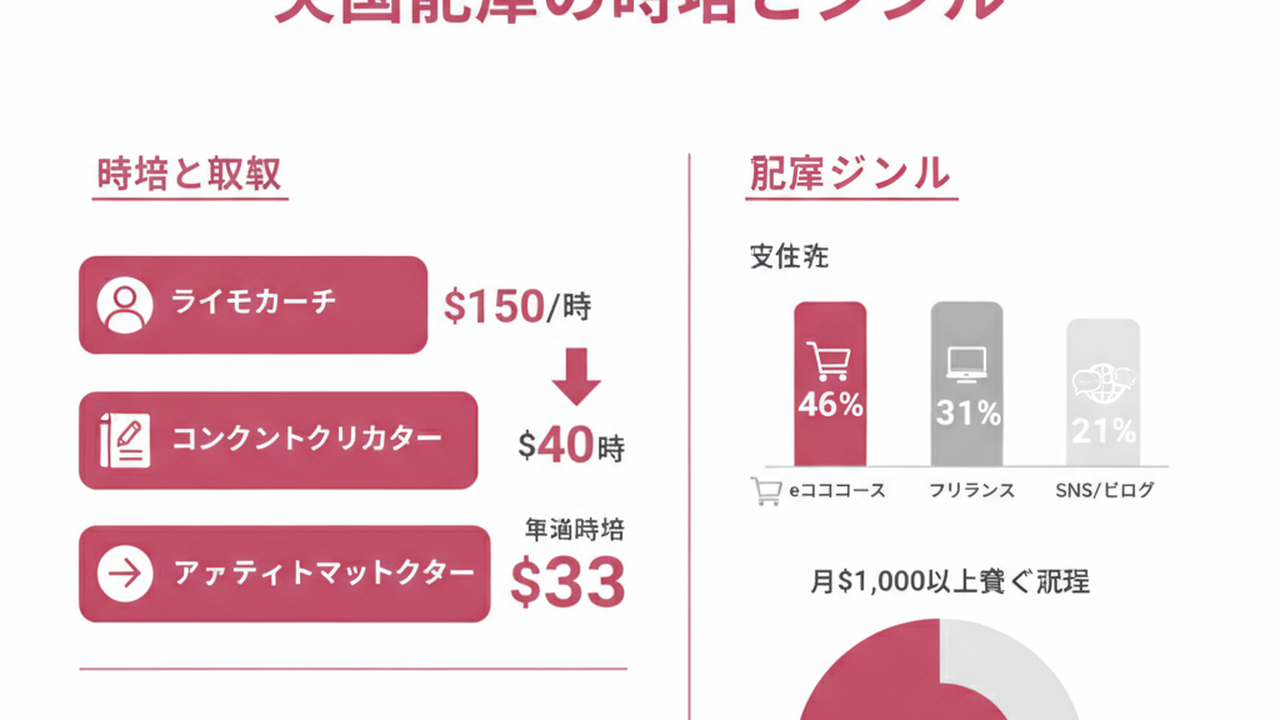
On the hourly rate side, BestBrokers used Upwork data to calculate rankings. The top 5 hourly earners featured in the USA Today article:
| Rank | Side Hustle Type | Average Hourly Rate |
|---|---|---|
| 1 | Life coach | $150 |
| 2 | Brand content creator | $40 |
| 3 | Affiliate marketer | $37.50 |
| 4 | E-commerce, photo/T-shirt design, influencer marketing, copywriter, tutor | $30+ |
| — | Bookkeeping with cloud accounting software experience | $75+ |
Life coaches blow everyone else out of the water at $150/hour (roughly ¥22,500). But as LendingTree’s own notes acknowledge, it’s a field that “depends on personal brand and reputation.” Starting from zero, you won’t hit $150/hour in the first six to twelve months. The smarter target is the $30–$40/hour range in positions 2 and beyond.
Now look at where side hustlers are actually operating:
- 46% in e-commerce (selling or reselling products online)
- 31% in freelancing (contracted work)
- 21% in social media content creation or blogging
And here’s the income reality underneath those numbers: 39% of e-commerce side hustlers earn $1,000+/month. Freelancers come in at roughly 28%, food delivery at roughly 26%, content creators at 19%.
The takeaway: e-commerce is both the most popular category and the one with the thickest layer of people actually hitting strong income. YouTube and TikTok content looks glamorous, but fewer than 1 in 5 creators clears $1,000/month. If you’re serious about crossing ¥30,000/month, put e-commerce on the table first. That’s my conclusion.
Three Gaps Between Japan and the U.S. — Why the Average Stops at ¥65,000
Now we get to the real work. Staring at U.S. numbers and sighing doesn’t start anything. The question is where the structural gaps are between Japan and the U.S.
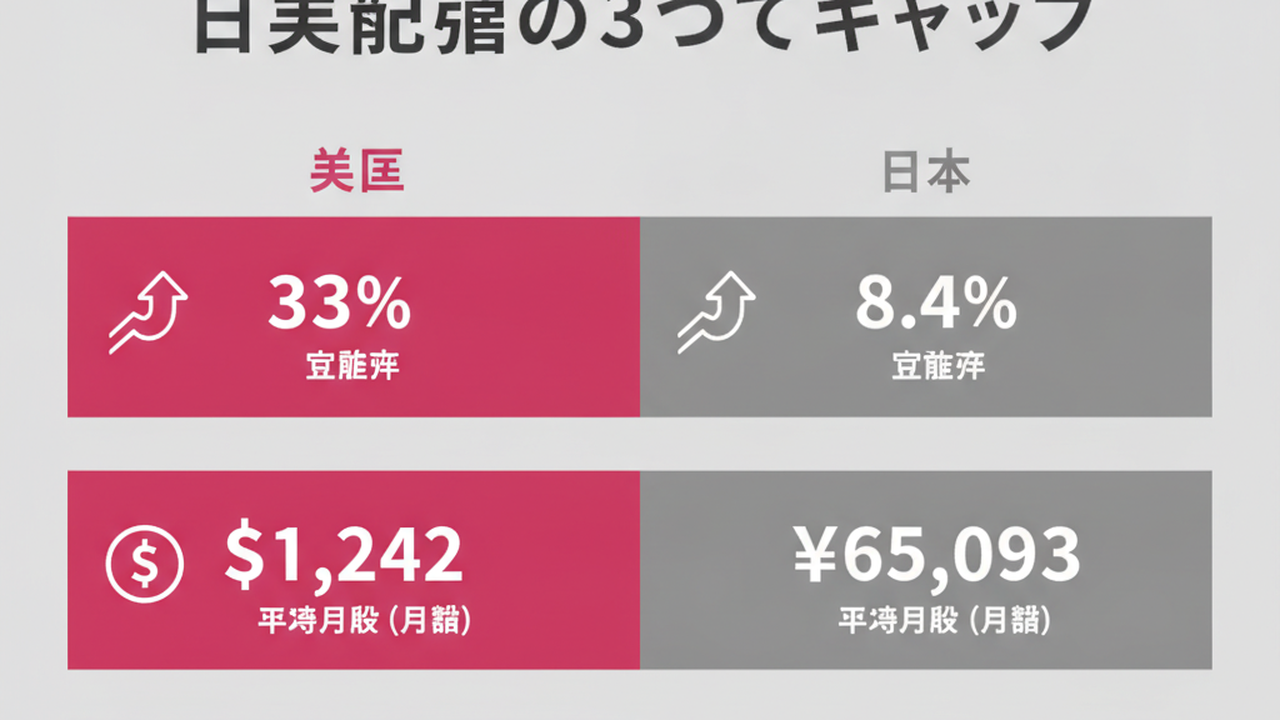
The most reliable source on Japan’s side hustle reality is Persol Career’s doda survey. The latest edition, announced January 2024, shows:
- Side hustle participation rate: 8.4% (increasing for two consecutive years)
- Average monthly income: ¥65,093 (up ¥13,875 from the previous survey)
- Top categories: 1st “service industry (customer service/retail)” 21.3%, 2nd “stocks/FX” 18.4%, 3rd “internet business (mail order/affiliate/online shops)” 10.6%
- Employers permitting side hustles: 27.5%
Set those next to the U.S. numbers and three gaps emerge clearly.
Gap 1: Participation rate is roughly 4x lower (33% vs. 8.4%)
The bulk of this is a policy gap. The U.S. is structured around the assumption of side income, and companies have no incentive to stop it. Japan issued side hustle deregulation guidelines in 2018 (the government’s “Model Employment Rules” revision that removed the default prohibition on employees holding outside jobs), but fewer than 30% of employers have actually adopted them. It takes time for the culture to shift.
Flip it around though, and you get an opportunity: fewer side hustlers in Japan means less competition. From where I stand, that’s not a handicap — it’s an opening.
Gap 2: Average monthly income is roughly 3x lower ($1,242 ≈ ¥186,000 vs. ¥65,093)
This is a gap in hourly rates. U.S. rates of $30–$40/hour convert to roughly ¥4,500–¥6,000. Browse Japanese crowdsourcing platforms and you’ll find beginner writing jobs routinely paying below ¥1,000/hour.
Why? Japan’s side hustle market hasn’t fully developed the “high-value skill” segment — the kind where one person’s output scales without inventory. E-commerce gets tangled up in inventory risk from China imports. Design work gets hammered on price. That makes it hard to compete on hourly rates.
Gap 3: Top categories are completely different (e-commerce 46% vs. service industry 21.3%)
This is the most important gap. Japan’s top three side hustle categories are “service industry,” “stocks/FX,” and “internet business.” Service industry is the classic time-for-money trade — hourly rate ceiling is low. Stocks and FX are investment, not labor — a different animal from the “side hustle = living expenses” story.
When you try to transplant the U.S. “side hustle = living expenses” model to Japan, the closest match is the 3rd-place category: “internet business.” Specifically: mail order, affiliate marketing, and online shops. Currently sitting at just 10.6%. That’s where the growth potential is.
The 3-Route Blueprint for Clearing ¥30,000/Month
With those gaps in mind, here’s the blueprint I’ve designed for aspiring solo operators in Japan to break through ¥30,000/month. These are ranked in the order I’ve seen actually work in my consulting practice.
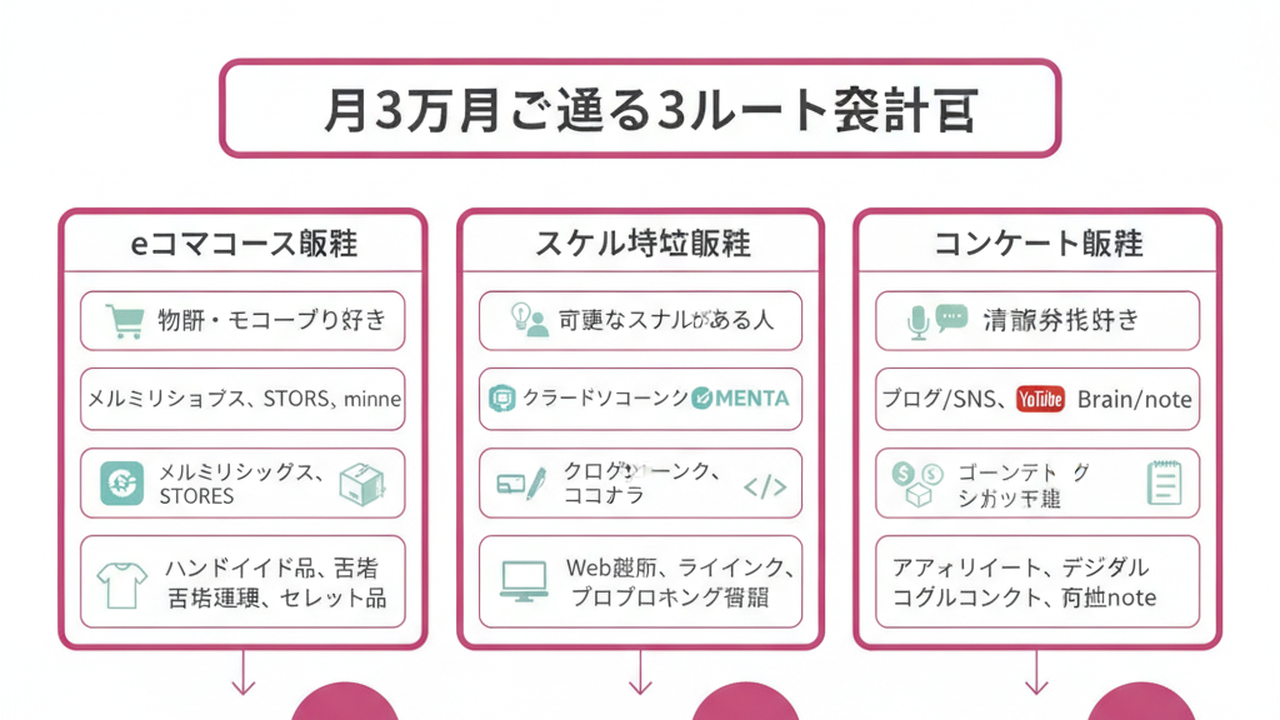
Route 1: E-Commerce (Start with One Item)
Who it fits: People who enjoy buying, selling, or making physical products; anyone who’s sold something on Mercari (Japan’s leading C2C marketplace) before; people who don’t want to put their face on camera.
The shortest path looks like this: List exactly one item on Mercari Shops or BASE (a free-to-start Japanese e-commerce platform similar to Shopify Lite). Shopify costs a monthly fee — wait until you’re clearing ¥30,000 before migrating. BASE is free to start and has a strong beginner community with solid support.
Three ways to source products:
- Sell what you already own (closet items, old books, collectibles): Zero upfront cost, fastest feedback loop
- Domestic or cross-border resale: Arbitrage price gaps on eBay, Buyma (Japan’s luxury cross-border marketplace), or Rakuten. Initial investment ¥5,000–¥30,000
- Handmade or original goods: List on minne or Creema (Japan’s leading handmade marketplaces). Materials cost as low as ¥5,000 to start
The ¥30,000 line is within reach at 10 sales with a ¥3,000 average order, or just 3 sales at ¥10,000. Given that 39% of U.S. e-commerce side hustlers clear $1,000+/month (roughly ¥150,000), ¥30,000 is well within range.
Route 2: Skill-Based Hourly (Targeting ¥3,000/Hour or More)
Who it fits: People whose full-time job skills have market value; people who know how to present their deliverables well; people with scheduling flexibility.
U.S. rates of $30–$40/hour convert to roughly ¥4,500–¥6,000. Closing that gap in Japan means getting off the crowdsourcing beginner tier.
Two ways to break out:
- Win on direct referrals: Build a reputation on Coconala (Japan’s skill marketplace, similar to Fiverr) or via SNS direct messages so clients specifically ask for you. Create a portfolio of 5 pieces and post it on X (formerly Twitter)
- Move up to corporate clients: Use contacts from your company days, or access mid-to-senior freelance platforms like Lancers Pro or Workship
¥3,000/hour × 10 hours/month = ¥30,000. ¥5,000/hour × 10 hours/month = ¥50,000. Two hours on weekends for four weeks puts ¥30,000 in range. Design, copywriting, bookkeeping, education, and translation are the highest-paying categories for hourly work.
Route 3: Content (12–18 Month Build)
Who it fits: People who don’t mind writing or talking; people who want to share their own experiences; people who think long-term.
Build on note (Japan’s Medium-like paid writing platform), X, YouTube, or TikTok over 12–18 months. U.S. data shows only 19% of content creators hit $1,000+/month — this is the hardest route.
That said, once it gets moving, the ceiling is higher than either of the other two routes. Ad revenue plus affiliate plus paid articles or paid communities can reach ¥100,000–¥300,000/month.
The concrete step-by-step: post 2 pieces of content per week for 18 months — 144 total. From there, go after the ¥30,000 line through note paid articles, Brain (Japan’s info-product platform), or YouTube memberships. I typically structure this as a 3-year plan.
This Weekend: 3 Steps in 60 Minutes to Pick Your Route
Here’s a decision sequence that lets you figure out which of the 3 routes fits you — in 60 minutes this weekend.
Step 1 (20 min): Calculate a realistic monthly number for each route
For each of the 3 routes, multiply the time you can realistically commit each month by the expected hourly equivalent.
- E-commerce route: 10 hours/month × ¥1,500/hour effective rate (including packing and shipping) = ¥15,000–¥30,000
- Skill hourly route: 10 hours/month × ¥3,000/hour = ¥30,000
- Content route: 20 hours/month × ¥0 effective (basically zero for the first 6 months) = ¥0, rising to ¥30,000+ from month 12
“I need ¥30,000 starting this month” → Route 2. “I want to be up and running in 3–6 months” → Route 1. “I’m aiming big over the long term” → Route 3. Use your time horizon to narrow to one.
Step 2 (20 min): Audit your existing skills
Open your phone’s notes app and write down 3 tasks you’ve been asked to do at work five or more times. Examples: “deck design,” “meeting notes summarizing,” “translating English emails,” “presenting in front of groups,” “Excel formulas.” These are your starting point for hourly rate potential.
If nothing comes to mind, Route 1 (e-commerce) is probably your fit. Selling things is faster than selling skills when you’re starting from scratch.
Step 3 (20 min): Do exactly one thing, right now
- Route 1: Take a photo of one item to sell on Mercari and post the listing
- Route 2: Create one listing on Coconala or Lancers (Japan’s leading freelance marketplace, similar to Upwork) for your services
- Route 3: Open a note account and publish one introductory article
Nine out of ten people stop here. The one in ten who moves — three months later, they’ve crossed ¥30,000. In everything I’ve seen, this holds without exception.
Takeaway
Thanks for reading this far. Let me compress it down to three things to take with you.
- 54% of U.S. side hustlers said their reason was “covering living expenses.” Side hustles aren’t casual anymore. The baseline assumption is a real design for hitting ¥30,000, ¥50,000, ¥100,000.
- The $1,242 average is driven by “e-commerce at 46%, with 39% clearing $1,000+.” The unglamorous product-sales route makes more money than the glamorous creator route.
- The 3 routes for Japanese side hustlers to break ¥30,000 are e-commerce, skill hourly, and content. Use your time horizon and a skills audit to pick one, then make one move this weekend in 60 minutes.
“I’ll get around to it someday” side hustles are the same as no side hustle at all. The moment you finish reading this is your starting line. The ¥30,000/month three months from now only becomes visible to the people who make it to Step 3 this weekend.
Stop deliberating. Move. Failure isn’t the end of the world.
I started my first side hustle selling used books on Mercari, pocketing ¥500 in profit. ¥500 to ¥30,000 happens faster than you’d think.
Sources:
- USA Today / AOL “Americans are relying on side hustles to pay bills. Which pay best?” (2026-05-29) https://www.aol.com/articles/americans-relying-side-hustles-pay-161642000.html
- LendingTree “2026 Side Hustle Survey” (conducted by QuestionPro, March 3–6, 2026, n=2,049) https://www.lendingtree.com/debt-consolidation/side-hustlers-survey/
- Persol Career (doda) “Side Hustle Reality Survey [Latest Edition]” (published 2024-01-29) https://www.persol-career.co.jp/newsroom/news/research/2024/20240129_1315/

女性だからこそ、AIを使いこなさなきゃって思ってる。仕事も、副業も、推し活も、旅行も、全部やりたい。人生一度きりなのに時間は足りないじゃん?だからAIに任せられることは全部任せる。浮いた時間で本当にやりたいことをやる。それがあたしのスタイル。ここにはあたしが実際にやったことをまとめてるだけ。誰かのためになったらいいなって思って書いてるよ。