The Day Zoom Handed $30K to 5 People. The Fastest Benchmark for Designing Your Solopreneur Income
Zoom's $30K Solopreneur 50 grant isn't prize money — it's a measuring stick. Using Census Bureau data on 33M self-employed Americans, here's how to reverse-engineer your income target.
What you'll learn in this article
- The key point to grasp before reading the full article
- How the issue changes practical decisions after reading
- Which follow-up article is worth opening next

Stop the moment you think “I would have applied for that.” The $30K Zoom gave out isn’t prize money — it’s a ruler.
On May 3rd, Fortune broke the story, and Zoom made the official announcement the next day: “Zoom Solopreneur 50.” A program that selected 5 people from nearly 3,000 applicants and gave each one $30,000 in cash — $150,000 total. Open to US-based solopreneurs using AI to run their businesses. Barely any media outside the US covered it.
But closing the tab with “that’s a US story” would be a mistake. That $30K figure means something. It’s the fastest benchmark available for those of us juggling a side hustle or considering going independent — trying to figure out what our annual revenue target should actually be.
Today I’m reverse-engineering that number alongside Census Bureau data on 33 million self-employed Americans.
What Zoom Solopreneur 50 Was Actually Measuring — 5 People Chosen from 3,000
Let me lay out the program’s structure first. Without this, the meaning of $30K won’t land.
Zoom Solopreneur 50 was officially announced on May 4, 2026 — America’s first solopreneur recognition program (Zoom official press release / GlobeNewswire). It identified the top 50 US entrepreneurs running AI-powered one-person businesses, then gave $30,000 cash grants (no conditions attached) to 5 of them. Total: $150,000.
Applications came in from nearly 3,000 people across 48 states and over 400 cities. An independent panel of academics and business leaders made the final selections. That alone tells you: 3,000 people in the US raised their hands and said “I run a one-person business.”
The published selection criteria were five:
- Originality of the idea
- Evidence of actual growth and sustainability
- Impact on customers and community
- How deeply the entrepreneur’s values are embedded in the business
- Reach and influence within their industry
They’re not cutting by revenue alone. To give away $30K, they didn’t require “100% profitable” — they selected on values and influence. That surprised me.
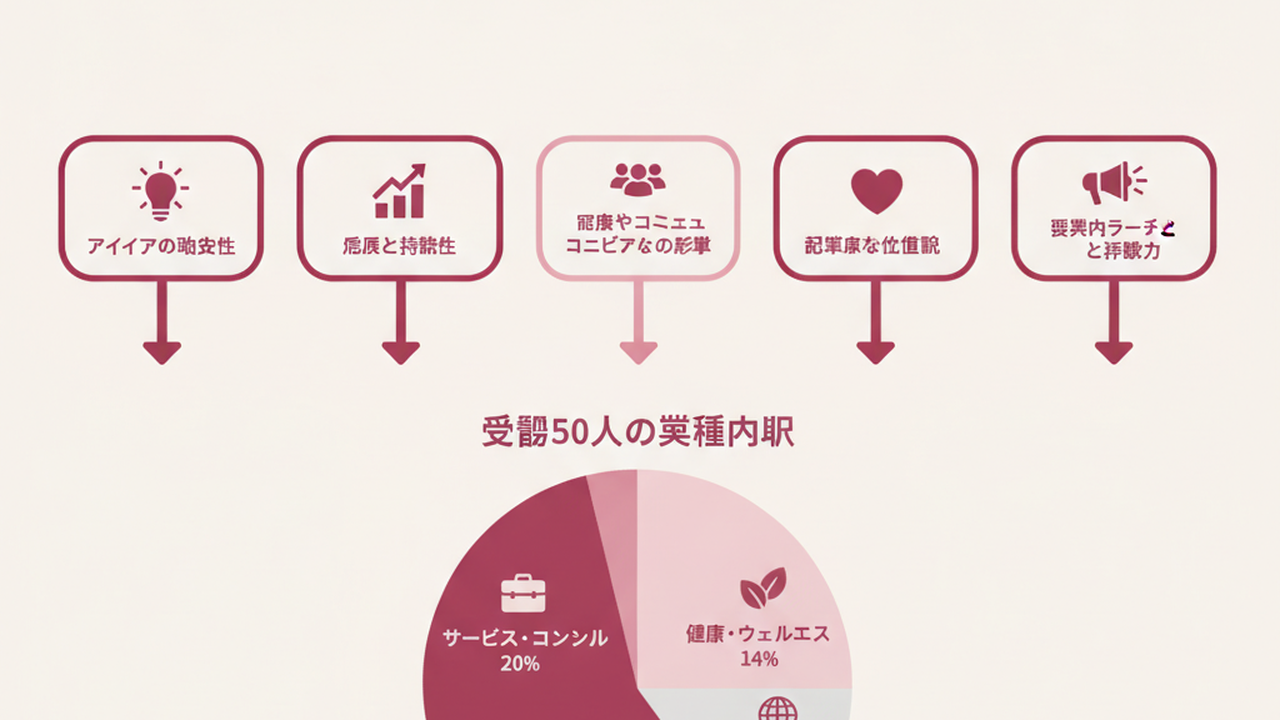
The industry breakdown of the top 50 was also released — and it’s telling.
- Services & consulting: 20%
- Health & wellness: 14%
- Social impact: 12%
- Others across 12 industries: agriculture education, nonprofit support, baking, workplace documentation tools, and more
Tech SaaS is not dominating. “Human-facing service businesses” are. That’s the shape of the modern solopreneur: AI-powered efficiency built around human service.
62% of applicants had active, revenue-generating businesses. Median founding year: 2022. These are people who built and ran something in the past three years. Nearly half reported prior industry experience before going solo. The pattern: experienced professionals going independent and running it with AI.
Four of the five winners were named publicly.
Derek McCracken — The Owl’s Nest (agriculture education): Runs online agriculture curriculum solo. Publicly stated the $30K will fund “hiring contract instructors to expand the curriculum nationwide.” He builds and delivers content alone, contracts out the rest. Classic solopreneur structure.
Dana Snyder — Positive Equation (nonprofit support): Designs recurring-donor systems for nonprofits. Plans to invest in awareness of her “Monthly Giving Builder.” B2B-adjacent solopreneur work in a high-social-value niche.
Angela Morrison — Cakes by Angela Morrison (cake design): The quintessential craft solopreneur. The fact that she won — not a tech founder — matters.
Cierra Gross — Worklution Inc (workplace documentation): Her tool “Wrk Receipts” is used by 22,000+ employees. A solo-built product at 22,000 enterprise seats. The $30K goes toward scaling further.
Just from these four, a clear picture emerges: agriculture, cakes, nonprofits, workplace tools — none of it is tech SaaS — and all of it works as a solopreneur business using AI and automation. Zoom deliberately spread recognition across 12 industries because they wanted to plant an industry-agnostic benchmark. That’s my read.
Why $150K Was Distributed Right Now — Reading the “33 Million” Behind It
Why did Zoom suddenly launch this program? The background is in US workforce data.
Census Bureau’s 2025 working paper “Business Owners and the Self-Employed: 33 Million (and Counting!)” (Census Bureau CES-WP-25-60). The title is the conclusion: business owners plus self-employed workers in the US have surpassed 33 million. Fortune’s headline “33 million workers ditch their 9-to-5” pulls directly from this data.
A quick definition note. There are three ways to measure self-employment in the US:
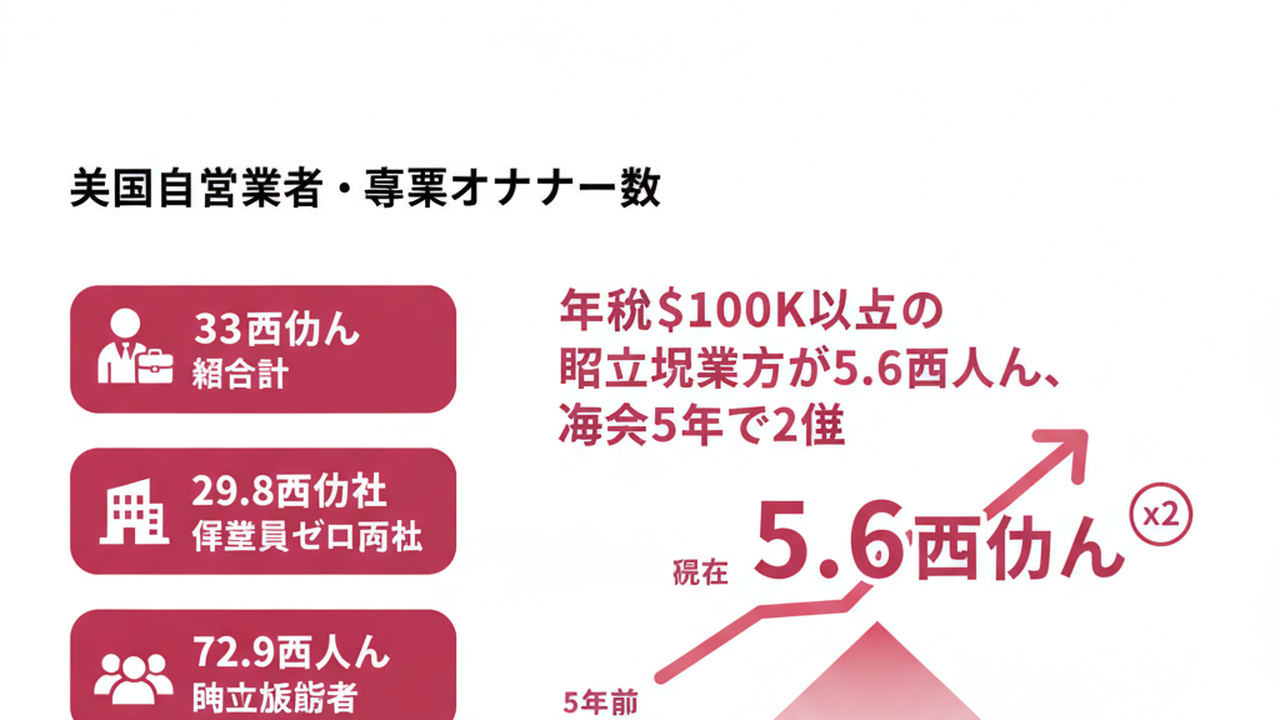
- 33 million (Census Bureau): Total business owners + self-employed individuals
- 29.8 million firms (Zoom “The state of solopreneurship in 2026”): Employer-less legal entities, combined revenue of $1.7 trillion (Zoom official blog)
- 72.9 million people (MBO Partners 2025 “State of Independence”): All independent workers including side hustlers, contractors, and full-time solos (MBO Partners official report)
Broadest to narrowest: 72.9M → 33M → 29.8M. Which number you use changes the argument. Fortune used “33 million” because it’s closest to Zoom’s target audience (full-time business owners) — that’s my interpretation.
The most striking finding in the MBO Partners report is something else. Independent workers earning $100K+ annually: 5.6 million — doubled over the past five years. What this means: the assumption that “going independent means financial struggle” is breaking down.
5.6 million people. That’s a massive cohort running solo businesses at significant income. In the US, more than 1 in 13 independent workers is earning six figures or more.
Zoom giving away $150K to Solopreneur 50 was, in my view, a move to turn the people already using Zoom as their business infrastructure — within this 5.6 million market — into brand ambassadors. As advertising, it’s a cheap investment. $150K bought a Fortune pre-release, then coverage in Inc., Black Enterprise, Yahoo Finance — all of them.
That’s the factual foundation. Now: how do we translate these numbers into our own income design?
Using $30K as a Ruler — 3 Layers of Revenue Calculation
$30,000. That’s what Zoom gave to one solopreneur.
Use it as a ruler. Why? Because “I want to go independent someday, but I don’t know what income to actually aim for” is the number-one frustration — and $30K gives you a useful reference point right at that threshold.
Here are the three revenue layers.
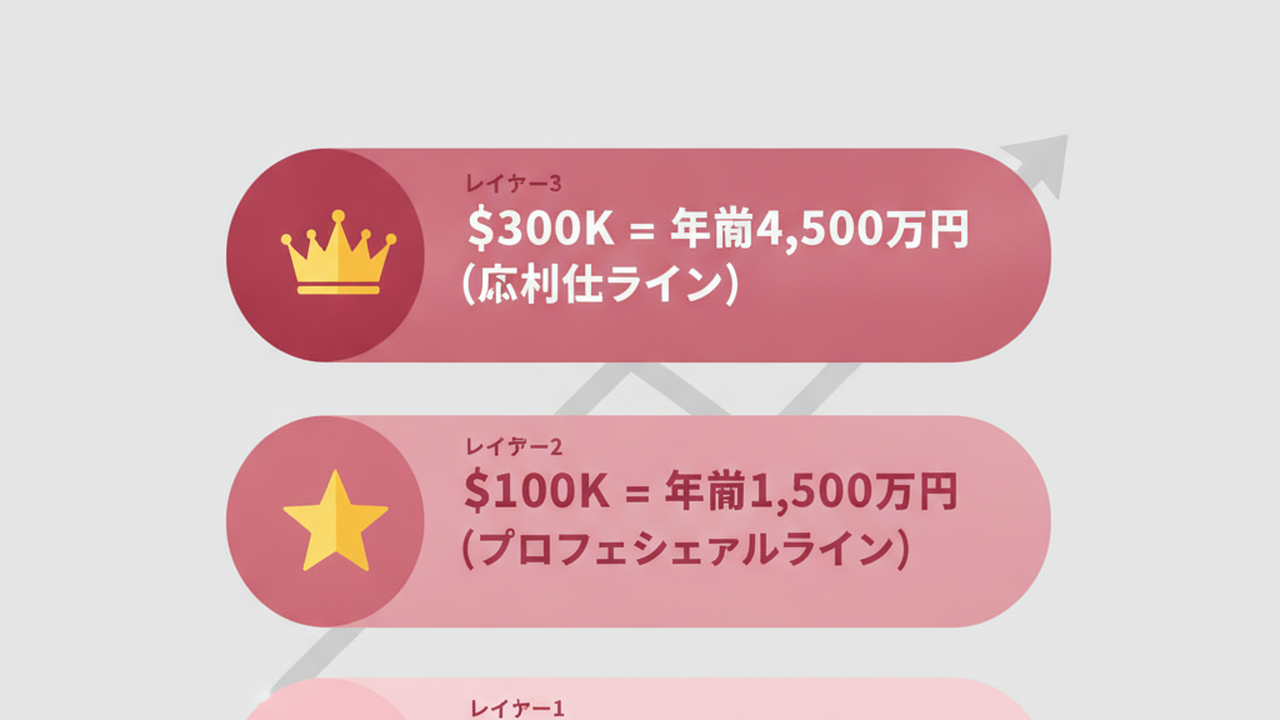
Layer 1: $30K = Independence Consideration Line
This is the threshold Zoom deemed “worth giving a grant for.” Flip it around: if you’re in the side-hustle phase and still below $30K in annual side revenue, jumping straight to full independence is premature.
Monthly target: $2,500. At $1,000/client, you reach it with 3 clients. At $700/client, 4 clients. For consulting work, 10 hours/month across 3 clients covers it. This is achievable while keeping a day job.
If you’re in this zone, staying at “employee + side hustle” is the more efficient structure. Fixed costs come out of your salary. Side income goes back into reinvestment: AI tools, courses, books, networking. Layer 1 is the preparation phase.
Layer 2: $100K = Independence Viability Line
This is the entry point for the $100K+ cohort in the MBO Partners 2025 report — the 5.6 million.
Monthly revenue: $8,300. At $2,000/client consulting rate, that’s 4 clients. Or recurring subscription at 100 accounts ($83/month × 100). The structure changes at this level. You can cover fixed costs while also funding taxes, health insurance, and retirement savings on your own.
Reaching Layer 2 means you can genuinely say you’ve made independence work. At this point, after business expenses and taxes, you’re at or above the net income equivalent of a well-compensated salaried position.
One important caveat: $100K is not the median — it’s the upper tier. The 5.6 million who earn $100K+ represent about 7.7% of MBO’s 72.9 million independent workers. Fewer than 1 in 10.
Layer 3: $1M = Solo Unicorn Threshold
This is the “solo unicorn” range: one-person businesses clearing $1 million annually.
Fortune ran a feature recently: Solo founders are using AI to do the work of entire teams. The premise: more solo entrepreneurs are using AI to handle the workload of entire teams. Monthly revenue: $83K+. At $100K/client, that’s roughly 1 major client per month. Or SaaS at $30/month × 3,500 subscribers.
Everyone who reaches Layer 3 combines three things: AI stack design, automation pipelines, and content as a compounding asset. I’ll write more on that separately.
The reason I lay out all three layers is so you can decide where you actually want to land. If Layer 1 is enough, you may not need to go fully independent at all. If you’re targeting Layer 2, income design is the priority. If you’re going after Layer 3, AI adoption becomes non-negotiable. The right moves change depending on which layer you’re targeting. That’s the whole point of reverse-engineering from $30K.
The “AI × Solo Business” Value Structure, Read Through the Industry Distribution
Take another look at the Zoom Solopreneur 50 breakdown.
- Services & consulting: 20%
- Health & wellness: 14%
- Social impact: 12%
Combined: 46%. Nearly half the winners are from “human-facing services, health, and social impact.” Not tech SaaS. This is where today’s AI solopreneurs are concentrated.
Why? Because what AI cannot replace is “personality and judgment” — and that’s what these three categories demand most. Consulting runs on judgment. Health runs on personal connection. Social impact runs on story. AI handles document creation, scheduling, drafting, follow-ups — all of it. But the final call and human presence? That remains with the human.
Derek McCracken publicly saying he’ll use $30K to “hire more contract instructors” is the telling detail. Even with AI handling content creation, delivery, and progress tracking, he’s adding more humans. That’s the Solopreneur 2.0 model: use automation and contracts to make “essentially one-person operation” viable — not “literally one person does everything.”
Here’s the misconception that trips people up: “using AI means doing everything yourself.” It doesn’t. AI eliminates work you shouldn’t be doing. Then you separate “work only a human can do” from “work that should be contracted out.”
Cierra Gross (Worklution Inc) having 22,000 enterprise seats on a solo-built product is instructive. A SaaS at 22,000 seats — alone. That’s only possible through AI + automation + templated customer support. She isn’t personally responding to 22,000 users. AI + a help center + canned responses maintains “essentially solo” at that scale.
NAGI’s piece on how to think about AI agents — that three-stage model of “using / integrating / delegating to” AI — maps exactly onto this structure. All five Solopreneur 50 winners had moved past “using” AI into “integrating and delegating.”
3 Things to Do This Week — Use $30K as Your Ruler Now
That’s the structural picture. Here are three steps you can start today.
Step 1: Measure your layer in 30 minutes
Total up all your revenue — side work, main job, planned business — for the past 12 months. Decide which layer you’re at: Layer 1 (under $30K), Layer 2 ($30K–$100K), or Layer 3 ($100K+).
If you’re “not started yet,” set Layer 1’s halfway mark — $15K annual ($1,250/month) — as your 6-month target. That’s the first real milestone in “side hustle → independence preparation.”
Step 2: Lock your AI stack budget at 5% of target revenue
Standard solopreneur rule: keep your monthly AI tool spend (ChatGPT, Claude, automation, social tools, email management) at 5% of your target annual revenue.
Layer 1: $1,500/year = $125/month. Layer 2: $5,000/year = $417/month. Layer 3: $50,000/year = $4,167/month.
If your instinct is “I can spend more than that” — watch out. More AI spending doesn’t linearly produce better results. Capping it forces the monthly question: “Do I actually need this tool?” Zoom’s Solopreneur 50 applicants were 62% active revenue-generating businesses with a median founding year of 2022 — using tools fully tends to beat adding more.
Step 3: Pull one KPI this week
Layer 1: “How many potential clients did I contact this week?” Layer 2: “How many rate increase conversations did I initiate this week?” Layer 3: “What’s the measured KPI from one automated flow this week?”
Write it down. Compare same day next week. That’s the whole practice.
NAGI’s piece “Which of the 8 articles should I start with?” makes the point: “what you can’t measure can’t grow.” Apply that to your own revenue layer — and start measuring this week.
Closing: $30K Is a Ruler. You Don’t Have to Apply — But You Do Have to Calculate
The $30K Zoom gave out might look like “a US-only contest irrelevant to me.” Read it as a ruler, and it becomes a reference value for how a $30K annual revenue model gets structured.
The numbers from today, again:
- Zoom Solopreneur 50: 5 winners from ~3,000 applicants, $30K each, $150K total
- US business owners + self-employed: 33 million (Census Bureau 2025)
- Non-employer firms: 29.8 million, combined revenue $1.7 trillion (Zoom official)
- MBO Partners independent workers: 72.9 million, of whom 5.6 million earn $100K+ (7.7%)
This isn’t a numbers exercise in isolation. Here’s what I actually want you to take away: decide what income level is “enough” for you — before any application deadline. Do that work now.
Zoom celebrated five solopreneurs with $150K. While watching that, build your own ruler. Is Layer 1 enough? Are you aiming for Layer 2 to make independence viable? Are you chasing Layer 3 territory?
Once you decide, you move. If it’s wrong, you adjust. That’s the whole loop.
You don’t have to apply for anything. But reverse-engineering your income target from $30K — that work starts today. I thought “it’s too soon to go independent” for a long time. The question isn’t when you started. It’s where you are now, and whether you’re measuring it. The people who check that every week are the ones who, three years later, say: “I’m glad I looked at those numbers back then.”

女性だからこそ、AIを使いこなさなきゃって思ってる。仕事も、副業も、推し活も、旅行も、全部やりたい。人生一度きりなのに時間は足りないじゃん?だからAIに任せられることは全部任せる。浮いた時間で本当にやりたいことをやる。それがあたしのスタイル。ここにはあたしが実際にやったことをまとめてるだけ。誰かのためになったらいいなって思って書いてるよ。