A 55-Year-Old Launched an AI Consultancy the Day After Getting Laid Off. Here's Why We in Our 20s Keep Saying 'Not Ready Yet'
Business Insider reported on May 10, 2026 that a 55-year-old banker launched an AI consultancy within 24 hours of being laid off. For everyone who's been using 'age,' 'experience,' and 'timing' as excuses, here are 5 steps to end the 'still preparing' phase — starting today.
What you'll learn in this article
- The key point to grasp before reading the full article
- How the issue changes practical decisions after reading
- Which follow-up article is worth opening next

When you hear “launched an AI consultancy 24 hours after getting laid off,” you probably picture a twenty-something founder.
Wrong.
The person Business Insider profiled on May 10, 2026 was a 55-year-old former banker named Kristina Martinelli. The day after her company told her she was no longer needed, she started a hybrid intelligence firm called “coaigence” — combining AI and human cognition for decision-making support. She’s now 56, based in Glastonbury, Connecticut, running ChatGPT, Claude, Copilot, Gemini, Grok, and Perplexity. She even built her own custom GPT called “Raivyn” from scratch. She teaches AI adoption to companies and individuals alike.
When I read that, something snapped into place for me.
I went independent in my late twenties. I thought of myself as someone who moves fast. But when I look at someone who moved in 24 hours at age 55, I have to ask: what exactly did “moving fast” mean?
That’s when it clicked. The real reason people don’t move isn’t age. It isn’t lack of experience. It isn’t timing.
It’s something else entirely.
That’s what we’re talking about today. Starting from Kristina’s story, we’ll break down why people in their 20s and 30s keep stalling despite calling themselves “almost ready” — and lay out 5 concrete steps to end the preparation phase starting now.
”AI Consultancy in 24 Hours” Flipped Everything We Assumed About Age
Kristina’s background: 20+ years in software development lifecycles (SDLC — the full process from planning through maintenance), corporate M&A, and digital transformation. Her industries: insurance, banking, and defense — the heaviest of heavy sectors. She wasn’t some AI startup veteran who’d been running sprints for years.
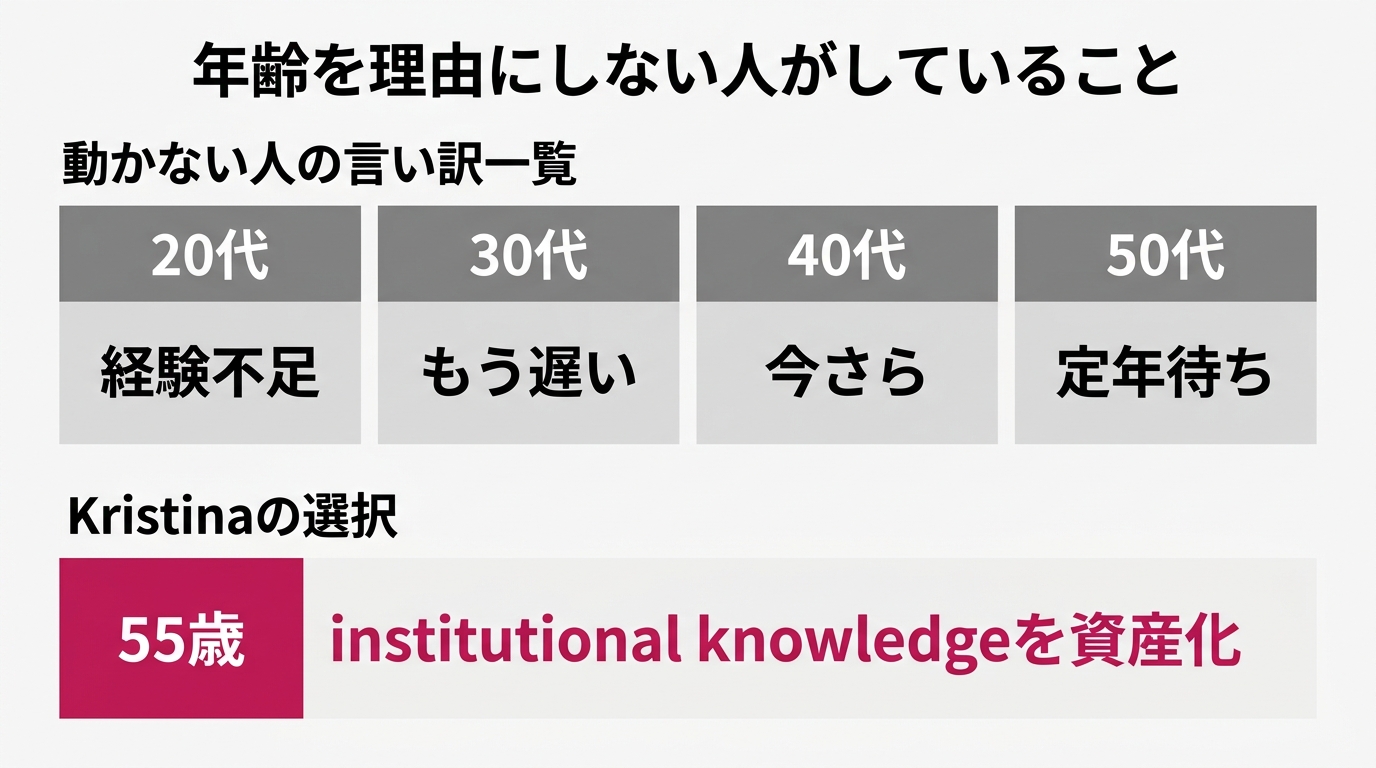
Then at 55, she got laid off. She’s said publicly why she acted immediately: “As an older worker, do I keep staying in an industry that doesn’t value my institutional knowledge?” That was the question she was asking herself.
The industry decided her knowledge was obsolete. She decided it wasn’t. That reassessment took 24 hours.
Here’s what hit me.
People in their 20s who are thinking about going independent say “maybe I don’t have enough experience yet.” By their 30s, it shifts to “maybe it’s already too late.” In their 40s, it becomes “it’s too late now.” And then at 55, someone who actually got laid off says “I have the experience, I can do this” — and moves.
Which means: people who use age as an excuse can’t move at any age. If Kristina had been in her 20s, she would have found a different excuse. And if we’re still doing this at 55, we’ll find one then too.
Age is not the variable. The real variable that separates people who move from people who don’t is somewhere else entirely.
Why a 55-Year-Old Could Move at Startup Speed: The Structure Behind It
Kristina didn’t launch coaigence in 24 hours by luck. Three things were already in place.
First: 20+ years of deep industry knowledge. She’d worked across insurance, banking, and defense — and specifically on M&A and digital transformation. That’s a completely different asset than “a young person currently learning AI fundamentals.” Why? Because she already knew where inefficiencies lived inside organizations. She knew what ate up decision-makers’ time. Before she ever tried to sell AI services, she already knew exactly who to target and what to offer them.
Second: she was already running multiple AI tools in parallel. She used six general-purpose LLMs (large language models — massive AI systems trained on human language). Specifically: ChatGPT, Claude, Copilot, Gemini, Grok, and Perplexity. She’d already built an operational system for choosing the best tool for each task. That’s a completely different level from “I’ve tried ChatGPT a few times.” On top of that, she’d built her own custom GPT, Raivyn. Her hands-on fluency with the tools is what enabled the launch speed.
Third: the layoff itself acted as external pressure that forced the decision. This is ironic but important. As an employee, she probably would have kept second-guessing: “I want to try this, but the risk…” A layoff forcibly closes one side of the choice. You have no option but to go all-in on what’s left.
Those three things together are what produced the 24-hour timeline.
So what does this translate to for people in their 20s and 30s?
Institutional knowledge and multi-tool AI fluency are both buildable in your 20s. Institutional knowledge isn’t just about years — it’s about the density of what you’ve observed in a specific industry. Three years, five years — if you’ve been watching how decisions get made in one sector, you already have it. Multi-tool AI fluency: start running three or more LLMs in parallel today, and within a year you’ll be at a practical level. The harder part is the external pressure — and that you have to manufacture yourself. Set a hard deadline. Hand in your notice. Lock in a contract before you move. Whatever works. The people who can create their own external pressure are the only ones who can move at 24-hour speed.
3 Shifts That Have Made “Not Ready Yet” Indefensible
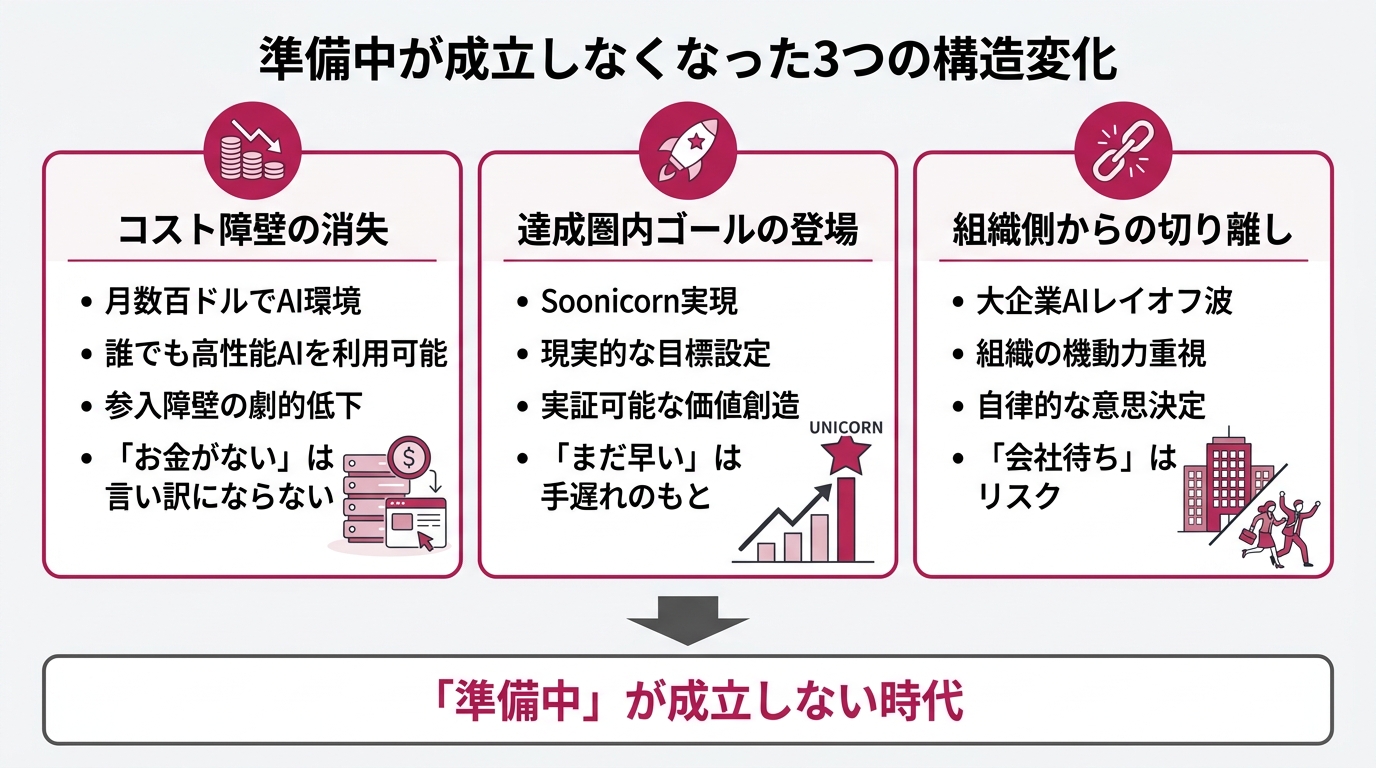
A lot of people will want to file Kristina’s story away as “exceptional case, not applicable to me.” But from where I’m standing, this is a symbol of a structural shift that happened in 2026. Three things have changed simultaneously, and together they’ve eliminated the ground that “not ready yet” used to stand on.
Change one: AI has pushed the startup cost for individuals to nearly zero. As Anthropic’s small business Claude package announced in May 2026 makes clear — covered in The Real Meaning Behind NYT Calling 2026 the Year of AI-Native Work — you can now get an enterprise-grade AI environment for tens of dollars a month. Kristina runs six LLMs simultaneously; her total subscription spend is in the low hundreds per month. Launching a consultancy doesn’t require an office or servers.
Change two: the alternatives to working inside an organization have become genuinely viable. This connects to what I covered in What NYT Really Meant When It Called 2026 the Year of the Soonicorn. The $500M–$999M valuation range — the Soonicorn zone — has become a realistic target, reachable even by solo founders and tiny teams. The rational case for clinging to a large organization is getting weaker.
Change three: organizations have started cutting the people who hold institutional knowledge. Amazon: 30,000 jobs. Meta: 8,000. Walmart: 1,000. As covered in Amazon, Meta, Walmart — The Reality of AI-Driven Workforce Restructuring, this restructuring isn’t going anywhere. Kristina’s case isn’t unusual. It’s one data point in a much larger wave that’s still building.
Put all three together. Cost is zero. The goal is realistic. Organizations are letting people go. Where exactly does “not ready yet” fit?
It doesn’t.
The Real Reason People in Their 20s and 30s Still Don’t Move
If you’ve read this far and still feel like you can’t move — I get it. I was there too.
When people say they “can’t move,” the stated reasons are usually three: not enough experience, not enough savings, wrong timing. But those are surface-level explanations. The real cause is something different.
The real cause is that the cost of failure is visible in vivid detail.
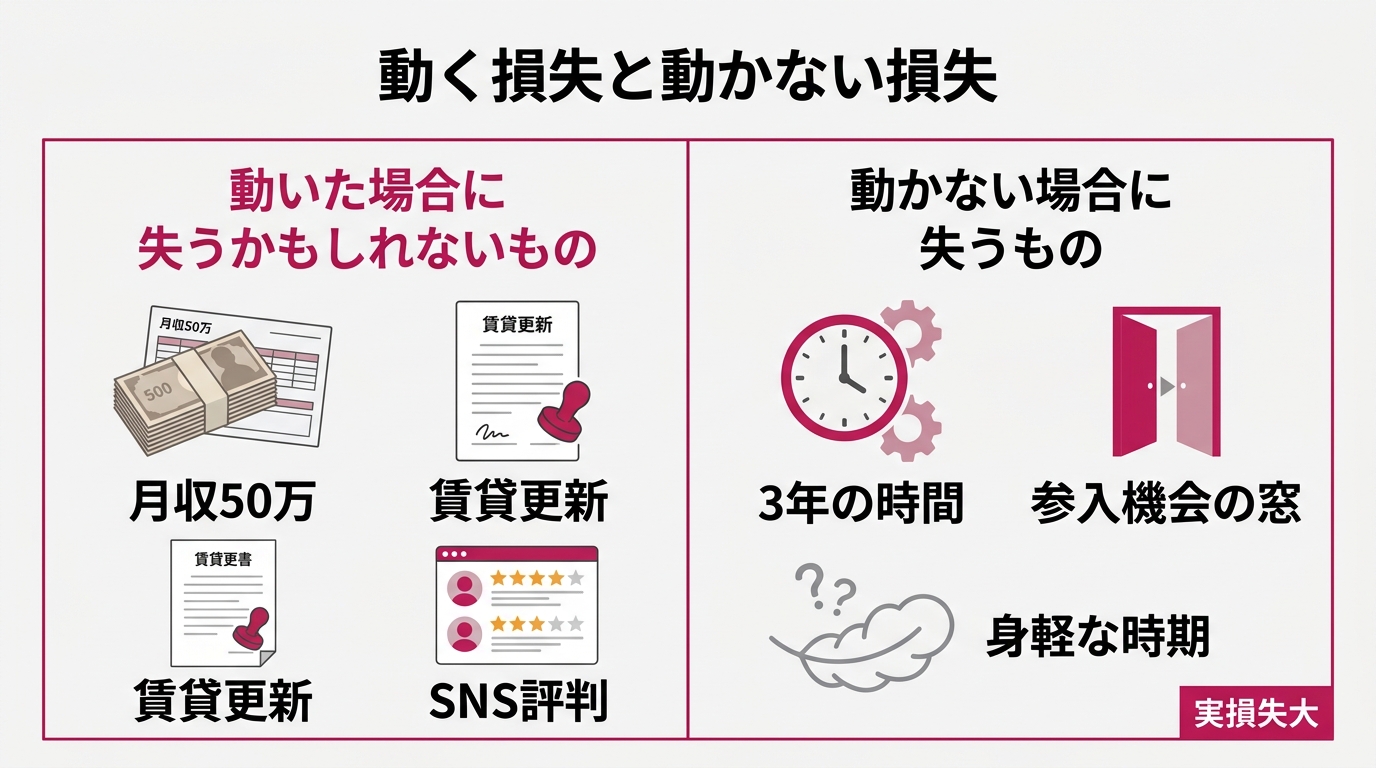
People in their 20s and 30s haven’t lost much yet. Which means they can see exactly what they have to lose. A stable income of ¥500K a month. Lease renewals. Marriage plans. How you look to your parents. Your reputation online. The resolution on “things that can be lost” is extremely high. Part of why Kristina could move in 24 hours might be that at 55, she’d already lived through losing things. Her kids were grown. The mortgage was nearly paid off. She’d already built and tested a reputation in her industry. What remained was simply: “what do I do with all of this now?”
People in their 20s and 30s are the opposite — they’re holding a lot of things they haven’t gotten yet. So “if I move now and fail, I’ll lose all of this” hits with full clarity.
You have to look at this directly.
And then, once you’ve looked at it, you have to switch to a different question: what am I losing by not moving?
Three years of not moving means three years of time, gone. The market changes. Entry windows close. Competitors who got fluent in AI are three years ahead. If you’re in your late 20s, those are three prime years of independence-building. If you’re in your early 30s, three years while you’re still unattached and mobile. You’re losing it. You just can’t see it.
5 Steps to End “Not Ready Yet” — Starting Today
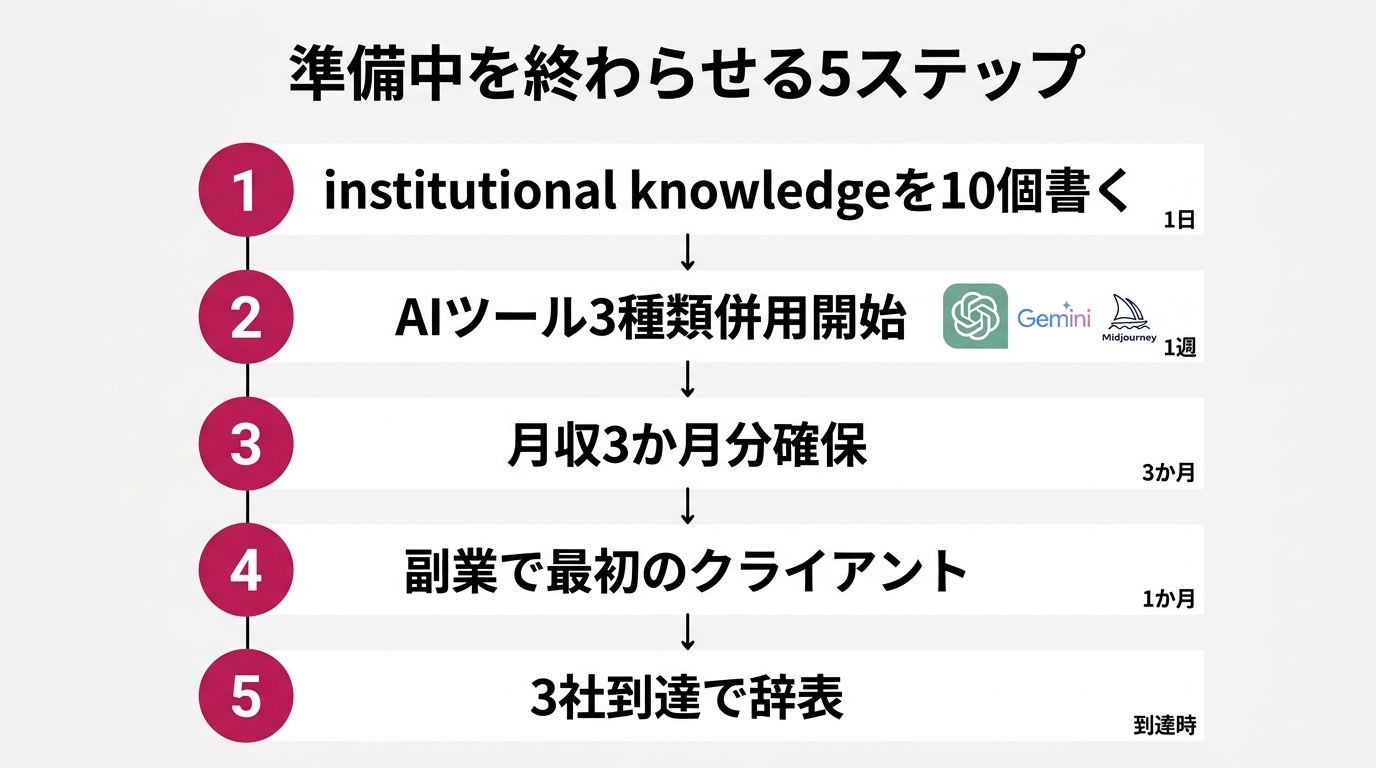
Kristina’s 24-hour model, translated for people in their 20s and 30s. Move through one step per day this week and by next Monday you’ll have graduated from “preparing.”
Step 1: Write out your institutional knowledge. What have you seen in your industry? Who is struggling with what? Where are the inefficiencies in decision-making structures? Write 10 things down. I did this before going independent. When you actually write it out, you’ll be surprised by how much you already know. This is the moment when “not enough experience” reveals itself as a lie.
Step 2: Start running at least 3 AI tools in parallel. Starting today: ChatGPT, Claude, and Perplexity, at minimum. Total cost: around $60–80/month for all three. Ask the same question to all three and compare the answers. Within a week you’ll have a felt sense of “this one is stronger for this type of task.” That becomes the foundation of your future business.
Step 3: Secure 3 months of living expenses. This is your defense fund. Its job is to kill the feeling of desperation after you launch. Kristina may have had a severance package; in your 20s you don’t, but your cost of living is lower. If you live on ¥200K/month, you need ¥600K. That’s saveable in 3 months.
Step 4: Create your first client as external pressure. Before you go fully independent, land one contract as a side project. Take on a task that fits in two weekend days, for ¥30K–50K/month. That’s your external pressure. You have a deadline, so you have to move. You have a result, so your next pitch lands. You’re building your own version of Kristina’s layoff.
Step 5: Set your resignation date as “when I have 3 clients.” One client means too much dependency — they’ll low-ball you. Three clients is a portfolio. Hit three, hand in your notice. That’s how you enter the same structure as Kristina’s 24 hours — except the external pressure is one you chose, not one that was forced on you.
All five steps require almost no money and no new skills. All they need is: start today.
Takeaway: AI Erased the Age Barrier. Only the Speed of Action Remains
Kristina’s story is not “an exceptional success story from a 55-year-old.”
It is a devastating counterexample aimed at every generation that used “age,” “experience,” and “timing” as reasons not to move. Someone who got laid off at 55 launched in 24 hours. We in our 20s have zero justification for still saying “not ready” three years in.
AI has cut the cost of going independent. Solo founder goals have become realistic. Organizations have started cutting institutional knowledge holders. These three structural shifts are not reversing. The expiration date on “preparing” has already passed.
That said — Kristina’s 24-hour launch wasn’t random. She had 20 years of institutional knowledge, hands-on fluency with multiple AI tools, and the external pressure of a layoff all at once. For us to move at that speed in our 20s and 30s, we have to manufacture the external pressure ourselves. That’s what the 5 steps above are for.
Speaking from my own post-independence experience: I’ve never met anyone who went independent only after they were fully ready. Everyone figures it out while doing it. Kristina figured it out after she launched in 24 hours. There is no “ready” flag planted somewhere waiting for you. The flag appears on the other side of moving.
One more time.
Look at what you’re losing by not moving. The moment you can see that clearly, the version of you 24 hours from now will be different.
The ones who act win. “Not ready yet” — over.
References
- Business Insider, May 10, 2026: “I Was Laid Off at 55 and Built My Own AI Consultancy; What I Learned” (Kristina Martinelli, as-told-to)
- coaigence Official About — AI Strategy & Hybrid Intelligence
- Kristina Martinelli LinkedIn — Founder, coaigence
- Anthropic “Claude for Small Business” Announcement (May 2026)
- What NYT Really Meant When It Called 2026 the Year of the Soonicorn
- Amazon, Meta, Walmart — The Reality of AI-Driven Workforce Restructuring

女性だからこそ、AIを使いこなさなきゃって思ってる。仕事も、副業も、推し活も、旅行も、全部やりたい。人生一度きりなのに時間は足りないじゃん?だからAIに任せられることは全部任せる。浮いた時間で本当にやりたいことをやる。それがあたしのスタイル。ここにはあたしが実際にやったことをまとめてるだけ。誰かのためになったらいいなって思って書いてるよ。