The era of winning with 'better prompts' is over. Context Engineering (information ecosystem design) is the next weapon
Feeling pressured to write better ChatGPT prompts? You're not alone.
What you'll learn in this article
- The key point to grasp before reading the full article
- How the issue changes practical decisions after reading
- Which follow-up article is worth opening next
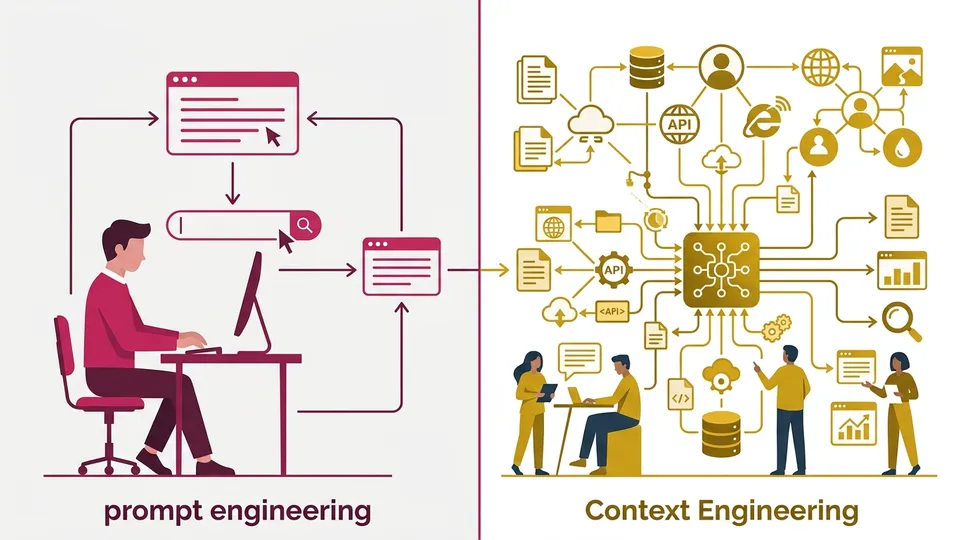
“I need to get better at writing ChatGPT prompts.” A lot of people are feeling that pressure right now, aren’t they?
I was the same. There was a period when I devoured prompt-writing books, saved every template collection I could find, and desperately memorized patterns. But at some point I realized something. Even with perfectly crafted prompts, AI responses sometimes just fall flat.
The reason was simple. It wasn’t about “what to ask” the AI — it was about “what to show” the AI. That’s what was missing.
In the US, this technique is now being called Context Engineering. I want to translate it as “information ecosystem design.” Fortune ran a feature on it on March 26, but there’s still zero Japanese-language coverage. So I’m writing it first.
Read this article and you’ll see what comes after prompting.
”People good at prompts” are starting to lose their edge
The term “prompt engineering” exploded into the mainstream around 2023, right?
It’s the skill of giving ChatGPT clever instructions. Things like role-setting (“You are an expert in X”) or thought-guidance (“Think step by step”). I drilled into it hard, and I taught it to my clients too.
But in 2026, the landscape is shifting. Prompt skill alone doesn’t cut it anymore.
According to an analysis by Towards AI, over 70% of errors in today’s AI applications aren’t caused by “model capability limits.” The cause is “insufficient or inappropriate context (background information).” Put another way: AI performance is already high enough. What was missing was the quality of information being handed to the AI.
For example, say I ask AI: “Make me 10 social media post ideas for next month.” That’s not a bad prompt, right? But the AI doesn’t know my past post performance. It doesn’t know my followers’ reaction patterns, doesn’t grasp what competitors are doing — and it answers anyway.
The result? A pile of “looks-like-it-could-work but actually unusable” suggestions. I hear it constantly from clients: “AI’s answers are too generic to use.”
It’s not that the prompts are badly written. It’s that the design of the “background information” being given to the AI was weak. The people who noticed this problem started building up the concept of “Context Engineering.”
CIO’s explainer put it this way: “The era of prompt engineering is over. In its place, a more robust and scalable new discipline is rising.”
From my own experience: until last year, just delivering a “prompt template collection” to clients was enough to make them happy. But lately, I’m getting more and more inquiries like “we followed the templates but the results aren’t consistent.”
Same prompt every time, yet AI’s response quality varies. Monday delivers usable suggestions, Wednesday is lackluster. Why the gap?
Dig into the cause and it lands on this: “the information being passed in is different each time” or “necessary information is missing.” It was never a prompt problem. It was a context problem.
What is Context Engineering? The skill of designing the AI’s entire “field of view”
Let me rephrase it in my own words: “information ecosystem design.”
It’s the skill of deliberately designing the entire landscape of information the AI sees while it works. Dextralabs’ comparison article used a great analogy. Prompt engineering is “writing a good letter.” Context Engineering is “designing the entire postal system.”
That comparison really clicked for me. We’ve been practicing letter-writing, but what we actually needed was system-level design.
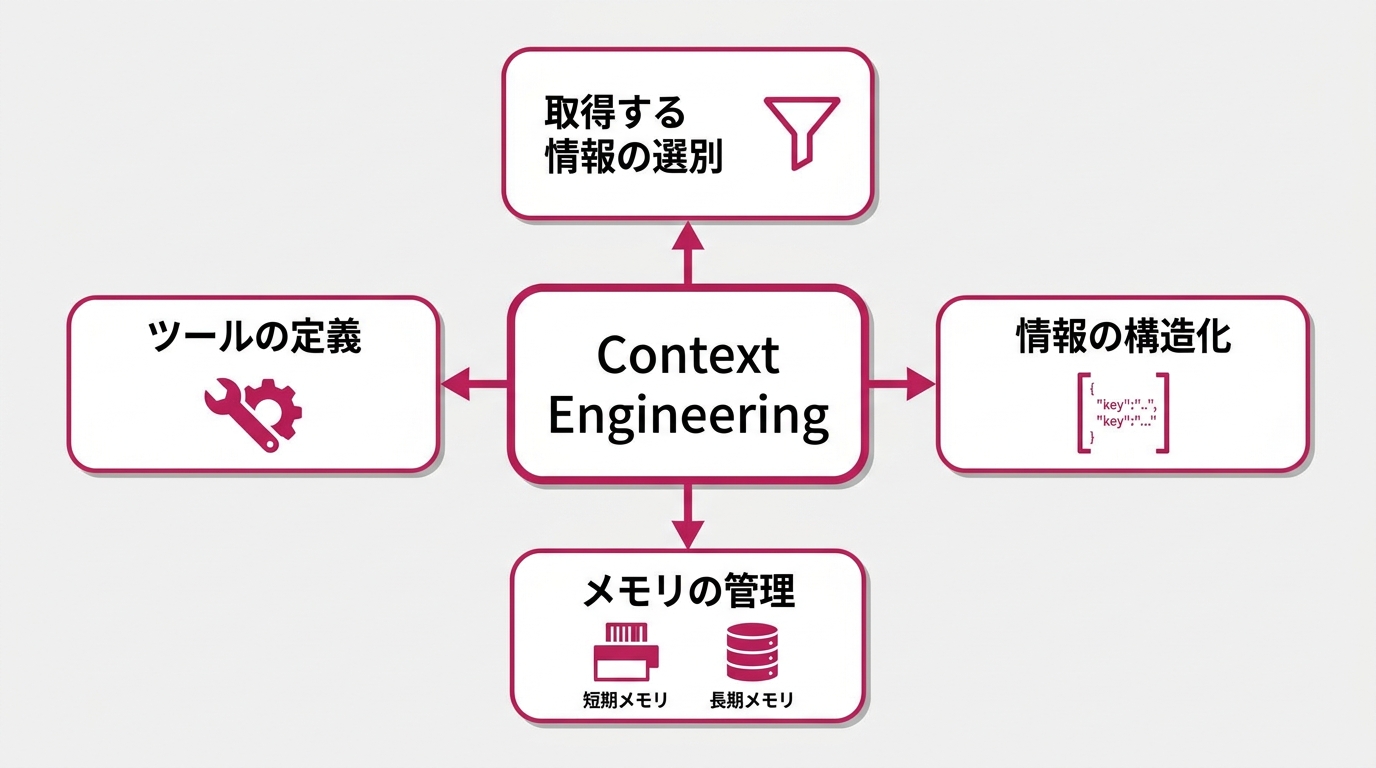
So what specifically are we designing? Let me break it into four areas.
1. Curating what information gets pulled in
The contents of the database the AI sees, reference materials, past conversations. Choosing what to show and what to hide is the starting point. More isn’t better. Throwing in piles of irrelevant information actually drops AI answer quality.
2. Structuring the information
Organize the information you pass in using JSON (a data-formatting standard) or summary text. Bundle in instructions on “how to read this data.” Handing over raw data versus handing over structured data — the difference in AI comprehension is night and day.
3. Memory management
The split between short-term and long-term memory is critical. Weaviate’s technical blog explains it clearly. Short-term memory is “information needed at this exact moment.” Long-term memory means “past knowledge accumulated in a vector database (a system that converts information into numbers for fast searching).”
In human terms, “today’s meeting agenda” is short-term, “last year’s sales data” is long-term. You design this split for the AI too.
4. Defining the tools
Define in advance what tools the AI can use (search, calculation, file operations, etc.). Bundle in the decision criteria: “Use this tool in this kind of situation.”
What matters here is “not thinking it through manually each time” but “automating it as a system.” Design it once, and the AI assembles the necessary context for you on its own. That’s the fundamental difference from rewriting prompts every time.
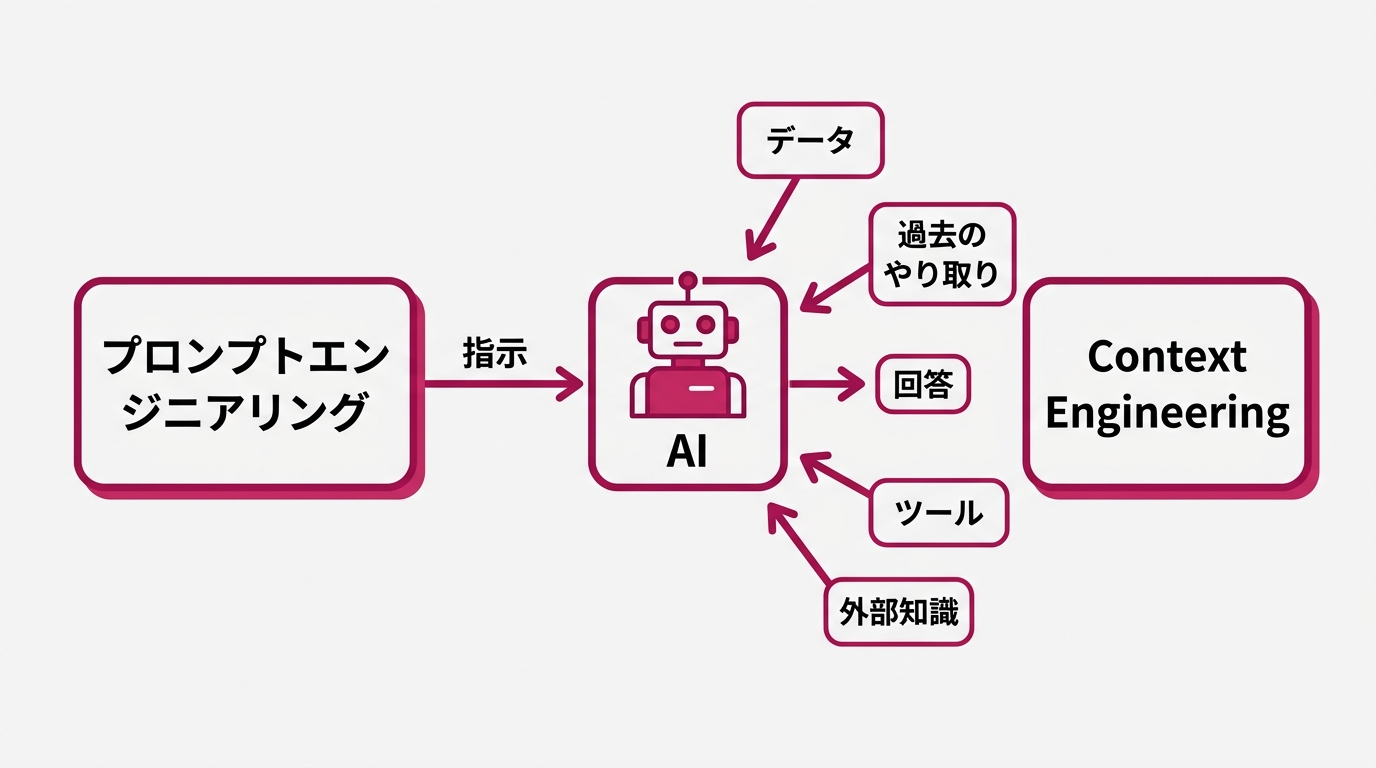
I want you to read The New Stack’s explainer too. You know RAG (a technique where AI searches external data to supplement its answers)? Context Engineering is positioned as its evolution. RAG is the system of “finding and bringing in the needed information.” Context Engineering goes one step further.
It designs even “how to arrange the information you brought in, and what to leave out.” If RAG is “grocery shopping” in cooking terms, Context Engineering is “the full course — from menu planning through plating.”
$4.5M ARR with one person. Polsia proved the power of “context design”

“Sure, the theory makes sense, but does it actually work?” You’re probably thinking that. I was skeptical too at first. But this case study turned my doubt into conviction.
Fortune’s feature published on March 26 gave me the answer.
Ben Broca. Founder of a company called Polsia, with a headcount of exactly one person — himself. He’s hit ARR (Annual Recurring Revenue) of $4.5M, roughly ¥670M in Japanese yen.
And the speed was insane. He cleared $1M ARR (about ¥150M) just 30 days after launch. According to Context Studios’ report, over 1,000 companies are running on the platform. From there, in another two weeks, he reportedly hit a $2M (about ¥300M) run rate (Dealroom coverage).
What does Polsia do? It provides a “platform that lets AI run a company end-to-end.” A user enters an idea, and the AI builds the product. It fixes bugs. It handles customer support. It even runs marketing campaigns on autopilot. Every night the AI works, and the next morning it emails a progress report. A world where AI works while you sleep — kind of enviable, right?
What’s at work here is the Context Engineering mindset. What Broca designed wasn’t “one clever prompt.” He designed an entire “information environment” where the AI understands the whole business and can make autonomous decisions.
True Ventures’ analysis declares “the one-person company is no longer a metaphor.” Venture capital firm Sequoia Capital is moving on it too. They’re starting to bake “Agentic Leverage” into their portfolio assessments.
Broca’s background is also worth noting. He was originally an early member of CloudKitchens (the ghost-kitchen business founded by Travis Kalanick). He has tech industry experience, but he’s not some engineering superstar. What stood out in his interview was this line: “An era has arrived where you don’t need to be in Silicon Valley, you don’t need to be able to code, because AI will do it for you.”
“$4.5M ARR” may be an extreme case. But pay attention to the structural shift rather than the dollar amount. The moment you go from “person who gives instructions to AI” to “person who designs the environment AI works in,” the ceiling of what one person can do shoots up.
The reason I can run social media marketing for five clients solo — the scale is totally different, but I think the structure is the same. It’s not prompt skill that decides the game. It’s the quality of the information the AI sees.
Prompts vs. context: sorting out the difference in 3 minutes
“Isn’t this just an extension of prompt engineering?” Some of you might be thinking that. I wouldn’t say they’re completely different things, but the scope they cover is fundamentally different. Let me lay it out.
Prompt engineering
- Target: a single instruction
- Goal: communicate “what you want AI to do” accurately
- Skill: verbalization, template creation
- Limit: weak on complex tasks requiring memory and reasoning
Context Engineering (information ecosystem design)
- Target: the entire information environment the AI sees
- Goal: create a state where AI “can make correct judgments on its own”
- Skill: information design, data management, workflow construction
- Strength: handles combinations of memory, reasoning, and real-time information
To put it plainly: prompt engineering is “how to ask good questions.” Context Engineering is “how to build an environment where AI can behave intelligently.” The former is just one piece of the latter.
According to Gartner’s forecast, by the end of 2026, 40% of enterprise apps are expected to embed AI agents. It was under 5% in 2025, so that’s an 8x jump. AI agents are “AIs that judge and act autonomously.” In PwC’s AI agent survey, 79% of executives said they’ve “already adopted.” But only 35% have managed broad deployment.
Why isn’t it progressing? Because while companies decide “what to make AI do,” they haven’t designed “what kind of information environment to provide the AI.” This is where Context Engineering comes in.
I’ve seen the same phenomenon across my clients. Plenty of companies say “we’ve adopted ChatGPT!” but their usage stops at “thinking up a prompt and throwing it in each time.” Without designing the information environment, AI is essentially in a state of “meeting a stranger” every single time.
Maybe it’s easier if you think about it in terms of human relationships. A conversation that starts from self-introduction every time can’t reach depth, right? Turns out AI is the same.
How I personally got started with Context Engineering
“OK, so where do we actually start?”
Here’s the heart of it. No complicated tools, no programming required. Let me share three methods I actually use in my client work doing social media marketing.
Practice 1: Build a “background information sheet” to feed AI
Whether you’re using ChatGPT or Claude, start by handing over a document summarizing “things you should know first.” For me, I include things like this:
- My business overview (industry, revenue scale, target customers)
- Top 5 social media posts from the last 3 months by engagement
- Recent communication trends from 3 competitors
- This month’s goal (follower count? sales? brand awareness?)
This alone shifted AI’s response quality by roughly 3x in my felt experience. “Passing in good context” turned out to be far more effective than “asking a good question.” I still remember seeing the AI’s answer the first time I handed over those four items — “wait, it’s THIS different?”
The key is making it “a reusable sheet.” Don’t write it from scratch every time — just update it once a month. I keep a template in Notion and manage it per client.
Practice 2: Decide “what NOT to show.” Subtractive design.
More information isn’t always better. Pass in unrelated information and AI gets confused.
I stick rigidly to the rule “cut anything not directly related to the current task.” When you’re creating social media posts, you don’t need accounting data, right? It sounds obvious, but the temptation to “just throw everything in” is real.
I used to do the same thing. Thinking “more information is better,” I’d hand entire client documents to AI. But then the AI can’t figure out “what to focus on.” The result tends to be vague answers.
After switching to “subtractive design,” AI’s responses got dramatically sharper. I think this is the core of Context Engineering. Design needs to cover not just “what to show AI” but also “what NOT to show.”
Practice 3: Build results into a feedback loop
Record the results (numbers, reactions) from executing AI’s suggestions, and pass them along the next time you use AI. Just telling it “last time’s suggestion produced X result” naturally raises the next suggestion’s quality.
This is where people who do it and people who don’t pull apart. If you treat AI as “single-use,” you’re rebuilding the relationship from zero every single time. Whatever learning could’ve accumulated just doesn’t.
For me, I log weekly social media reaction data in a spreadsheet. “This angle had high engagement,” “Posts at this time slot didn’t perform” — that kind of information goes to AI the next time I consult it. This tiny step alone transforms the proposal quality.
I’ve kept these three running for half a year. The result: I can handle social media operations for 5 clients alone. It feels like a hassle at first, but once you’ve designed it, you stop having to write instructions from scratch every time.
How to bring “information ecosystem design” into your work starting today
If reading this far makes you want to try it, that makes me happy. Let me lay out concrete steps for starting Context Engineering today.
Step 1: Pick one AI use case of your own (time: 15 min)
Email replies, social media post creation, meeting note summaries, proposal drafts. Anything works — just pick one. “I’ll do all of them” leads to none of them getting done.
I started with “weekly reporting to clients.” It’s a weekly task that repeats, which is perfect for practice. The trick is picking “something you do the same way every time but still write instructions for every time.”
Step 2: Write out the “background information list” needed for that task (time: 30 min)
Bullet-point the information AI needs to nail that task.
Example: for social media post creation
- The brand’s tone and manner
- Target audience attributes and pain points
- Characteristics of past high-performing posts
- This month’s campaign info
- Recent trends from 3 competitors’ last 3 posts each
This list becomes your first “context design doc.” It doesn’t need to be perfect on day one. Five items is enough to start.
Step 3: Use it for a week and refine it (time: 5 min daily)
Use the background sheet you made when you ask AI to do the task. If the result is meh, think about “what information was missing” and add it to the sheet. Run this for a week and you’ll have your own personal “information environment that makes AI produce its best.”
Add up all the time and day one is 45 minutes. Day two onward is 5 minutes. Done in the time it takes to drink one cup of coffee. This investment fundamentally changes the quality of your work with AI.
One of my clients started this 3-step process and saw a shift in 2 weeks. “The time I spend thinking up instructions for AI has been cut in half,” they told me. And AI’s output quality went up.
Think about it and it’s obvious, right? Humans give better suggestions when they know the other person’s work and worries. AI is the same. Just by tidying up the information environment, AI becomes a different beast in terms of intelligence.
Wrap-up
To you who read this far, I’ll say one thing honestly.
The era of competing on “how to write prompts” is reaching its end.
The next battlefield is your design skill for “what to show AI.” This is Context Engineering. The technique I named “information ecosystem design” — this is its true form.
The Polsia case showed us the possibility that mastering this technique lets one person run a billion-yen business. Of course, not everyone needs to aim there. But just escaping the “writing instructions to AI from scratch every time” state will reliably change your work.
Fortune covered this concept on March 26. Only 4 days have passed. This is probably the first Japanese-language article explaining it. Meaning: you reading this right now are one of the very first people in Japan to encounter this concept.
If you have time to hesitate, just move. Start by making one “background information sheet.” That’s where I started too. It doesn’t have to be perfect. Write it out, hand it to AI, look at the result, and revise. Just run this cycle for one week and your relationship with AI changes.
The conclusion I arrived at after half a year: “Don’t focus on how to ask the AI — focus on shaping the view the AI sees.” “Whoever moves first wins” hasn’t changed in the AI era either. The next weapon after prompts is already in front of you.

女性だからこそ、AIを使いこなさなきゃって思ってる。仕事も、副業も、推し活も、旅行も、全部やりたい。人生一度きりなのに時間は足りないじゃん?だからAIに任せられることは全部任せる。浮いた時間で本当にやりたいことをやる。それがあたしのスタイル。ここにはあたしが実際にやったことをまとめてるだけ。誰かのためになったらいいなって思って書いてるよ。