Polsia Hit $1M ARR in 30 Days. One Founder, AI as the Only Team. Are You Still Calling This 'Not My Problem'?
Every night, AI wakes up, gets to work, and emails you a report by morning.
What you'll learn in this article
- The key point to grasp before reading the full article
- How the issue changes practical decisions after reading
- Which follow-up article is worth opening next

Every night, AI wakes up, gets to work, and emails you a report by morning.
This isn’t science fiction. It’s a real company that Fortune magazine reported on by name on March 26, 2026 — a company that exists right now.
One founder. No full-time employees, no outsourced staff. The team is just AI. And it’s pulling an annualized revenue run rate of $4.5 million (about ¥670 million).
“One-person unicorn” — that’s the phrase you want to start remembering this week. It’s the concept Anthropic’s CEO publicly stated has “a 70–80% chance of becoming reality during 2026.”
You might feel like this is “not my problem.” But after reading this article to the end, I don’t think you’ll feel that way anymore.
What Fortune Magazine Featured Two Days in a Row: The “One-Person Unicorn”
On March 23 and 26, 2026, Fortune magazine ran back-to-back feature stories on the “one-person unicorn.”
A unicorn is a privately held startup valued at $1 billion (about ¥150 billion) or more. There are currently 1,590 of them worldwide, with a combined valuation of $7.0 trillion (PitchBook, as of February 2026).
Traditionally, unicorns have been “things you build with a team of dozens to hundreds.” You needed dedicated product development teams, sales teams, marketing teams, legal, HR, and customer support — finely divided roles were essential.
But things are changing.
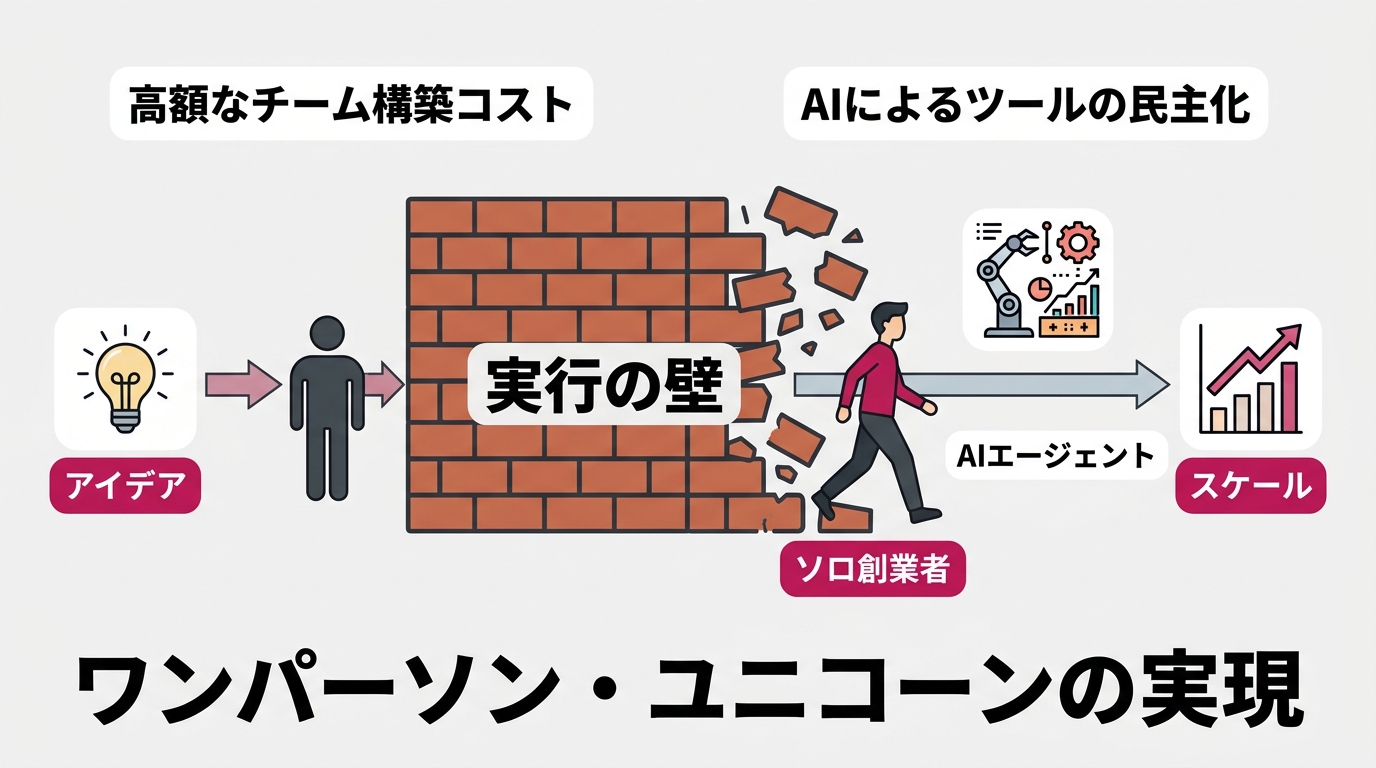
In the March 23 issue, Alibaba.com’s Kuo Zhang wrote in a contributed piece: “The Execution Wall is crumbling. Because the tools for scale have been democratized.”
The “Execution Wall” he’s referring to is the old problem of “having a great idea but needing a team to actually execute on it.” That wall is now melting away thanks to AI.
In the March 26 issue, the spotlight turned to Ben Broca, the founder who actually built Polsia — a company with one founder and AI as its only team.
And at Anthropic’s developer conference “Code with Claude,” CEO Dario Amodei stated clearly: “There’s a 70–80% chance that during 2026, a single founder will run a $1 billion company by leveraging AI agents” (Inc.com).
70–80% isn’t “possible” — it’s closer to “more likely than not.”
For context, Amodei originally said “it will definitely happen,” then walked it back to “70–80%” during a press session. So the revised, more cautious estimate is still 70–80%.
Among all new ventures, the share of solo founders (people launching companies alone) has now reached 36.3% (Scalable.news). One in three new companies is started by a single founder — that era is already here.
Dissecting Polsia’s Full Design: How They Hit $1M ARR in 30 Days
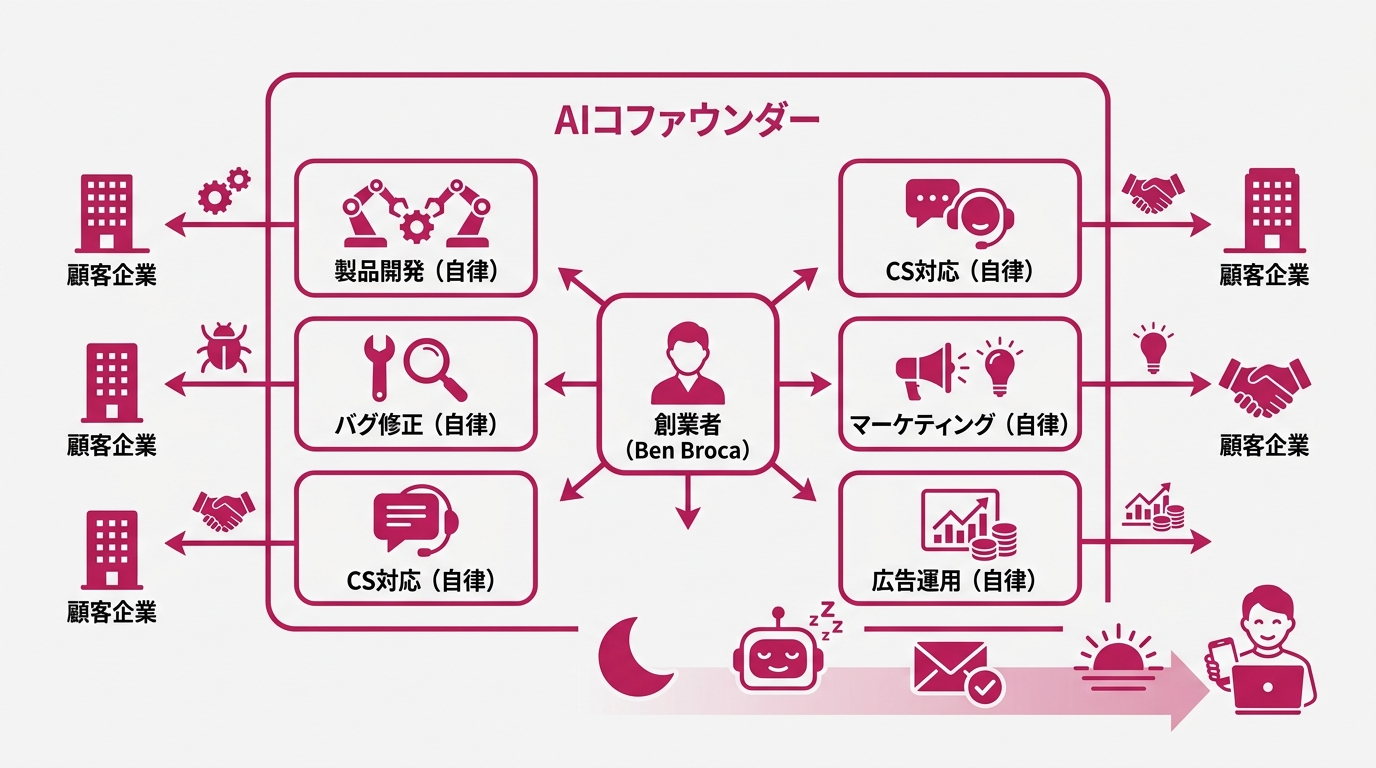
So what is Polsia? It’s a service that provides an “AI cofounder” — a platform where AI autonomously handles product development, marketing, and customer success as if it were a cofounder (Fortune 3/26).
Founder Ben Broca came out of Travis Kalanick’s (Uber founder) CloudKitchens. He’s someone with a normal startup career trajectory who deliberately chose to go solo.
He’s currently managing over 3,000 separate businesses simultaneously, all by himself. For each business, AI autonomously handles product building, bug fixes, customer support, marketing, and ad operations.
Broca’s own words capture it best: “Every night, the AI wakes up, does its work, and emails me a report in the morning.” That’s what’s happening right now.
Let’s look at the ARR (Annual Recurring Revenue) trajectory.
- Hit $200K (about ¥30 million) within weeks of launch
- Grew 10x to $2 million in just 2 weeks (about ¥300 million)
- Reached $1M ARR with 1,000 customers within 30 days of launch
- Expanded to $3M ARR with 3,000 customers the following month
- At the time of the Fortune article, hitting a $4.5M run rate (annualized, about ¥670 million)
This kind of speed doesn’t happen in normal businesses. It’s the result of AI autonomously running customer acquisition, operations, and iteration.
“Polsia is too unique a case” — I get that reaction. So let’s also look at other solo operator examples for comparison.
- Danny Postma (HeadshotPro): $3.6M ARR (about ¥540 million), still running as a solo operator (Grey Journal)
- Maor Shlomo (Base44): Built up 250,000 users, sold to Wix in an M&A deal for $80 million (about ¥12 billion) in June 2025
- Pieter Levels (Nomad List and others): Solo-running multiple businesses totaling over $3M in combined ARR
- Midjourney (David Holz): 11 full-time employees, over $200M in annual revenue, valuation in the multi-billion dollar range
Midjourney’s example — “you can clear $200M with just a team of around 10” — shows this isn’t a binary choice between “1 person or 200 people.”
The moment you think “becoming a unicorn is impossible, but what about $1M ARR (¥150 million)?”, Polsia’s design suddenly becomes very practical reference material.
How a $100–$500/Month AI Stack Produces 80% Profit Margins
You’ve probably heard “using AI raises profit margins.” But how big is the gap, concretely?
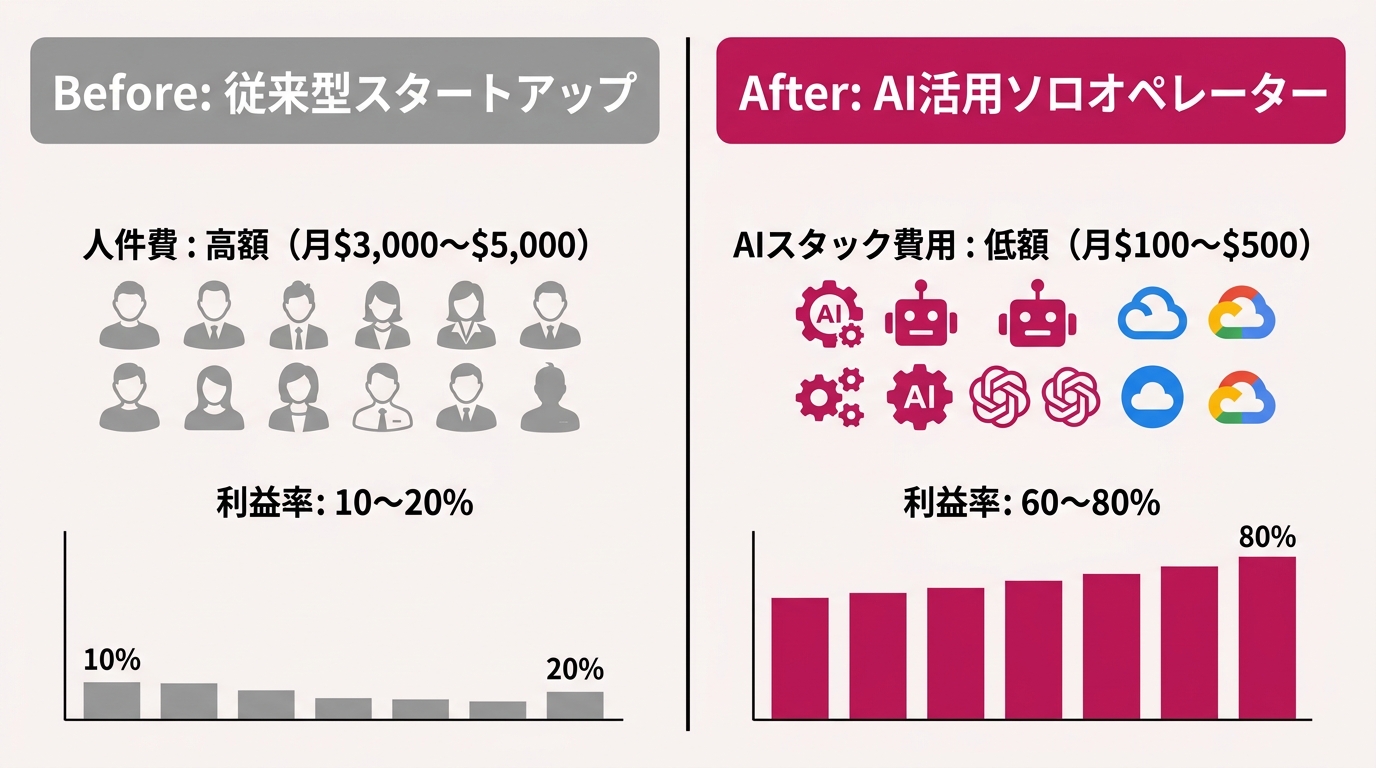
The key point is that the cost structure changes from the ground up. Looking across multiple AI solo founder cases — HeadshotPro, Base44, Polsia — they all share operating margins in the 60–80% range. Compared to traditional staff-based startups at 10–20%, that’s a 3–8x difference.
Why such a massive gap? Look at the cost comparison when using AI agents (AI systems that autonomously execute specific tasks).
- Annual AI stack cost: $3,000–$12,000 ($100–$500 per month)
- Hiring a virtual assistant (human): $3,000–$5,000 per month
That’s a 95–98% reduction. Personnel costs basically drop to zero.
Let’s get concrete about “what you can cover with a $200–$500/month AI stack.”
| Work Area | Main Tools |
|---|---|
| Development & Coding | Cursor, Claude Code |
| Content Creation & Writing | Claude Pro, ChatGPT Plus |
| Design & Visuals | Canva Pro |
| Workflow Automation | Zapier, Make |
| Customer Support | AI chatbots |
| Accounting & Billing | AI accounting tools |
| Research | Perplexity Pro, Claude |
Claude Pro ($20/month), ChatGPT Plus ($20/month), Cursor ($20/month), Canva Pro (about $17/month), and Zapier Basic ($20/month) — even all bundled together, it stays under $100/month. That covers a substantial amount of work.
If you want to go all-in on automation, even adding Zapier’s higher tiers or API costs keeps you within $500/month.
There’s another number that’s easy to overlook.
Solo founders make up 36.3% of all new startups (Scalable.news) — we’re in an era where one in three new companies has a single founder. In Zoom & Upwork’s “State of Solopreneurship 2026” survey (covering 1,000+ SMBs in 2026), 74% of respondents said they had been able to “scale the business without hiring” since they started using AI.
Not having a team no longer means the business is weak.
Why Amodei Committed to “70–80%” and Your 5 Conditions for Riding the Wave
70–80% is a huge number, but not everyone gets to ride this wave automatically.
After reading Fortune, Inc.com, and multiple solo founder interviews, here are the “5 conditions for people who can ride this wave” that I’ve put together.
Condition 1: Can your market be solved with software?
AI agents are best at digital work. SaaS (Software as a Service, the business model of delivering software as a service), digital content, and platform-style businesses have the highest compatibility. If physical manufacturing or shipping is at the core of your business, running it on AI stack alone is still difficult.
Condition 2: Can AI automate customer acquisition?
One reason Polsia grew 10x in 2 weeks is that AI was also driving marketing and customer acquisition. The dividing line is whether you can build a system that says “I’ll get the first 10 myself, then hand it off to AI.” Content marketing, SEO (search engine optimization), and email sequence automation are all within AI’s reach today.
Condition 3: Are you on a subscription model?
Polsia’s very high DAU/WAU ratio (per the Fortune article) shows that customers are using it daily. Whether you can build a structure where subscription revenue accumulates steadily is the precondition for rapid ARR growth. If you’re on one-shot pricing, ARR doesn’t compound — so this needs to be baked into the design stage.
Condition 4: Are “judgment, strategy, and taste” your weapons?
Kuo Zhang wrote that “the competitive advantage of the next decade isn’t coding skill or headcount. It’s judgment, taste, and strategic vision.” Coding can be handed to AI. But “what to build,” “who to deliver it to,” and “how to combine things” are still human jobs. Whether that lives at your core is the question being asked.
Condition 5: Can you start moving this year?
Amodei said it would happen “with 70–80% probability during 2026.” That means this year. The window of opportunity is open right now. “I’ll get serious about it next year” may be too late. There’s a high chance that people who started moving in the first half of this year will be in a very different place from people still watching by 2027.
Especially with AI tools, the earlier you start using them, the more “your own way of using them” sinks in. The speed at which you accumulate know-how itself becomes a competitive advantage.
You don’t need to satisfy all conditions immediately. Just use it as a checklist to see “where am I right now?”
Even just being aware of Condition 1 (market type) and Condition 5 (timing) should change what you do today.
The Reality: 13.03 Million Japanese Freelancers Are Falling Behind — And Why “It Doesn’t Have to Be a Unicorn”
Here comes a slightly inconvenient truth.
Japan has 13.03 million freelancers (Lancers “Freelance Survey” 2024). The economic scale reaches ¥20.32 trillion. That’s a substantial population.
But AI adoption rate is roughly 30% or less (Zoom & Upwork “State of Solopreneurship 2026”). Compared to over 90% AI adoption among US freelancers, that’s an overwhelmingly low number.
How do you interpret this gap? I think it’s not a “crisis” but an “opportunity.”
Low AI adoption means few people have mastered AI yet — which means you can become a first mover in your space the moment you start using it. The advantage of being in the Japanese-language market is still there.
Some of you might be thinking “but I’m not technical.” That’s irrelevant.
Looking at the main AI tool functions shown in Polsia’s example, beyond coding it includes content creation, design, customer support, and accounting. The fields most Japanese freelancers work in — IT, design, writing, consulting, marketing — are all areas with high AI compatibility.
In fact, in the Zoom + Upwork “State of Solopreneurship 2026” report, among the 1,000+ SMBs (small and medium-sized businesses) surveyed:
- 91% reduced administrative work using AI
- 74% scaled their business without hiring by using AI
- 64% said “the business couldn’t have continued without AI”
“The one-person unicorn doesn’t apply to me” — I understand that reaction. But “it doesn’t have to be a unicorn” is actually the correct judgment. You don’t need to aim for a unicorn — not even slightly — and the same design works even if you don’t.
Let’s scale Polsia’s design down a bit.
Hitting $1M ARR with 1,000 customers in 30 days means an average of $83/month (about ¥12,000) per customer × 1,000 customers. Translated to Japan: ¥10,000/month service × 1,000 people = ¥10 million/month.
Let’s shrink it further. ¥10,000/month × 100 people = ¥1 million/month. The scale of 100 people paying ¥10,000/month for a freelance consulting service, online school, or SaaS-style tool is realistically within reach.
With an AI stack, even one person has a high chance of being able to run the customer support, operations, and marketing needed to manage 100 customers. That’s the essence of the “AI solo founder design.”
Even if your goal is “running my own ¥1 million/month business with as low cost and as much automation as possible,” Polsia and other solo operator designs are directly applicable as reference. The landscape will shift in six months, in a year. But there’s still time this year.
3 Steps to Start Moving Today + Summary
Let me organize where to start, concretely.
STEP 1: Audit your current AI stack
Write out every AI tool you’re using right now, and check how much you pay per month. If you’re under $50/month (about ¥7,500), there’s room to invest. Even if you’re spending $500/month, with a 70% profit margin you’re completely paying it off. Just making a list of “what I pay for, and how much time it saves” will show you where to invest next.
STEP 2: Make a list of “work I can hand off to AI”
Write out tasks in your current work that you could hand off to AI. The criteria are three: “do I always do this in the same format?”, “are the steps fixed?”, “is this more about processing than judgment?” Note how many hours per week each one consumes, and it becomes easy to prioritize.
Standard email replies, research summaries, social media post drafts, invoice and quote creation — these are classic examples you can hand off this week.
STEP 3: Automate one thing this week
Pick the one thing eating the most time from your list, and try handing it to AI this week. It doesn’t need to be perfect. “AI generates at 70% quality, you fix the other 30%” is plenty for the start.
What matters is trying. Moving while you fix the design beats perfecting the design before you move — every time.
Once you’ve automated one thing, add another next month. Run that cycle, and in six months your work structure will look noticeably different.
One pitfall worth flagging before you go.
Don’t “set it and forget it” just because you’ve handed something to AI. Think of the first month as “the period where I check AI’s output myself and teach it my quality standards.” Polsia’s Broca said too that “at first I checked the AI’s reports every morning.” That investment is what makes full automation possible later.
Key Takeaways
- Fortune magazine ran back-to-back “one-person unicorn” features on March 23 and 26, 2026. This is happening now
- Polsia hit $1M ARR in 30 days. One founder, AI-only team, currently at a $4.5M annualized run rate
- AI solo founders run at 60–80% profit margins. Achievable with an annual AI stack of $3,000–$12,000 ($100–$500/month)
- Dario Amodei (Anthropic CEO) clearly stated “70–80% probability during 2026”
- Japan’s freelancer AI adoption rate is under 30%. The gap with the US (over 90%) is the first-mover advantage available this year
- You don’t need to aim for unicorn status. The same insights apply to a “¥1 million/month × AI-automated” design
- Just trying to automate one thing this week is enough to start
“Whether you’ll learn how to run a high-margin solo business with AI this year” is a question that applies to everyone.
I’m already moving. Are you still watching?
Reference links:

女性だからこそ、AIを使いこなさなきゃって思ってる。仕事も、副業も、推し活も、旅行も、全部やりたい。人生一度きりなのに時間は足りないじゃん?だからAIに任せられることは全部任せる。浮いた時間で本当にやりたいことをやる。それがあたしのスタイル。ここにはあたしが実際にやったことをまとめてるだけ。誰かのためになったらいいなって思って書いてるよ。