One Man Sold for $80M (≈¥12B) Solo. Now That AAIF Has Set the Rules, Here's Why Solopreneurs Are Moving
Let me say it straight.
What you'll learn in this article
- The key point to grasp before reading the full article
- How the issue changes practical decisions after reading
- Which follow-up article is worth opening next

Let me say it straight.
“AI agent market will hit $80B by 2030” — you’re sick of hearing this, right?
But what I want to talk about isn’t market size. It’s that the rules have been set.
In December 2025, a standard was born in the AI agent world. AWS, Anthropic, Google, and Microsoft sat at the same table and agreed to build shared infrastructure together.
“So what does that have to do with a one-person company?”
Here’s my answer.
The moment the rules of a game are disclosed to everyone, the people who move first win.
And in this game, individuals can move more nimbly than big corporations. The evidence is already in.
The Story of One Man Who Built $189K MRR Solo and Sold for $80M (≈¥12B)

Let’s start with the facts.
Maor Shlomo. An entrepreneur from Israel. He built “Base44,” a no-code SaaS (software delivered as a cloud service) platform. Employees: nearly zero. Built and operated with AI alone.
When monthly revenue hit $189,000 (≈¥28M), website builder Wix acquired Base44 for $80M (≈¥12B). This was June 2025. (See Wix press release; MRR figure from Zoom/Upwork “State of Solopreneurship 2026”)
The weight is in the fact that “he did it alone.”
AI wrote the code. AI handled support. AI ran the marketing. What Maor did was decide what to build and design who to deliver it to.
This isn’t a story about a one-of-a-kind genius.
It’s a story about “using AI agents correctly and hitting the right market.”
In a market growing at a 46.3% CAGR (compound annual growth rate), with rules being put in place right now, the number of people who can pull off the same play is going to grow — guaranteed. Base44 stopped being “fantasy” and became a “role model.”
What Is AAIF (Agentic AI Foundation)? What “The USB-C of AI” Really Means
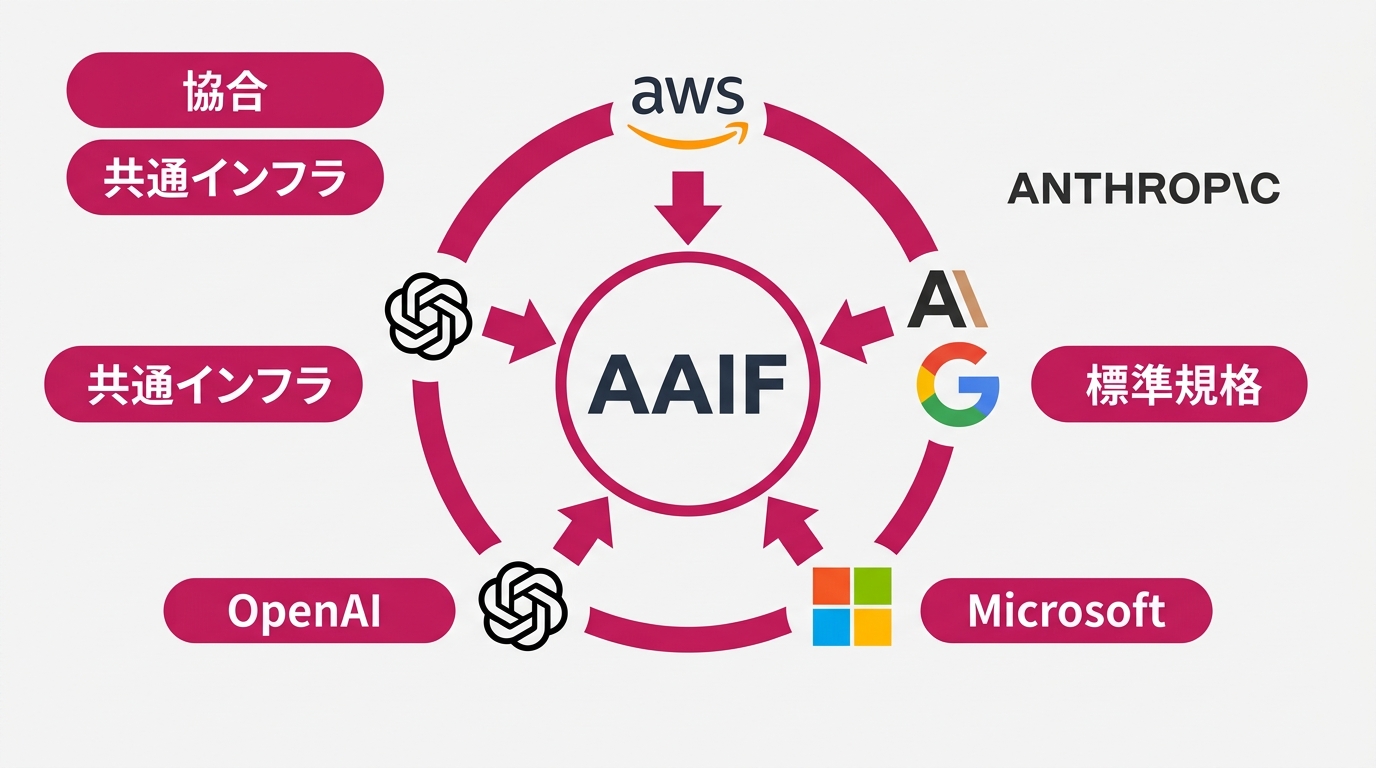
Let me pause and explain what AAIF actually is.
AAIF (Agentic AI Foundation) is a nonprofit foundation that manages standard specs for AI agents. It was established on December 9, 2025, under the Linux Foundation. (OpenAI official announcement)
The Linux Foundation itself is a well-established nonprofit that has managed Linux and many open-source projects. Its purpose is democratizing technology and creating standards that aren’t tied to any one company.
The founding members are eight companies: AWS, Anthropic, Block, Bloomberg, Cloudflare, Google, Microsoft, and OpenAI. The fact that rivals are sitting at one table is, in itself, remarkable.
They brought three “standard specs” to the table.
- MCP (Model Context Protocol): Developed by Anthropic, donated to AAIF. Called “the USB-C of AI” — a connection standard. A common protocol (communication rules) that links AI to tools.
- goose: Donated by Block. An open-source (freely available) agent framework that runs locally.
- AGENTS.md: Donated by OpenAI. A standard spec file format for AI coding agents.
Since the announcement, participation in AAIF has been expanding rapidly.
“So what’s the upside of standardization?”
The answer is simple. Vendor lock-in (being chained to a specific service) disappears.
Before, once you started using a given AI tool, you could only combine it with tools that played nicely with that AI. Now, anything that supports MCP just connects. Works with Claude, Cursor, Gemini CLI — whatever.
When the platform changes, the things you built don’t get thrown away wholesale.
The Math Behind “99.8% Reduction in Connection Cost” — What This Actually Means
This is the most important point.
Picture the world before MCP existed.
1,000 AI models × 1,000 tools = 1 million custom connections needed.
Each one required dedicated API code, dedicated error handling, dedicated maintenance. This was work that only enterprise engineering teams could pull off.
After MCP arrived?
(1,000 models + 1,000 tools) × MCP implemented once = about 2,000 connection points.
Reduction: 99.8% (a theoretical comparison value).
In practice, you’d rarely connect all 1 million combinations, but the magnitude of the shift still comes through.
What does this mean?
The logic of “you need dedicated engineers to build the infrastructure” collapses. “System integration” that used to take a team of 10 engineers a month can now be done by one person in a week using MCP.
MCP-compatible SDKs (development toolkits) have been downloaded over 97 million times per month (Python + TypeScript combined, per Anthropic). The numbers prove the ecosystem has momentum.
“But I’m not an engineer…” — relax.
As I’ll explain in the next section, the foundation is in place even if you’re not an engineer.
”One-Person Billion-Yen Company” Isn’t a Fantasy — There’s Evidence
Anthropic CEO Dario Amodei said this:
“There’s a 70–80% probability that someone will build a billion-yen-scale company solo in 2026.”
The promising industries he specifically named: “prop trading, dev tools, automated customer service.”
Can you brush this off as “a CEO selling dreams”?
I can’t. Because the precedents already exist.
Base44 (above): One person, AI only, $189K MRR → $80M acquisition (case study in Zoom/Upwork “State of Solopreneurship 2026”)
Cursor (Anysphere): A team of fewer than 50 hitting $500M ARR (as of June 2025). Rocketing growth as the top runner among AI coding editors.
FounderPal.ai: One person developed and runs an AI marketing copilot. Over 2,250 companies use it (per official site, 2025).
These aren’t accidents. They’re products of a structural shift: “With AI, a small team can do big things.”
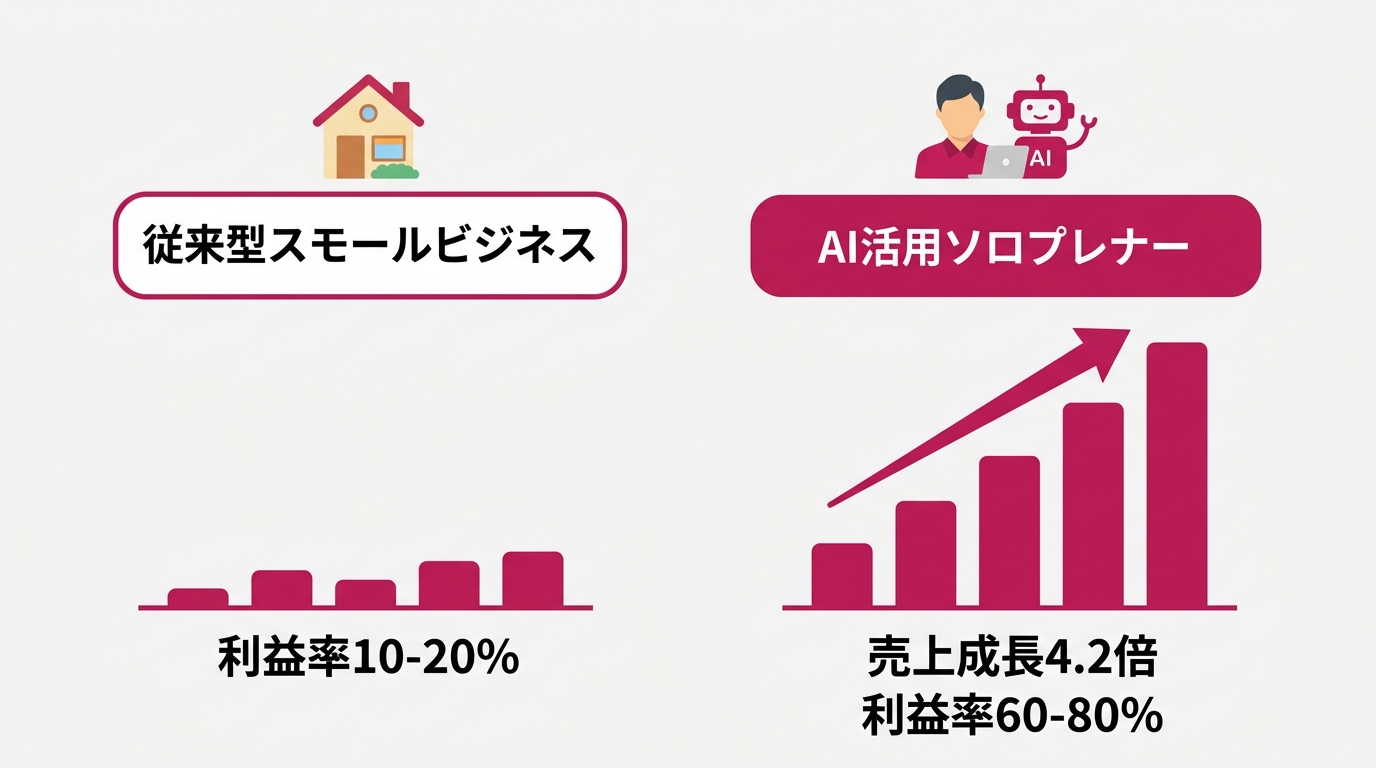
Look at the comparison numbers.
| Metric | Traditional Small Business | AI-Powered Solopreneur |
|---|---|---|
| Operating Margin | 10–20% | 60–80% |
| Annual AI Stack Cost | 100% of headcount cost | 95–98% reduction |
| Operational Efficiency | Baseline | 4.2× manual work (McKinsey 2025, reference value) |
| Year-1 Profitability Rate | ~50% | 77% |
(Source: Zoom/Upwork “State of Solopreneurship 2026”, McKinsey 2025 reference values)
The share of solopreneurs earning over $100K (≈¥15M) per year within two years: 42%.
For anyone who says “stop selling dreams,” here’s all I’ll say. The numbers are there. The precedents are there. The rules are in place.
All that’s left is whether you do it or not.
Three Steps You Can Take Right Now
For anyone wondering “okay so what do I actually do,” let me get concrete.
The goal isn’t “mastering AI agents.” The goal is “claiming your own position in the AI agent ecosystem.”
Get this wrong and no amount of tool-testing will move you forward.
Step 1: Pick One “Your Industry × AI Automation” Combination
The four areas AI agents do best:
- Highly repetitive work (scheduling, email reply drafts, report generation)
- Data collection, organization, and analysis (competitor research, market data aggregation, customer feedback organization)
- Content generation and SEO optimization (article writing, social posts, newsletter generation)
- Customer support handling (Q&A-based inquiry processing, FAQ auto-generation)
What industry are you good at? Cross it with AI automation, and you get a “differentiated solo service.”
Concrete examples.
If you come from marketing: “Fully automated SEO article generation + publishing consulting.” If you come from consulting: “Differentiate by AI-generating client analytics reports.” If you’re an engineer: “No-code SaaS development on contract” (the Base44 model).
“I don’t know what to pick.” Start by listing the tasks you spend hours repeating every day in your current job. That’s the highest-ROI automation candidate.
Step 2: Pick One Stack That Plugs Into the MCP Ecosystem
Don’t try to do everything. Pick one first.
As of March 2026, recommended entry points:
- Claude (Anthropic): The home of MCP. Recorded a 54% selection rate as the “most preferred AI” in coding (overall enterprise share is 40%) (Menlo Ventures 2025 report). Strong at long-form analysis and document processing.
- Cursor: AI coding editor for engineers. Supports AGENTS.md, so it benefits cleanly from standardization.
- Claude Code: Terminal-based AI agent. MCP-compatible, strong for local work.
If you’re not an engineer, Claude alone is plenty to start.
Here’s one concrete example of MCP-powered automation.
Take a marketer. Use Claude with MCP to chain “Notion database (info organization) → SEO analysis tool (keyword selection) → WordPress MCP (article publishing).” “Idea generation → research → writing → publishing” runs from a single command. You don’t need a dedicated engineer to assemble this workflow. Because AAIF standardized MCP, tools can now speak a common language. That’s the heart of it.
Drop one MCP-compatible tool into your daily routine and start developing a feel for the ecosystem. For anyone who’s tried Claude and thought “okay but what do I make it do” — just hand off one of your daily repetitive tasks to Claude, end to end. If it flops, no big deal.
Step 3: Design “What Sells” From the Start
If we’re learning from Base44, this is the heart of it.
Not “build something amazing and then figure it out” — instead, decide upfront “who you’re delivering what to, and how.”
The three industries Dario Amodei called promising (prop trading, dev tools, automated customer service) are all areas where “the problems are clear and AI automation fits well.”
If you can state in one sentence “whose problem your service solves, and how AI solves it” — you’ve got a design that can sell.
If you can’t say it, the design isn’t there yet.
The people who can put it into words start moving. If you have time to hesitate, you have time to move. Failing is no big deal anyway.
AI Stack Costs and Revenue: A Real Calculation
Let’s talk about what it actually costs.
The annual cost of an AI stack for a solopreneur in 2026 is $3,000–$12,000 (≈¥450K–¥1.8M).
(Source: Zoom/Upwork “State of Solopreneurship 2026”)
Compared to hiring equivalent talent?
| Role | Hiring Cost (annual, approximate) | AI Stack Cost (annual) | Reduction |
|---|---|---|---|
| Marketing Assistant | ¥3M–¥5M | ¥150K–¥300K | 93–97% |
| Content Production | ¥2.5M–¥4M | ¥100K–¥200K | 94–96% |
| Admin/Accounting | ¥2M–¥3.5M | ¥50K–¥150K | 95–97% |
Share of solopreneurs who scaled their business without hiring: 74%. Share who recouped their AI stack investment within a year: 91%.
Update the “AI = cost” mental model right now. Accurately: “AI = team-level output without having a team.”
The fact that one person can run a business with 60–80% operating margins. This isn’t hype — it’s an operational reality.
In Japan, AI adoption among freelancers is below 30%, and surveys show around 50% say they’re “not interested” (Lancers Freelance Survey 2024). While 90%+ of U.S. solopreneurs use AI, what does this gap mean?
Room for first-mover advantage is still wide open in Japan.
Summary: Now That the Rules Are Set, the Earliest Window Is Right Now
Let me wrap up.
- AAIF launched (December 2025), setting global standard rules for AI agents (OpenAI official announcement)
- MCP slashes connection costs. The foundation anyone can use is in place.
- Precedents for the “one-person era” have arrived — Base44 ($80M acquisition), Cursor ($500M ARR), and others.
- AI stack costs reduce hiring spend by 95–98%. 60–80% margins are a realistic number.
- AI adoption in Japan is below 30%. The gap with the U.S. (90%) creates first-mover advantage.
I’m not going to say “don’t get left behind by AI.” That’s the boilerplate phrase of clickbait.
What I want to communicate is this.
You’re in the early stage of a game whose rules have been set.
The moment the rules of a game are set is the most cost-effective time to enter. The window where solopreneurs can move — before big corporations get serious about “real entry” — is right now.
Whether you do it or not is up to you. Whether you spend the next 2–3 years thinking “I should’ve moved back then” is also up to you.
I’m in the “move now” camp. Which one are you in?
Reference Resources

女性だからこそ、AIを使いこなさなきゃって思ってる。仕事も、副業も、推し活も、旅行も、全部やりたい。人生一度きりなのに時間は足りないじゃん?だからAIに任せられることは全部任せる。浮いた時間で本当にやりたいことをやる。それがあたしのスタイル。ここにはあたしが実際にやったことをまとめてるだけ。誰かのためになったらいいなって思って書いてるよ。