'Think About It After Retirement' Is a Trap: 50-Somethings Are 2x More Likely to Succeed at Startups Than 30-Somethings — Plus 3 Steps to Start Today
Let me be blunt. 'You're too late to start a business if you're not young' is completely a lie.
What you'll learn in this article
- The key point to grasp before reading the full article
- How the issue changes practical decisions after reading
- Which follow-up article is worth opening next

Let me be blunt. “You’re too late to start a business if you’re not young” is completely a lie.
Whether you’re watching your parents struggle with post-retirement re-employment, or you’re a little scared about where you’ll be in 10 years, today’s story is relevant to all of you.
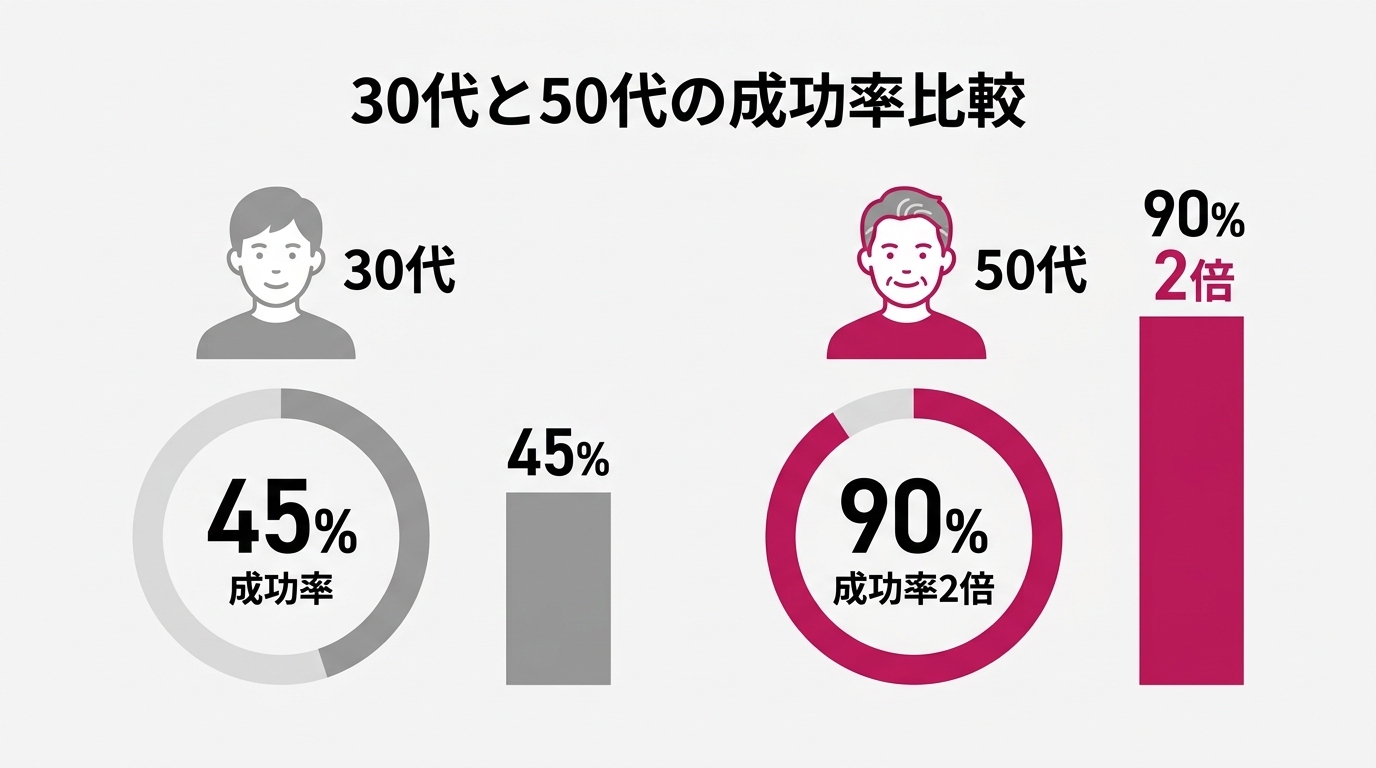
A Harvard Business Review study analyzing data on over 2 million founders found that the probability of success when a 50-year-old launches a company is twice as high as when a 30-year-old does.
If you didn’t know this fact, I want you to start using it as a weapon today.
The people who say “I have nothing to sell” or “I’ll think about it slowly after retirement” are getting the timing of preparation completely wrong. If you’re not going to move while your skills are at their peak, when exactly are you planning to move?
This time, I’m going to talk about that timing — all of it. I’ll speak with data. No emotional arguments. I’ve organized 3 steps to turn your corporate skills into a business, in a form you can use starting today.
Do You Know Which Age Group Starts the Most Businesses in Japan?
First, look at the numbers.
According to Teikoku Databank’s 2024 Survey on New Corporate Establishment Trends, 153,789 new corporations were established in 2024. That’s the highest figure ever recorded. And the average founder age was 48.4 years old — also a record high.
Founders in their 50s accounted for 25.2%, a 20-year high. Those 60 and older hit 18.6%, the highest since 2000. Combined, more than 40% of new corporations are owned by people aged 50 and above.
The image of “an era when young people start companies” no longer matches reality.
According to the Japan Finance Corporation’s 2024 New Business Opening Survey, the average age of new business openers who received financing was 43.6. The largest group was those in their 40s, accounting for 37.4% of the total. In Japan, the people starting businesses are mainly in their 40s and 50s.
The same trend appears globally.
The Branch × Mastercard Solopreneur Report (January 2026), a survey of more than 1,400 people in North America, found that 64% of solopreneurs (people running businesses alone) were 45 or older. Gen X (born 1965–1980) made up 30%, and Baby Boomers 31%, meaning younger demographics are in the minority.
What the data shows is this fact: “You are already on the majority side.”
On top of that, let’s return to the HBR study. The average age of the most successful entrepreneurs was 42. The peak zone is late 30s to late 40s, and 50-somethings are still well within that zone. Far from being “too late,” you’re approaching exactly the period when probability of success is highest.
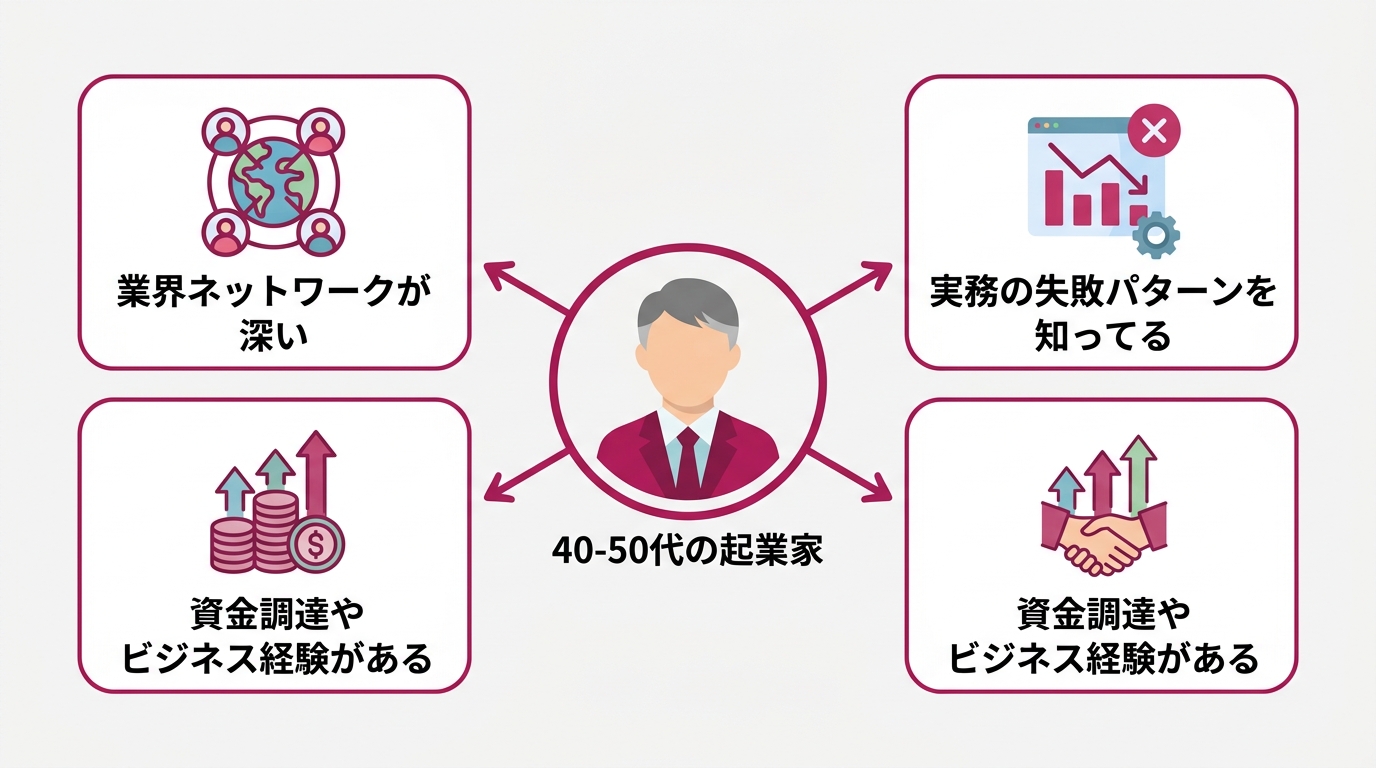
Why are people in their 40s and 50s more likely to succeed? Three reasons: deep industry networks, knowledge of real-world failure patterns, and experience with funding and business operations. The parts that younger entrepreneurs “cover with passion,” veterans can substitute with “track record and trust.” This is an overwhelming structural advantage.
The True Identity of the Belief “I Have Nothing to Sell”
What corporate employees most easily fall into is confusing their personal skills with their company’s brand.
Many people think, “I’m strong with numbers because I’m the finance person at my company.” But actually, you have concrete skills — “financial knowledge,” “hands-on cost management experience,” “the ability to read SME financial statements” — and all of that stays yours even after you leave the company.
Without being able to make this distinction, you fall into the illusion that “if my company’s brand disappears, I have nothing.”
Another common confusion is the pattern of equating “what comes naturally” with “what has no value.”
The skill you took 15 years to master may be, to someone else, “a challenge they might not master even with 5 years.” If you forget this asymmetry, you’ll undervalue yourself and become unable to do anything.
Let me give a concrete example.
Suppose someone has worked in purchasing and procurement at a manufacturer for 20 years. They’ve “racked up experience in cost reduction negotiations,” “gotten used to supplier risk evaluation,” and “developed an intuitive grasp of raw material price trends.”
If this person said, “I have nothing to sell,” I’d reply instantly: “That intuition can provide value to 10 small and medium-sized companies.” Few companies of similar scale can afford a dedicated purchasing specialist. There are definitely owners who would want to hire you as an external advisor for ¥30,000–¥50,000 per month.
There’s value in “what you’re starting to get bored with.” Because getting bored means you’ve mastered it that deeply.
Step 1: Inventory Your Skills. Start with “What You’re Starting to Get Bored With”

Here’s where we move to practice.
The trick to taking inventory is not to search for “what you’re good at.”
When you start looking for “what you’re good at,” modesty kicks in first and nothing comes out. Instead, use the question, “What am I starting to get bored with in my current work?” Boredom is a sign of mastery. You’re bored because you can do it unconsciously. That’s the true identity of “sellable skills.”
Exercise A: Write down the tasks you do on autopilot in today’s job
Things like “I can immediately spot mistakes in my subordinates’ Excel,” “I can tell what’s happening from a customer’s first words during a complaint,” “I can see holes in new projects at the proposal stage.” That kind of intuition.
It’s invisible to you only because it’s too everyday — you’re doing operations instantly that are nearly impossible for beginners.
Exercise B: Confirm whether you’ve taught it to someone doing it for the first time
Having taught someone = being able to systematize it = having the raw material for a product.
If you remember someone calling your explanation “easy to understand” or “really helpful” when you taught a junior, there’s a hint there. Being thanked means you provided something they couldn’t have reached on their own.
Exercise C: Imagine if there are people outside your company wanting the same thing
Even at companies in industries different from yours, there are people with the same problems.
If you’re in finance, any SME that can’t afford a finance staffer is a potential target. If you’re in HR, any sub-30-employee company struggling with recruiting. If you’re in legal, any SME with cases that don’t warrant a lawyer but can’t be handled in-house.
When you cross industries, the market size expands dramatically.
If you do this A → B → C on a single sheet of paper, you’ll typically come up with 2 or 3 ideas.
Among the corporate employees I’ve talked with, the most common answers were: “labor management and work regulation maintenance,” “know-how in cost reduction negotiations,” “sounding-board for new businesses / sorting out key issues,” “designing sales talk scripts,” and “designing scoring rubrics for hiring interviews.” All of these are everyday tasks for corporate employees, but they become valuable when taken outside.
Going one level deeper: “what you take for granted within your industry” often turns out to have value when taken outside. There’s always a situation where someone who doesn’t know the industry’s common sense needs that common sense.
Step 2: Packaging. Write “For Whom, With What, At What Price” on a Single Sheet
Once the inventory is done, the next step is packaging.
A common failure here is “waiting until you have a perfect product.” It’s fine to be incomplete at first. Putting it out in a provisional form and polishing it based on reactions is overwhelmingly faster. If you wait for perfection, you’ll never move.
There are only 4 elements needed for packaging.
Target
Narrow it down like this: “Small and medium-sized business owners (10–30 employees) at companies without an accounting staff member.” Narrowing too much is just right. Going with “any kind of company” reaches no one. Conversely, narrowing it down to “small and medium-sized manufacturers where the president doubles as the purchasing manager” increases the chance of resonating with that segment.
What you offer
Write what you’ll do in 3 lines. The simplicity of “organize monthly financial data and create a one-page report usable for management decisions” is good. I understand the urge to write details, but if it can’t be understood in 3 seconds, it won’t get through.
Write it in terms of “what changes for you,” not “what I will do.” That hits home faster.
Price
It’s fine to start slightly below the market rate. The initial goal is to “build case studies.”
A common price range is the monthly advisory model at ¥30,000–¥100,000. For one-off engagements, ¥50,000–¥300,000. The full-time-equivalent rate may look low, but you can accept this as a portfolio- and word-of-mouth-building period. Once your track record stacks up, you can make decisions about raising rates.
Start at a price you can afford to be turned down at. Setting it too high and selling nothing is worse than starting low and building a track record — that’s more advantageous long-term.
Duration and Frequency
Be specific: a monthly online meeting plus email report. Without this, it’s hard for clients to commission you either. Decide upfront “how many hours you’ll commit” and “how you’ll communicate,” and you’ll head off trouble later.
A “service overview on one sheet” filled with these four elements is your first product. It doesn’t have to be perfect — I want you to make it this week.
There are increasing cases of professionals in their 50s starting “gentle entrepreneurship” with consulting, coaching, or writing, and reaching over ¥500,000 in monthly income. The characteristic feature is “low-risk, side-job start, then scaling while validating.”
“Anycrew,” a side-job matching service for mid-career professionals, provides infrastructure for 40s and 50s professional talent to offer their specialized skills as side work, and functions as a place to make skills visible and externalize them.
Step 3: Land Your First Client. The Fastest Way Was “Announcement”
Once you have even a provisional package, move immediately.
The fastest method for landing your first client is “directly announcing it to people you know.” It’s more effective than social media.
The reason is simple: trust costs are zero. People who know you know your personality and your work. When they hear, “Oh, you’re starting that kind of thing,” they’re more likely to either use it themselves or refer someone. In most cases, it’s 10 times faster than trying hard to broadcast to strangers.
Concrete actions
List 20 former colleagues, business partners, and people you’ve met at cross-industry networking events. Then send each one an individual message: “I’m about to start this kind of service, and I’d like to hear your thoughts.” Not bulk — one by one.
The point is “don’t pitch.” Going in with a “please give me your opinion” stance makes it hard to refuse. At the same time, you get the benefit of being able to polish your product while receiving feedback.
The first client can be free or low-priced. Moving with “building a track record” as your goal will lead to higher unit prices long-term. With zero track record, even if you present a high price, the other party has no material to judge by and can’t move.
When you get refused
Getting refused is normal — think of it as feedback. When you ask “why didn’t this resonate,” you often find the issue is in how you targeted or in the appeal text of your package. Fix it and hit another 10 people. Most people land their first client within 3–4 cycles.
For an overseas example, Luisa Zhou’s coaching platform is a useful reference. They have a track record of more than 4,000 former corporate employees in over 50 countries transitioning to coaching and consulting businesses. They show data indicating that with 5–10 years of industry experience, annual income of $180,000 to over $350,000 is possible — though, of course, unit prices differ domestically. Still, the structure of “corporate employee skills becoming a business” is the same in Japan.
Accelerate the 3 Steps with AI. Finish Your Preparation This Week
All 3 steps I’ve discussed can be done much faster with AI’s help.
Inventory phase
Ask Claude or ChatGPT: “I’ve worked in the purchasing department of a manufacturer for 15 years. Please ask me 10 questions to help inventory my sellable skills.” Just by answering, strengths you hadn’t noticed yourself will surface.
When someone from outside asks about “what you’ve taken for granted,” it becomes visible as value for the first time. Dialogue with AI functions as that “outside perspective.”
Packaging phase
Throw this prompt: “Target: SME manufacturing owners. Offering: monthly consulting for purchasing cost reduction. Price: ¥50,000/month — please create 3 patterns of appeal copy for this setup.” A draft is ready in 3 minutes.
You’re the one who judges “which expression I can most naturally say in my own voice.” Pick from the 3 AI-generated options and rewrite them in your own words.
Competitive check
Ask “What kinds of freelance services compete with this service?” and you’ll get hints for finding differentiation points. It becomes easier to discover the axis of “I’m stronger in this aspect.”
The McKinsey “Superagency” 2025 report reports that AI tool usage can yield efficiency improvements of up to 30–50% of work hours.
Putting AI to work on the “thinking tasks” of inventory and packaging dramatically shortens the prep period. People who put it off because “thinking is a hassle” will find it far easier to proceed in a dialog format with AI.
One thing to be careful about: “don’t use AI’s drafts as-is.” What AI writes isn’t “your words.” What customers buy is skill and trust, and that trust is born from your own words. Always keep the awareness that AI is a training wheel.
Let me summarize the content so far.
- The 2024 average founding age was 48.4, a record high (per Teikoku Databank)
- HBR’s analysis of 2 million founders shows that 50-year-old entrepreneurs are twice as likely to succeed as 30-year-olds
- The true identity of “I have nothing to sell” is “confusing personal skill with company brand”
- The 3 steps (inventory → packaging → initial announcement) can start from a single sheet of paper
- Using AI tools dramatically shortens the time spent on inventory and packaging
For someone 10 years from retirement, whether or not you can earn ¥30,000–¥50,000 a month from a side business completely changes your post-retirement options. Just having one income axis that doesn’t depend on your company makes job changes, going independent, even relocation — all your options — real.
Even those who say, “My workplace doesn’t allow side businesses,” can do “just the preparation of bringing skills outside” for now. Inventory and packaging can be done before you actually start a side business. When side jobs become allowed, or when you move after retiring, you can be in a state where preparation is already done.
The choice to “think about it after retirement” is synonymous with doing nothing while your skills are still at their peak.
What are you starting to get bored with at your current workplace? Please start from there.
Data and Sources Cited in This Article
- Harvard Business Review, “Research: If You Want to Succeed in Business, Start in Middle Age”
- Japan Finance Corporation 2024 New Business Opening Survey
- Branch × Mastercard Solopreneur Report, January 2026
- McKinsey “Superagency in the Workplace” 2025
- Luisa Zhou Coaching Platform
- Anycrew (side-job matching for mid-career professionals)
List of Image Directives
- eyecatch: A businessperson in their 50s writing out a skill list (opening)
- diagram: Illustration showing the separation of “company brand” and “personal skills” (preconception breakdown section)
- illustration: 4-square packaging template sheet (packaging section)
- diagram: Announcement flow to acquaintances (Step 3 section)
Total: 4 images

女性だからこそ、AIを使いこなさなきゃって思ってる。仕事も、副業も、推し活も、旅行も、全部やりたい。人生一度きりなのに時間は足りないじゃん?だからAIに任せられることは全部任せる。浮いた時間で本当にやりたいことをやる。それがあたしのスタイル。ここにはあたしが実際にやったことをまとめてるだけ。誰かのためになったらいいなって思って書いてるよ。