Build the Media Before the Product: The Reverse Strategy for the Age of 29.8 Million Solopreneurs
Let me tell you about a guy named Justin Welsh.
What you'll learn in this article
- The key point to grasp before reading the full article
- How the issue changes practical decisions after reading
- Which follow-up article is worth opening next

Build the Media Before the Product: The Reverse Strategy for the Age of 29.8 Million Solopreneurs
Let me be blunt.
If you’re still thinking “I’ll start social media once my product is done,” you’ve got the order backwards.
If you want to generate revenue as an individual in 2026, grow the media first. The product can come later. This reverse approach might make you go “huh?” at first. But once you look at the data, you’ll have no choice but to agree.
There are now 29.8 million solopreneurs (people running businesses solo) in the US alone. The economic scale exceeds $1.7 trillion, or roughly ¥250 trillion in Japanese yen. Among them, there’s a pattern shared by the people “doing well.” Media first. Product second.
In this article, I’m going to lay out the entire mechanism of this reversal, and how to accelerate it with AI.
Why “Media Before Product”—Dissecting Success Stories
Let me tell you about a guy named Justin Welsh.
He’s a former VP of Sales at a SaaS company. One day he quit and started solo. The first thing he built wasn’t a product—it was a LinkedIn presence and a newsletter. A weekly Saturday-only newsletter called “The Saturday Solopreneur.”
He had no product. He just kept writing.
When readership grew and trust accumulated, he launched an online course. He now has over 215,000 subscribers and over $1.5M in annual revenue (according to coverage from Inc.com, founderreports.com, and other English-language outlets). Solo, mind you.
Why was this possible? Because he had “people who would listen” before he had a product. When he wanted to sell something, he already had a place to deliver it. That’s the essence of “Distribution First” (the strategy of building the delivery mechanism before anything else).
Let me give you one more example.
Anne-Laure Le Cunff, a French neuroscientist. After working in marketing at tech companies like Google, Glitch, and Kano, she went independent. The first thing she did wasn’t build a product.
She kept writing articles on the theme of “maximizing human potential.” She sent a weekly newsletter and published over 400 articles for free. After building trust with her readers, she launched “Ness Labs” as a paid community service. She now runs a reader community of tens of thousands, solo.
Justin Welsh and Anne-Laure work in different industries, with different backgrounds, of different genders. They share one thing in common. The order of “first, keep writing for someone.” The Distribution First structure works the same way for everyone.
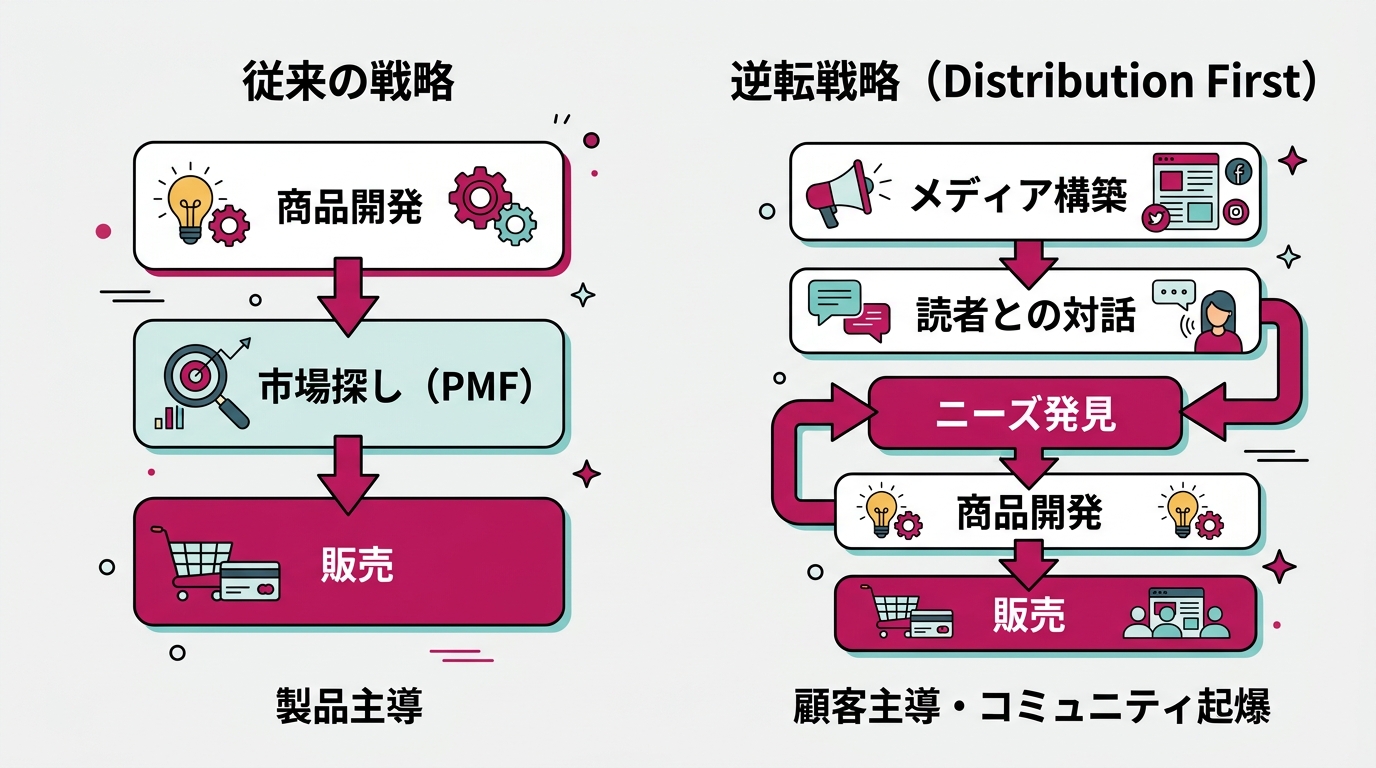
The conventional wisdom was “build, then sell.” Finding product-market fit was supposed to be your first mission. But Distribution First flips the order. First, confirm “who is the message landing with,” then design the product.
Marketing waste disappears. Failure rates drop. Hints for the product collect themselves automatically from reader reactions. This structural advantage is what makes solo operators strong.
“But isn’t it brutal to keep writing with zero readers?” I hear you. Here’s official data from beehiiv (one of the major US newsletter platforms). The median time to first revenue through a newsletter is 66 days (source: beehiiv “State of Newsletters 2026”). Just over two months until your first dollar comes in.
Creators who diversified their revenue earn approximately 3x more than single-revenue models (same source). When you read “66 days” not as “the period when zeros continue” but as “the period until your prep work pays off,” the brutality starts to feel different.
Let me add one more important piece of data. According to founderreports.com (an aggregator site compiling multiple solopreneur surveys), 77% of solopreneurs become profitable in their first year. And 20% reach annual revenue of $100K–$300K with no employees (primary sources are individual research firms; these are reference figures aggregated by founderreports.com). This isn’t a story about specially talented people. The effect of the order—“first build an audience, then sell”—shows up in the numbers.
The data lines up in Japan too. The freelance population is 13.03 million, with an economic scale of ¥20.3 trillion (source: Lancers 2024 survey). 40% of Japanese workers have experience with side businesses (Job Research Institute 2025 survey), up about 20% from 2023. “Earning as an individual” has become a normal option.
That said, the average monthly side-business income in Japan is ¥54,000 (median ¥30,000), a 2x gap from the ideal of ¥108,000 (source: Job Research Institute). This gap isn’t because “people lack skills.” One contributing factor is likely that people keep taking on one-off jobs without being aware of the “grow the media first” order. With the Distribution First mindset, this gap is easier to close.
How It Differs from One-Off Jobs—What Changes When You Have Media First
Let me organize the difference between one-off work and Distribution First.
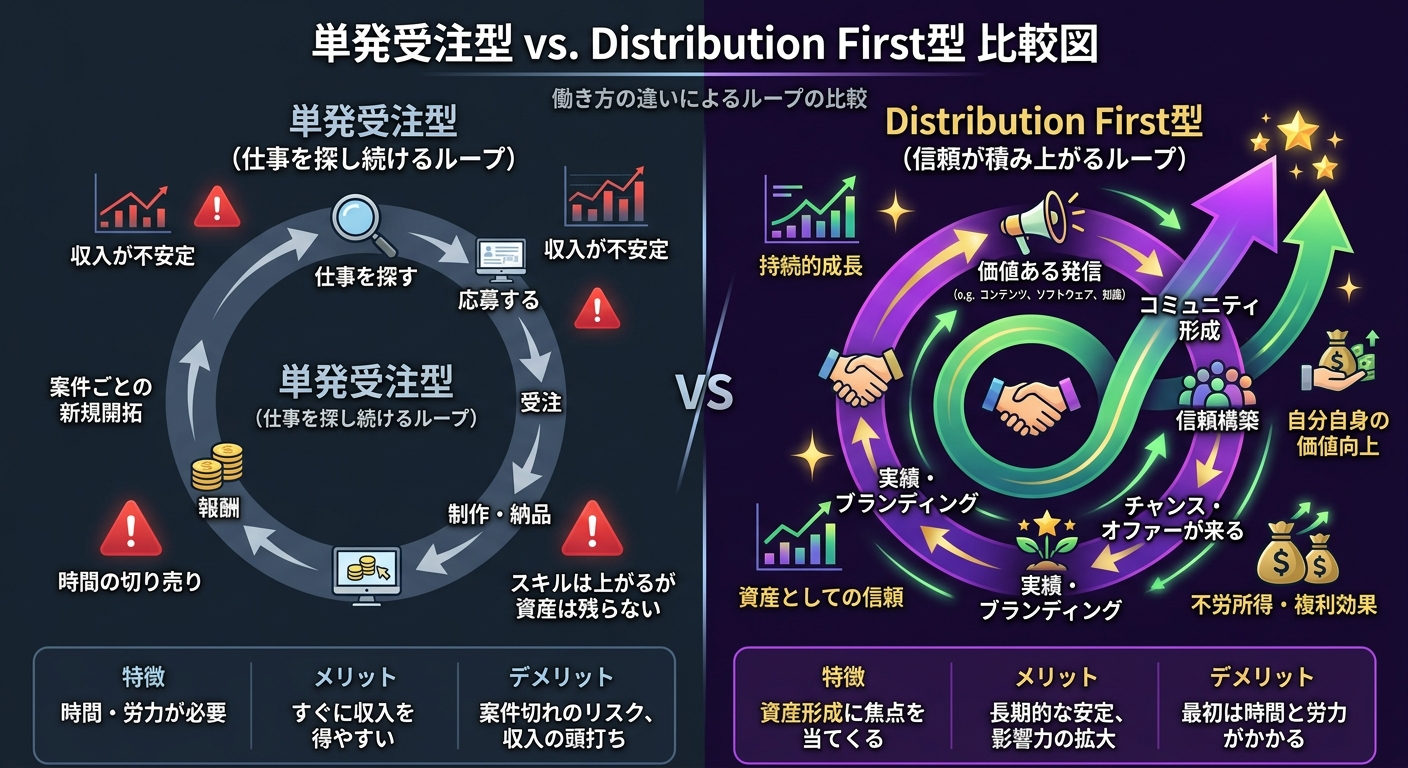
The structure of one-off work is simple. Find a job → propose → win it → deliver → find another job. Revenue accumulates, but trust belongs to the other party’s platform. Close your crowdsourcing profile, and the relationship is severed.
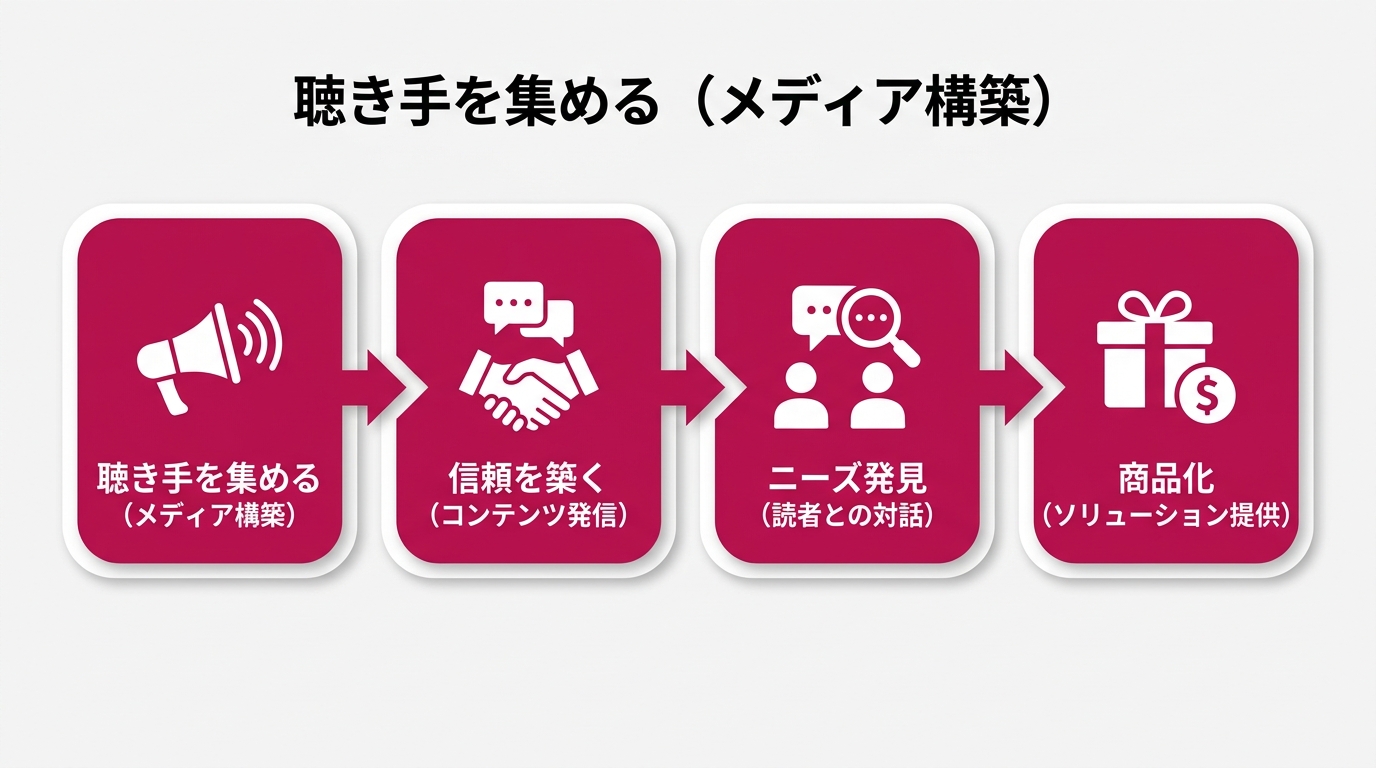
The Distribution First structure is different. Stack content → readers gather → trust accumulates → product needs become visible from readers → release product → deliver directly to readers. What matters is that trust becomes your asset.
The biggest difference compared to one-off work is whether you can create a state where you don’t have to go hunting for the next job. When you have media, “I want this” comes to you from the other side. This is what leads to revenue stability.
“But what if I write one a week and no readers gather?” comes the rebuttal. Here’s one condition for reproducibility. The difference between those who continue and those who don’t isn’t talent—it’s “theme setting.” If you have an axis like “a 30-something female marketer sharing the process of starting a side business in real time,” people in the same situation will keep reading. A “post anything” account lands with no one. Justin Welsh succeeded, Anne-Laure Le Cunff succeeded, because “who is this for” was clear from the start.
Why AI Changed the Common Wisdom That “Solo Has Limits”
There’s a problem solo CEOs and freelancers have always carried: there are too many kinds of work.
Content creation, customer support, accounting, social media management, data analysis—you had to do all of it solo. That’s where the phrase “solo has limits” came from. When work increased, your only choices were to hire or push yourself past the breaking point.
The structure has changed now.
Zoom (the video conferencing tool) and Upwork (the freelance platform) jointly surveyed over 1,000 companies (source: zoom.com official “State of Solopreneurship 2026”).
- 91%: “Recouped AI investment within one year”
- 74%: “Thanks to AI, scaled without hiring”
- 82%: “Achieved business cost reductions with AI”
- 64%: “Couldn’t have continued my current business without AI”
A lot of people read these numbers as “AI has gotten convenient, hasn’t it.” My read is different.
This is a story about reallocating time.
By having AI substitute for repetitive and clerical work, the freed-up time can be concentrated on “thinking work,” “writing work,” and “trust-building work.” The 74% who “scaled without hiring” doesn’t mean “didn’t have to hire”—it means “obtained a structure where hiring isn’t necessary.”
Let me get specific about cost too. As I’ll describe later, the AI stack (a combination of multiple AI tools) for running content production and distribution costs $53–60 per month. That’s ¥70,000–90,000 a year. It covers most of the roles of writer, designer, and social media manager.
The advantage over a hiring-based business model comes down to one thing: “fixed costs don’t accumulate.” Even as the media grows and revenue starts coming in, the ability to have a structure where fixed costs don’t increase is the biggest benefit of AI for solo CEOs and freelancers. The era of “individuals who can’t hire have limits” is, as a structure, starting to end.

Concretely, How to Start—The 3 Steps to Media-fication
Abstract talk alone won’t get you moving. Let me write it concretely.
STEP 1: Decide “Who You’re Answering What For” in One Line
Before starting your media, do this: write a one-line declaration.
Example: “Teach 30-something women considering going independent from a side business the methods I actually used.”
Once this is decided, what you write on social media and the theme of your newsletter can all be reverse-engineered from there. Starting “Instagram for now” without deciding this is the failure pattern. You’ll end up agonizing over “is this OK” every time you post.
Readers empathize more with “stories from people just slightly ahead of them” than with “stories from finished experts.” All you have to do is write “what your current self wishes you could have told your self of 3 years ago.” No special credentials or skills required. Experience is enough.
STEP 2: Pick One Platform Only
If you’re starting now, I’d push for a newsletter. Because unlike social media, you’re not at the mercy of algorithms. An Instagram post is buried by the next day. Email reaches who you want it to reach. It accumulates as an asset.
Three options:
- beehiiv: Free to start. Sponsor revenue features are built in, so monetization is fast
- Substack: Has a strong character as a platform where readers “come looking.” Easy to be discovered
- note (Japanese): Strong reach with Japanese-language readers, and a low posting hurdle
Rather than which is correct, pick the one you can stick with. Pick one and write one piece a week. That’s it.
STEP 3: Use AI to Make “One a Week” Sustainable
“I can’t keep writing one a week” comes the cry. With AI, it’s a different story.
For brainstorming, ask ChatGPT “give me 10 things 30-something women interested in [your area of expertise] are worried about this week” and it’s done in 30 seconds. For structure, “make me an outline for a 1,500-character newsletter on this theme” finishes in 5 minutes. Have AI produce a draft, and rewriting in your own tone only needs to cover 30–40% of the whole.
Once you’re used to it, the actual work time per piece is 2–3 hours. One a week means 10–12 hours a month. Plenty sustainable to run as a side business.
One important caveat. Some people dump everything on AI and publish what comes out as-is. That’s the number one reason people don’t last. Readers attach to “your voice and your perspective,” not to AI mass-produced text. After having AI produce the draft, don’t skip the process of rewriting in your own phrasing. That’s where the difference is.
For people who say “I don’t know what to write,” here are 3 patterns where you never run out of newsletter material.
Pattern 1: “Tried It Report” Format Write your own experience as primary information, like “I tried automating invoices with ChatGPT and here’s what happened” or “What changed after 3 months of running a newsletter.” No research needed, and reader trust is high.
Pattern 2: “Explanation × Your Take” Format Cite industry news or research data and add your own interpretation: “what this actually means is…” You can leave information gathering to AI. The value you provide is purely “interpretation through your own perspective.”
Pattern 3: “Q&A” Format Answer questions from readers. You can write naturally with a setup like “Someone asked me to explain ___, so…” Two-way interaction with readers increases, and the next question becomes more likely to come.
Just rotating these 3 patterns, you’ll almost never run out of material. The wall of “one a week” becomes lower than you think.
Reader Reactions Will Design Your “Next Product”—Digging Deeper Into the 66-Day Mechanism
Let me dig a little deeper into beehiiv’s “first revenue in 66 days” data.
66 days isn’t a number where revenue naturally comes in if you do nothing. It’s the rough timeframe for building trust with readers and grasping their challenges.
Concretely, here’s the flow.
Weeks 0–4, you’re in a near-zero readers state. What matters here isn’t “to keep going” but “to observe reader reactions.” Even if only 5 people are reading, where those 5 people reacted becomes information. Themes that get comments like “tell me more about this” or “I have a similar problem” are the seeds of your product.
Weeks 4–8, readers gradually start to increase. At this stage, try directly asking within the newsletter: “Anyone struggling with this?” Themes that get multiple replies are proof of high problem density. Market research, free of charge, structurally.
From week 8 onward, release your first “product” on the theme that got the strongest reaction. The first product doesn’t have to be big. Starting with 1-on-1 consulting (¥5,000–¥10,000 for 30 minutes) is the fastest. Listening deeply to your readers’ challenges becomes information you can use directly for designing the next product.
This cycle is the reality of Distribution First. Readers tell you what the product is. That’s why the failure rate drops.
The beehiiv data continues like this: creators with multiple revenue streams earn approximately 3x more than the single-model. With a newsletter as the foundation, you can extend into sponsor revenue, paid content, consulting work, online course sales—the real strength of having media is that you can extend in any direction. Designing multiple revenue outlets is what creates stable income.
A Mechanism for Sustaining—A $60/Month AI Stack and 12-Month Roadmap
Here’s a concrete AI stack for keeping the media running. Costs included.
Content production layer:
- ChatGPT Plus ($20/month): Brainstorming, outlines, drafts, title ideas
- Claude Pro ($20/month): Tone checks, long-form content, deep research
Design layer:
- Canva Pro (about $13/month): Social media images, newsletter headers, document creation
Distribution & management layer:
- beehiiv free plan (switch to paid after exceeding 2,500 subscribers)
- Zapier free plan: Automation of new subscriber → CRM integration
Monthly total: about $53–60 (annually about ¥80,000–90,000)
This is a mechanism that substitutes for marketer, copywriter, and designer. One person can take on multiple roles.
Here’s something important. “Just leave everything to AI” is wrong. AI is good at mass production. But “I love this person’s perspective” is a kind of trust AI can’t create. You handle “perspective,” “experience,” and “the voice that speaks to readers.” AI fills in everything else. That’s the right division of labor.
Between people who think of AI as “a tool to make work easier” and people who think of it as “a tool to make time for deeper thinking,” a gap will open in 6 months. Do you spend the freed-up time staring at social media, or thinking deeply about your readers’ challenges? That’s where the long-term difference lies.
12-Month Roadmap:
| Period | What to do | Goal |
|---|---|---|
| 0–3 months | Decide on theme, make one post a week a habit | 100 readers, build your delivery format |
| 3–6 months | Dig deeper into reader reactions, ask about their challenges | 500 readers, discover product seeds |
| 6–9 months | Release first product (consulting or paid content) | First revenue, experience the 66-day median |
| 9–12 months | Improve product based on feedback, diversify revenue | Build foundation of ¥100K–¥300K/month |
This roadmap is designed so that “you don’t think about revenue for the first 0–3 months.” If you panic about “I have to earn” from the start, your attention turns to money instead of readers. Build trust first. Money follows after. That’s the logic of Distribution First.
Conclusion—Change Just One Thing About the Order, and the View Changes
Let me sum up what I want to say, simply.
The 2026 solopreneur strategy. The conclusion is this.
- Media first. Product second. Just this order alone eliminates marketing waste.
- Make time with AI. A $60/month stack can substitute for much of your clerical work.
- Continue one a week for 66 days. That’s where the median for first revenue is.
In the Zoom × Upwork survey, 64% answered “I couldn’t have continued my current business without AI.” Flip that around, and it means using AI raises your probability of continuing. The era of “solo has limits” is, structurally, starting to change.
I don’t mean to deny the feeling of “wanting to earn.” But the shortcut to earning is to have trust first. The reverse is what many people in Japan are still doing. The number ¥54,000 for average monthly side-business income shows that.
What Justin Welsh and Anne-Laure Le Cunff did was simple. “Wrote one piece a week, for someone.” With AI, you can do the same thing today.
The “industry experience,” “knowledge you want to teach someone,” and “challenges you’ve solved yourself” that you have—all of it can become content. With AI, you can keep converting that into one piece a week.
Not moving when you can move is a waste.
You just need to write the first piece. This week.
Reference Data Sources
- Zoom × Upwork “State of Solopreneurship 2026” (zoom.com/blog/state-of-solopreneurship-2026/)
- beehiiv “The State of Newsletters 2026” (beehiiv.com/blog/beehiiv-the-state-of-newsletters-2026)
- founderreports.com: Solopreneur economy data 2026 (aggregator site; primary sources are individual research firms)
- Lancers “Freelance Reality Survey 2024” (lancers.co.jp)
- Job Research Institute 2025 Side Business Reality Survey
- Inc.com / founderreports.com: Solopreneur population and economic scale (coverage from multiple English-language outlets)

女性だからこそ、AIを使いこなさなきゃって思ってる。仕事も、副業も、推し活も、旅行も、全部やりたい。人生一度きりなのに時間は足りないじゃん?だからAIに任せられることは全部任せる。浮いた時間で本当にやりたいことをやる。それがあたしのスタイル。ここにはあたしが実際にやったことをまとめてるだけ。誰かのためになったらいいなって思って書いてるよ。