AI Consulting Works as a Side Hustle: 3 Ways Individuals Can Break Into the $49.1B Market
Think making money with AI means YouTube, blogging, or posting on X?
What you'll learn in this article
- The key point to grasp before reading the full article
- How the issue changes practical decisions after reading
- Which follow-up article is worth opening next

Think making money with AI means YouTube, blogging, or posting on X?
That’s so 2024.
In 2026, if you want the juiciest position as an individual, you can’t afford to skip “AI consulting.”
“Consulting is for the big firms”—that’s the most common misconception.
The market is $49.1B (about ¥7.3 trillion), and what’s most in short supply right now is “people who can teach small and medium businesses.”
You don’t need to fight the big firms over enterprise contracts.
Just by shifting your stance from “user” to “teacher,” the same AI knowledge turns into revenue.
In this article, I’m laying out the 3 entry routes that anyone with industry experience can take—and exactly how to land your first client.
This Market Is 10x Bigger Than You Think
When I say “the AI consulting market is huge,” most people can’t really picture it.
So let me show you the numbers.
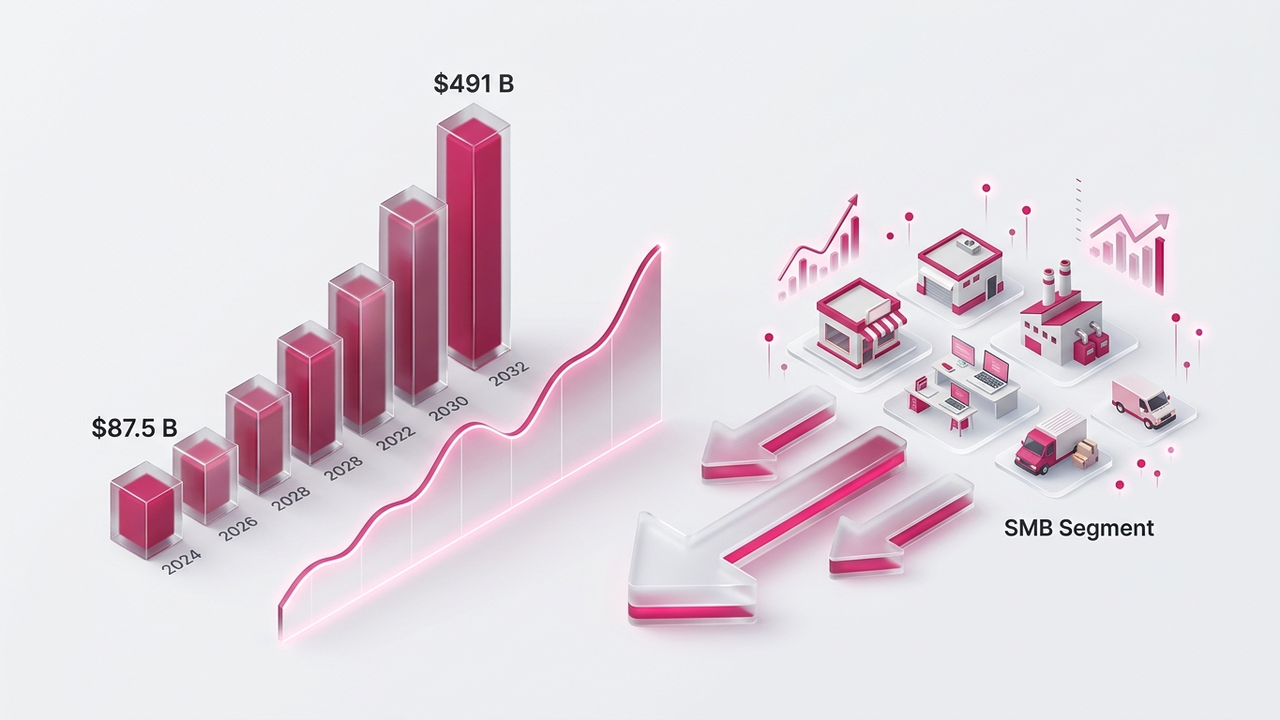
The AI consulting services market was $8.75B (about ¥1.3 trillion) as of 2024.
By 2032, it’s projected to hit $49.11B (about ¥7.3 trillion). Compound annual growth rate (CAGR): 24.14% (Source: SNS Insider / GlobeNewswire, August 2025).
Can you picture how fast 24% growth is?
Japan’s GDP grows 1–2% per year. This market expands by more than a quarter of its size every single year.
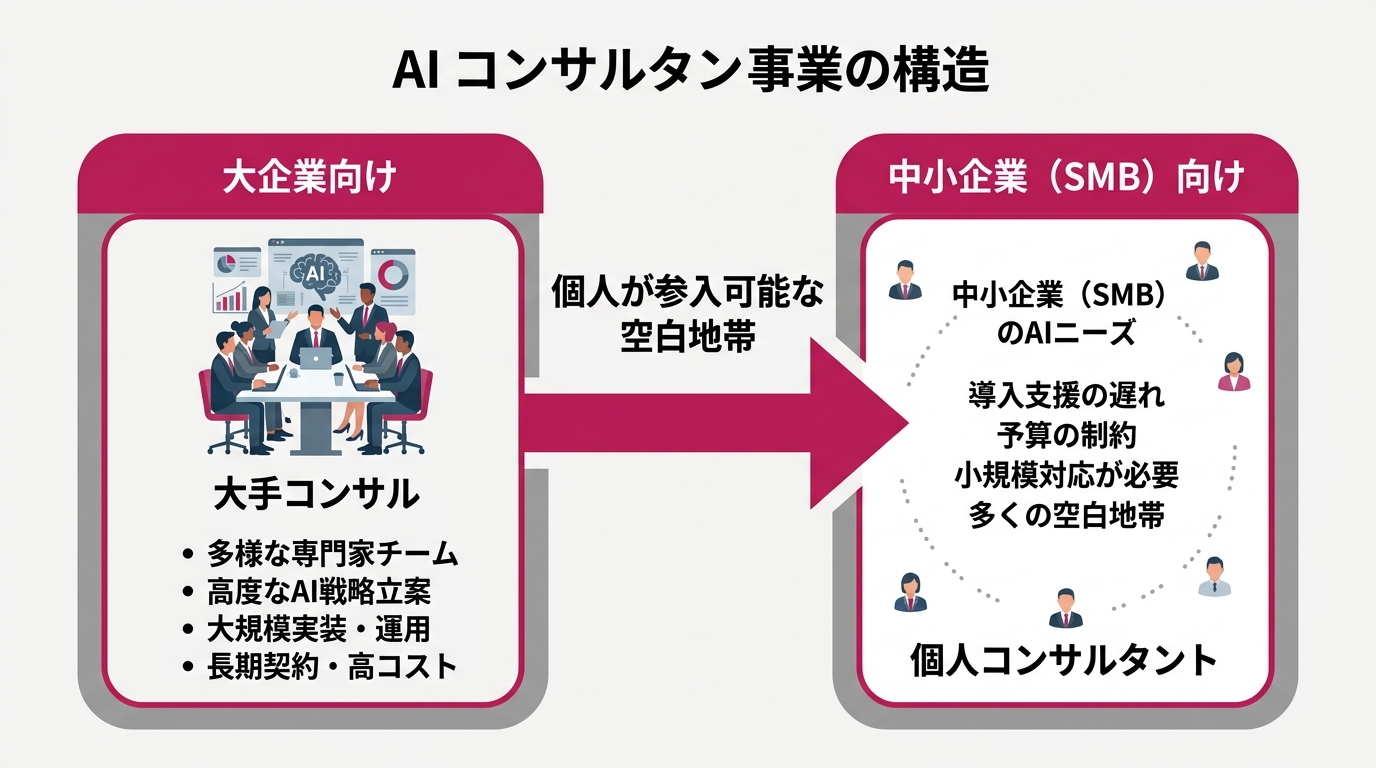
And here’s what’s interesting: the center of gravity for growth isn’t enterprise consulting—it’s demand from small and medium businesses (SMBs).
The major consulting firms have already moved into enterprise. Meanwhile, the SMB market still has plenty of white space.
A recent study put the AI consulting market at $11.07B (Source: Future Market Insights, 2025). The growth pace hasn’t slowed.
There’s a real gap for people with industry experience to step in as “bridges” for SMBs that say, “We can’t afford the big firms, but we can’t do it ourselves either.”
The reality is: companies want to bring in AI. But they don’t know what to do. And nobody’s teaching them.
“AI integration” isn’t just about installing ChatGPT.
You have to map out the workflow, identify which steps can be handed to AI, pick the tools, and get employees actually using them.
The number of people who can design this entire flow is dramatically short in every company.
Even if a company pays to deploy AI, it’s meaningless if it doesn’t get adopted on the ground.
That’s where demand emerges for “the person who helps make AI stick after deployment.”
You might wonder, “Isn’t the competition too tough for individuals?”
In reality, big consulting firms’ main battleground is the enterprise tier.
They specialize in million-dollar contracts with large corporations, so the math doesn’t work for SMBs that can only pay a few thousand to tens of thousands of dollars per month.
The position for individuals who can walk SMBs through it step by step is still virtually untouched.
That’s why “industry veterans currently using AI” have a real opening right now.
“You Need to Be an Engineer” Is the Biggest Myth
Let me be straight with you.
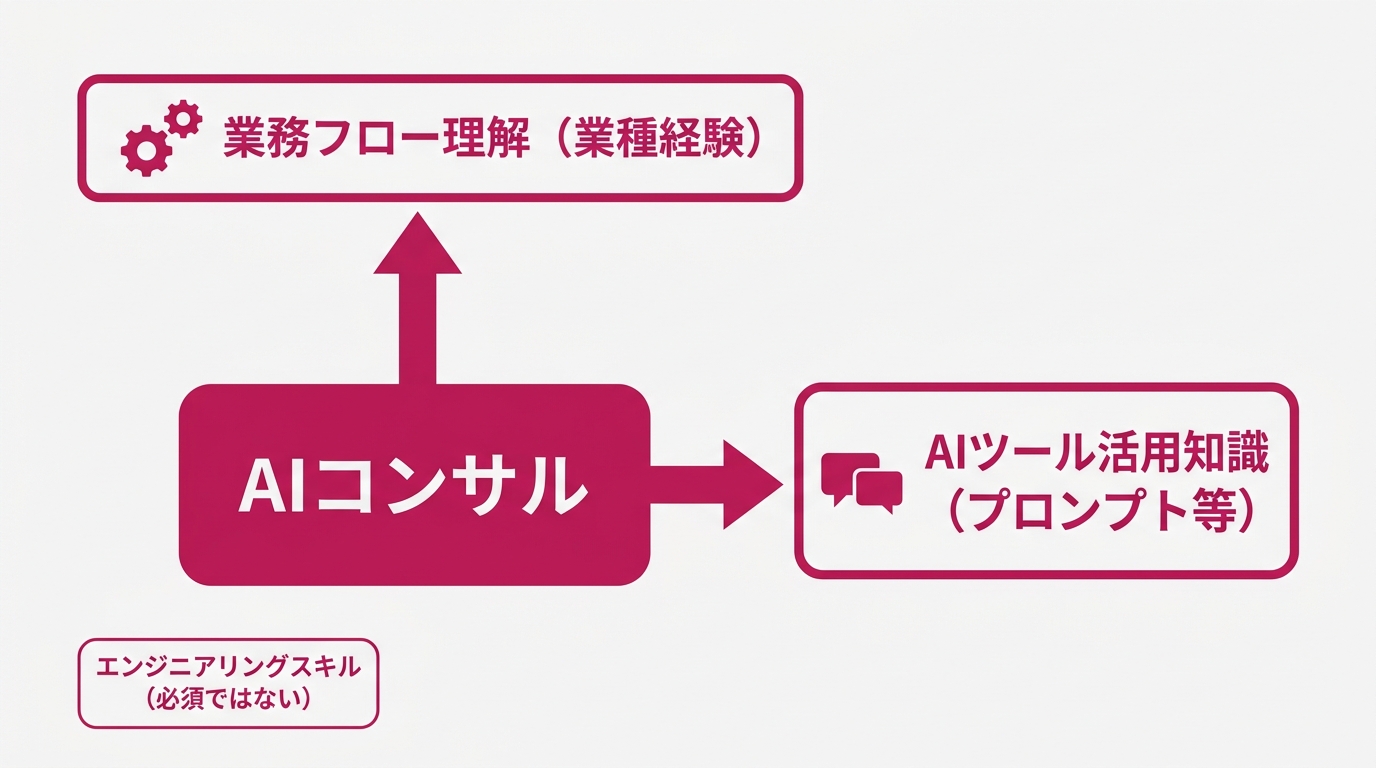
What AI consulting requires isn’t coding ability.
It’s the ability to understand a client’s workflow and design “which AI tools combine into which step.”
In many cases, someone with industry experience has an edge over an engineer.
Take someone who spent 10 years at a marketing agency, designing “how to streamline proposal writing for clients.”
What they need is knowledge of marketing workflows and how to use Claude (Anthropic’s AI) or ChatGPT.
Not a single line of code required.
From what I’ve seen, most of the people working as AI consultants today are creating value through the multiplication of “their industry experience × AI knowledge.”
Former accountants helping SMBs automate bookkeeping and invoicing. Former HR people supporting AI-enabled hiring and interview workflows. Former marketers consulting on SNS × AI operation design.
None of them are AI specialists—they’re “industry specialists who got fluent with AI.”
There’s just one prerequisite.
“Having actually touched AI tools yourself” is non-negotiable.
You can’t consult if you’ve never written a prompt in Claude or tried using ChatGPT in your work.
But that bar is pretty low.
A $20/month subscription and 1–2 months of hands-on use is enough to start seeing “how this applies in my industry.”
What’s the minimum to flip to the “teaching side” of AI? Using AI at least 3 times in your own work. That’s enough.
A lot of the reason people feel “this looks hard” or “it’s too early for me” is simply that they haven’t tried it.
Then, if you build the habit of articulating “why this tool worked here,” your consulting framework starts to form.
The ability to put your own experience into words becomes your consulting pitch.
That’s often something industry veterans who work with language do better than engineers.
3 Entry Patterns for Individuals (With Rates & How to Start)
Let me walk through 3 concrete entry routes.
Just pick the one closest to your background.

Pattern 1: Industry Experience × AI Knowledge (Easiest Entry)
Leverage your industry experience directly to teach AI use to companies in the same or related industries.
- Target clients: SMBs and sole proprietors in the industry you’ve worked in
- What you provide: Workflow audit → identify AI insertion points → tool selection → operational design
- Hourly rate range: ¥15,000–¥35,000/hour
- How to start: Reach out to former workplaces and industry communities. Referrals are enough for your first client
Here’s a specific case.
A former accountant who consults on bookkeeping automation combining freee (cloud accounting software) and Claude MCP—here’s how they landed their first client.
They reached out to an executive at their former workplace. It started with “That process? AI can almost fully automate it,” and turned into a ¥50,000/month retainer (recurring monthly) contract.
Using MCP (a mechanism that lets AI directly operate external tools) actually reduces the need to learn how to manipulate tools.
If you know the industry, you can design the tool combinations.
The biggest strength of this pattern is the client’s sense that “this person gets our industry.”
That’s also why industry-specialized consulting commands higher rates than general AI consulting.
Pattern 2: Prompt Engineer (Highly Scalable)
Operate as a trainer or instructor teaching ChatGPT/Claude usage design.
- Target clients: Individual learners and SMB employee training programs
- What you provide: Workshop-style training and 1-on-1 coaching
- Rate range: ¥80,000–¥150,000/day for training, ¥15,000–¥30,000/hour for individual coaching
- How to start: Online seminars (Connpass/Peatix) get fast response
The strength of this pattern is that it’s industry-agnostic.
“I want to use ChatGPT for business” is a need in every industry.
But it’s hard to build trust without a “I’ve actually used it myself” track record.
Just preparing one small before/after gives you a huge boost in credibility.
“What used to take 8 hours a week now takes 2 hours”—your own experience becomes your sales pitch as-is.
Putting together a structured document on how to write prompts (instructions for AI) makes it easy to scale the same training across multiple companies.
Once you can deliver the same content to 10 companies, your hourly rate keeps climbing.
Pattern 3: Vertical Specialist (Highest LTV, Lowest Churn)
Take on AI workflow design and operations end-to-end for a specific industry.
- Target clients: Industries you can narrow down—hair salons, e-commerce, professional services firms, education providers, etc.
- What you provide: SNS automation, inquiry-response AI, proposal-generation workflows, and other industry-specific problem solving
- Rate range: ¥50,000–¥300,000/month on retainer
- How to start: Narrow to one industry and build one case study. Publish it on note or social
As the concept of Vertical AI (industry-specialized AI apps) expands, demand is surging for “someone who can custom-design AI for my specific industry.”
LTV (lifetime value—the total revenue from one client) is the highest of the three patterns.
Churn also tends to be the lowest.
Because someone who understands the language and problems of an industry is hard to replace.
When you accumulate clients in the same industry, you can replicate the systems you’ve designed.
Roll out the same workflow across 3 hair salons, and the work takes a third of the time.
This is the biggest strength of the solopreneur (one-person business) × Vertical AI structure—it’s built to scale.
Just like Harvey, the legal-specialized AI ($100M ARR, $3B valuation as of February 2025), concentration on one industry becomes the source of differentiation.
The same principle applies at the individual level. The more you narrow to one industry, the more value you can deliver that generic services can’t match.
How to Land Your First Client (No Cold Outreach Needed)
“Where do I get my first client?” is the most common question I get.
The answer: your existing network is enough.
Even with no social media followers and no landing page, you can secure your first 3–5 clients.
Even in overseas AI consulting case studies, the pattern of “first few clients come from the existing network” is consistent.
Step 1: Narrow to one industry × one problem you can solve
Get as specific as “marketing × proposal-writing efficiency” or “accounting × monthly report automation.”
Abstract pitches like “I do AI consulting” don’t land.
If you can say “I solve [specific problem] in [specific industry] with AI,” the listener thinks, “Wait, that’s us.”
Step 2: Reach out to former workplaces, business partners, and industry communities
Just send a LINE or email: “I recently started supporting businesses with AI-driven workflow optimization, and I’m looking for someone in [industry] who’d be willing to try it out.”
No cold DMs (direct messages to strangers) or paid ads needed.
Inquiries from acquaintances close at a higher rate, and they give you more useful feedback.
Step 3: Prioritize building case studies first
For the first 1–2 clients, take them on as monitor/pilot cases at a low time commitment.
You can try framing it as “a 3-hour AI assessment session.”
The before/after that comes out of those sessions brings in your next clients.
For Japanese SMB consulting, you can start with just a few thousand to tens of thousands of yen in monthly cloud tool subscriptions.
No inventory, no capex—it’s a business model that fits a side hustle.
Here’s a concrete LINE message example.
“I’ve recently started supporting businesses with workflow optimization using ChatGPT and Claude. If there’s somewhere you could try it out, I’d love to chat once.”
That’s enough. Reaching out with a “want to try this out” tone rather than a sales pitch boosts your reply rate.
How to Build the Revenue Model (From One-Off to Retainer)
To “keep earning” with AI consulting, the key to stability is moving from one-off projects to retainers (recurring monthly contracts).
The limits of one-off work
With one-off projects, your revenue swings month to month.
Some months you make ¥500k. Some months it’s zero.
There’s a cap on how many projects one person can handle, so you need a strategy: raise your rates, or grow recurring clients. One or the other.
Designing the retainer contract
I recommend a “initial implementation (one-off) → monthly support (retainer)” transition flow.
- Initial phase: AI assessment, workflow design, tool deployment support (¥100,000–¥300,000)
- Monthly phase: Operations review, improvement, proposing new AI applications (¥30,000–¥100,000/month)
For the client, this becomes “cheaper than hiring an AI staffer.”
Hiring a full-time AI staffer would cost ¥300,000–¥500,000/month.
A ¥100,000/month retainer is less than a third of that.
Just laying out this comparison massively boosts the persuasiveness of going recurring.
Designing for scaling
The realistic ceiling on retainer clients one person can handle is 5–10.
To break past that, “templatization” is the key.
When you accumulate clients in the same industry, you can replicate the system you’ve designed.
Hair salon A → Hair salon B → Hair salon C—rolling out the same workflow keeps reducing your hours.
This is the “the stronger you get, the easier it gets” structure of the vertical specialist route.
Going deep into one industry is more efficient long-term than holding many one-off clients across industries.
What I Think Separates “AI Consultants Who Last” from the Rest
To close, here’s what I’ve felt from actually doing marketing × AI work myself.
The difference between people who keep earning long-term as AI consultants and people who flame out is “learning speed.”
AI tools change dramatically every six months.
What was “the best move” six months ago might be outdated now.
So if your goal is “selling today’s method,” every tool update creates obsolescence risk.
Consultants who aim for “the client becomes capable of judging on their own” build longer-term trust and have higher retention.
Specifically:
- Tell the client “why this tool is the right pick,” including the judgment criteria
- Build workflows that run without you, together with them
- Set up a relationship of mutual learning: “Let me know if there’s an update”
When you do this, clients start to feel “this consultant isn’t a stopgap—they’re growing my capability.”
Then you start getting referrals: “I want to work with you specifically.”
In a $49.1B market, becoming one of the people who get named.
That’s the simplest answer to how you differentiate in AI consulting, in my view.
If you’re thinking “I’m not sure my industry experience is enough for consulting,” try writing out your own workflow on a single sheet of paper.
You’ll always find spots where you go “wait, AI can do this.”
That’s your starting point.
Japan has 4.62 million freelancers (Cabinet Secretariat survey, 2020). 2.14 million full-time and 2.48 million side hustlers—and the number’s grown since.
Combining both, the share of “people who can pivot to AI consulting” is growing rapidly.
The earlier you start, the more case studies you accumulate—and those case studies bring in the next clients.
The structure widens the gap between early starters and latecomers over time, so “start while preparing” is more practical than “prepare, then start.”
Summary
Let me pull the threads together.
5 keys to breaking into the $49.1B AI consulting market as an individual
- Market size: $49.1B (about ¥7.3 trillion) by 2032. SMB segment is white space and the entry window is now
- Required skills: No engineering required. Industry experience × hands-on AI use is enough
- 3 patterns: ① Industry × AI (easiest entry) ② Prompt-engineer (industry-agnostic) ③ Vertical specialist (highest LTV)
- First clients: No cold outreach needed. Start with 3–5 from your existing network
- How to earn: Move from one-off to monthly retainer to stabilize revenue
Companies want to bring in AI, but there aren’t enough people who can help them actually use it.
That situation will continue for a while.
The more AI spreads, the more demand grows for “I want to learn from someone who’s already using it.”
While you stay on the “user” side, you can’t ride that demand.
By moving to the “teacher” side, you can convert the market tailwind into your own revenue.
In my previous article (03-22), I covered the “$1.7 trillion solopreneur economy” market—this one is the practical answer to “okay, but what specifically do I use to get in?”
AI consulting is one of the few entry routes where your industry experience—“something you already have”—becomes your weapon.
Starting YouTube takes broadcasting skill. Blogging takes persistence.
But AI consulting turns your past work experience directly into value.
The people who think “YouTube and blogging aren’t for me” often find consulting fits them better than anything else.
If you’ve got time to hesitate, move.
That’s what I think.

女性だからこそ、AIを使いこなさなきゃって思ってる。仕事も、副業も、推し活も、旅行も、全部やりたい。人生一度きりなのに時間は足りないじゃん?だからAIに任せられることは全部任せる。浮いた時間で本当にやりたいことをやる。それがあたしのスタイル。ここにはあたしが実際にやったことをまとめてるだけ。誰かのためになったらいいなって思って書いてるよ。