Still Saying 'One Person Has Limits'? The Era of Replacing Entire Departments with a $100/Month AI Stack — The Complete 2026 Guide to the Solopreneur Economy Where 29.8M People Move $1.7 Trillion
Handle the work of a 5-10 person team alone with a $100/month AI stack. The full picture of the solopreneur economy where 29.8 million people move $1.7 trillion.
What you'll learn in this article
- The key point to grasp before reading the full article
- How the issue changes practical decisions after reading
- Which follow-up article is worth opening next

Still saying “one person has limits”?
Let me give you the answer first. With an AI stack costing $100/month at minimum and $300/month fully loaded, one person can handle most of the work that used to require a 5-10 person team. I wrote “most” intentionally. Not all. I’ll get into what can and can’t be replaced later. But that ratio is steadily flipping.
Want proof? I’ll bring it.
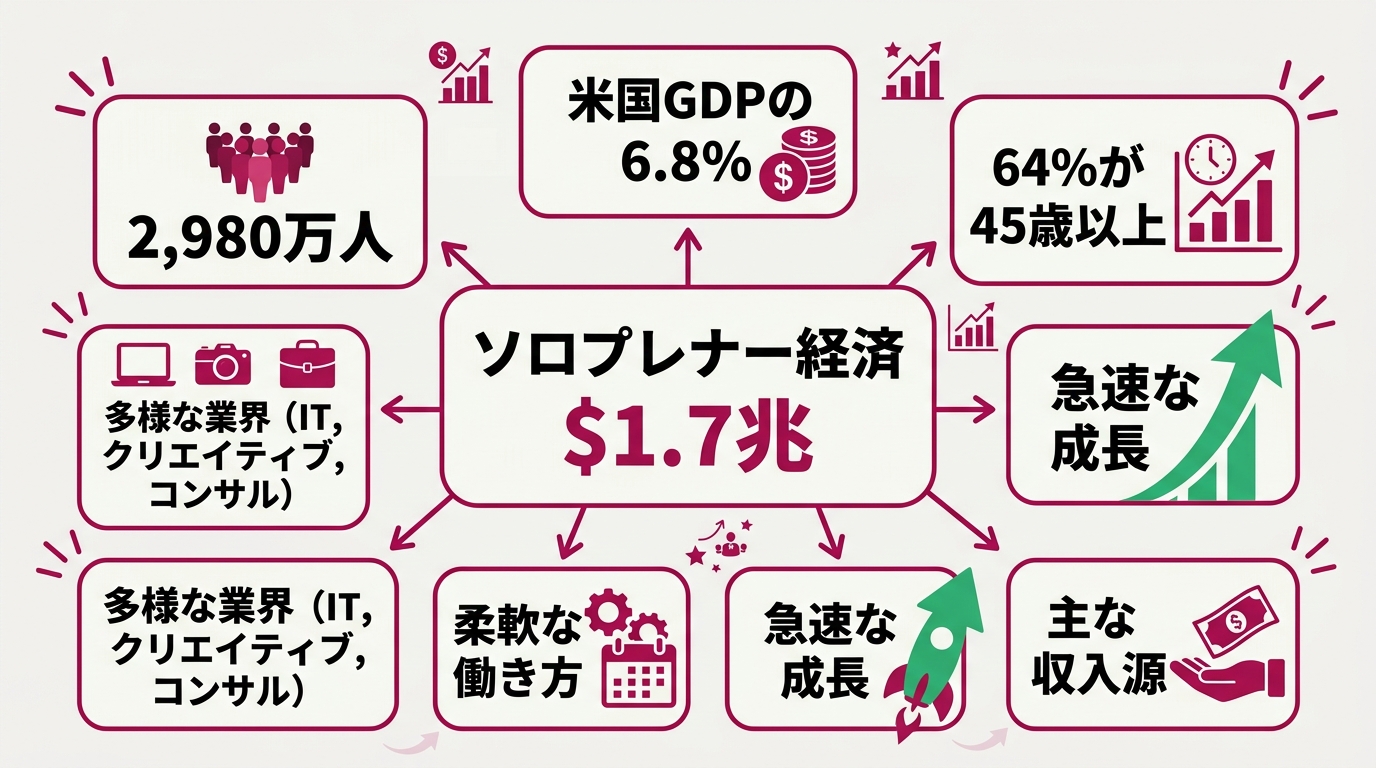
In the US, 29.8 million people already operate as “solopreneurs” — individuals running every step of their business alone. The market has reached $1.7 trillion — about ¥255 trillion in Japanese yen. Source: Inc.com (“Solopreneurs Are Having a $1.7 Trillion Moment,” 2026).
That’s roughly 6.8% of US GDP.
If you’re thinking “that’s an American story, not relevant to me,” hold on. This article turns that “American story” into an AI stack blueprint you can use right now. I’ll lay out the data, cost estimates, and specific tool names — so stick with me to the end.
By the way, I wrote a separate article on this topic before. But the data was incomplete back then. Now the numbers are in. So I’m rewriting it as the “complete edition.”
What is the Solopreneur Economy? — The Reality Behind 29.8M People and $1.7 Trillion
Let me organize the numbers first.
A “Solopreneur” is an individual proprietor running a business without employees. Using outsourcing or contractors is fine — the defining point is that “you yourself are the core of the business.” In Japan, this maps to “one-person company owners,” “freelancers,” and “people who turned a side gig into independence.”
In the US, this segment has reached 29.8 million people (source: founderreports.com Solopreneur Statistics 2026). Including freelancers in a broader definition of solo business workers, the market reaches tens of millions of people.
The $1.7 trillion market size is roughly equivalent to 40% of Japan’s GDP. The common assumption that “large enterprises drive the economy” is shifting.
Not a “Young People’s Thing” — The Reversal Where 64% Are 45+
A lot of people think “solopreneurs are young gig workers.” But the data says the opposite.
64% are 45 or older (source: Branch × Mastercard Solopreneur Report, January 2026). The breakdown is Gen X 30%, Baby Boomers 31%. More and more people are going independent in their 50s, armed with 20-30 years of skills and networks built up as employees. The excuse “it’s too late now” doesn’t work anymore.
For those of you in your late 20s to 30s, this is actually the perfect moment to move while there’s still a first-mover advantage. The right play is to build your system before this market swells to $2 trillion or $3 trillion.
Why Solopreneurs Are Multiplying Now
The reason is simple: AI removed the “labor shortage” barrier. There used to be real grounds for saying “one person has limits.” Design had to go to a designer, accounting to a tax accountant, marketing to a specialist — otherwise the quality wouldn’t be there. But 2026 is different.
By tearing down the “practical wall,” AI made it possible for one person to run multiple “departments.” This is the fundamental reason for the solopreneur explosion.
Replacing “Departments” with a $100-$300/Month AI Stack — The Complete Cost and Case Data
Now let me talk about the “AI stack.”
An “AI Stack” refers to the entire combination of AI tools you bring into your business. Think of it like a “set” of apps you install on your computer.
A minimum configuration runs under $100/month, and a fully loaded setup is realistically around $300/month ($3,600/year). Being able to choose based on use case and operational scale is the strength of today’s AI tool market.
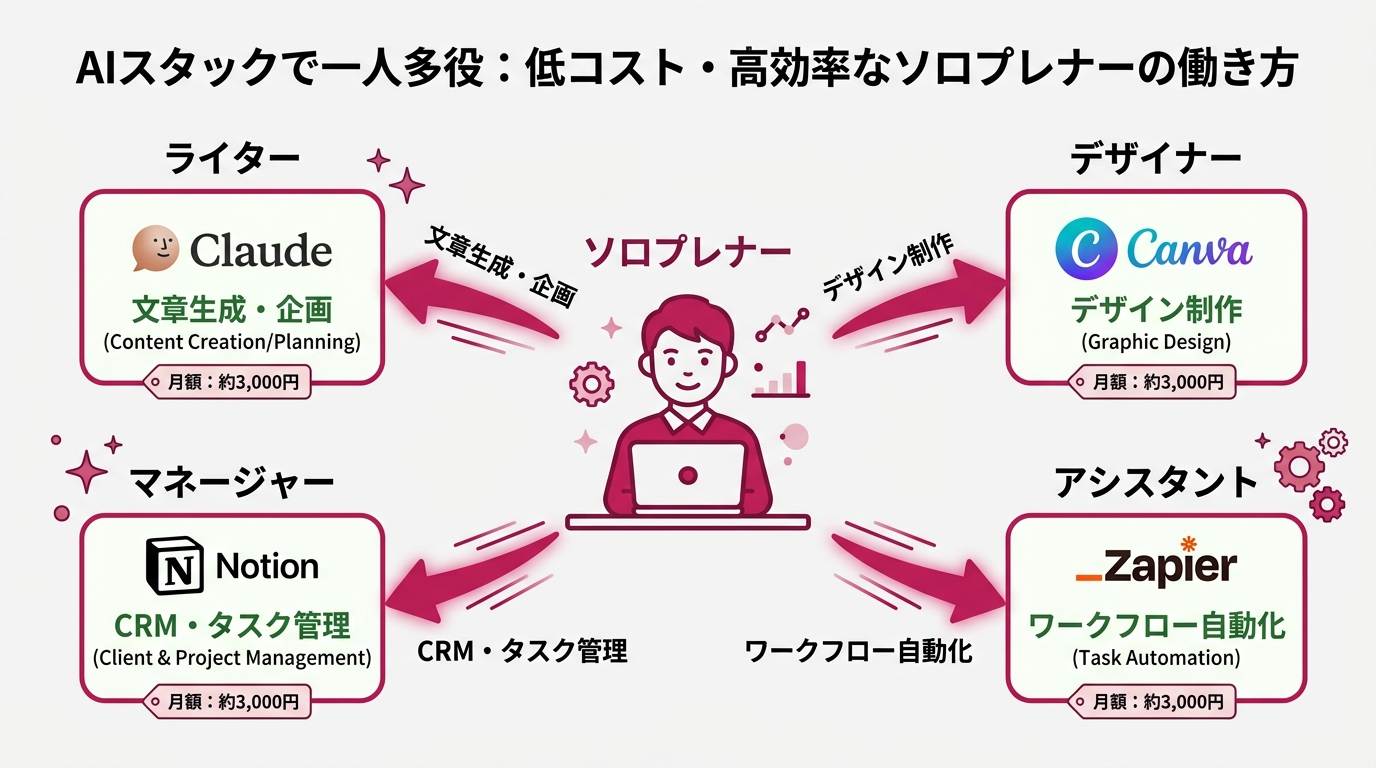
The 4 Pillars of the Optimal 2026 AI Stack
Let me give you the specific tool combinations.
① Reasoning, Writing, Design → Claude (Anthropic) Use Opus 4.6 for complex proposals, strategic planning, and long-form content. Use Sonnet 4.6 for daily writing, emails, and social posts. Pick the plan based on your monthly usage and your cost optimizes itself. Pro starts at $20/month (around ¥3,000).
② Workflow Automation → Zapier / Make “Bundle the morning news and send it to Slack at 9 AM,” “Auto-reply to inquiry form submissions,” “Trigger follow-up emails after invoices go out” — tools that automate this kind of repetitive work. The strength is that they run no-code (no programming knowledge required), and you can start from around $20/month.
③ Visual Production → Canva Pro Social posts, decks, landing pages (LP — the product introduction page), business cards, thumbnails. A tool that brings work you used to send to a design firm into reach. With expanded AI features, it now handles text-to-image, background removal, and bulk resizing. Around $15/month.
④ CRM / Task Management → Notion AI You can build your own “CRM (Customer Relationship Management, customer management system).” Centralize client info, active projects, weekly KPIs, and idea notes. Notion AI supports summarization, formatting, and ideation. Starts around $10/month.
Two-Tier Cost Estimate — $100/Month and $300/Month
The realistic flow is to start with the “minimum configuration (under $100/month)” and expand as your workload grows.
Minimum configuration (approx. ¥9,800/month):
| Tool | Monthly cost (est.) | Examples of work replaced |
|---|---|---|
| Claude Pro | approx. ¥3,000 | Writing, planning, analysis broadly |
| Canva Pro | approx. ¥2,300 | Design, visual production |
| Notion AI | approx. ¥1,500 | Task management, CRM, documentation |
| Zapier Starter | approx. ¥3,000 | Workflow automation (5-10 zaps) |
| Total | approx. ¥9,800 |
You fit it under ¥10,000/month. Even this minimum configuration covers the four work areas of “writing, design, automation, and management.”
The full setup adds SEO tools, email marketing, and video editing AI to land at ¥30,000/month (¥360,000/year). Think of it as stacking on incrementally as your business grows.
What AI Handles Well vs. What Belongs to Outsourcing
I said “$100/month can replace a 5-10 person team,” but let me add an honest footnote.
Areas where the AI stack is strong (replaceable for $100/month):
- Writing (emails, proposals, social posts, blog drafts)
- Design (social images, decks, thumbnails)
- Automating repetitive tasks (reminders, data transfer)
- Information organization and summarization (meeting notes, research summaries)
- Client management (progress tracking, scheduling)
Areas that need outsourcing or human judgment (hard for AI alone):
- Brand strategy direction and high-level decisions
- Complex negotiation and deep relationship building (building trust with clients)
- Specialized final judgments (tax filing review, legal consultation)
- Content requiring real-world experience (on-site reporting, interviews)
“AI drafts it, you decide and finish it” — that model is realistic. Bringing in AI doesn’t mean you let everything go; the right move is to use it as “a tool to secure thinking time.”
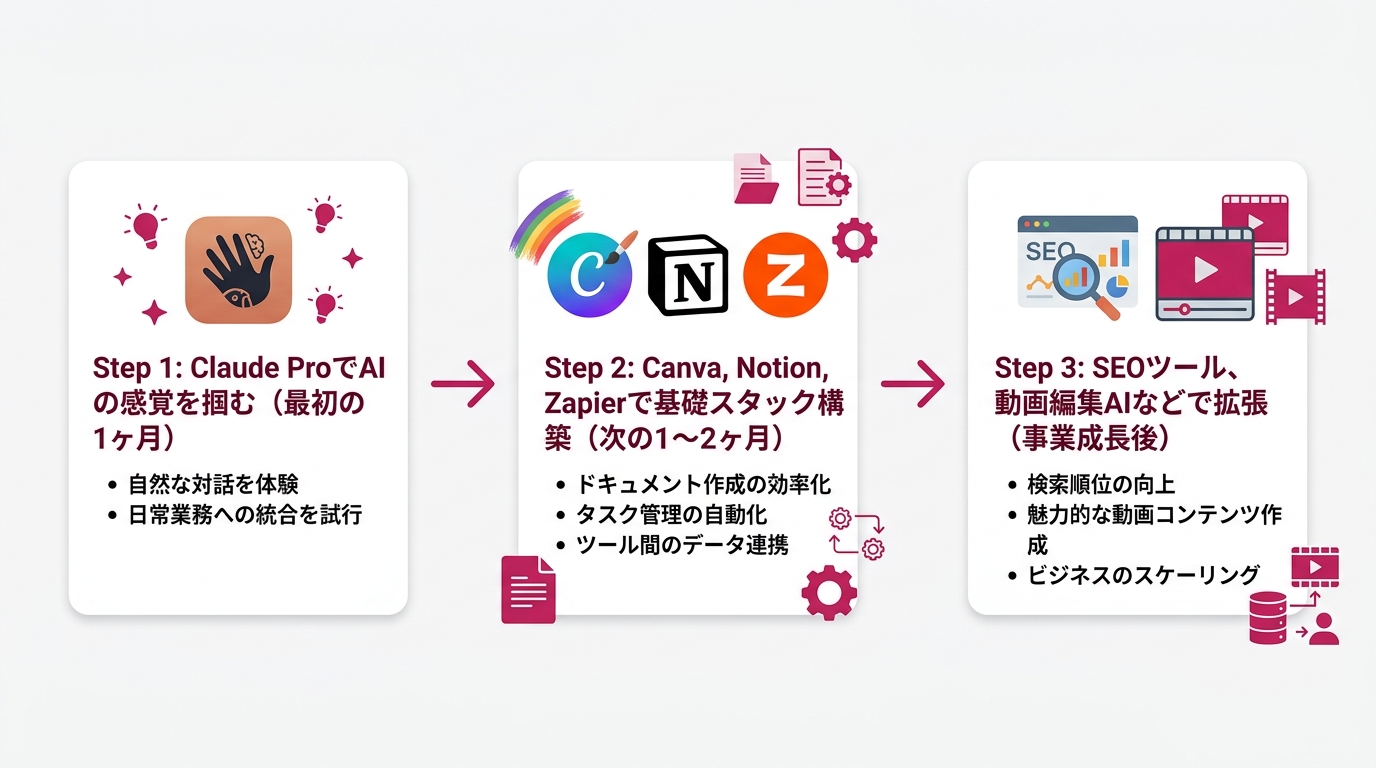
Recommended AI Stack Adoption Order
For those wondering which tool to start with, here’s the recommended sequence.
Step 1 (First month): Just Claude Pro. Try it across writing, planning, and analysis to get a feel for “what you can hand off to AI.” As a $20/month investment, try it for a week first.
Step 2 (Months 2-3): Add Canva Pro. If you’ve been agonizing over whether to outsource design or do it yourself, this is where you slash costs in one shot.
Step 3 (Once the business is running): Add Zapier or Make to automate repetitive work. Bringing it in after revenue starts coming in lets you concretely envision “what you want to automate.”
You don’t need to think “it’s pointless unless I install everything at once.” Try one tool, get a feel for it, then add the next.
Operating Cost Reduction Estimates and Cases
Here’s a comparison with the costs you typically face when starting out.
Before AI (outsourcing-heavy): Writer outsourcing (2-4 articles/month): ¥30,000-80,000/month, designer outsourcing (LPs, decks): ¥20,000-50,000/month, social media management tools: ¥10,000-20,000/month — these often add up to ¥70,000-180,000/month.
After AI stack: You can compress this to around ¥10,000/month. Even adding freee Accounting (with AI assist) keeps you under ¥15,000/month.
According to metaintro.com estimates, aggressive AI use can cut first-year operating costs by about 37% (reference figure — varies significantly by industry and business style). On the time-to-profitability side, AI tends to shorten the timeline, but industry differences are large, so treat it as a rough guide.
Per a Zoom + Upwork joint survey, 91% of AI-using solopreneurs report that “administrative work has decreased,” and 74% say they “can scale without hiring thanks to AI.” Zero hiring cost, more capacity, for $100/month — the ROI (Return on Investment, the metric for how much return you get on what you invested) is significant.
Let me share one reference case. As reported by greyjournal.net, a woman named Sarah Chen launched a design agency solo in January 2025. She used ChatGPT Plus + Canva Pro + Zapier. Working 25 hours a week, she reportedly hit an annualized revenue equivalent of $420,000 (about ¥63 million) by August 2025. This isn’t a guarantee of repeatability, but I’m putting it forward as one case where the “AI + existing skills + reach” multiplication clicked (source: greyjournal.net, 2026).
“¥63 million a year solo?” sounds too good to be true. But the essence isn’t special. It’s a combination you can try too.
”Distribution Over Building” — The Real Battle for 2026 Solopreneurs
This is the part I most want to convey in this article.
“An era has arrived where AI can build anything. So if you make a product or service, you’ll make money” — this is half right and half wrong.
My read is that the 2026 contest is shifting from “Building” to “Distributing.” The cost of generating content with AI has dropped close to zero. As a result, the structure of “the best product loses if it’s unknown” is strengthening. “An average product wins with 100,000 followers” — that’s my call (reference: techbullion.com The Solopreneur Empire 2026).
In other words, “Personal Distribution” has become the greatest asset.
Why Social Followers Are the “Ultimate Asset”
Let’s think through a concrete example.
Say you want to run a side-business consulting practice that brings in ¥300,000/month.
Pattern A: Service content is incredibly substantive. But only 500 social followers. Monthly income tops out at ¥0-30,000. Pattern B: The service is ordinary. But 50,000 Instagram followers and daily posting. ¥200,000+ per month flows in naturally.
It’s obvious which one earns more easily.
Precisely because AI dropped the “build” cost to zero, “who sees it” became the only differentiator. For solopreneurs, social isn’t a “marketing tool” — it’s “the lifeline of the business.”
What I Practice Myself
To talk about myself, I use Claude across the board for social content creation.
When I hand it “Make me 5 post patterns on this theme that resonate with women in their 30s,” a draft comes back in 2 minutes. From there I add Mikoto’s voice and personal experience to finish it. My daily content creation time dropped from 45 minutes to 10 minutes.
I can use the remaining 35 minutes to write proposals for new clients. This is what “buying time with AI” means.
AI Is Also a “Thinking Sparring Partner”
The first wall people hit after going independent as a solopreneur isn’t skills or capital — it’s “lonely decision-making.”
When you were an employee, a manager’s eyes were on every proposal. If the content was off, someone pointed it out. But the moment you become a one-person company owner, you lose anyone to ask “is this right?”
What fills that gap now is AI. “Is there a gap in this service design?” “Does this pricing match the market?” “Is this email phrasing too strong?” — questions like these get a logical reply within 10 seconds.
The “sparring time” you used to pay an external consultant ¥50,000/month for can be replaced for ¥3,000/month. Using AI not just for task efficiency but as “something that raises the quality of solo thinking” is the smart solopreneur play.
Concrete Ways to Use This for Japan’s One-Person Companies and Side-Hustlers
“OK, I get the American story. So how do I use it in Japan?” Let me cover that.
If you’re earning as a solopreneur in Japan, these three patterns are realistic.
Pattern ①: Carve Out Employee Skills as a Side Business
“I’m good at Excel,” “I ran social media,” “I have 5 years of sales experience” — all of these can be turned into consulting or contracted work at ¥30,000-100,000/month per client.
Using an AI stack, you can build a proposal for one company with Claude in 30 minutes and shape it into a deck with Canva. Once you land a contract, automate invoice delivery and progress management with Zapier. With no outsourcing and ¥10,000/month in tool costs, side income of ¥150,000-300,000/month is well within range.
What matters here is “putting your skill into words as a ‘service.’” Concretizing it as “B2B sales cold-call script creation and improvement consulting, ¥100,000/month” rather than “good at sales” makes it easier to land deals. You can design this service by asking Claude to “create a proposal given this target and these pain points” and it’ll generate a draft.
Pattern ②: Scale a Content Business with AI
A model where you continuously publish content on blogs, note, Substack, or newsletters, then convert that into product or service sales.
Pre-AI, “spending 3-5 hours to write one article a week” was normal. Now you use Claude for outline → draft generation → add your own experience and opinion → done in 30-60 minutes. As your content volume grows, search traffic and social referrals increase.
A virtuous cycle of “distribution stacking up” emerges. Even if it’s slow at first, after 3-6 months of continuation, inquiries start coming in naturally.
Pattern ③: Run a Service Business as a One-Person Corporation
Even after incorporating from freelancing, you can build a setup with an AI stack where “one person moves faster than a big company.”
Proposal creation (Claude) → design (Canva) → progress management (Notion AI) → recurring task automation (Zapier) — the number of people running this loop for ¥10,000/month is realistically growing.
Per the Zoom + Upwork survey, 64% of AI-using solopreneurs say “without AI, the business wouldn’t have grown.” Without exaggeration, whether or not you use AI is now the watershed for business growth speed.
Defeating the 3 Big “Time Thieves” for Solopreneurs with AI
Three things quietly steal your time after going independent.
① Email and proposal writing Quotes for clients, contract renewal messages, new proposals — each one takes 30-60 minutes from scratch. Hand Claude “In this situation, for this purpose, write the email” and you get a draft within 5 minutes. You just add your own temperature.
② Social and blog content creation Keeping up 3-5 posts a week takes time from ideation to writing. “Based on the proposal that resonated with a client last month, give me 3 social post ideas” — you get drafts grounded in real experience. The amount of text you write from zero plummets.
③ Accounting and number wrangling Invoice creation, organizing tax filing docs, monthly P&L tracking — connect this with freee + Claude (or freee MCP) and your monthly “accounting time” shrinks dramatically. Ask Claude “Looking at this revenue and expense data, what stands out?” and you get on-target observations.
Just by streamlining these three with AI, you recover 5-8 hours a week. Use that time for “Distribution (boosting reach)” and your revenue 6 months from now changes.
5 Steps to Strengthen Distribution
Even saying “train your Distribution (reach),” a lot of people don’t know where to start. Here’s the concrete sequence.
Step ①: Narrow to one platform Instagram, X, or note — pick one. But concentrate on just one at the start. Trying to do everything means you can’t sustain it. Choose based on where your target reader lives, and the decision becomes easier.
Step ②: Set your content axis as “your expertise × common pain points” Continue 3-5 posts a week at the intersection of “your specialist skill × your target’s struggles.” AI drafts, you add experience, numbers, and opinion — this format reconciles volume and quality.
Step ③: Triple your posting volume with AI Bump content from once a week to three times a week with AI. As volume rises, engagement (likes, comments, shares) increases and you ride the algorithm. You need a “rack up reps with volume” phase first.
Step ④: Build the “DM/Inquiry → Service Proposal” funnel Put “DM me to learn more” in your profile and at the end of your content. Around the point you exceed 1,000 followers, inquiries start coming in naturally. When an inquiry comes, Claude builds the proposal — once this loop starts spinning, it takes shape as a business.
Step ⑤: Calculate “revenue → reinvestment in Distribution” once a month Consciously set “what share of this month’s revenue goes toward boosting reach.” Continuously reinvesting in tool fees, learning costs, and content creation creates the upward spiral. Many solopreneurs neglect this and plateau.
Summary: 3 Steps to Move on Today
This got long. Let me wrap up.
Let’s review what we know about the 2026 solopreneur economy.
- 29.8 million in the US, $1.7 trillion — solo business is no longer “small-scale”
- Minimum AI stack under ¥10,000/month — replaces much of the outsourced work that used to run ¥70,000-180,000/month
- “64% are 45 or older” — it’s never too late to start
- The 2026 contest is “Distribution (reach)” — delivering matters more than building
- The “AI + existing skills + reach” multiplication is something anyone can try
So what do you do starting today?
STEP 1: First, install the minimum AI stack Start with two: Claude Pro ($20/month) + Canva Pro ($15/month). It covers 90% of writing and visual production. If you get ¥3,000-5,000 worth of work efficiency back, the investment pays for itself instantly. If you’re “want to verify the impact before paying for tools,” the realistic path is to try the free Claude.ai version, feel the impact within a week, then upgrade to Pro.
STEP 2: Write down one “carve-out-able” skill “Work I’ve done for 5+ years,” “things I get praised for,” “things I can teach others” — ask Claude “What service could I turn this into to earn ¥XX/month as a side business?” You’ll get concrete suggestions. People who think “I don’t have any real skills” should be especially careful here. The “obvious stuff” you took 10 years to master is sometimes “something others would pay ¥50,000 to learn.”
STEP 3: Continue 3 posts a week for one month “One platform × 3 posts a week × one month” — keep this going and followers start recognizing your area of expertise. DMs and inquiries grow out of this. It’s slow at the start, but skipping this and building a service won’t sell, so respect the order. If you try it for a month and get zero response, change the angle. The data on “what doesn’t land” you collect there sharpens your next strategy.
If you have time to hesitate, move. Even if you fail, no big deal. In an era where the doers win, going first is what we do.
All AI stack costs and impact figures in this article are reference values. They vary significantly by industry, working hours, and skillset. Make investment and business decisions at your own discretion.

女性だからこそ、AIを使いこなさなきゃって思ってる。仕事も、副業も、推し活も、旅行も、全部やりたい。人生一度きりなのに時間は足りないじゃん?だからAIに任せられることは全部任せる。浮いた時間で本当にやりたいことをやる。それがあたしのスタイル。ここにはあたしが実際にやったことをまとめてるだけ。誰かのためになったらいいなって思って書いてるよ。