Cursor Bugbot Is Back—and Now It's the Closing Act of a 3-Part Industry Response
Cursor Bugbot went GA in February, but WIRED.jp picked it up in June. Here's why: the Lovable incident, Infosecurity's warning, and Bugbot aren't three separate stories—they're three acts. Plus three pitfalls I hit using Bugbot myself.
What you'll learn in this article
- The key point to grasp before reading the full article
- How the issue changes the way developers should work next
- Which follow-up article is worth opening next
Writing “Cursor Bugbot is back” makes this its second appearance in my writing. I don’t intend to retread the feature breakdown I wrote in March.
On June 10, 2026, WIRED.jp reportedly covered Cursor Bugbot. Bugbot itself went GA in February 2026, and I wrote a detailed post about it in March. Despite that, it’s being picked up again in a breaking-news frame in June. I read that as having an industry-structural reason.
There’s one reason: In the context of June 2026, Bugbot is not a “new feature”—it’s the closing act of a three-part industry safety response.
What to Do This Week—Three Steps After You Finish Reading
I’ll put the exit upfront. Here’s what I want you to do before the end of this week:
“Run Bugbot-equivalent diff review on at least one PR from your own project.” Thirty minutes, total.
Three concrete steps:
- Step 1 (5 min): From PRs you or your team submitted in the past week, pick one that includes code changes
- Step 2 (15 min): If your repo has Bugbot enabled, read its comments. If not, ask Claude Code or Cursor Composer: “Point out only the parts of this diff that humans are most likely to overlook”
- Step 3 (10 min): From the feedback you receive, pick the single point that “you were taking for granted” and log what you found when you actually checked it
These three steps are the minimum unit of safety practice for this week. They’re the same habit I’m running right now to keep my own repositories from having a Lovable-type incident.
Why do these three steps matter? Because the “3-act timeline” I’ll explain below—three layers of incident, warning, and tool—is compressed into this 30-minute exercise.
Why Is Bugbot Being Treated as “Breaking News” in June?
Start with the first question. Bugbot went GA in February 2026. By March, Japanese-language coverage existed, and numbers like “2 million PRs processed per month” and “76% resolution rate” were already public. And yet WIRED.jp’s June 10 coverage ran in a breaking-news frame. That’s the starting point.
WIRED.jp reportedly covered Cursor Bugbot on June 10, 2026. Since I haven’t been able to directly verify the article’s exact phrasing, I’ll describe only the fact of the coverage.
The question I want to sit with is “why now?” Bugbot’s functionality hasn’t changed since February. What changed was the surrounding context.
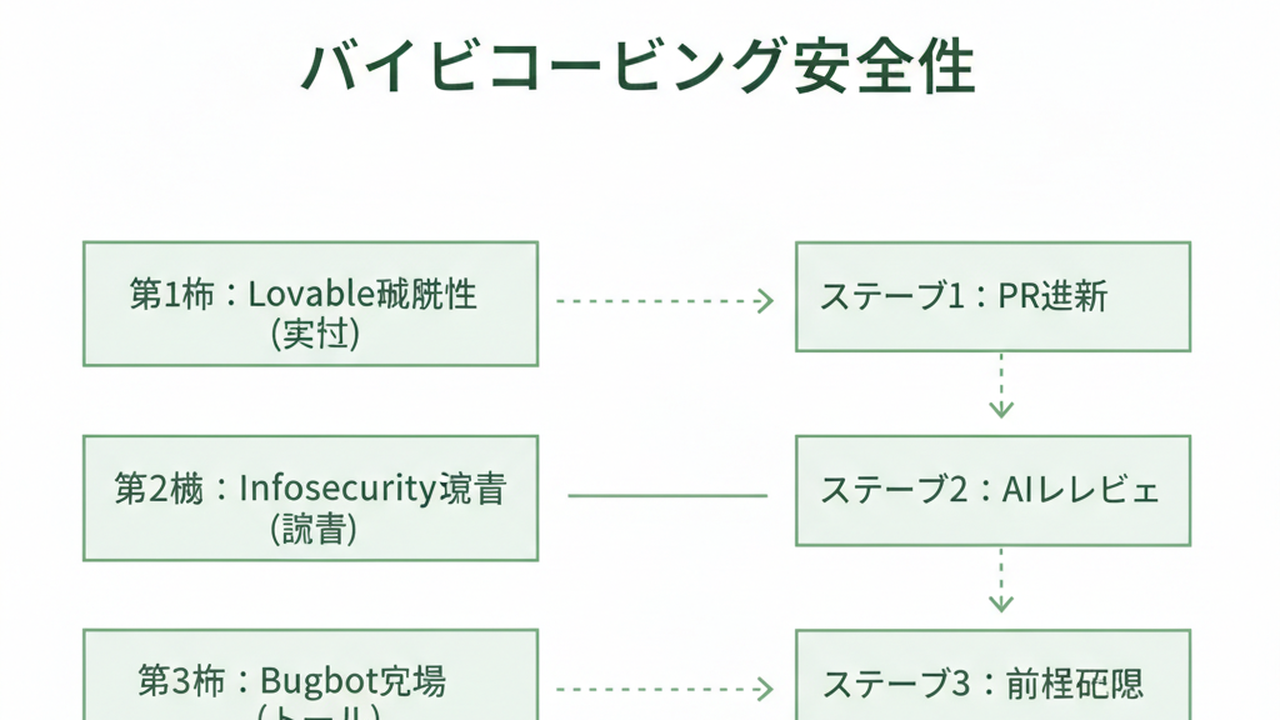
In April, the Lovable vulnerability incident happened (critical defects in 10.3% of apps, stemming from RLS bypass). On June 8, Infosecurity Magazine reportedly issued a warning about vibe-coding security broadly. After these two data points—“real harm” and “official warning”—placing Bugbot as “the standard tool for vibe coding safety” for the first time completes its industrial meaning. That’s the real implication of WIRED.jp’s coverage, as I read it.
Put another way: “Bugbot has existed since February. But the industry couldn’t articulate that it was necessary until June.” Our job as writers isn’t to describe features—it’s to explain when, why, and for whom something became necessary.
My March article was about “what Bugbot can do.” This article is about “why Bugbot became necessary.” Same tool, different angle, different content. That’s what makes this worth writing twice.
Act 1: The Lovable Vulnerability (April) Made the Real Harm Visible in Numbers
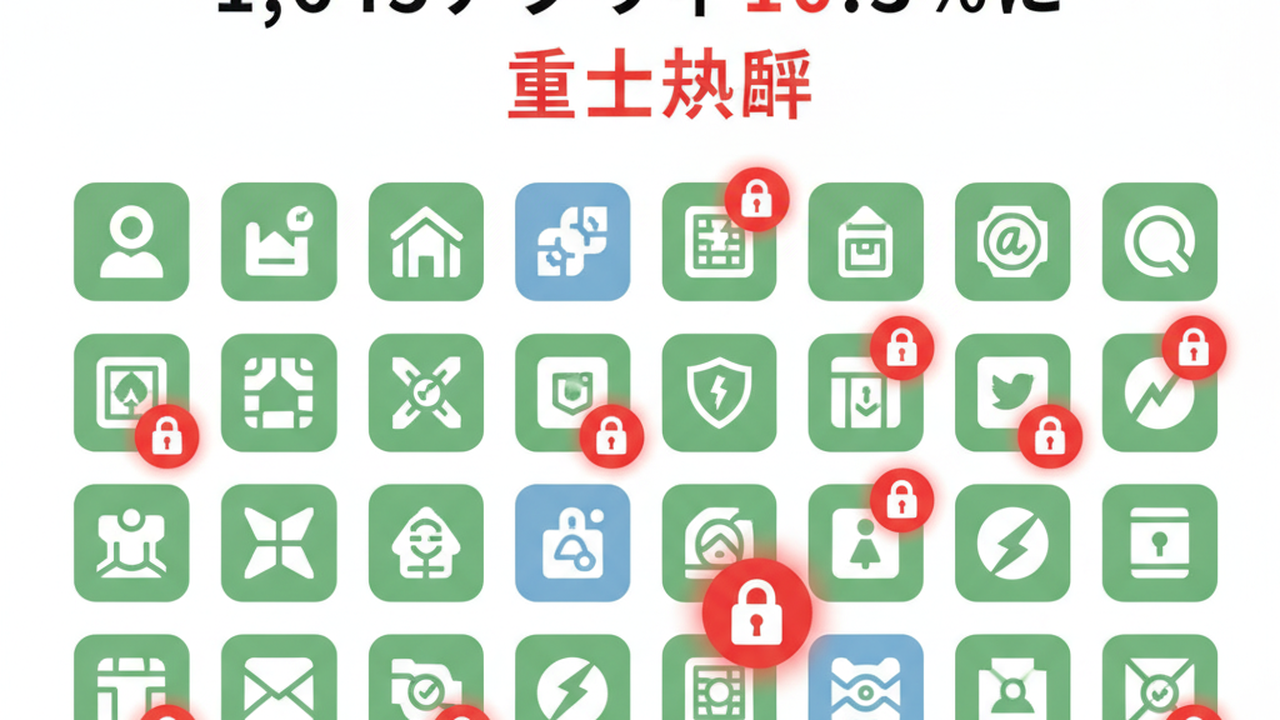
Act 1 was covered in detail in my April Lovable vulnerability article. Of 1,645 Lovable-built apps, 170 (10.3%) were found to have critical security defects.
What was exposed: Google Maps and Gemini API keys, eBay authentication tokens, personal data, financial data. Root cause: CVE-2025-48757 (discovered by Matt Palmer), stemming from unconfigured Row Level Security (RLS) database access controls in Lovable. “170 back doors left open” was the metaphor I used at the time.
The impact wasn’t “the tool is bad.” It was something deeper: the “build until it works” design philosophy of vibe coding structurally makes it easy to skip the safety checks that matter—and for the first time, that was visible in numbers.
In terms of industry response structure, Act 1 did three things:
- Made the numbers visible: 10.3% of 1,645 apps had critical defects (source: Matt Palmer statement, Escape.tech, Superblocks)
- Made the types visible: Unconfigured RLS, exposed API keys, PII leakage
- Made the language visible: “Back door,” “works but full of holes”
What mattered here was that real harm became a number. “I think it’s risky” doesn’t move an industry. “170 out of 1,645” makes developers look at their own repositories. That was Act 1’s role.
But Act 1 alone doesn’t complete the industry response. There’s still a gap between “an incident happened” and “the industry articulates it as a security problem.” Act 2 closed that gap.
Act 2: The Infosecurity Warning (June 8) Gave the Industry Its Vocabulary
On June 8, 2026, Infosecurity Magazine reportedly issued a warning about vibe-coding security.
Since I haven’t been able to confirm the exact primary text, what matters here isn’t “what the warning said” but “that the warning was issued.” Act 2’s role is to take the specific incident from Act 1 and restate it as an industry-wide problem.
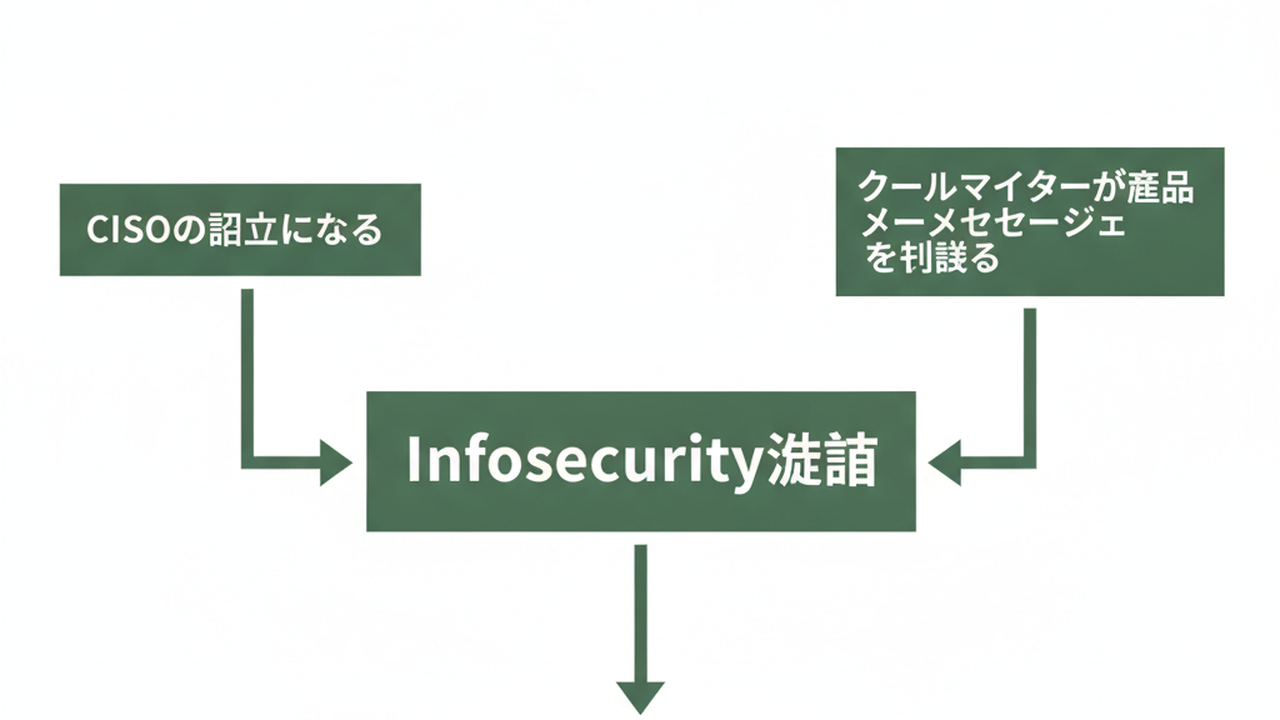
Two days earlier (June 9), I wrote in a different article that the industry’s discourse was progressing through three phases: “awareness phase → detection phase → tracking phase.” When an industry publication like Infosecurity issues a direct warning, three things shift:
- It becomes a CISO agenda item: Individual incidents get dismissed as “just a Lovable thing,” but once an industry publication issues a warning, it gets elevated to the security meeting agenda at organizations
- Insurance and regulatory movement begins: Cyber insurance underwriting starts incorporating how AI coding is handled; regulatory bodies start discussing guidelines
- Tool makers switch their product messaging: AI coding tools that were marketing “fast and convenient” start adding “safe and traceable” alongside
The third one is especially important. Cursor pushing “Bugbot” again in June’s context was, I read, precisely this moment of product message switching. Bugbot isn’t new. But Cursor responded “we already have this” to the vibe-coding safety need that had just been articulated in June’s language.
With this reading, WIRED.jp’s coverage isn’t just a feature overview. It’s a repositioning from the tool side, immediately after the industry put the problem into words.
Act 3: Bugbot (June 10) Gave the Industry Its Standard Tool
Act 3 is today.
WIRED.jp reportedly covered Cursor Bugbot as new coverage on June 10. A brief refresher on how Bugbot works:
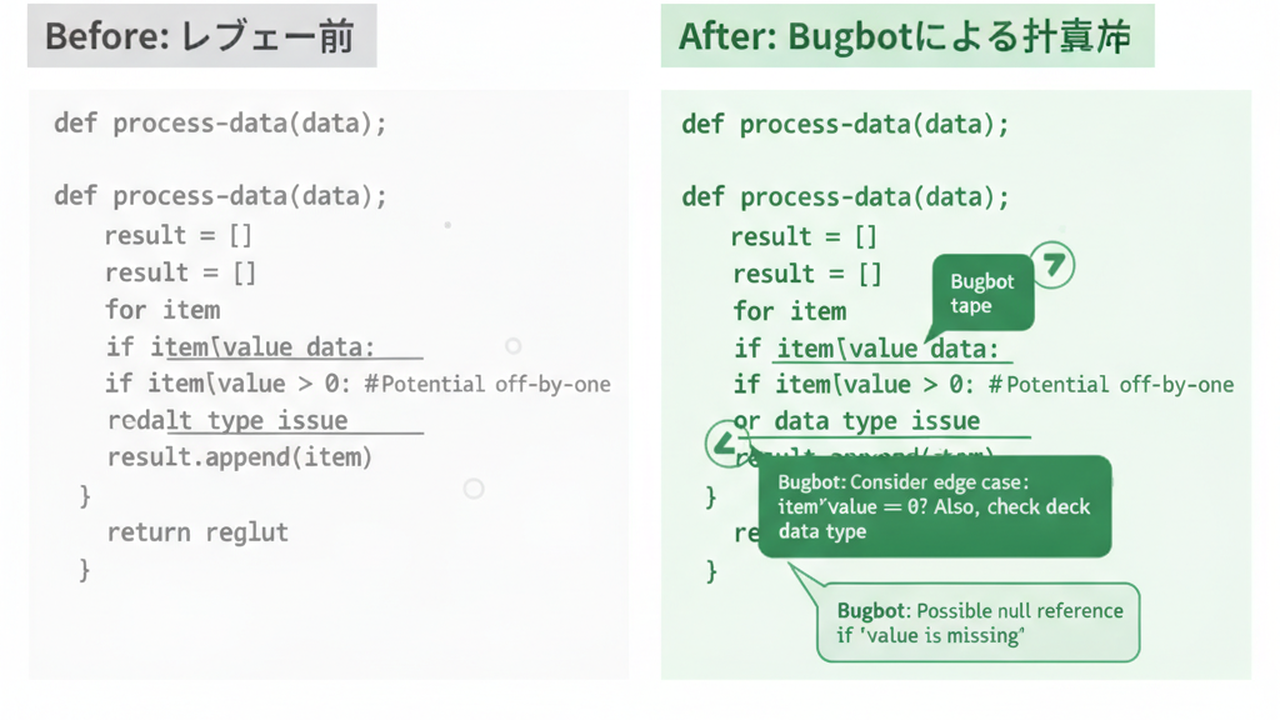
- What it does: AI reads the PR diff and leaves comments on bugs and false assumptions humans are likely to miss
- How accurate: 76% resolution rate (Cursor official published number), 35% of Autofix suggestions merged as-is
- Where it runs: Automatic comments on GitHub PRs, or runs inline inside the Cursor editor
Nothing in the functionality has changed since my March deep-dive. What changed is that June’s three-act timeline formed the industry consensus that “this should be standard.”
When I say “standard tool,” I mean a tool that satisfies three requirements:
- Requirement 1: Runs automatically — CI or the editor runs checks even when humans don’t notice
- Requirement 2: Explainable — Explains “why this is risky” in human-readable form
- Requirement 3: Composable — Layers onto existing developer workflows (PR review, CI, pre-commit hooks, editor completion) without breaking them
Bugbot satisfies all three. Act 3’s role is to have an immediate answer ready for “so what do we use?” once Acts 1 (real harm) and 2 (vocabulary) are both on the table. Safety campaigns that end at slogans don’t stick in industry practice. A tool has to be close at hand, usable as a standard, before it becomes culture.
When all three acts are assembled, the frame “year zero of vibe coding safety” stops being a slogan and becomes a factual description—that’s my position.
Three Pitfalls I Hit Using Bugbot Myself
I’ve been writing about the industry response, but let me share the pitfalls first. My three hours so you save yours.
Pitfall 1: The silent diff trap
Bugbot is powerful, but there are diffs where it goes completely silent. For example, TypeScript files where only type information changed but implementation didn’t. Or config file changes (env, yaml) with only value updates. Bugbot mainly looks at code logic risks, so config-originated bugs can slip through.
The real case I hit: in a Cloudflare Worker config, one of the two instances where I needed to swap the production URL had been left with the old staging URL. Bugbot saw “types OK, logic OK” and said nothing. After merge, production traffic started hitting the staging environment.
One-line fix: “For PRs that change config files, don’t trust Bugbot—maintain a separate human checklist.” I keep a simple checklist in Notion (5 points: env vars, timeout values, connection URLs, key name typos, staging/production co-presence) and run config PRs through it every time. One minute per PR. That alone catches half of the “silent diff” cases before they merge.
Pitfall 2: Feedback resolution fatigue
Bugbot is thorough. But taking every comment at face value is exhausting. Comments like “this error handling may be swallowing exceptions” and “this variable name is ambiguous” mix high-priority and low-priority issues with no sorting.
In the beginning I tried to address everything and was spending 2 hours per PR. Trying to “fix everything pointed out” dropped my feature development speed by what felt like 30%. My customer support background means I can’t easily ignore complaints—that instinct backfired here.
One-line fix: “Sort Bugbot comments into two buckets: ‘would cause a production outage if ignored’ vs. ‘wouldn’t.’” In practice: read each Bugbot comment and ask yourself “would this cause an incident if left as-is?” in one second. Yes → fix now. No → leave a comment in the thread (“will address in next refactor”) and merge. It takes 30 minutes to internalize the habit. After that, I can process Bugbot feedback in 15 minutes.
Pitfall 3: CI usage cost spike
This one is easy to miss. Bugbot runs on every PR, so projects with high PR volume can easily exceed their monthly budget. In my case, adding Bugbot to an internal tool repository running 30 PRs per day resulted in 2.5x the projected cost. Simple reason: machine-generated release PRs, documentation update PRs, and dependency auto-update PRs were all triggering Bugbot.
One-line fix: “Filter which PRs trigger Bugbot using path filters (e.g., specific paths, branch name whitelist).” In Cursor settings, specifying target paths lets you skip documentation and config change PRs. In my repo, I run Bugbot only on src/** and infra/**, and exclude docs/** and .github/**. With that, cost came back within the original estimate. If you want to configure this before you get burned, check “Bugbot → Repository → Path filter” in the Cursor admin panel.
Closing: What This Week’s Three Steps Actually Mean
Back to the exit-first three steps:
- Step 1: Pick one PR from the past week
- Step 2: Ask Bugbot, Claude Code, or Cursor to “point out only the risky parts”
- Step 3: From the feedback, confirm “one thing I was taking for granted” and log what you found
These three steps compress the three elements of the 3-act timeline into your own repository.
- Step 1 is doing “making real harm visible” on your own code (bringing the same perspective as the Lovable incident to your own repo)
- Step 2 is applying “industry-vocabularized safety criteria” to your own diff (reading your own PR through the lens of what Infosecurity was warning about)
- Step 3 is turning “how to use the standard tool” into a personal habit (the bar to start is at its lowest now that Bugbot has arrived)
My argument: the industry’s three acts can be directly translated into individuals’ thirty minutes. The Lovable-type incident looks far away, but the distance is exactly one repository.
One honest thing before I close. In my March article I called Bugbot a “god-tier tool.” I still stand by that. But what June’s three acts taught me is that “there’s a god-tier tool, therefore we’re safe” isn’t enough.
Tools don’t create safety. People who habitualize tools create safety. Bugbot is a habit-building aid. Whether you turn the aid is still your call. With all three acts now assembled, the barrier to building that habit is the lowest it has ever been. What it takes to not be the next Lovable incident isn’t hard.
Take 30 minutes this week. If one “back door” in your repository gets closed by that, it’s worth more than it cost. I’m spending the same 30 minutes this week. Let’s move together.

正直、一度エンジニアは諦めました。新卒で入った開発会社でバケモノみたいに優秀な人たちに囲まれて、「あ、私はこっち側じゃないな」って悟ったんです。その後はカスタマーサクセスに転向して10年。でもCursorとClaude Codeに出会って、全部変わりました。完璧なコードじゃなくていい。自分の仕事を自分で楽にするコードが書ければ、それでいいんですよ。週末はサウナで整いながら次に作るツールのこと考えてます。