Microsoft Pulled Claude Code Licenses Internally. A Former Failed Engineer Breaks Down What It Really Means
Reports say Microsoft revoked Claude Code licenses in-house and pushed devs back to its own AI tools. Here's the three-layer structure behind that decision—and what solo devs should do this week.
What you'll learn in this article
- Where pricing and adoption questions around Claude Code stand right now
- Which plan or rollout stage fits the reader's situation
- Which follow-up article to open next for setup, cost, or bigger-picture context

I woke up this morning to a notification: the-decoder.com is reporting that Microsoft has revoked Claude Code licenses internally and is steering its engineers back toward its own AI tools.
My first instinct was panic. Is my Claude Code about to stop working?
It won’t. I’m on a personal Claude Code Max plan. Microsoft’s internal policy has nothing to do with my subscription. After I took a breath and reread the article, it was clear: this is a story about Microsoft’s internal affairs, not about individual users.
But it doesn’t stop there. Microsoft’s internal decisions flow almost immediately into what gets offered in their standard enterprise contracts. Enterprise policy shapes which tools make the approved list at companies everywhere. And approved tool lists quietly determine how wide an individual engineer’s career options can grow.
As a former failed engineer, I want to get my thoughts down today while they’re fresh. Three points: what the reporting actually says, the structural logic that led Microsoft to pull Claude Code internally, and what this means for people like us—solo developers, side-project engineers, and learners—starting this week.
One note: primary source verification is still in progress as I write this. I’m treating the the-decoder.com report as “reported facts” throughout. Where I make definitive claims, I’ve grounded them in official statements from Microsoft, Anthropic, and GitHub. I’ll flag clearly where I’m speculating versus stating confirmed facts.
First: What Was Actually Reported
The-decoder.com published a piece on May 18, 2026 reporting that Microsoft had revoked Claude Code licenses for internal developers and was redirecting them to its own AI tooling. A literal translation of the title: “Microsoft strips Claude Code licenses and pushes developers back toward its own AI tools.”
The reported facts, as I understand them:
- Microsoft revoked Claude Code licenses that had been distributed to internal developers
- After the revocation, Microsoft began steering those developers toward its own AI ecosystem, primarily GitHub Copilot
- The scope is Microsoft’s internal engineering organization. No direct impact on VS Code extension users or GitHub Copilot subscribers outside the company
I want to separate confirmed from unconfirmed here. What I’m treating as confirmed: that the revocation happened, that it targets internal engineers, and that GitHub Copilot is where they’re being directed.
What I’m not asserting in this piece: the effective date of the revocation, the number of engineers affected, whether Microsoft issued an official public statement, and the specific reason for the decision (cost, competitive dynamics, contract terms, or security). These remain open items for further fact-checking.
Taken at face value, “stopped a license” sounds like routine contract housekeeping. So why does “Microsoft pulled Claude Code internally” become industry-wide news? The answer is in the Microsoft-Anthropic relationship.
Why Was Claude Code Inside Microsoft in the First Place?
A bit of background. For people who haven’t been following closely, the fact that Claude Code was running inside Microsoft at all might seem surprising.
Microsoft built VS Code—the world’s most widely used code editor. It also owns GitHub. GitHub Copilot is Microsoft’s flagship AI coding product, and it launched running on OpenAI’s GPT family as the underlying model.
Since late 2024, GitHub Copilot has shifted to a multi-model setup where users can choose Anthropic Claude as one of their options.
So Microsoft had already integrated Anthropic models into its own GitHub Copilot. Simultaneously, Anthropic’s direct-to-user Claude Code product was also running internally at Microsoft. That dual-track arrangement had been running for some time.
Why run both? Drawing on press coverage and industry observation, I see three likely reasons.
- Collecting engineer productivity data: Running the same tasks through GitHub Copilot and Claude Code side by side generates comparative benchmarks. That’s valuable product development intelligence. Using Anthropic’s own tool internally lets Microsoft measure where its own product falls short.
- Model diversification as insurance: Avoid over-dependence on any single AI provider. With both OpenAI and Anthropic in the internal stack, if one underperforms, development doesn’t grind to a halt.
- Talent accommodation: A lot of engineers specifically want to use Claude Code. Keeping it available internally reduces friction for new hires and retains existing engineers who prefer it.
That third reason is, in my reading, basically a preference problem—keeping the people inside happy. From the outside, even with my customer-success background, this looked like a completely natural setup for a company Microsoft’s size. Running both in parallel was arguably more rational than picking just one.
That natural equilibrium just ended.
The Three-Layer Structure Behind “Pulled the License”
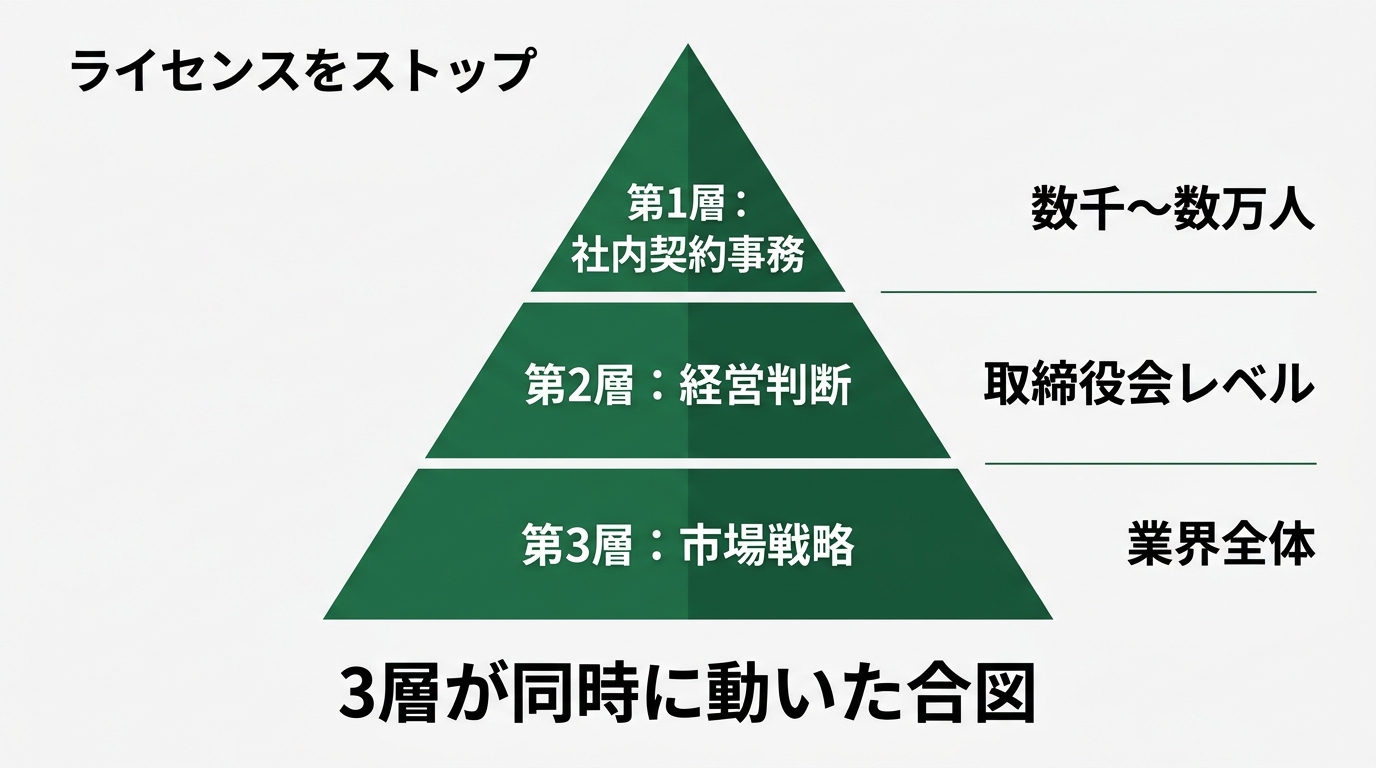
This is the core of what I want to say. “Pulled the license” sounds like contract administration on the surface. In industry context, it represents three layers of decisions stacking on top of each other.
| Layer | What it is | Who’s affected |
|---|---|---|
| Layer 1 | Contract administration: changing the tool stack for internal engineers | Thousands to tens of thousands of Microsoft engineers |
| Layer 2 | Executive decision: ruling on whether a competitor’s product belongs in-house | Board-level Microsoft leadership |
| Layer 3 | Strategic positioning: Microsoft choosing to stand apart from Anthropic in the AI coding tools market | The entire industry, financial markets, and enterprise procurement decisions |
All three layers moving at once is what turns this into industry-wide news. Layer 1 alone would have been a routine cloud-cost optimization story. Three layers moving together reads as a signal that Microsoft is shifting its engine into “no longer cooperating with Anthropic” gear.
I’ll be honest: I can’t stay entirely detached writing this.
The reason is Layer 3. Layer 3 decisions cascade directly into enterprise procurement. Microsoft’s internal policy almost immediately converts into the standard offer on Microsoft enterprise contracts. IT departments (Japan’s term: “jouhou-shisu,” the systems team that controls approved tool lists) at companies buying Microsoft enterprise deals will hear that Microsoft pulled Claude Code internally and start asking: “Should we pull it too?” And once that question is asked, the act of asking it often becomes the justification for the answer.
That’s my speculation. But in my years in customer success, I watched this exact pattern play out repeatedly. “The mega-vendor doesn’t use it internally”—that’s the single most powerful weapon the opposition faction in any enterprise ever wields. I saw it with CRM. I saw it with marketing automation. Same structure every time.
The Four-Tool Landscape: Claude Code / GitHub Copilot / Cursor / Windsurf
Let me map where the AI coding tool options stand right now.
The headline says “three-way” but the real picture is four. I’ll line them up as four.
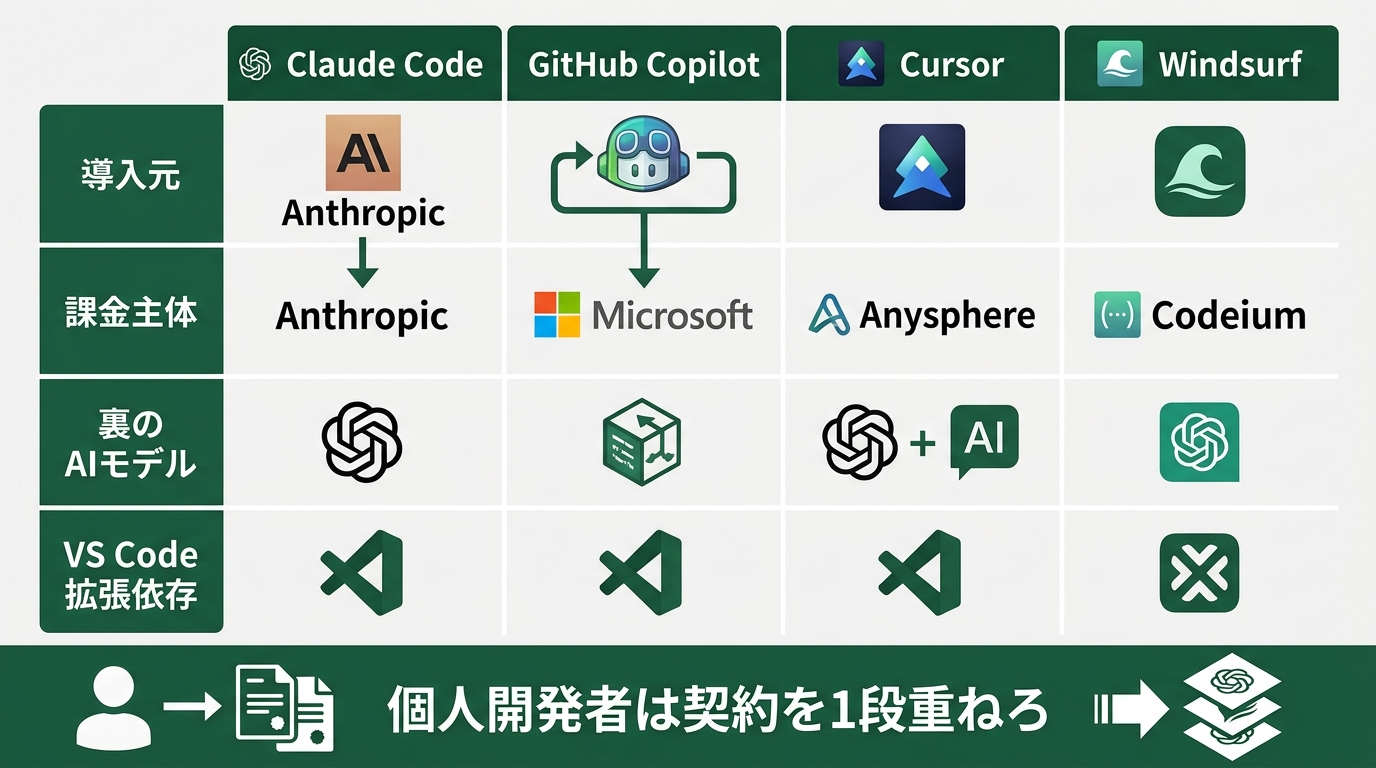
| Tool | Developer | Pricing | Underlying AI | Strengths |
|---|---|---|---|---|
| Claude Code | Anthropic | Pro $20/mo · Max tiers available | Anthropic Claude (Sonnet/Opus) | CLI-first · agent-driven · designed for long context |
| GitHub Copilot | Microsoft (GitHub) | Business $19/mo and up | OpenAI GPT · Anthropic Claude (user’s choice) | Deep VS Code/Visual Studio integration · enterprise contract infrastructure |
| Cursor | Anysphere | Pro $20/mo | OpenAI · Anthropic · Google etc. (user’s choice) | Editor-integrated · popular inside companies |
| Windsurf | Codeium | Free tier available · Pro paid | Multiple models (user’s choice) | Editor-integrated · broad free tier |
Pricing based on publicly available information as of May 2026. Check each company’s official page for current Claude Max pricing and GitHub Copilot Enterprise rates.
These four sit alongside each other as “AI coding tools” on the surface. But their ownership structures have very different interests.
- Claude Code is Anthropic’s direct-to-user channel for selling its own models
- GitHub Copilot is Microsoft’s integrated platform that packages AI model choice as a feature
- Cursor and Windsurf are independent startups that bundle multiple AI models into a single interface
Microsoft pulling Claude Code internally is, in effect, a declaration to push the “Anthropic direct” option off to the side within that four-tool map. The route to Anthropic models through GitHub Copilot might continue. But the “direct contract with Anthropic” route has just gotten narrower inside Microsoft.
This is the geopolitics of enterprise AI procurement. It looks like a debate about which AI model performs better. The reality is a sorting process for which companies you maintain direct relationships with.
What This Means for Individual Developers
This is the section I most wanted to write.
The headline players are Microsoft and Anthropic. But the people who feel the impact are individual developers—side-project engineers like me, non-engineers building their own internal tools, people learning to code who, like me at one point, stumbled and got back up. All of us are in scope.
Three ripple effects seem plausible.
1. The “approved tools at work” list gets rewritten
For company employees using Claude Code on the job, it depends on whether it’s on the IT department’s approved list. Microsoft pulling it internally gives IT departments everywhere a concrete reason to ask whether it should stay on their own approved lists.
If it gets removed, you can only use GitHub Copilot during work hours. Even if you have a personal Claude Code Max subscription, work code goes back to GitHub Copilot. This is a realistic scenario.
2. Dual subscriptions—Anthropic direct and Microsoft route—become necessary
This is my own plan.
If the company standard is GitHub Copilot, I use that for work code. But for personal side projects and learning, I keep a separate Claude Code subscription. That means paying for two things as one person—but I’m doing it. The reason: Anthropic’s models are purpose-built for CLI agent-driven development workflows. That experience hasn’t been fully replicated on the GitHub Copilot side yet, as far as I can tell.
Running work and personal on separate stacks sounds annoying. But in an era where the entire tooling structure can shift underneath you, stacking one extra subscription feels like basic insurance. Around ¥10,000 a month (roughly $65-70) is a reasonable price for one career safety net.
3. The job market for Microsoft engineers who used Claude Code quietly starts moving
Some of Microsoft’s internal engineers who got comfortable with Claude Code are going to be unhappy. Being forced onto a new tool stack is a real source of friction. Some will end up on the job market.
This might seem unrelated to individual developers. But if a wave of “people experienced with Claude Code” enters the job market, their likely destinations are Anthropic, Cursor, or independent startups. The ecosystem’s share composition shifts slowly. And ecosystem share, over the long run, moves tool pricing structures too.
Three Things I’m Thinking About This Week
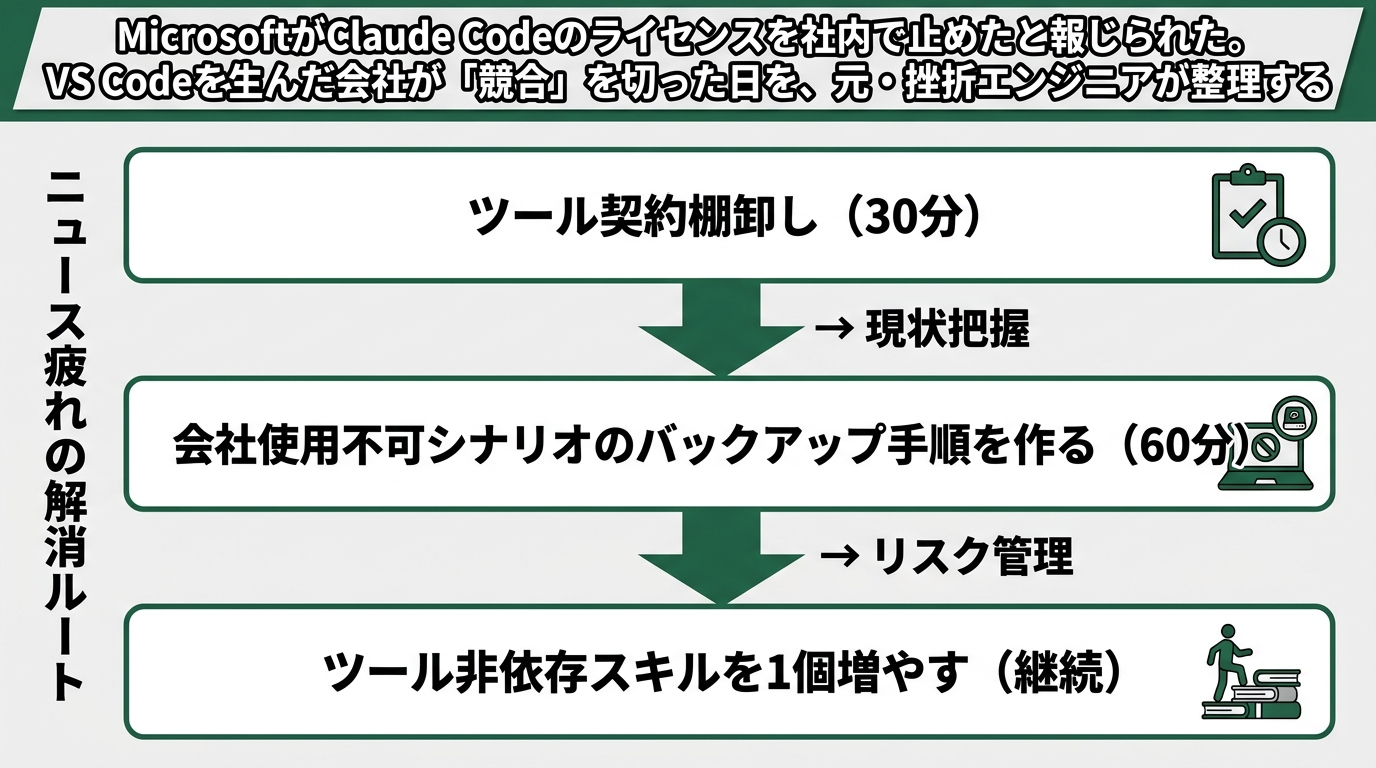
Now the practical part. What I’m actually going to do this week based on reading this news.
A. Take inventory of my current tool subscriptions
Paper and pen or a spreadsheet—doesn’t matter. Write down every AI coding tool, AI chat service, and AI-related subscription you’re currently paying for.
In my case: five. Claude Code Max, ChatGPT Plus, Cursor Pro, Perplexity Pro, and GitHub Copilot Individual. Combined, about $100 a month.
Writing it all out surfaced some messiness. Items where I’m paying but not using. Items where the subscription name doesn’t match the account owner. With the Microsoft news in the background, there’s plenty of reason to get your own contracts organized. Left alone across a year, stray subscriptions quietly add up to real money—easily several hundred dollars in unused spend.
B. Write a one-page backup plan for “what if it stops being allowed at work”
If you’re using Claude Code professionally, prepare for the possibility that your company’s IT department could change the policy.
Specifically, it’s worth having a single-page document that covers:
- How to export your
.specfiles,.cursorrules,CLAUDE.mdand similar files to a personal GitHub repo - Criteria for converting any Claude Code-specific syntax (custom slash commands, etc.) in your work code to generic equivalents
- Your priority list for GitHub Copilot features to try first if you need to switch
An hour is enough to do this. Think of it as a disaster recovery runbook. From my customer success background: this is the “rehearsal document” that keeps you from panicking when the policy changes.
C. Add one tool-agnostic skill to your toolkit
Development skills that are tied to a specific tool disappear in value when that tool disappears. The skills that survive tool changes—those are the real assets.
For me this week, I chose: “articulate code review criteria in my own words.” Being able to look at AI-generated code and say, in plain English, “the types are too loose here,” “this naming will confuse the next person,” “error handling is thin here”—that capability survives any tool migration.
If you come from a customer success or account management background, you probably have a glossary of explanations for clients. Same idea. Write your own code review criteria list by hand this week. After that, put it wherever works—Notion, Obsidian, a spreadsheet. Anchoring it in one place will help you six months from now.
Conclusion: The Era of Choosing Decisions, Not Tools
Reports say Microsoft pulled Claude Code internally. The facts aren’t fully confirmed at time of writing, but if the reporting holds, this is one of the most symbolically significant industry events in years.
Three reasons: Microsoft—which owns VS Code, GitHub, and Azure—has decided to remove Anthropic’s direct-sale product from its internal stack. That decision sits directly upstream of enterprise procurement decisions everywhere. And as a downstream consequence, the “approved at work” tool list for individual developers has a real chance of changing.
I want to be clear: this is not a “Claude Code versus GitHub Copilot” piece. It’s not about who wins or loses. The real point is that the ground under the entire AI coding tools category is shifting—oscillating between the strategic decisions of mega-vendors and the individual preferences of working engineers.
What we can do is prepare not to get swept away. Take inventory of your subscriptions. Write a backup plan. Add one tool-agnostic skill. All three can be done this week. Three hours each, nine hours total.
As someone who once gave up on coding and then found something click back into place when AI arrived—I know what that moment feels like. I don’t want it taken away by corporate politics. So this week, I’m organizing my subscriptions and my workflows. When the next announcement comes, I want to still be building.
If this news made you anxious, start with the inventory. Three hours is enough. Read the news again afterward and see if the distance feels different. If you can say “whatever Microsoft does, here’s how my own workflow moves”—you won’t get thrown by the industry headwinds. That’s the concrete practice for surviving the storm in AI coding tools.
References and Sources
- the-decoder.com “Microsoft pulls Claude Code licenses and pushes developers back toward its own AI tool” (reported 2026-05-18 · URL not yet confirmed)
- Anthropic official Claude Code product page: https://www.anthropic.com/claude-code
- Anthropic official pricing page: https://www.anthropic.com/pricing
- GitHub Copilot official page: https://github.com/features/copilot
- Related articles in this series: The BBC Orchids Incident and 4 Alarms in 3 Weeks · The Day Claude Code Enterprise Adoption Went to Market


正直、一度エンジニアは諦めました。新卒で入った開発会社でバケモノみたいに優秀な人たちに囲まれて、「あ、私はこっち側じゃないな」って悟ったんです。その後はカスタマーサクセスに転向して10年。でもCursorとClaude Codeに出会って、全部変わりました。完璧なコードじゃなくていい。自分の仕事を自分で楽にするコードが書ければ、それでいいんですよ。週末はサウナで整いながら次に作るツールのこと考えてます。