The Day Vibe Coding Became a Certification: From Hobby to Credential, the Career Boundary for AI Coding Is Shifting
Vibe Coding is a term coined by OpenAI co-founder Andrej Karpathy. It all started with an X post in February 2025.
What you'll learn in this article
- The key point to grasp before reading the full article
- How the issue changes the way developers should work next
- Which follow-up article is worth opening next
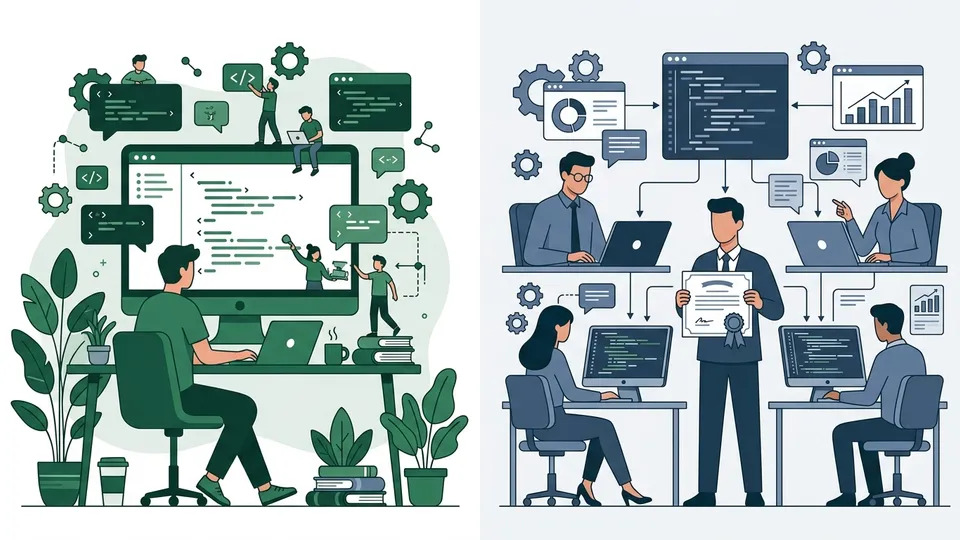
“Vibe coding” now has a certification exam.
How did that sentence hit you? “The thing where people write code by vibes is now a credential?” I bet that was the reaction for many of you. Honestly, that was my first take too.
But after digging into it, I changed my mind.
In March 2026, the Japan AI Skills Certification Association launched the “Vibe Coding Certification.” The exam fee is free. You can take it online, and if you pass, a PDF certificate is issued instantly.
Around the same time, Techno-Edge kicked off its “Let’s Try Vibe Coding” series. Coursera added a dedicated vibe coding Specialization (free). Stanford Continuing Studies (course now ended) and Microsoft Learn have added formal courses too.
What used to be a hobby — “writing code together with AI” — is turning into something you can study and prove. In this article, I’ll unpack that shift from the perspective of a former failed engineer.
So What Was “Vibe Coding” Again?
Vibe Coding is a term coined by OpenAI co-founder Andrej Karpathy. It all started with an X post in February 2025.
“Hand everything over to the LLM and forget that the code even exists. It’s a whole new way of coding.”
That post was viewed more than 4.5 million times. It was even selected as Collins English Dictionary’s Word of the Year for 2025.
The key point is that it’s defined as “a style of development.” You use Cursor, Claude Code, or GitHub Copilot, and give instructions in natural language. If it works, you’re good. You don’t dig into the details of the code.
“Is that really okay?” is a fair question. Karpathy himself positioned it as “good for throwaway weekend projects.”
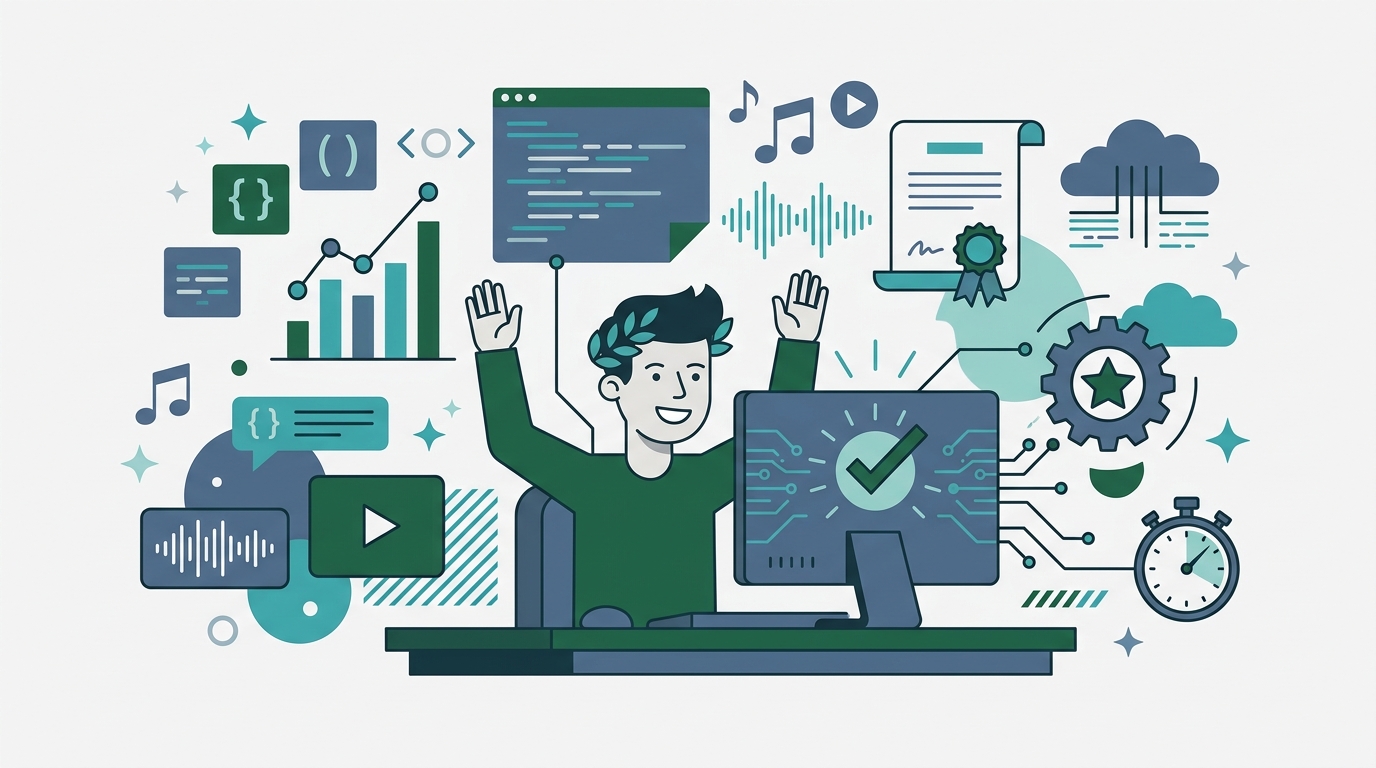
But in 2026, the situation has completely changed.
A Pragmatic Engineer survey of 906 developers found that 95% use AI tools every week. 75% said they handle more than half of their work alongside AI. 70% reported using two or more AI tools simultaneously.
What was “good for weekend projects” has moved into professional development workflows. That reality is the backdrop for the certification’s existence.
A Look Inside the “Vibe Coding Certification”
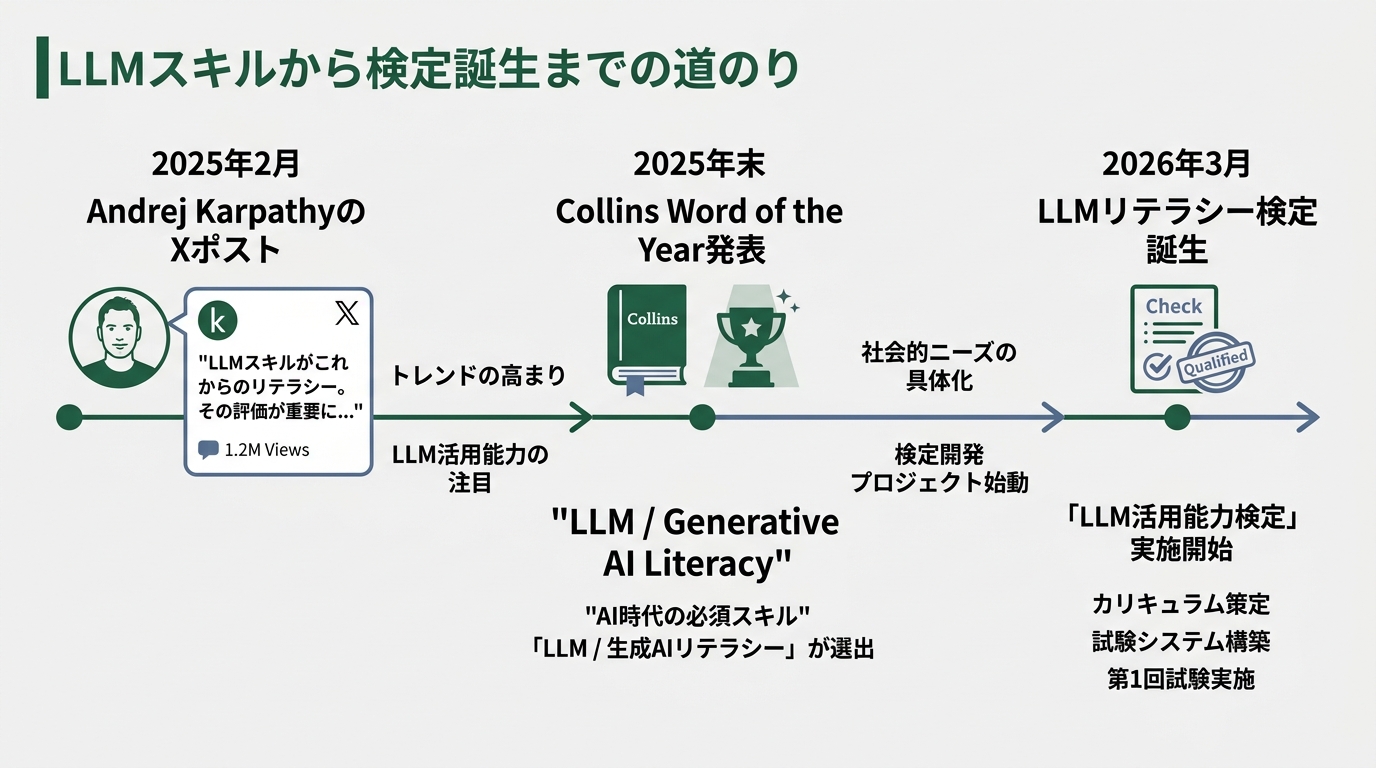
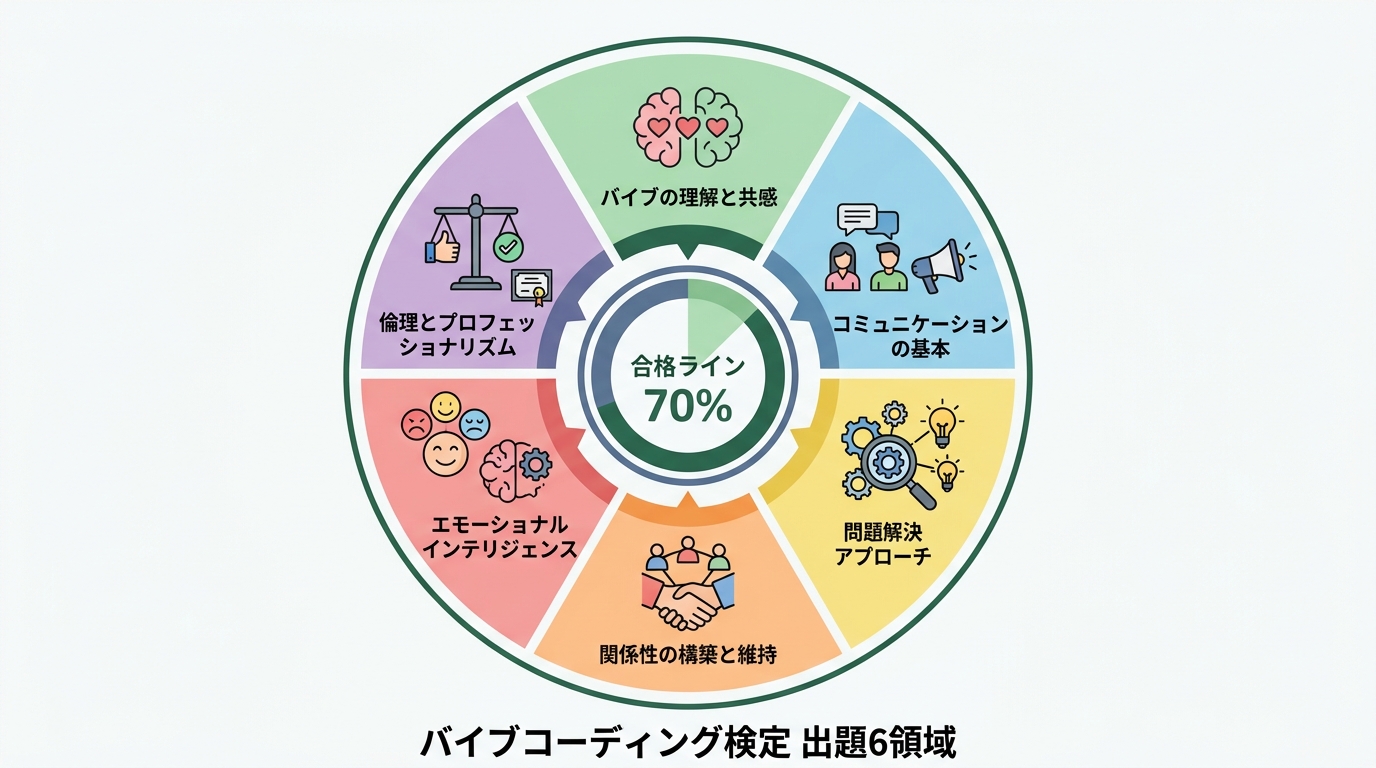
The Vibe Coding Certification is a multiple-choice test with questions drawn randomly from a pool of 100. The passing line is 70% (42 points). It takes 30 to 50 minutes, and you get your result on the spot.
Hearing the word “certification” might make you tense up. But looking at the scope, it’s actually structured around practical work, and that’s interesting.
The questions are split across six domains.
- Fundamentals of vibe coding: definitions, differences from traditional programming
- Requirements definition and prompt design: what to tell the AI, and how
- UI and UX basics: not just “it works” but “it’s usable”
- Data management and security basics: API key handling, protecting personal information
- Deployment, publishing, and operations: how to get what you built out into the world
- Quality management when collaborating with AI: verifying and improving generated code
What caught my attention is that “prompt design” and “quality management” stand as independent domains. It’s not just “give the AI instructions” — you’re also tested on the ability to “check the generated code.”
That’s a slightly different direction from Karpathy’s “forget that the code even exists.” Instead of forgetting, you’re expected to “know how to verify.” I felt the maturation of vibe coding in that detail.
A quick note on pass rates. The Japan AI Skills Certification Association’s AI Skills Exam (Beginner) recently ran around 65.5%. The pass rate for the Vibe Coding Certification hasn’t been officially published yet since it just launched in March. But looking at the question structure, anyone who has actually used AI tools should be able to handle it.
Put another way: it’s designed so you can’t pass on textbook study alone. As a certification, I think that’s healthy.
When I looked at each domain one by one, I had a few realizations of my own. The “deployment, publishing, and operations” domain in particular. Honestly, I know this is a weak spot for me. I’m fine getting something working in Cursor. But once it comes to publishing on Vercel and setting up a domain, I’m Googling every time.
It reminded me that I’m satisfied just with “it works!” The exam’s structure itself is a map of “the points vibe coders tend to miss.” Just getting that map is valuable, even before you worry about passing.
A “Hobby” Became a Credential in One Year. What This Failed Engineer Felt About the Shifting Boundary
Looking back at the timeline, the speed of institutionalization is striking.
Karpathy coined the term in February 2025. By the end of that year, it was Collins English Dictionary’s Word of the Year. In March 2026, the certification launched in Japan. Coursera, Stanford, and Microsoft Learn launched official courses around the same time. About a year from the birth of the word.
For comparison, “NoCode” is the easiest reference. NoCode went mainstream around 2019. It took 3 to 4 years for related official credentials and educational programs to take shape. Vibe coding was institutionalized at roughly triple that pace.
The reason is simple: the number of users exploded. According to the Pragmatic Engineer survey, Claude Code became the #1 most popular tool (46%) just eight months after release. That’s well above Cursor (19%) and GitHub Copilot (9%).
The Techno-Edge series even noted that shogi player Sota Fujii has taken an interest in vibe coding. This is no longer an inside conversation within the engineering community.
Let me get personal here.
I joined a web development company as a new grad and wrote code. Both frontend and backend. But at my next company, I was overwhelmed by the level of the engineers around me, and I realized I couldn’t keep up.
So I shifted my career to customer success. I left coding behind entirely. I had no regrets, but the feeling of “I want to build something, but I can’t” stayed with me.
That changed with Cursor and Claude Code. I give the AI instructions, and out comes code at a level I could never have written myself. It felt like an elite engineer had taken up residence inside me. My motivation to build came roaring back.
So when I saw the news about this certification, my first thought was: “The boundary moved.”
The boundary of what? The line between “hobby” and “professional skill.”
Until now, saying “I write code with AI” sometimes drew an awkward silence. The “is that real coding?” look. Django co-creator Simon Willison also clearly distinguishes the two as separate things.
The distinction itself is fair. But looking at the exam content, you can’t pass just by “leaving it to vibes.” Prompt design, security basics, quality management. These are areas you can’t answer with “I’m just doing it by vibes.”
In other words, the Vibe Coding Certification is designed as a credential for “the skill of building products together with AI.” Someone who “can’t write code” can become someone who “can build code together with AI.” A formal mechanism to recognize that transition has now been born in Japan. For someone like me, from the failed-engineer camp, that’s a pretty big deal.
”So, Should I Get It?” — My Answer
Let me be straight.
At this point, “I hold the Vibe Coding Certification” probably won’t directly land you a new job or a contract. Recognition of the credential is still building.
But I think it’s worth taking.
Reason one: you can measure your own understanding.
Vibe coding is a field where things tend to end at “well, it kind of worked.” Looking at the exam scope, the “after it works” areas — prompt design, security, deployment, quality management — are solidly included. It makes clear what you know and what you don’t.
When I checked the scope, I got nervous too. API key management, environment variable handling. I’ve been skating past these in the spirit of “if it runs, it’s fine.” Just realizing that is reason enough to take the exam.
Reason two: you can turn “I do it” into “I can prove it.”
People building side-project tools, people automating workflows inside their company. There’s a real difference between saying “I can code with AI” and showing a certificate. Especially to non-engineer bosses or clients.
I’d know — coming from CS, I get this — business-side people respond to “credentials.” Less about whether you understand the content, more about the reassurance that “this person learned it systematically.” The certification provides that function.
Reason three: the exam is free.
Zero risk. You lose nothing if you fail. It’s done in 30 to 50 minutes. If you pass, you get a PDF certificate.
The bar for “just trying it” is extremely low. Isn’t that the spirit of vibe coding itself? “Just run it.” “If it works, move on.” The act of taking the exam itself feels vibe-coding-like.
By the way, the article Nagi is writing today covers the organization of AI-related terms like LLMO, AEO, and GEO. There’s a flow here: “terms get organized → certifications appear → they can be used in your career.” You can really feel that AI skills are being institutionalized all at once.
Where Is Vibe Coding’s “Next Wall”?
While I welcome the certification, I also see the challenges.
The first wall is “over-trusting generated code.”
Vibe coding lets you build fast, but there’s a risk of moving forward without understanding why something works. The fact that “quality management” is included in the exam is probably a response to this. That said, “knowing it” on a multiple-choice test is a different thing from actually catching bugs.
For example, “Bugbot,” the AI bug-fixing tool from Cursor, posts an auto-resolution rate of 76%. That’s reassuring, but the remaining 24% still needs human eyes.
I’ve been there myself. I shipped AI-generated code as-is and it looked perfect. Then a few days later, an edge case threw an error. Because I hadn’t understood the meaning of the code, it took me three hours to track down the cause. “It works but I don’t know why” turns into hell the moment it breaks. That lived experience is exactly why I think it’s right that the exam has a quality management domain.
The second wall is “lack of design ability.”
KDDI Agile Development Center promotes a method called “Spec-Driven Development (SDD).” The idea is to nail down the spec first and leave the implementation to the AI. The baseline ratio is “80% design, 20% implementation.” Now that AI has accelerated implementation, the bottleneck has shifted to the design side.
I think the inclusion of “requirements definition and prompt design” in the exam reflects an awareness of this issue. But the strength to define requirements isn’t something you build through an exam alone. You need real experience actually building products, breaking them, and fixing them.
The third wall is “an unclear career path.”
What kind of career someone who “can do vibe coding” will be in five years from now is something no one knows yet. The old “Junior → Senior → Lead” staircase isn’t visible.
Then again, this isn’t unique to vibe coding. As long as AI keeps changing the development workflow, the traditional career ladder is in the middle of being redefined. The certification is just the first step.
”Want to Give It Another Try?”
While writing this article, there’s a thought I kept coming back to.
“What would the me of five years ago have felt if he’d heard about this certification?”
Five years ago, I was working in customer success. I had things I wanted to build but had convinced myself I couldn’t build them. I thought about going to a coding bootcamp. But I gave up, telling myself I couldn’t balance it with work.
If I’d told my past self, “You can take a certification in coding alongside AI — for free, in 30 minutes” — he wouldn’t have believed me.
But now, it’s real.
The Vibe Coding Certification isn’t yet a “career-changing credential” at this stage. Recognition is still emerging. Market value is unknown.
But it can be a gateway to the experience of “I can write code too.” Just reading the exam scope gives you a full picture of what you can do alongside AI. Even if you fail, you’ll see “ah, this is what I’m missing.”
A hobby became a credential. The fact that it became a credential means more people will use it at work. As more people use it at work, career options widen.
People who wanted to write code but gave up. People who attended a coding bootcamp but never put it to use. People who tried to switch careers to engineering and stepped back.
Want to give it another try?
This time you’re not alone. AI is right next to you. And the mechanism to prove “I can do vibe coding” already exists.
Open the exam page. It’s free, and you can take it right now. Thirty minutes later, you’ll know what you know and what you don’t. That’s where the start line is.
Sources:
- Vibe Coding Certification (Japan AI Skills Certification Association)
- Vibe Coding Certification Exam Page
- Japan’s First “Vibe Coding Certification” Launches (NEWSCAST)
- Let’s Try Vibe Coding, Part 1 (Techno-Edge)
- AI Tooling for Software Engineers in 2026 (Pragmatic Engineer)
- Andrej Karpathy X post (February 2025)
- Vibe coding (Wikipedia)
- Not all AI-assisted programming is vibe coding (Simon Willison)
- Vibe Coding Essentials (Coursera)
- Vibe Coding: Building Software in Conversation with AI (Stanford Continuing Studies, course ended)
- Introduction to Vibe Coding (Microsoft Learn)

正直、一度エンジニアは諦めました。新卒で入った開発会社でバケモノみたいに優秀な人たちに囲まれて、「あ、私はこっち側じゃないな」って悟ったんです。その後はカスタマーサクセスに転向して10年。でもCursorとClaude Codeに出会って、全部変わりました。完璧なコードじゃなくていい。自分の仕事を自分で楽にするコードが書ければ、それでいいんですよ。週末はサウナで整いながら次に作るツールのこと考えてます。